 Skip to content

Yes, scalp micropigmentation works for gray hair, because SMP practitioners don’t use a single black pigment. They use a grayscale system, diluting carbon pigment down through charcoal, ash, and silver tones to match whatever shade your hair has settled into. The International Society of Hair Restoration Surgery confirms this grayscale approach is why well-executed SMP blends with any hair color, including hair that’s gone fully gray since the original treatment.
The real skill isn’t picking a “gray pigment.” It’s building density gradually, over a standard three-session protocol, so the practitioner can watch how each layer settles into your specific skin tone before committing to more.
Pro Tip: Ask your practitioner to start lighter than you think you need. It’s far easier to add density in session two or three than to lighten pigment that’s already healed too dark.
Key Takeaways
SMP works for gray hair because grayscale pigment dilution, incremental three-session layering, and conservative test patches let practitioners match tone precisely instead of guessing.
| Point | Details |
|---|---|
| Grayscale pigment is the mechanism | Carbon pigment diluted from charcoal to silver lets SMP match salt-and-pepper, transitioning, or fully white hair. |
| Three sessions build density safely | Layering pigment gradually across sessions prevents the over-darkening that ruins gray-hair results. |
| Fading works in your favor | Pigment lightens gradually over four to six years, which tends to age gracefully on gray tones. |
| Healed photos matter more than fresh ones | Judge a practitioner by healed, month-plus-old results, not same-day post-session images. |
| Enhanced Scalp specializes in corrective work | Its experience fixing over-darkened SMP directly informs a more conservative approach for gray-haired clients. |
Table of Contents
- How SMP Adapts to Gray and White Hair
- What Will SMP Actually Look Like on Gray Hair?
- How Practitioners Choose the Right Gray-Hair Pigment
- How Long Does SMP Last on Gray Hair?
- What Are the Risks and Limitations of SMP for Gray Hair?
- How to Choose an SMP Artist for Gray Hair
- Why Some Gray-Haired Clients Choose Enhanced Scalp
- Our Approach to Treating Gray and Transitioning Hair
- Ready to Talk to Someone About Your Gray Hair?
- Sources
- FAQ
How SMP Adapts to Gray and White Hair
SMP for gray hair works because the technique was never really about matching “black” in the first place. Carbon pigment gets diluted into a spectrum, from deep charcoal for salt-and-pepper hair down to pale silver for someone who has gone fully white. A skilled artist mixes and layers these tones the way a painter mixes gray from black and white, adjusting ratios until the dots disappear into your existing hair color instead of sitting on top of it.
That’s the technical reason scalp micropigmentation gray hair treatments don’t come out looking like a five o’clock shadow drawn in Sharpie. The pigment is calibrated to your undertone, not just your hair color as a general category.
Most clinics run this over multiple sessions spaced with healing time in between. Each pass adds a layer of dots rather than trying to hit final density in one sitting. This matters more for gray hair than for dark hair, because gray and white strands are more translucent, and mismatched density shows up faster under bright light or a low ceiling fixture.
Gray hair isn’t one condition. Practitioners generally plan around four distinct scenarios:
- Salt-and-pepper hair needs a blended charcoal-to-medium-gray tone that reads as neither too dark nor too light against mixed strands.
- Fully gray or white hair calls for the lightest end of the pigment spectrum, since even a slightly-too-dark dot pattern will look like stubble rather than a shaved, graying scalp.
- Actively transitioning hair (still going from pepper to salt) requires a forward-looking tone, usually a shade lighter than the current average, because the surrounding hair keeps lightening after treatment.
- Gray hair with concurrent thinning demands extra restraint on density, since sparse gray strands show scalp between them more than thick dark hair does, and overcorrecting reads as artificial.
A conservative test patch, followed by incremental dilution across the three sessions, is what separates a natural gray-hair result from one that looks painted on. You can always deepen a pattern later. You cannot easily undo pigment that healed one shade too dark against thinning white hair.
What Will SMP Actually Look Like on Gray Hair?
The visual result depends heavily on how you wear your hair, not just how gray it is. On a buzzed or very short style, SMP creates the illusion of a closely shaved head with visible stubble density, which is where the technique performs best regardless of hair color. On longer hair, SMP is mostly working as a scalp shadow underneath the strands rather than mimicking individual follicles, so the effect is subtler and more about reducing scalp shine than creating a stubble look.
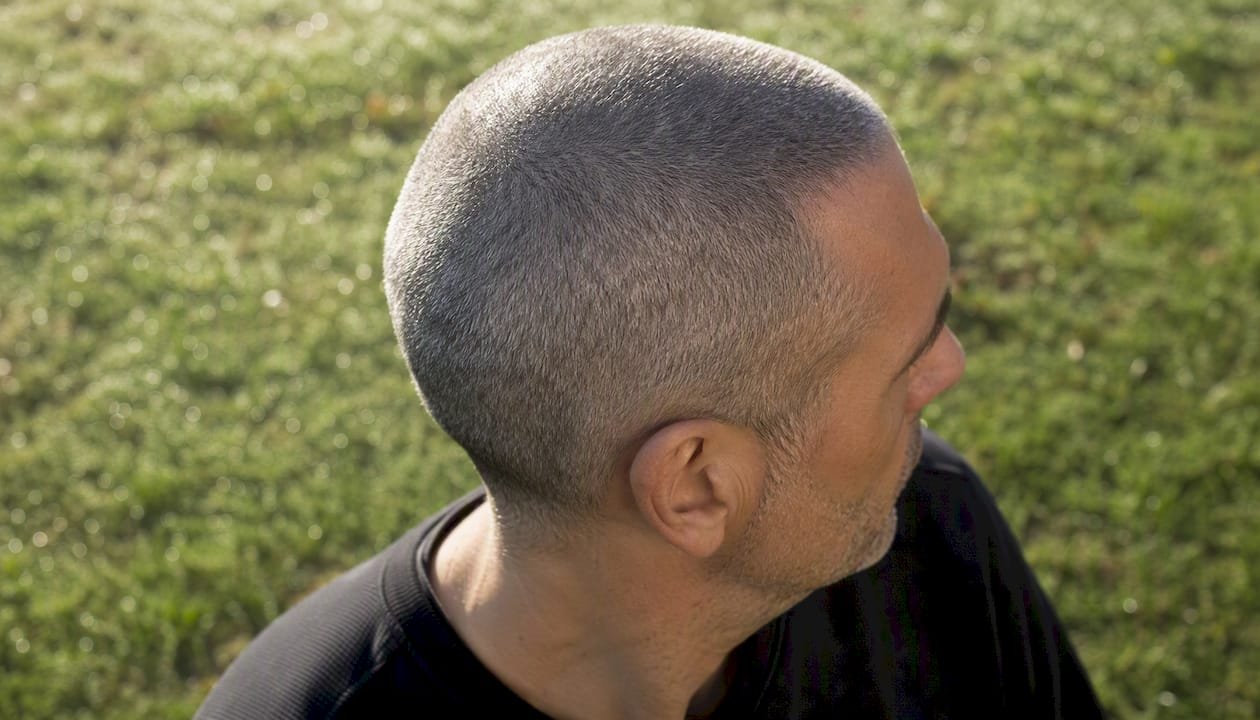
Salt-and-pepper clients tend to see the most seamless blend, because the mixed dot tones mirror the mixed strand colors already there. Fully white hair is trickier: dot spacing has to be slightly wider and tones lighter, because white hair against skin creates more contrast than pepper-gray hair does, and tight, dark dot clusters will read as gray stubble rather than white.
Before booking, look at healed photos rather than photos taken right after a session. Fresh SMP often looks darker and more saturated for the first one to two weeks, and only the healed result, typically photographed a month or more out, shows the actual tone you’ll be living with. A clinic’s gallery of healed outcomes tells you far more than a same-day photo ever will.
A few styling choices consistently produce the most convincing results:
- Keep hair clipped to a low, even length rather than letting it grow long enough to hide or contradict the pigment pattern.
- Avoid slicking hair back wet immediately after healing, since this can temporarily expose uneven spacing before everything settles.
- If you’re salt-and-pepper, consider a slightly shorter clipper guard than you’d normally use. It lets the pigment and remaining hair blend at the same visual plane.
How Practitioners Choose the Right Gray-Hair Pigment
Getting the tone right isn’t guesswork, or at least it shouldn’t be. A competent practitioner runs through a defined process before a needle ever touches your scalp for the real sessions.
- Assess your skin undertone. Warm, cool, and neutral undertones all interact differently with gray pigment, and a tone that looks perfect on one client’s skin can look slightly blue or slightly warm on another’s.
- Apply a small test patch. This is placed in an inconspicuous area and left to heal fully, usually over a couple of weeks, before the practitioner commits to that formula across your whole scalp.
- Start with a lighter dilution than the target. Because pigment can appear darker once healed than it looks on application day, most experienced artists intentionally undershoot on session one.
- Layer incrementally across sessions two and three. Density and tone get built up gradually, with the practitioner checking the healed result of each session before deciding how much more to add.
Carbon-based pigments are the preferred choice for gray hair work specifically because they’re stable. They don’t drift toward unexpected undertones the way some iron-oxide-based tattoo inks can over years, which matters enormously when the whole goal is matching a neutral gray or silver.
Pro Tip: If your hair is still actively transitioning to gray, ask your practitioner to select a tone slightly lighter than your current average shade. Your surrounding hair will likely continue lightening for years, and pigment that matches perfectly today can look a touch dark five years from now.
The failure mode to watch for is overly dark pigment applied too aggressively in a single session. On gray or white hair, this doesn’t read as “shaved head.” It reads as a dark shadow that doesn’t match anything else on your scalp, and it’s one of the harder corrective cases clinics see.
How Long Does SMP Last on Gray Hair?
SMP fades gradually over roughly four to six years, and for gray-haired clients, that fading pattern can actually work in your favor. Research on pigment chemistry and tissue response shows that implanted pigment breaks down and lightens slowly over time rather than shifting color abruptly, which means a gray-toned SMP pattern tends to soften toward an even lighter gray rather than aging into a mismatched or discolored patch.
Typical timeline and cost band: Most clients see a full touch-up need somewhere in that four-to-six-year window, though scalp exposure to sun, skin type, and aftercare all shift that range in either direction. Pricing varies by clinic, region, and scope of work, but SMP is generally quoted per session rather than as one flat number, with the total shaped by how many sessions your case requires and whether you’re treating a full scalp or a smaller area like a hairline or scar.
The maintenance rhythm looks like this:
- Three initial sessions, spaced one to two weeks apart, to build the base pattern.
- A settling period of several months where the final healed tone becomes clear.
- A touch-up session, typically somewhere in the four-to-six-year range, to refresh density as pigment naturally lightens.
You can influence how gracefully that fading happens. Daily SPF on the scalp reduces UV-driven pigment breakdown, which is the single biggest controllable factor in how evenly SMP ages. Avoiding harsh exfoliating scalp treatments and chemical peels directly over treated areas also helps preserve dot definition longer. None of this stops fading entirely. It just keeps it even, which is really what you want with a grayscale pattern anyway.
What Are the Risks and Limitations of SMP for Gray Hair?
SMP is a form of micro-tattooing, and it carries the same category of risks as any tattoo procedure, plus a few considerations specific to gray-haired clients. The FDA’s consumer guidance on tattoo safety points out that ink and pigment ingredients vary by manufacturer and that anyone getting pigment implanted should understand what’s going into their skin before treatment.
- Allergic or inflammatory reactions. Dermatology literature has documented cases of skin reactions to tattoo pigments, which is a small but real risk that makes test patches worth the extra week they add to your timeline.
- Over-darkening. This is the most common complaint specific to gray hair clients: pigment applied at a density calibrated for dark hair looks dramatically wrong against gray or white strands.
- Unsuitable scalp conditions. Active psoriasis, eczema flare-ups, or open sores on the treatment area typically need to resolve before SMP can proceed safely.
- Mismatched expectations on longer hair. Clients who want visible density on hair longer than a short crop sometimes expect stubble-level realism that SMP simply can’t deliver at that length.
Disclose your full medical history, including any known skin sensitivities or previous reactions to tattoos or piercings, before your test patch. This single conversation prevents most of the complications that show up in the clinical literature on pigment reactions.
SMP tends to be a poor fit for one specific case: someone with severe, diffuse thinning who wants to keep hair long. At that length and thinning level, SMP can’t create the density illusion it’s known for, and a more appropriate conversation might be about scalp coverage options suited to longer styles rather than SMP alone.
How to Choose an SMP Artist for Gray Hair
Not every SMP practitioner has deep experience with gray or white hair specifically, and the difference shows up fast in healed results. Here’s a practical way to screen for it.
- Ask to see healed photos of gray or white-haired clients, not just their general portfolio. Dark-hair results tell you almost nothing about how someone handles a silver-tone dilution.
- Ask directly about their pigment dilution protocol. A practitioner who can explain, specifically, how they adjust carbon pigment ratios for lighter hair tones is signaling real technical fluency, not a rehearsed sales answer.
- Confirm they run a test patch before the first full session, and ask how long they wait before evaluating it.
- Verify formal training or certification rather than assuming years in business equals technique.
At consultation, come with a short list of questions:
- What does the three-session plan look like for someone with my hair tone specifically?
- How will you decide whether to lighten or darken pigment between sessions?
- What does your aftercare protocol involve, and when should I expect the healed result to settle?
- What’s your policy on touch-ups if fading looks uneven after a few years?
A few red flags are worth walking away from. No healed photos of gray-haired clients at all is one. Pressure to compress the three-session protocol into one or two visits is another, since that usually means skipping the incremental checks that keep density from overshooting. A practitioner with no test-patch policy for new clients is a third.
When you review healed photos, look closely at dot size and spacing rather than the overall impression from across the room. Tight, uniform dot spacing with soft tonal blending into the surrounding gray is what you want. Dots that look clustered, uneven in size, or noticeably darker than the hair around them are signs of rushed or inexperienced work.
Why Some Gray-Haired Clients Choose Enhanced Scalp
Enhanced Scalp built its reputation on conservative hairline design and corrective SMP work, including cases where a previous provider applied pigment too dark or too dense. That corrective specialty matters directly to gray-haired clients, because over-darkening is the single most common gray-hair mistake in the industry, and a clinic that regularly fixes it understands the failure mode from both directions.
A typical gray-hair client journey through Enhanced Scalp starts with a consultation to assess hair tone, skin undertone, and scalp condition, followed by a test patch left to heal before the first full session. From there, the three-session protocol builds density gradually, with each session’s healed result reviewed before adding the next layer.
The clinic documents its work with healed photo galleries rather than relying only on same-day images, and it runs SMP training programs for practitioners, which reflects a level of technical standardization behind the treatment itself. For gray hair specifically, that combination of documented healed timelines and corrective experience is the trust signal worth checking before you book anywhere.
Our Approach to Treating Gray and Transitioning Hair
We treat gray hair as its own category of case at Enhanced Scalp, not a variation on standard dark-hair SMP. Every gray or transitioning-hair client goes through a test patch before we commit to a full pigment formula, because guessing at dilution on hair that’s still changing color is how over-darkened results happen. We’d rather add a fourth check-in session than rush density onto hair that needed more restraint.
Documented healed photos are non-negotiable for us, both because they hold our own work accountable and because they’re the only honest way for a prospective client to judge whether our gray-tone matching actually holds up months later. Training is part of that same discipline. The more rigorously an artist understands pigment behavior on lighter hair, the fewer surprises a client sees three years down the road.
Ready to Talk to Someone About Your Gray Hair?
If you’re weighing SMP against simply living with a thinning, graying scalp, Enhanced Scalp’s process is built specifically around the caution that gray hair requires. That means a test patch before any full session, a three-session build so density gets calibrated to your actual undertone rather than a generic gray, and pigment work handled by artists trained to catch over-darkening before it happens rather than after.
A consultation is where this actually starts. Bring photos of your hair at different times of year if you have them, since seasonal sun exposure can shift how gray your hair looks, along with any relevant medical history around skin sensitivities or previous tattoo reactions. From there, expect a conversation about which of the four gray-hair scenarios fits your case, what tone range makes sense, and a realistic timeline for your three sessions. If you’re ready to see whether SMP fits your hair and goals, book a consultation for scalp micropigmentation and start with the test patch conversation.
Sources
- Scalp MicroPigmentation (SMP): All You Need to Know – ISHRS
- Think You Ink? Tattoo safety – FDA
- PubMed: 1911294
- F1000Research article (DOI 10.12688/f1000research.7520.1)
FAQ
What are the disadvantages of SMP for gray hair?
The main risks include allergic or inflammatory pigment reactions in a minority of patients, the possibility of over-darkening if dilution isn’t handled carefully, and limited effectiveness on hair worn long rather than short.
How does SMP look after 10 years on gray hair?
Pigment typically fades gradually over four to six years, so by the ten-year mark most clients have had at least one touch-up; well-maintained SMP on gray hair tends to soften evenly rather than shifting to an odd tone.
How much does SMP cost for gray hair treatment?
SMP is priced per session rather than as a flat fee, with total cost shaped by clinic, region, and how many sessions and how much scalp area your case requires.
Does SMP make gray hair look thicker?
Yes, on closely cropped or buzzed styles, SMP creates a stubble-density illusion that reads as thicker hair; on longer hair, the effect is more subtle and works mainly as a scalp shadow rather than added visible density.
Can SMP match salt-and-pepper hair specifically?
Yes, salt-and-pepper hair typically gets a blended charcoal-to-medium-gray pigment tone, and it’s often the easiest gray-hair scenario to match because the mixed dot coloring mirrors the mixed strand colors already present.

