 Skip to content

Yes, scalp micropigmentation can meaningfully conceal most FUT strip scars once the scar has fully matured and the practitioner uses the right layered technique. Typical cases need two to three sessions, though wider or raised scars often require pre-treatment first. SMP alone usually falls short on hypertrophic or keloid scars without medical coordination beforehand.
TL;DR:
- SMP can conceal most FUT scars effectively once the scar has matured, but hypertrophic or raised scars often require pre-treatment with laser or cortisone.
- Widened or stretched scars need additional care before SMP, and irregular scar tissue complicates pigment depth and absorption during sessions.
- Results usually improve by 75 to 85 percent after two to four sessions, with better concealment for flat or pale scars and moderate results for hypertrophic or wide scars.
- Pre-treatment, layered pigment deposition, and realistic expectations based on scar subtype are essential to achieving satisfactory outcomes.
- SMP’s longevity depends on skin type, exposure to UV, and maintenance, lasting four to eight years with periodic touch-ups.
Table of Contents
- What Are the Different Types of FUT Scars for SMP?
- When Do You Need Pre-Treatment Before SMP?
- What Happens During SMP Sessions on a Scar?
- How Much Can SMP Actually Improve a FUT Scar?
- How Do You Choose a Provider for FUT Scar SMP?
- What SMP Providers Miss About FUT Scar Work
- Book a Consultation for FUT Scar Camouflage
- Further Reading on FUT Scar Camouflage
- FAQ
What Are the Different Types of FUT Scars for SMP?
Not every FUT scar behaves the same way under pigment, and the subtype largely decides how much improvement is realistic. Practitioners generally sort linear donor scars into four categories, each with its own texture and pigment behavior.
- Fine or flat scars heal thin and sit level with surrounding skin, so pigment settles evenly and blends fast.
- Widened or stretched scars result from tension during closure and can span a centimeter or more, which means pigment has to bridge a bigger gap of visibly different skin.
- Hypopigmented or pale scars lack normal melanin, so the surrounding hair-bearing skin often looks a shade darker than the scar even after treatment unless color matching is precise.
- Hypertrophic or raised scars sit above the skin’s surface and reflect light differently, which pigment alone cannot fully correct.
Timing matters as much as scar type. Guidance aligned with the International Society of Hair Restoration Surgery recommends waiting roughly several months after transplant surgery before starting SMP, giving grafts time to mature and scar tissue time to settle into its final texture. Anyone with a history of keloid scarring, an actively healing wound, or a need for blood thinners should get physician evaluation before booking a session, since these factors change how the skin will take pigment.
When Do You Need Pre-Treatment Before SMP?
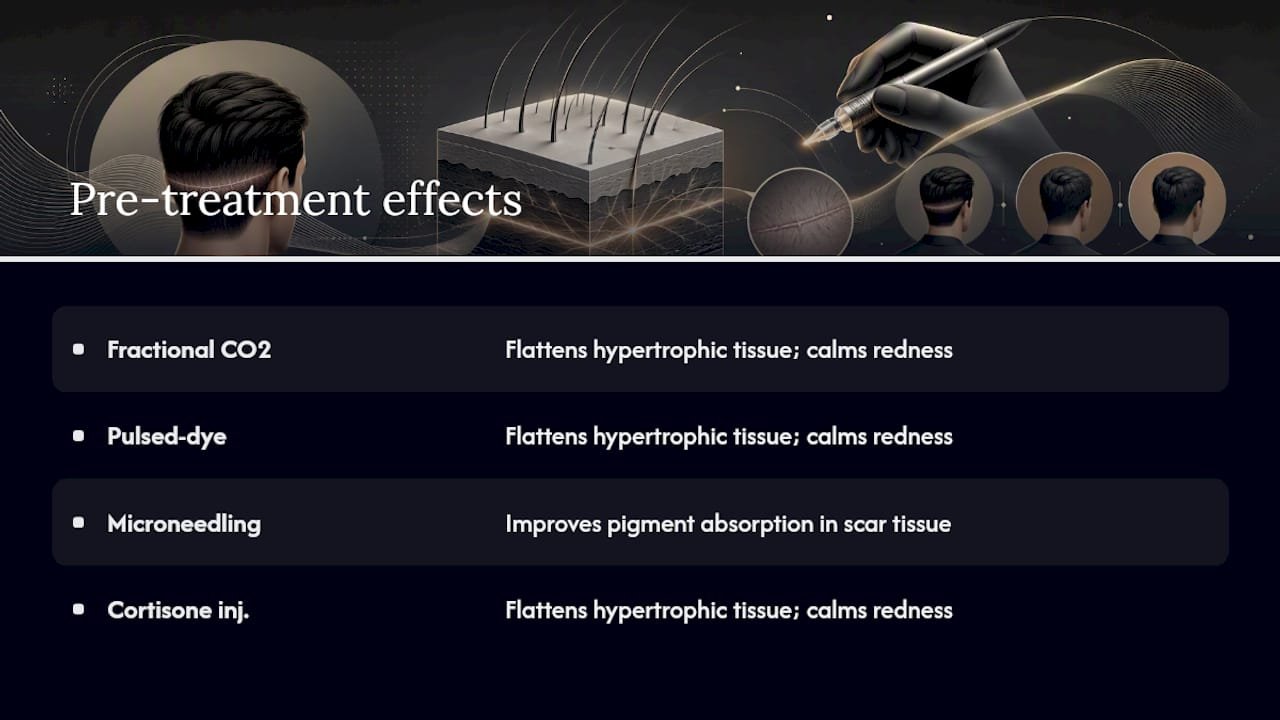
Raised or wide scars often need work before a needle ever touches them. Fractional CO2 laser, pulsed-dye laser, medical microneedling, and corticosteroid injections are the common tools clinicians reach for, and each targets a different problem: laser and cortisone injections flatten hypertrophic tissue and calm redness, while microneedling improves how well pigment gets absorbed into stubborn scar tissue.
Once the scar is ready, technique shifts from standard SMP. Providers use hierarchical, layered pigment deposition rather than a single dense pass, building color gradually across two or three sessions so the scar’s edges blend into surrounding follicle dots instead of reading as a flat block. A test spot on a small section of the scar is standard practice before committing to full coverage, since scar tissue can absorb pigment unpredictably.
Depth control gets trickier here too. Normal skin takes pigment well around 0.5mm deep, but scar tissue has irregular collagen density that can cause pigment to sit too shallow in one spot and too deep a few millimeters away.
Pro Tip: Ask your provider to show you the test spot after it heals, not just right after application. Fresh pigment always looks darker than the healed result, and judging color match too early leads to unnecessary anxiety.
What Happens During SMP Sessions on a Scar?
Most FUT scar cases run two to four sessions, though two to three is typical for scars without hypertrophic tissue. Clinics space sessions ten to fourteen days apart so pigment settles and any inflammation resolves before the next round.
- Session one starts with topical numbing, a test spot on the scar, and initial pigment layering to gauge how the tissue holds color.
- Session two, roughly two weeks later, builds density based on what the first session revealed and starts blending scar edges into the surrounding pattern.
- Session three (if needed) refines tone, fills gaps, and addresses any spots where pigment faded faster than expected.
- Healing happens in two distinct phases: a light scabbing period in the first two weeks, followed by roughly six weeks of color settling as the skin’s healing response stabilizes the final shade.
Final results aren’t judged until the six-week mark, and some clients need a touch-up after that point once the true healed color is visible. Aftercare during healing is simple but non-negotiable: keep the area out of direct sun, skip harsh exfoliants, and avoid picking at scabbing. Mild redness and tightness for a few days after each session are normal and typically resolve on their own.
How Much Can SMP Actually Improve a FUT Scar?
Concealment ranges vary by scar subtype, and no reputable provider should promise total invisibility. Enhanced Scalp’s clinical data puts average improvement in scar appearance around 75 to 85 percent for typical cases across multiple sessions, though outcomes shift depending on which subtype you’re dealing with.
- Fine, flat scars: high levels of concealment under ideal conditions
- Widened or stretched scars: moderate concealment, with expectations adjusted due to larger scar width and texture differences
- Hypopigmented scars: substantial concealment achievable with precise color matching
- Hypertrophic scars: moderate concealment typically requires pre-treatment to improve outcomes
Hair length plays a bigger role than most people expect. SMP disappears almost completely under a short buzz cut, but hair longer than a half inch or so can shift and reveal the scar’s raised edges or texture, even with excellent pigment work underneath.
SMP is semi-permanent, generally lasting four to eight years before fading becomes noticeable, with UV exposure being the main driver of that fade. A touch-up every few years keeps the color matched to your natural tone as it changes. On cost, this is a cosmetic procedure and insurance typically does not cover it, with pricing driven by session count and how complex the scar is. A consultation is the only reliable way to get an accurate quote for your specific scar.
How Do You Choose a Provider for FUT Scar SMP?
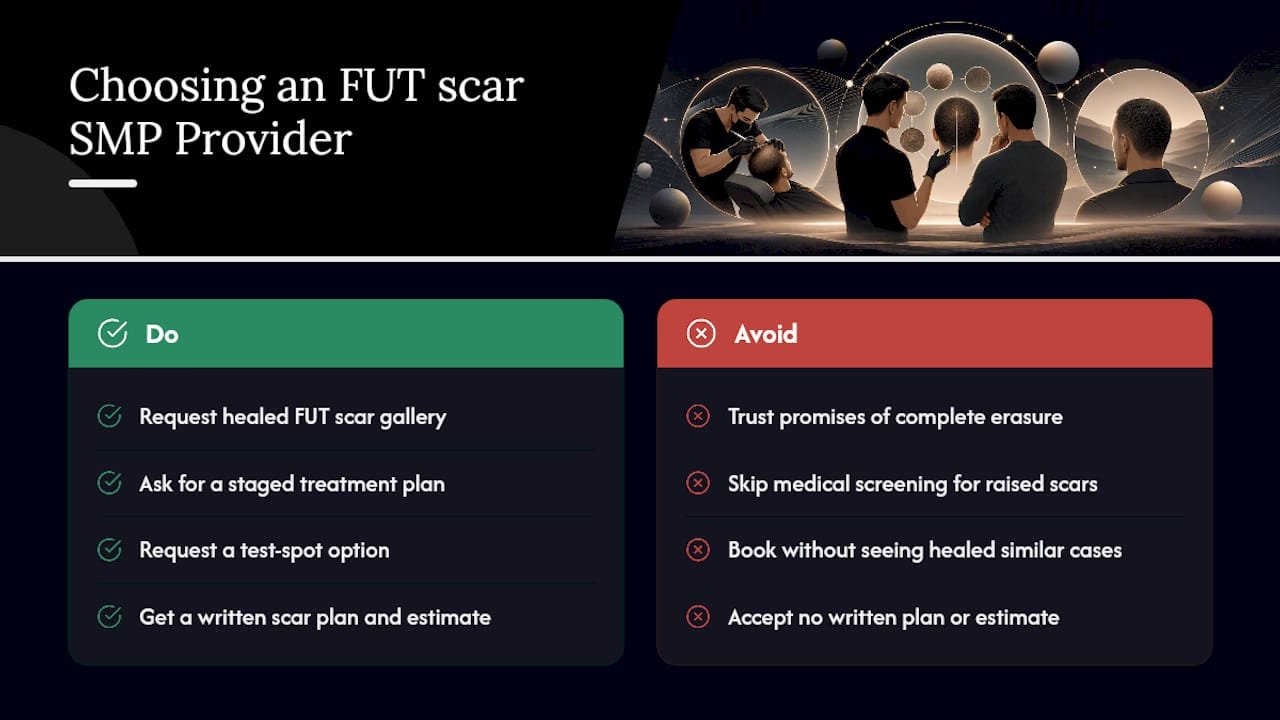
The gap between a good outcome and a disappointing one usually comes down to who’s holding the needle, not the pigment they use. Before booking, ask to see a healed scar gallery of FUT cases similar to yours, not just fresh work photographed under studio lighting. Look for a staged treatment plan with a test-spot option built in, and confirm whether the clinic coordinates with a physician when pre-treatment is needed for raised or hypertrophic scars.
During the consultation, ask directly: How many FUT scar cases have you treated, and can I see healed results specifically from your subtype? What pre-treatment options do you offer, and when do you refer out for that? How many sessions do you expect for my scar, realistically? What’s your touch-up policy after healing?
Walk away from any provider who promises complete erasure without seeing your scar in person, or who skips medical screening questions when your scar is visibly raised.
Pro Tip: A strong consultation ends with something in writing, a scar classification, a proposed session count, a timeline, and a cost estimate. If a provider can’t put that on paper, that’s a sign their planning process is thinner than it should be.
What SMP Providers Miss About FUT Scar Work
Most SMP marketing treats scar camouflage as a simple pigment job, and that’s where expectations go wrong. A fine, flat scar and a widened, tension-stretched scar are not the same procedure wearing different labels. They need different needle depths, different session counts, and, honestly, different levels of patience from the client.
The providers who get consistent results are the ones willing to say “this scar needs a laser session first” instead of pushing straight to pigment because it’s a faster sale. Enhanced Scalp’s approach leans conservative for exactly this reason: layered deposition, test spots before full commitment, and healed documentation reviewed at the six-week mark rather than immediately after a session when everything looks darker and denser than it will end up.
Clients who come in expecting a scar to vanish entirely under any hair length are usually the ones disappointed. Clients who understand the realistic range for their specific scar subtype, and plan their haircut around it, tend to walk away genuinely satisfied.
— James Christopher
Book a Consultation for FUT Scar Camouflage
Enhanced Scalp treats FUT scar camouflage as a scar-specific procedure, not a one-size pigment job. Every consultation starts with classifying your scar subtype, coordinating physician-led pre-treatment when a scar is raised or hypertrophic, and matching pigment tone against your actual skin rather than a generic chart.
A consultation gets you a real scar assessment, a proposed session count, and a written cost estimate before you commit to anything. Enhanced Scalp documents healed results rather than fresh, overly dark photos, so you can see what similar scars actually look like months out. If your scar is wide, pale, or raised, expect an honest conversation about pre-treatment rather than a rushed pitch straight to pigment.
Start by reviewing the scar camouflage service page and booking a consultation to get your scar classified and a realistic plan built around it.
Further Reading on FUT Scar Camouflage
For deeper detail on protocols and technique, Enhanced Scalp’s FUT scar repair treatment guide covers session planning and pre-treatment pathways in full. The hair transplant scar camouflage overview breaks down FUT versus FUE outcomes side by side, and the SMP process guide walks through what to expect session by session, from anesthesia to aftercare.
FAQ
Can Scalp Micropigmentation Camouflage a FUT Scar?
Yes, SMP can meaningfully conceal most FUT strip scars, with results depending on scar subtype, maturity, and whether pre-treatment was needed first, with concealment varying by scar characteristics.
What Are the Disadvantages of SMP for Scar Treatment?
SMP requires ongoing touch-ups every few years as pigment fades from UV exposure, results depend heavily on keeping hair short, and hypertrophic or keloid scars often need pre-treatment before pigment will hold evenly.
How Much Does SMP Scar Camouflage Cost?
Cost varies by clinic based on session count and scar complexity, and since this is a cosmetic procedure, insurance generally does not cover it. A consultation is the best way to get an accurate quote for your scar.
Is SMP Treatment Worth It for a FUT Scar?
For most people with a mature, flat, or moderately widened scar, SMP delivers a substantial visual improvement in two to three sessions at a fraction of the cost and downtime of surgical scar revision.
How Long Does SMP Last on a FUT Scar?
SMP typically lasts four to eight years before noticeable fading, with sun exposure being the main factor that speeds up color loss over time.

