 Skip to content


Scalp micropigmentation (SMP) can be done on skin affected by vitiligo, but only in a narrow set of cases, and never as a casual cosmetic decision. The condition has to be stable, the patch usually small and localized, and you should talk to your dermatologist first. The main risk is the Koebner phenomenon: the needle trauma itself can trigger new white patches. This guide explains how to judge your situation, what results look like, and what a responsible clinic should say to you before it takes a deposit.
TL;DR
- SMP on vitiligo is a medical-tattoo decision, not a standard hair loss treatment. It should be considered only when the vitiligo is stable, localized and has not responded to other treatments.
- The biggest risk is Koebnerization: tattooing can trigger new or spreading depigmented patches, sometimes long after the procedure.
- Pigment is permanent. If the color match is poor or the patch spreads, laser removal is not a safe or easy way out.
- A test spot does not prove safety, so get your dermatologist’s view before any needle touches your scalp.
- If your vitiligo is elsewhere on the body and you want SMP for baldness, thinning or scars, the conversation is different, but disease activity still matters.
Table of Contents
- Two very different situations
- The Koebner phenomenon: the risk you need to understand first
- What “stable” actually means
- Why tattooing is not the first-line option
- What results look like when it does go well
- SMP for a shaved-head look with vitiligo patches
- When vitiligo is elsewhere and your scalp is unaffected
- Our perspective
- Questions to ask any clinic before you book
- A realistic decision path
- If SMP is the right call for you
- FAQ
- Sources
Two very different situations
People who search for SMP with vitiligo usually mean one of two things. It helps to know which one you are, because the risks and the results differ.
Vitiligo on the scalp itself. You have white patches on the scalp, or patches of white hair, and you are wondering whether pigment could blend them into the surrounding skin or into a shaved-head look.
Vitiligo elsewhere, hair loss on the scalp. Your scalp skin is unaffected, but you have vitiligo on your hands, face or body and you want SMP for a receding hairline, thinning, alopecia or a transplant scar. Here the question is whether your autoimmune condition makes the skin more reactive to needle trauma.
In both cases the same underlying issue applies. Vitiligo is an autoimmune condition in which the cells that make melanin are lost, which is why the Canadian Dermatology Association describes it as causing white patches on skin. Skin that reacts to injury by losing pigment is exactly the skin you would be injuring on purpose with a tattoo needle.
The Koebner phenomenon: the risk you need to understand first
The Koebner phenomenon is the appearance of new lesions at a site of skin trauma. In vitiligo, a cut, a burn, friction or a tattoo can be followed by a new depigmented patch in the same spot. A 2026 clinical review of aesthetic procedures in vitiligo patients notes that this reaction is unpredictable and can appear even years after the procedure. It also makes a point that matters for SMP: a small test spot is not a reliable predictor of safety, and it may sensitize the skin unnecessarily.
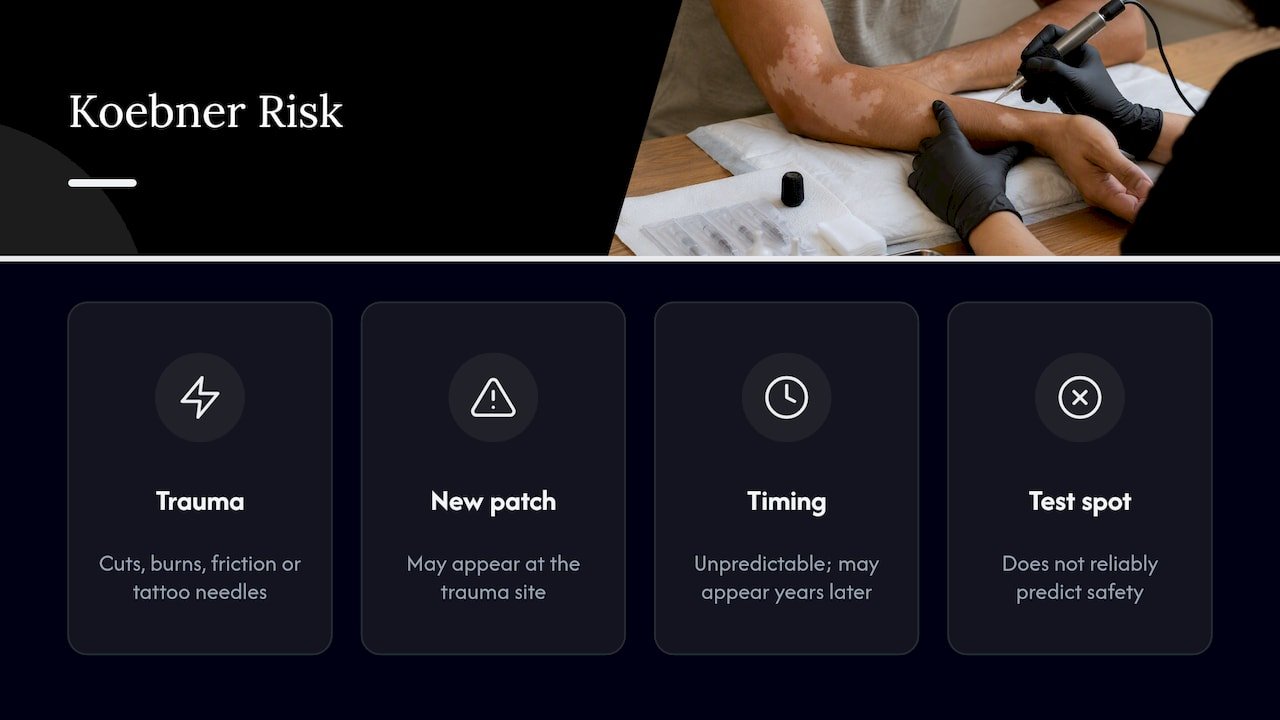
The same review reports that procedures causing significant epidermal or dermal injury, such as microneedling and ablative lasers, are the ones that carry concern in vitiligo, while low-trauma procedures such as botulinum toxin show better safety profiles in stable disease. SMP deposits pigment into the upper dermis with a needle, so it belongs on the cautious side of that line.
Dermatologists who have documented cases of camouflage tattooing going wrong describe a common false belief: that tattooing will somehow contain the disease. According to a paper on tattoo camouflage and tattoo regret, the trauma of the needle can instead reactivate vitiligo and make it spread. The same paper warns that tattooing on or near the edge of a patch can trigger extension of the depigmented area.
What “stable” actually means
Stable vitiligo is not “it feels like it has stopped.” The working definition in the dermatology literature on micropigmentation for camouflage is no new lesions and no enlargement of existing patches for at least 6 to 12 months. The same source says any sign of disease activity, such as inflammatory borders or rapidly changing spots, makes the procedure contraindicated.
That gives you a practical checklist to bring to your dermatologist:
- Have any patches grown, or have new ones appeared, in the past 12 months?
- Do any patches have red, raised or inflamed edges?
- Is the vitiligo localized to a small area, rather than widespread?
- Have standard treatments been tried without enough repigmentation?
- Has anyone documented the patches with dated photos so change can be measured?
If you cannot answer yes to the stability question with confidence, the honest answer is to wait. Waiting costs you time. A wrong decision costs you a permanent mark and possibly a larger patch.
Why tattooing is not the first-line option
In Canada, vitiligo care is built around repigmentation and halting progression, not camouflage. Patient and clinician input submitted to the national drug review agency lists repigmentation and stabilization as the core treatment goals patients identify, at 22.5% and 24.7% respectively. As of 2026 we found no formalized Canadian clinical practice guideline specifically covering scalp micropigmentation for vitiligo. The Canadian consensus guidelines for the management of vitiligo are the wider framework your dermatologist works from.
Tattooing is generally treated as an alternative for stubborn cases, meaning patches that have not responded to other options. That is why your first appointment should be with a dermatologist, not a tattoo chair. Topical and light-based options may repigment skin that SMP would only cover with ink, and repigmented skin is real skin, not a permanent pigment layer you cannot undo.
What results look like when it does go well
There is evidence that micropigmentation can work on stable vitiligo. A clinical and animal study in the Journal of Dermatology found excellent color matching in 80% of cases (20 of 25) in stable vitiligo, after a median of three sessions (range 1 to 5). That study covered light to moderately colored skin, so it does not tell you what to expect on every skin tone.
The same research is also clear about the limits:
- Procedure pain is common, and redness and swelling are expected for a few days.
- The match is never identical. Vitiliginous skin has no melanin, so the pigmented area will differ from treated healthy skin.
- Pigment can blur over time.
- It is hard to reverse. Because it is tattoo ink, laser removal is not a safe or easy fix if the result is poor or the vitiligo extends past the treated area.
That last point is the one people underestimate. If you choose SMP for a vitiligo patch and the patch later grows, you may end up with a ring of white skin around a block of pigment.
SMP for a shaved-head look with vitiligo patches
On a scalp with scattered patches, the goal is usually to blend. Pigment placed as tiny dots can reduce the contrast between pale patches and surrounding skin and hair. But a few realities apply.
Skin tone matters. The darker the surrounding skin, the greater the contrast with a patch, and the harder a single pigment shade is to match. Patches may need a custom-blended pigment, and that blend needs to heal before anyone judges it.
Hair color matters. White or grey hair within a patch (poliosis) behaves differently from pigmented hair. A shaved-head SMP look hides the difference between hair colors, but only if the density and color of the dots read as believable.
Edges are the danger zone. The border of a patch is where Koebnerization is most likely to extend the depigmentation. Any plan that works right up to that edge deserves extra scrutiny from your dermatologist.
When vitiligo is elsewhere and your scalp is unaffected
If your scalp skin has normal pigment and you want SMP for male pattern baldness, a receding hairline, a diffuse thinning pattern or a transplant scar, the vitiligo is not on the treatment site. That is a lower-risk situation than tattooing a patch directly, but it is not risk-free. Koebnerization is described as trauma-triggered lesions in skin that was previously uninvolved, which is exactly what your scalp would be.
Practical steps for this case:
- Tell your dermatologist you are considering SMP, and ask whether your disease is currently active.
- Share your vitiligo history in full at the consultation, including the date of your last new patch.
- Ask how the clinic would handle a small, discreet area first, and whether your dermatologist agrees with that plan.
- Treat the first sessions as monitoring time. Watch the treated area and surrounding scalp for new white spots over the following months.
We also have pages on SMP for men and SMP for women that explain the standard treatment when no skin condition complicates the picture.
Our perspective
We build our work around conservative design, realistic follicle replication, proper pigment selection and long-term healed results. That philosophy is exactly why vitiligo makes us cautious. A shaved-head result that looks natural at the end of week one means nothing if the skin reacts a year later.
Our view is simple. Vitiligo is a medical question before it is a cosmetic one, and a clinic that says yes quickly is not doing you a favor. If you are in this situation, we would rather you see your dermatologist first, bring us a clear picture of how long your vitiligo has been stable, and let us tell you honestly whether SMP is the right tool or whether another route fits better.
We also deal every week with people who are unhappy with earlier work, whether a poorly done SMP, a failed transplant or a difficult scar. The common thread is that the cost of a bad permanent result is far larger than the cost of waiting. That applies doubly when the skin condition itself is unpredictable.
— James Christopher
Questions to ask any clinic before you book
A trustworthy provider should welcome these questions and answer without defensiveness.
- Will you ask for my dermatologist’s input? A clinic that skips this step is treating a medical condition like a routine appointment.
- How do you define stable, and how long must I wait? Look for an answer in line with the 6 to 12 months of no new or growing lesions used in the literature.
- What do you tell clients about Koebnerization? The honest answer includes that it can be delayed and that a test spot does not rule it out.
- What happens if the vitiligo spreads after treatment? The answer should acknowledge that pigment is permanent and not safely laser-removable.
- Can I see healed results on comparable skin? Fresh photos mean little. Healed photos at several months matter far more.
- How is the procedure kept sterile? In Ontario, public health units expect body art operators to follow infection control rules. Public Health Sudbury & Districts notes that improperly administered tattoos can transmit serious infections, and City of Toronto guidance sets out record-keeping and infection prevention practices for tattooing in the city.
Also ask about aftercare. Skin that tends to react to trauma should be kept away from picking, scrubbing and friction during healing, and your dermatologist may give specific instructions on top of the clinic’s.
A realistic decision path
Here is the order we suggest to anyone with vitiligo who is curious about SMP.
Step 1: See your dermatologist. Get your disease activity assessed and ask whether repigmentation options are worth trying first. Dermatologists in Canada emphasize repigmentation over permanent tattooing, and for good reason.
Step 2: Document stability. Take dated, well-lit photos of every patch. Six to twelve months of no change is the benchmark.
Step 3: Define your goal. Are you camouflaging a patch, or treating hair loss on unaffected scalp? The risk profile differs.
Step 4: Book a consultation, not a treatment. Share your history openly, bring your photos and your dermatologist’s comments, and expect to hear “not yet” if the picture is unclear.
Step 5: Start small, if at all. If you and your dermatologist agree to proceed, a limited first session and a long monitoring period are better than a full-scalp commitment.
Vitiligo also carries an emotional load. The tattoo-camouflage literature stresses that counselling is a critical part of management for the distress visible vitiligo can cause. If the patches are affecting your confidence, that deserves attention in its own right, whether or not SMP is ever part of the plan.

If SMP is the right call for you
When your dermatologist agrees and your skin is stable, you want a clinic that treats the permanent nature of the work seriously. Scalp micropigmentation at Enhanced Scalp is priced at 3,000 to 4,000 CAD as a one-off, and we work from our clinic in Vaughan, Ontario, serving Toronto, the GTA and clients who travel to us from elsewhere in Canada and the United States. You can read the details on our scalp micropigmentation treatment page, or see how the process runs session by session in our SMP process guide.
If you are dealing with scarring rather than vitiligo, our scar camouflage treatment page covers that work. For an overview of conditions where SMP is better established, see our guide to SMP for alopecia.
FAQ
Can you get scalp micropigmentation if you have vitiligo?
Sometimes, but only under strict conditions. Dermatology sources say the vitiligo should be stable, with no new or growing patches for at least 6 to 12 months, and generally localized. Get your dermatologist’s input before booking.
Can SMP make vitiligo worse?
Yes, it can. Tattooing is a skin trauma, and in vitiligo that can trigger new patches or extend existing ones through the Koebner phenomenon. The reaction can be delayed by years, and a test spot does not reliably predict it.
Does SMP permanently cover vitiligo patches on the scalp?
It camouflages them with pigment, but it does not treat the disease. Studies show good color matching in many stable cases, yet the match is never identical to healthy skin, pigment can blur, and the ink is not safely removable by laser. If the vitiligo spreads, the untreated skin around the pigment can turn white.
Is SMP safe if my vitiligo is on my body but not my scalp?
It is a lower-risk situation than tattooing a patch, but trauma anywhere can trigger Koebnerization in people with vitiligo. Make sure your disease is inactive, tell the clinic your full history, and ask your dermatologist before starting.
Should I try other vitiligo treatments first?
Usually yes. Canadian vitiligo care focuses on repigmentation and stabilizing the disease, and tattooing is generally seen as an option for cases that have not responded. Your dermatologist can tell you which treatments make sense for your skin.
Sources
- Aesthetic Procedures in Patients with Vitiligo: Evidence-Based Clinical Guidelines for Minimizing Koebner Phenomenon Risk
- Tattoo for Camouflage: A New Cause of Tattoo Regret
- Micropigmentation (PMC)
- Micropigmentation for vitiligo on light to moderately colored skin, Journal of Dermatology
- Canadian Dermatology Association: Vitiligo
- Patient and Clinician Group Input (CDA-AMC)
- Canadian Consensus Guidelines for the Management of Vitiligo
- Tattoos and piercings: making a safe choice (Public Health Sudbury & Districts)
- Tattooing: Infection Prevention and Control Practices (City of Toronto)

