 Skip to content


A soft hairline in scalp micropigmentation (SMP) is a hairline with no hard edge. Instead of a crisp, dark line across the forehead, the artist places small, light, scattered impressions that fade gradually into bare skin, the way a real hairline looks up close. Done well, it reads as natural hair on a shaved head. Done badly, it looks like a drawn-on stripe. This guide explains what separates the two, who a soft hairline suits, how it is built over several sessions and what to ask before you book.
TL;DR
- A soft hairline uses lighter pigment, varied dot sizes and an irregular, feathered front edge, so it blends into the skin instead of sitting on top of it.
- It suits men with early to moderate hair loss, mature clients who want an age-appropriate look, and anyone who wants a conservative result they can build on later.
- Expect several sessions, not one. A 2025 analysis reports that patients typically need 3 to 5 sessions to reach the target density.
- At Enhanced Scalp, scalp micropigmentation is published at $3,000 to $4,000 CAD, one-off.
- Ask any clinic for healed photos, not just fresh-after-session shots.
Table of Contents
- What a soft hairline actually is
- Soft versus sharp: how to choose
- Who a soft hairline suits
- How a soft hairline is built, step by step
- Why depth and dot size decide whether it looks soft
- How a soft hairline ages
- What the first days look like
- How to spot a soft hairline done right
- Our perspective on soft hairlines
- Ontario rules and what they mean for you
- What it costs
- Book a consultation
- FAQ
- Sources
What a soft hairline actually is
A natural hairline is not a line. Look closely at any adult’s forehead and you will see a transition zone: a few isolated hairs at the very front, then a thicker scatter, then full density a centimeter or so back. The front edge is uneven. Some hairs sit forward, some sit back, and no two are exactly aligned.
A soft hairline in SMP imitates that transition zone. The technician uses:
- Smaller, lighter impressions at the front edge. The first row is sparse and slightly paler than the body of the work.
- Irregular spacing. Clusters and gaps replace a neat row of evenly placed dots.
- Gradual density. Darkness and density build slowly from the front edge backward.
- A gentle shape. Slightly rounded corners and a subtle, slightly asymmetrical outline rather than a ruler-straight edge.
The opposite is often called a sharp, crisp or “blocky” hairline. It can work on a very young shaved head with a strong natural line, but it tends to look manufactured on most clients, especially as the years pass.
Soft versus sharp: how to choose
The right choice depends on your age, your remaining hair, your head shape and the look you want. Here is how the two compare.
| Factor | Soft hairline | Sharp hairline |
|---|---|---|
| Front edge | Feathered, irregular, light | Defined, dense, straight |
| Best for | Early or moderate loss, mature clients, rounder head shapes | Strong, young natural hairline with clean edges |
| Forgiveness over time | Higher: gradual fade looks like natural aging | Lower: any fading or edge drift shows |
| Look when shaved very short | Realistic, subtle | Can look drawn-on if too dark or too low |
| Room for later adjustment | Easy to add density | Harder to soften without correction |
A soft hairline is also the safer starting point. It is far easier to add density to a conservative design than to remove an overly dark or too-low one. If you want to see how we handle age and placement, our guide to mature hairline SMP with healed photo proof walks through a staged, conservative approach, and our article on low hairline SMP for men covers what happens when the line is placed too ambitiously.
Who a soft hairline suits
Men with a receding hairline
If your temples are pulling back or your forehead is growing, a soft hairline restores the frame without pretending you are 18. The design follows the position your hairline would plausibly hold at your age. For a deeper look at how we approach this, read SMP for a receding hairline.
If you keep your hair longer on top rather than shaving, the styling on the rest of your head matters too. Choosing hairstyles for a receding hairline can help you decide whether SMP should blend into hair you keep or whether a full shave is the better route.
Men with early or diffuse thinning
When you still have a lot of hair, SMP is used to add the look of density between existing strands. A light, soft touch matters here, because heavy pigment next to real hair stands out. The goal is a slightly thicker look, not a visibly colored scalp.
Hair transplant patients
A soft design is also useful for camouflaging a transplant that left sparse areas or a visible scar. If that is your situation, see our pages on hair transplant scar camouflage and SMP on scar tissue. Scar tissue holds pigment differently from normal skin, so a test spot comes first.
Women with thinning
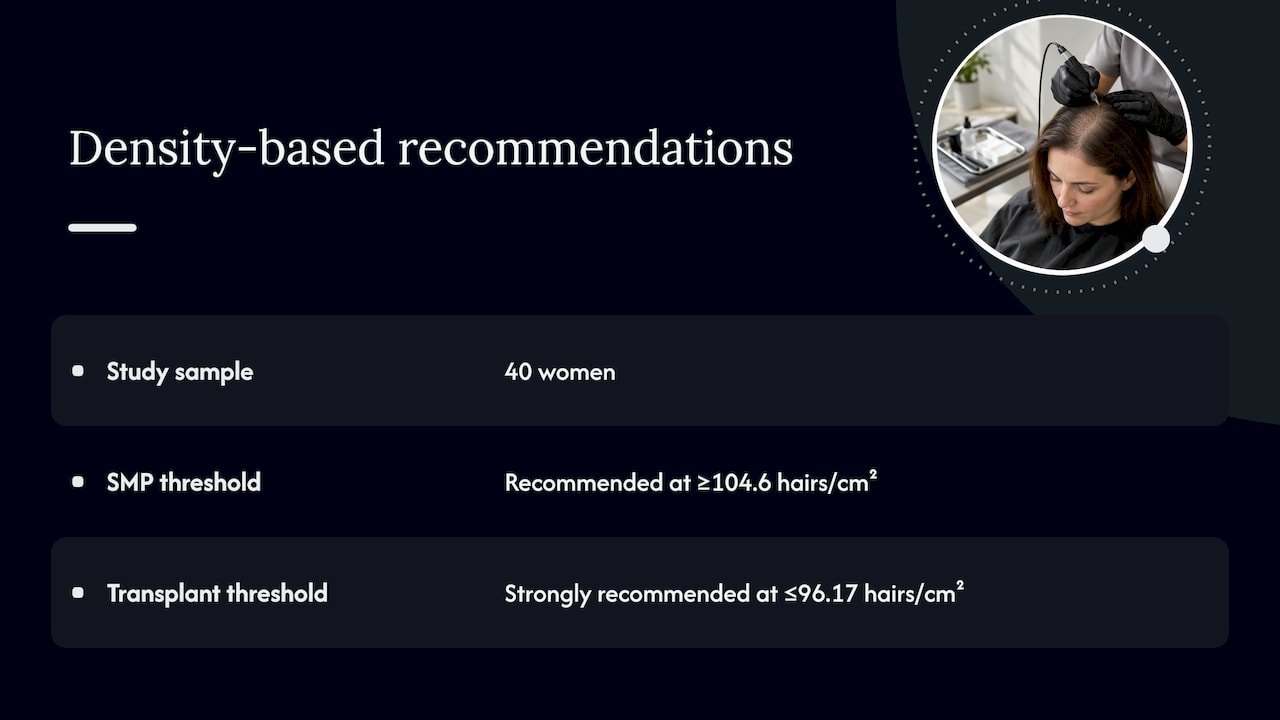
Women usually want to keep a natural, lightly filled part line and frontal area, so softness is the point. Suitability depends heavily on how much hair you have left. A 2025 retrospective study of 40 women found that hair density was the main factor in choosing between transplant and SMP: SMP was recommended at 104.6 hairs/cm2 or higher, while transplantation was strongly recommended at 96.17 hairs/cm2 or lower. Our page on female scalp micropigmentation explains what we offer.
How a soft hairline is built, step by step
SMP is a form of cosmetic tattooing that places tiny pigment deposits in the skin to mimic hair follicles cut close to the scalp. A published review describes it as a process that must be customized for each patient, because each person’s skin holds pigment differently. The same review notes that practitioners can spend up to 20 hours in total to reach a natural result across several sessions.
- Consultation and design. The hairline is drawn on, adjusted and checked from the front, side and at an angle. A good designer considers your age, face shape, temple recession and the way your hairline would naturally sit.
- Pigment selection. The pigment is matched to your skin tone and remaining hair, since the aim is a believable shaved look rather than a flat black.
- Session one: the foundation. The artist lays down the lightest layer, concentrating on the front edge. Nothing is rushed, and the first pass is deliberately conservative.
- Healing and review. Fresh pigment looks darker at first and settles as the skin heals. You come back after healing so the artist can judge what has actually stayed.
- Later sessions: density. Density is added gradually. The 2025 analysis cited above describes a target of 80 to 100 dots/cm2 by the final session across 3 to 5 sessions, spaced 5 to 7 days apart in that study.
- Final check. The front edge gets its last refinements once the rest has settled.
We set out the full sequence in what to expect from the SMP process, session by session.
Why depth and dot size decide whether it looks soft
Softness is partly design and partly technique. Practitioners describe the balance among dot size, distribution and pigment depth: pigment placed too superficially exfoliates and washes away, while pigment placed too deep risks diffusing into a blotchy, unnatural look in the upper-to-mid dermis range they aim for.
That is why a soft hairline is harder than it looks. A light touch must still be placed at the right depth to stay. If you want it to last, you cannot fix softness by simply using less pigment.
The same article stresses that corrective revisions for poor SMP are significantly harder than the original procedure. A 2025 paper on revising unsatisfactory SMP outcomes goes further: it warns that results of improperly performed SMP are exceedingly challenging to rectify. Starting soft and conservative is the cheaper route in every sense.
How a soft hairline ages
All SMP changes over time. Pigment fades gradually, and a soft hairline tends to age more gracefully than a hard one because there is no crisp edge to blur. A follow-up summary in the 2025 analysis reports that most patients show minimal fading 7 to 32 months after treatment. That is a range from a small study series, not a promise for any one person.
Your own result depends on skin type, sun exposure, the pigment used and how deeply it was placed. Many clients plan a light refresh after several years to restore density. If you are curious what long-term upkeep looks like, our guide on age-proof low hairline SMP with 3 to 5 year touch-ups covers it.
What the first days look like
Right after a session, the area can look darker, sharper or slightly uneven. That is expected during healing, and the final look appears after the skin has settled. Do not judge the hairline in the first week. Follow your clinic’s aftercare instructions exactly: keep to the washing, moisturizing and sun-avoidance rules you are given, and contact the clinic if something looks wrong rather than guessing.
See a doctor if you notice signs of infection such as spreading redness, heat, swelling or pus. The Wiley paper notes that rare but severe complications, such as foreign body granulomas or infections, are why you should verify your practitioner follows strict aseptic protocols.
How to spot a soft hairline done right
Photos can be misleading. Use this checklist when you look at any clinic’s portfolio, ours included.
- Healed photos. Ask for images taken months after the final session, not only right after treatment. We cover this in our forensic checklist for AI-edited SMP.
- Close-ups in natural light. Flash and heavy editing hide edges.
- Irregular front edge. If every dot lines up like a barcode, it will look fake.
- Reasonable placement. A line too low across the forehead is the most common giveaway of an unnatural result.
- Different head shapes and skin tones. Technique changes with skin, which is why we also publish what changes for afro-textured SMP.
A worrying finding from clinicians reviewing corrective cases: nearly 90% of unsatisfactory outcomes came from work done in non-specialized cosmetic or beauty salon settings rather than dedicated clinical environments. That is an observation from clinical experience, not a rule, but it is a good reason to choose a specialist.
Our perspective on soft hairlines
We design every hairline conservatively. Our view is simple: a hairline should look like it belongs to you at your age, and it should still look right when it has healed and aged. We prefer a slightly higher, slightly lighter line that clients can build on to a line that looks impressive in a fresh photo and wrong a year later.
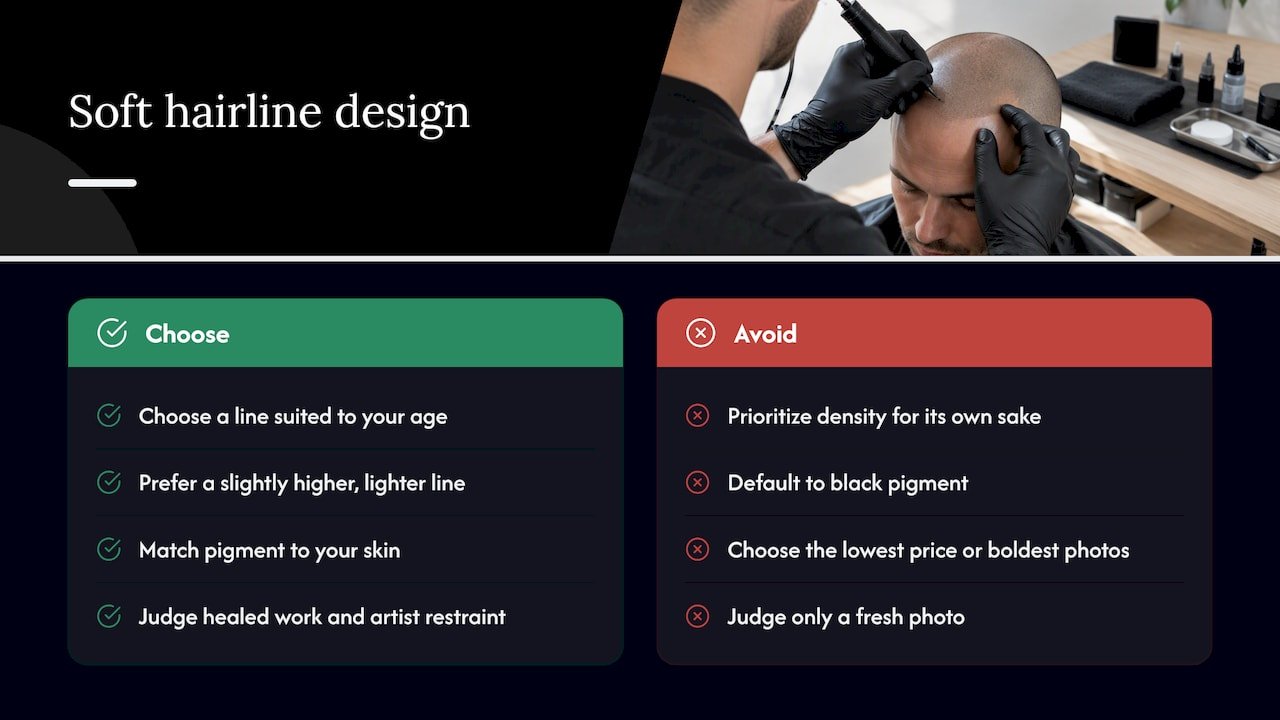
That means choosing realistic follicle replication over density for its own sake, matching pigment to your skin instead of defaulting to black, and documenting healed work so you can judge results honestly. It also means telling a client when they should wait, or when another option such as a transplant may serve them better. Many of the people who contact us come after a hairline that is too low, too dark or too sharp, which is why we also do corrective work. Our guide to fixing, correcting or removing SMP explains the options.
If you take one thing from this page: pick the artist by their healed work and their restraint, not by the lowest price or the boldest before-and-after.
— James Christopher
Ontario rules and what they mean for you
In Ontario, SMP falls under personal service settings regulation, O. Reg. 136/18, as summarized by the City of Toronto. It sets infection prevention and sterilization standards for the premises. According to that source, it does not require artist-specific skill certification, so a clean room alone does not tell you whether the person holding the machine can design a natural hairline.
In Toronto, operators must also hold a certificate of insurance for $1,000,000 in commercial general liability coverage. Ask to see proof of hygiene practices and insurance, then judge the artist on their healed portfolio. Rules can change, so check the City of Toronto page if you are in Toronto, or your local public health unit elsewhere in Ontario.
What it costs
Our scalp micropigmentation treatment is published at $3,000 to $4,000 CAD, one-off. The final figure depends on the area to be treated and the work required. Female SMP, scar camouflage and training do not have published prices, so we quote those after a conversation about your needs.
In all clinics, the cheapest option can cost the most later if it ends in correction. A soft hairline also usually costs no extra, since it is a design choice rather than an add-on, but ask about it during your consultation.
Book a consultation
Enhanced Scalp is based in Vaughan, Ontario, and we see clients from Toronto, the GTA, the rest of Canada, the United States and abroad. If you would like a soft, conservative hairline designed for your face and age, start with our scalp micropigmentation treatment page. You can also read about our men’s scalp micropigmentation or our approach to male pattern baldness. If you have a scar or a previous transplant, our scar camouflage treatment may be the right starting point.
FAQ
Should I shave my head before SMP?
Follow your artist’s instructions. For most male clients heading for a shaved look, the clinic will trim or shave the area at the appointment so the design can be seen clearly. If you plan to keep hair at a longer length, tell the artist during the consultation so the pigment is matched to it.
What happens to SMP after 5 years?
It fades gradually rather than disappearing at once, and the rate depends on your skin, sun exposure and the original technique. A published follow-up reported minimal fading 7 to 32 months after treatment in most patients, which does not stretch to five years. Many people book a touch-up after several years to refresh density.
Can a hard or unnatural hairline be softened?
Often, yes, by softening the edge, adjusting placement and blending the pigment, but results depend on how the original was done. Revision is harder than a good first procedure, so a consultation and a test area come first. See our SMP editing guide.
Is a soft hairline right if I am going completely bald?
Usually, yes, if you want a natural and age-appropriate look. A soft design avoids the overly sharp line that can look artificial on a fully shaved head. Your artist should show you the proposed line on your own scalp before any pigment is placed.
Sources
- Scalp Micropigmentation Is an Effective Treatment for Localized Alopecia: Technical Analysis and a Series of Ten Case Reports (2025)
- Scalp micropigmentation: a useful treatment for hair loss
- Hair transplantation versus scalp micropigmentation in female pattern hair loss: a retrospective study
- Practitioner review on SMP technique, PMC
- Revision for unsatisfactory outcomes of scalp micropigmentation, International Journal of Dermatology (2025)
- Body Piercing, Electrolysis, Hair Salon, Nail Shop, Tattoo and Waxing, City of Toronto

