 Skip to content

Yes, scalp micropigmentation can look completely real, but only when it’s designed and applied with restraint. The results that convince a barber, a coworker, or a first date all share three traits: a hairline drawn for the person’s actual age, dots that vary in size instead of forming a solid block, and pigment that reads gray-brown rather than blue-black once it heals. Poor SMP fails on one of those three almost every time.
Before you judge any result, run three quick checks: ask to see photos taken at least two weeks after the final session (not the day-of shots), look at whether the hairline has soft, irregular edges instead of a ruler-straight line, and check whether the color looks like shadow rather than ink. If a portfolio only shows fresh, glossy scalps under bright studio lighting, that’s a red flag, not a strength.
- Healed photos, not immediate post-op shots, are the real proof
- A soft, slightly irregular hairline reads as natural; a straight one doesn’t
- Gray-brown pigment blends; blue-black or solid black usually doesn’t
Pro Tip: Before booking anywhere, ask specifically for photos taken 3 to 6 weeks post-treatment in natural daylight. Any reputable studio has these on hand.
Key Takeaways
Realistic SMP results depend on age-appropriate hairline design, varied dot structure, multi-tone pigment, and judging results only after full healing.
| Point | Details |
|---|---|
| Judge healed, not fresh | Wait 2+ weeks past the final session before evaluating how natural results look. |
| Hairline design is the tell | An irregular, age-appropriate edge reads as real; a straight low line doesn’t. |
| Pigment tone matters most | Multi-tone, gray-brown pigment blends; flat black or blue-gray pigment doesn’t. |
| Enhanced Scalp’s approach | Builds density gradually across sessions and prioritizes healed-photo evidence over immediate results. |
Table of Contents
- Does SMP Look Real? The Design and Technique Behind It
- What SMP Looks Like Right After Treatment vs. Healed
- How SMP Ages and What Long-Term Upkeep Looks Like
- Spotting Fake-Looking SMP Before You Book
- Why Healed Photos Are the Real Proof
- What I’d Tell Someone on the Fence
- How Enhanced Scalp Approaches Realistic Results
- Sources
- FAQ
Does SMP Look Real? The Design and Technique Behind It
The honest answer is that SMP looks as real as the person applying it allows it to. Technique determines almost everything, and three variables matter more than the rest: hairline placement, dot structure, and pigment tone.
A hairline that sits too low, too straight, or too symmetrical is the fastest way to make scalp micropigmentation obvious at a glance. Natural hairlines are irregular. They recede slightly at the temples, thin gradually rather than stopping abruptly, and shift with age. According to the International Society of Hair Restoration Surgery, SMP works by placing specialized pigment to replicate the look of individual hair follicles, and that replication only convinces the eye when it accounts for these natural irregularities rather than drawing a clean edge.
Dot size and spacing matter just as much. Real follicles vary in scale and sit at inconsistent distances from each other. Technicians who use a single needle depth and identical spacing across the whole scalp produce a pattern that looks stenciled. The better approach mimics randomness on purpose, varying dot size slightly and increasing density gradually 1 to 2 centimeters behind the frontal hairline instead of starting at full density right at the edge.
Pigment choice is the third pillar. Multi-tonal, diluted pigments create the visual depth of individual hairs rather than a flat block of color. Research on color selection and perceptual outcomes supports layering lighter and darker tones rather than applying one uniform shade, since a single dark pigment tends to look artificial once it settles into the skin.
- Irregular, age-appropriate hairline beats a straight, low one every time
- Varied dot size and gradual density mimic real follicle distribution
- Multi-tone pigment avoids the flat, inked look of a single dark shade
- Immediate post-treatment color is always darker than the final healed result
Pro Tip: If a hairline in a portfolio photo looks like it was drawn with a ruler, that’s not a design choice. It’s a mistake that gets harder to fix the longer it sits.
What SMP Looks Like Right After Treatment vs. Healed
Freshly applied SMP always looks darker and sharper than the finished product will. Pigment sits closer to the skin surface immediately after treatment, and mild redness or swelling from the needle work exaggerates the contrast. A photo taken the same day as a session tells you almost nothing about how the result will actually look in six weeks, because the skin hasn’t finished its healing cycle yet.
The timeline generally breaks into three phases:
- Days 1 to 7: Pigment appears dark and dense, sometimes with light scabbing or flaking as the top layer of skin sheds.
- Days 7 to 14: Redness fades, flaking resolves, and the pigment starts to soften as the skin underneath finishes repairing itself.
- Days 14 to 30: The true color emerges. Pigment settles to its healed tone, usually noticeably lighter and softer than it looked in week one.
Clinical literature on skin healing after tattoo-like procedures backs this up: inflammatory and epidermal repair processes are still active for weeks after the needle work is done, which is exactly why the “final” look isn’t visible until the skin settles.
Most practitioners plan 2 to 3 sessions rather than trying to build full density in one sitting. Layering density across sessions gives the technician room to adjust tone and coverage based on how the first pass healed, and it sharply reduces the odds of ending up with a dark, blocked-in look that reads as tattooed rather than shaved. Trying to force complete coverage on day one is one of the more common causes of an SMP result that looks fake.
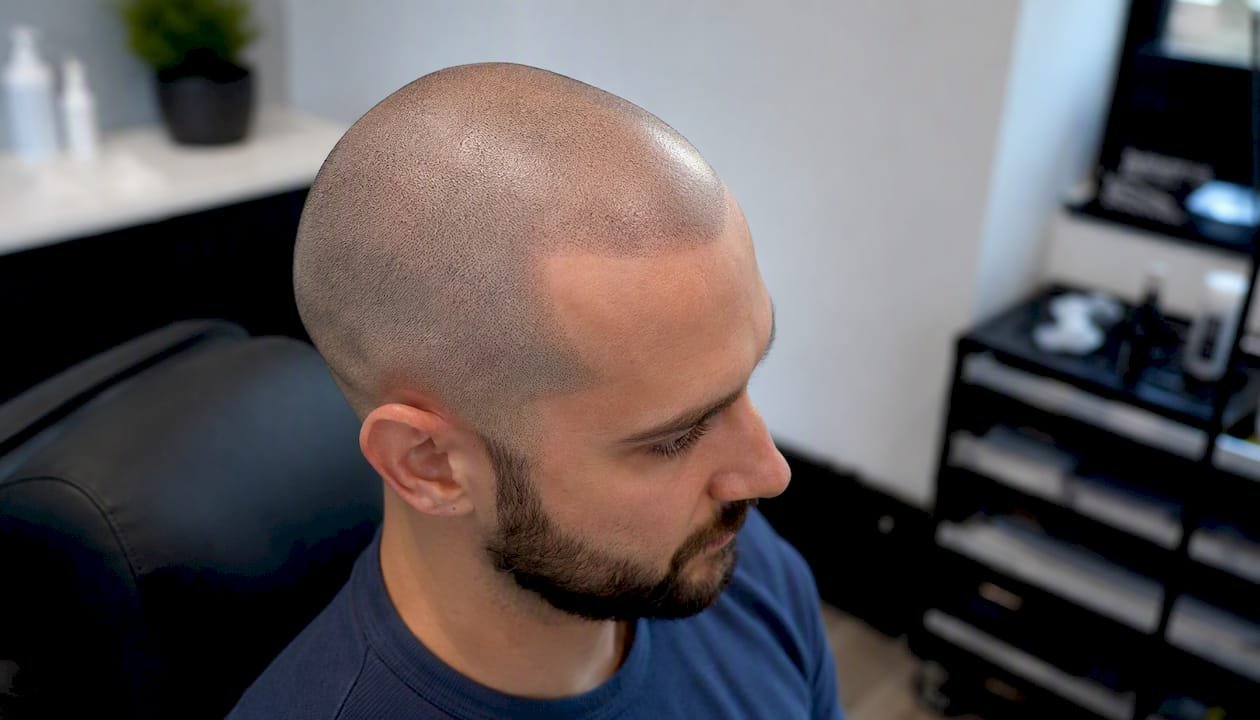
When you’re reviewing a clinic’s portfolio, ask specifically for photos taken two or more weeks after the final session, ideally from multiple angles and under natural light rather than a ring light. Video walk-arounds are even better, since a still photo can hide texture or shine that gives away artificial-looking pigment. You can browse examples like this in Enhanced Scalp’s healed results gallery to see what a fully settled result actually looks like weeks out, not hours out.
How SMP Ages and What Long-Term Upkeep Looks Like
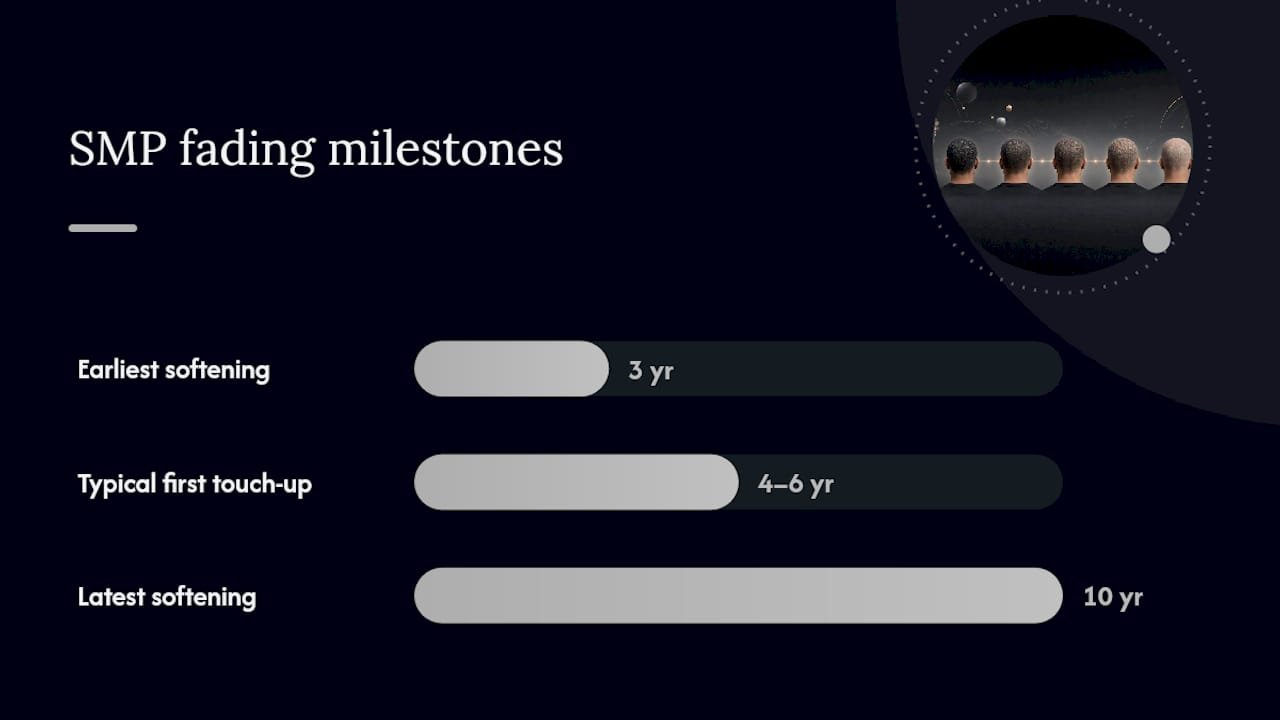
SMP doesn’t stay static. Pigment particles sit in the upper dermis, and like any dermal ink, they fade gradually rather than disappearing overnight. Most clients see a noticeable softening of tone somewhere between years 3 and 10, with the pace depending heavily on sun exposure, skin type, and how deep the pigment was placed originally.
Sun exposure is the biggest accelerant. UV breaks down pigment particles over time, which is why practitioners generally recommend SPF or a hat on the scalp during peak sun hours. Medical literature on pigment behavior in skin points to particle size and depth as key factors in how long color holds and how evenly it fades, which is part of why deeper, less careful application tends to shift color unpredictably over the years rather than fading uniformly.
A conservative touch-up schedule keeps results looking natural instead of patchy. Most people need their first touch-up somewhere between years 4 and 6, with lighter refreshes afterward as needed rather than a full redo. Clinics that build density gradually across the original sessions tend to need less aggressive touch-up work later, since there’s less pigment sitting too deep or too dense to begin with.
- Fading is gradual and expected, not a sign something went wrong
- Sun exposure accelerates fading more than almost any other factor
- A conservative first touch-up usually falls between years 4 and 6
- Deep or overly dense original work tends to age less predictably
If someone decides they want out entirely, laser removal is the standard path, though full removal is rarely guaranteed and can take multiple sessions with unpredictable results depending on ink depth. Corrective SMP is the more common route for people who don’t love their results but don’t want to go back to a bare scalp, reworking hairline shape or evening out density rather than erasing everything.
Pro Tip: Ask any clinic upfront what their touch-up policy actually covers. A studio that’s vague about this is usually vague about long-term results too.
Spotting Fake-Looking SMP Before You Book
Certain patterns show up again and again in results that don’t hold up. A hairline that’s perfectly straight and sits too low for the person’s age is the most common giveaway. So is a scalp that looks uniformly dark and dense from edge to edge, like a swim cap rather than a shadow of hair. Uniform dot size across the whole treated area is another tell, since real follicles never look that mechanically consistent. Blue-gray pigment, which happens when the wrong ink or too much depth is used, is one of the clearest signs of low-quality work.
Before booking a consultation, bring a specific list of questions:
- Can I see photos healed at least two weeks past the final session, from more than one angle?
- What pigment brand and formulation do you use, and why?
- What’s your touch-up policy, and what does it cost after the first year?
- How many sessions do you typically plan, and why that number?
- What’s your training and certification background?
- How do you adjust hairline design for someone’s age and face shape?
Healed portfolios worth trusting show variation in dot size, a gradual softening of density near the hairline instead of a hard edge, and consistent quality across different lighting setups and skin tones. If every photo in a gallery is shot under the same studio lighting from the same angle, that’s worth asking about directly.
Does SMP look fake up close?
Up close, even excellent SMP can show some texture difference from real stubble, since it’s pigment in skin rather than actual hair follicles. At conversational distance and under normal lighting, though, well-done SMP is designed to be indistinguishable from a closely shaved head.
Pro Tip: Bring a friend to your consultation and have them look at healed photos from across the room, not two inches from a phone screen. That’s the actual distance most people will ever view your scalp from.
Why Healed Photos Are the Real Proof
Vision science backs up why distance and lighting matter so much here. Human visual perception relies heavily on context and viewing conditions, which is part of why SMP reads as convincing at normal conversational distance even when a macro photo might reveal pigment texture that isn’t perfectly hair-like.
Practitioner restraint is the through-line connecting every technical factor discussed so far. Technicians who build subtle shadow instead of chasing maximum density on day one, who select multi-tone pigment instead of one dark shade, and who draw hairlines appropriate to age rather than a client’s Instagram wish list produce results that hold up under scrutiny. When you’re comparing healed portfolios, look for that variation in dot size, a gradual fade-in at the hairline, and consistent quality whether the photo was taken indoors or in daylight.
- Restraint in density beats aggression in every healed portfolio worth trusting
- Multi-tone pigment and age-appropriate hairlines are the two hardest things to fake convincingly
What I’d Tell Someone on the Fence
SMP is the right call for people who want a clean, natural shaved look and are willing to choose a practitioner based on healed evidence, not marketing photos. The clearest red flag isn’t price. It’s a studio that can’t produce real healed portfolios spanning different skin tones and hairline styles. Walk away from anyone who resists that request.
How Enhanced Scalp Approaches Realistic Results
Enhanced Scalp builds every treatment plan around what the result looks like once it’s fully healed, not what it looks like walking out the door. That means conservative, age-appropriate hairline design, multi-tone pigment selection matched to skin tone, and layered sessions that avoid the dark, blocked look that gives SMP away.
The clinic also handles corrective work for people dealing with a bad prior SMP job, a failed hair transplant, or scarring, using the same restrained, healed-first approach rather than repeating the mistakes that caused the problem in the first place. If you want to see what that actually looks like weeks after treatment rather than hours after, the healed results gallery is the place to start. From there, you can book a consultation through the scalp micropigmentation service page to talk through hairline design, pigment choice, and a session plan built for your specific hair loss pattern and skin tone.
Sources
FAQ
Does scalp micropigmentation look fake?
It can, usually when the hairline is too straight, the pigment is too dark or blue-toned, or density was pushed to maximum in one session. Well-designed SMP with age-appropriate hairline shaping and multi-tone pigment is built specifically to avoid that outcome.
How does SMP look after 10 years?
Expect gradual, natural fading rather than a dramatic shift, with most people needing a first touch-up between years 4 and 6 and lighter refreshes afterward. Sun exposure and original pigment depth both affect how evenly color holds over that stretch.
Can SMP be removed if I don’t like it?
Laser removal is the standard option, though full removal often takes multiple sessions and results vary depending on how deep the original pigment sits. Corrective SMP, which reworks hairline shape or density instead of erasing everything, is the more common fix for people who are unhappy but don’t want a bare scalp again.
Do people regret scalp micropigmentation?
Regret tends to trace back to poor technique, an overly dark or straight-edged result, or a practitioner who skipped healed-photo evidence during the consultation, not to the concept of SMP itself. Choosing a practitioner based on healed portfolios and a conservative session plan is the single biggest factor in avoiding regret.

