Skip to content

Scalp micropigmentation is the most reliable non-surgical option for concealing FUE dot scars, and clinical reviews confirm high patient satisfaction when the procedure is performed correctly. That said, outcomes vary based on scar type, skin tone, timing, and how experienced your provider is with scar tissue specifically. The immediate next step: book a scar-focused SMP consultation and ask to see a healed-photography portfolio showing FUE scar cases at a minimum of three months post-treatment.
Key Takeaways
SMP is the most effective non-surgical option for FUE scar camouflage when performed by a scar-specialist using a conservative, layered protocol documented with healed photos.
| Point | Details |
|---|---|
| Wait for full healing | Treat scars only after 9–12 months post-transplant; closer to 11–12 months is safer. |
| Session count varies by complexity | Standard FUE dot scars need 2–3 sessions; over-harvested zones typically require 3–4. |
| Concealment range for dot scars | Clinic frameworks report 75–95% concealment for standard FUE dot scars with proper technique. |
| Healed portfolio is non-negotiable | Request time-stamped photos at 3 months or beyond before committing to any provider. |
| Enhancedscalp for scar work | Enhancedscalp specializes in scar-specific SMP with documented healed results and a conservative layered approach. |
Table of Contents
- How does SMP work differently on FUE scar tissue?
- Is SMP right for your FUE scars?
- What does the treatment process actually look like?
- What are the real risks of SMP on scar tissue?
- How do you choose the right SMP provider for scar work?
- What does FUE scar SMP typically cost?
- What do high-quality healed results actually look like?
- Aftercare for scarred donor zones
- Why scar-specific technique matters more than most people realize
- Scar-specialized SMP consultations at Enhancedscalp
- Sources
How does SMP work differently on FUE scar tissue?
Standard SMP deposits pigment into the upper dermis to replicate the look of shaved follicular units. On healthy scalp, the skin responds predictably. Scar tissue is a different story. The ISHRS describes scar tissue as the most demanding environment for SMP because it is denser, less vascular, and far less forgiving of technique errors. Pigment can spread laterally, fade faster, or shift color in ways that simply do not happen on normal scalp.
The technical challenges specific to scar work include:
- Pigment spread: Dense collagen in scars can push pigment outward, creating blurred or halo-like dots.
- Uneven retention: Avascular scar tissue absorbs pigment inconsistently across even a small area.
- Color shift: Pigment deposited too deep in scar tissue tends to migrate toward blue or gray tones over time.
- Variable depth needs: Atrophic (sunken) and hypertrophic (raised) scars require different needle depths, sometimes within the same session.
- Altered skin turgor: Reduced elasticity changes how the skin accepts and holds the needle, demanding constant micro-adjustments.
Operators must calibrate needle depth and pigment placement millimeter-by-millimeter across the scar field. That level of precision is what separates a scar specialist from a general SMP practitioner.
Is SMP right for your FUE scars?
Ideal candidates have stable, fully healed dot scars, typically 9–12 months or more post-transplant, and realistic expectations for short hair lengths. FUE dot scars are actually the most predictable subtype for SMP camouflage. Their circular shape closely mimics a shaved follicular unit, and with careful dot-size calibration, concealment commonly reaches a high range often reported between three-quarters and near-complete concealment in clinical reports.
Good predictors of a strong outcome include small, evenly distributed dot scars, minimal color contrast between scar and surrounding skin, and no significant hypertrophy or atrophy. Skin tone matters too: high-contrast cases (very light scars on darker skin) require more layering and conservative density work.
Delay treatment if any of these apply:
- Your transplant was less than 9–12 months ago. Shapiro Medical’s clinical guidance recommends waiting until graft maturation and scar behavior are stable, often closer to 11–12 months.
- You have active healing, inflammation, or open areas in the donor zone.
- You have a documented keloid history. Keloid-prone skin can respond unpredictably to any needle-based procedure.
- Your donor zone shows signs of over-harvesting that have not yet been assessed by a specialist.
Pro Tip: Before your consultation, photograph your donor zone in natural daylight at multiple angles. This gives your practitioner a baseline record and helps map scar distribution before the first session.
What does the treatment process actually look like?
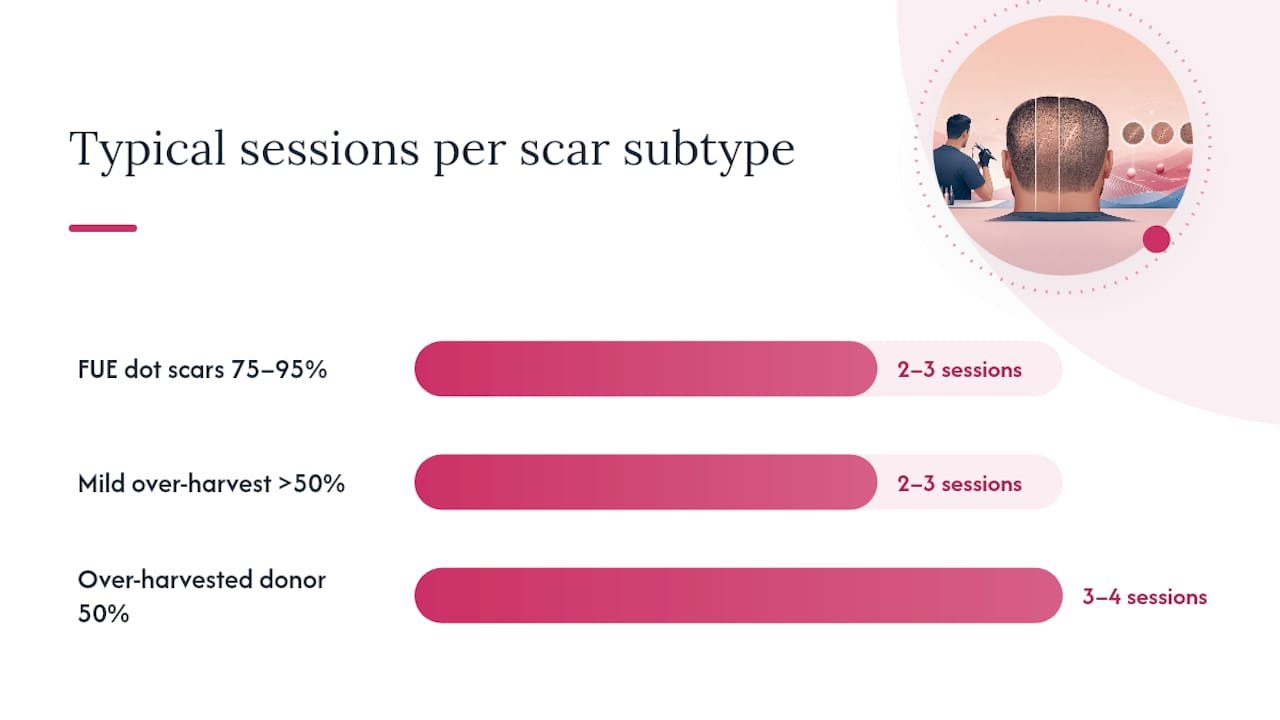
Most FUE scar cases require 2–3 layered sessions for standard dot scars. Over-harvested donor zones, where scar density is high and the skin texture is significantly altered, often need 3–4 sessions with customized density mapping. Sessions are spaced 10–14 days apart for the initial set, with longer intervals if you have had adjunctive scar prep like microneedling or laser.
A thorough consultation covers healed-photo review, depth and texture mapping of your specific scar pattern, a tone-match or test-patch consideration, and a full informed consent discussion. Topical anesthesia keeps sessions comfortable. Each session typically runs 2–4 hours depending on the size of the donor zone.
| Scar Subtype | Typical Sessions | Concealment Expectation | Notes |
|---|---|---|---|
| FUE dot scars (standard) | 2–3 | 75–95% | Most predictable subtype |
| Mild over-harvest | 2–3 | moderate concealment range typically reported to be over half but less than high | May need density layering |
| Over-harvested donor zone | 3–4 | 50% | Requires customized mapping |
What are the real risks of SMP on scar tissue?
Scar SMP carries higher unpredictability than standard scalp SMP. The most common issues are pigment spreading, early fading, color shift toward gray or blue, and uneven texture that becomes visible at certain lighting angles. These are not rare edge cases; they are the baseline risk profile for any needle-based treatment on scar tissue.
Experienced practitioners manage these risks through a layered approach: starting conservative on density and dot size, then building coverage across sessions rather than loading pigment in one pass. Color-matching strategies account for how scar tissue tends to alter pigment tone over time. When scars are significantly atrophic or fibrotic, some providers recommend microneedling or fractional laser as a preparatory step to improve pigment uptake before SMP begins.
Pro Tip: Ask any provider to show you healed photos at multiple timepoints, not just fresh results. Immediate post-session photos look dramatically different from results at 6 weeks and 6 months. A provider who only shows fresh work is showing you the easiest version of their results.
How do you choose the right SMP provider for scar work?
Choose a provider with documented scar-specific experience and a healed portfolio that matches your scar type and skin tone. General SMP skill does not automatically transfer to scar work. The ISHRS is explicit that scar tissue requires advanced technique and that patient selection and provider experience are the primary drivers of success.
When evaluating a provider, look for:
- Scar-specific healed photos: Time-stamped galleries showing FUE scar cases at 3 months and beyond.
- Documented session counts and touch-ups: Transparency about how many sessions their scar cases actually required.
- Training and certifications: Advanced scar-work training, not just a general SMP certificate.
- Patch-test or tone-match policy: Willingness to test pigment on a small scar area before committing to full treatment.
- Written post-treatment instructions and a follow-up plan: A provider who disappears after your last session is not a scar specialist.
Questions worth asking during your consult: How many FUE scar cases have you treated? Can I see healed results for my specific scar type and skin tone? What is your approach if pigment fades unevenly between sessions? Do you offer a touch-up policy?
What does FUE scar SMP typically cost?
FUE scar work is priced by complexity and coverage area, not by a flat rate. Small dot-scar camouflage on a limited donor zone costs less than a full over-harvested zone repair that requires multiple sessions and adjunctive prep. In the US, scar-specific SMP typically runs higher than standard scalp SMP because of the additional skill, session time, and layering involved.
Factors that drive the final price up include the number of sessions required, the extent of donor-zone coverage, whether microneedling or laser prep is needed before SMP, and the seniority and specialization of the practitioner.
For maintenance, plan realistically:
Touch-ups for scar SMP are typically needed sooner than for standard scalp SMP. While standard results often hold 3–5 years before a refresh is needed, scarred tissue can fade faster, particularly with regular sun exposure. Budget for a maintenance session within 2–3 years if your donor zone receives significant UV exposure.
What do high-quality healed results actually look like?
Excellent healed SMP on FUE scars looks natural at short hair lengths, with dot size, contrast, and blended edges that break up scar borders rather than drawing attention to them. The goal is not invisibility under a microscope; it is undetectability at normal social distances with a shaved or closely cropped head.
Visual markers of quality healed work:
- Consistent dot size and density that matches the surrounding donor hair pattern.
- Gradual shading at scar edges, not a hard line where treated and untreated areas meet.
- No haloing or excessive contrast around individual dots.
- Tone that reads as natural hair shadow, not gray or blue.
When reviewing a provider’s portfolio, look for photos taken at multiple timepoints: immediately post-session, at 4–6 weeks, and at 3–6 months. Lighting consistency across those photos matters. A gallery that only shows dramatic before-and-afters under studio lighting tells you very little about how the work holds up in real life.
Aftercare for scarred donor zones
Strict aftercare and sun protection meaningfully improve pigment retention in scar tissue, which fades faster than healthy scalp when exposed to UV or friction.
First 48–72 hours: Keep the treated area dry. No sweating, swimming, or direct water contact. Avoid touching or rubbing the scalp. Sleep on a clean pillowcase.

First two weeks: No sun exposure on the treated zone. Avoid saunas, steam rooms, and intense cardio. Apply any provider-recommended aftercare product as directed. Do not pick or scratch any flaking.
Months 1–3: Use SPF 30 or higher on the donor zone whenever outdoors. Avoid harsh shampoos or exfoliants on the treated area. Watch for signs of uneven fading or color shift and report them at your follow-up.
| Healing Phase | Expected Appearance | Key Actions |
|---|---|---|
| Days 1–5 | Darker, slightly raised dots | Keep dry, no sun, no sweat |
| Days 6–14 | Flaking, lightening | Gentle wash only, SPF daily |
| Weeks 3–6 | Significant lightening, settling | Continue SPF, avoid friction |
| Months 2–3 | Near-final healed tone | Follow-up assessment, touch-up if needed |
Red flags to report immediately: Unusual swelling or redness beyond 72 hours, signs of infection (warmth, discharge, fever), excessive pigment loss across a large area, or a color shift to bright red or deep blue within the first month.
Why scar-specific technique matters more than most people realize
The gap between standard SMP and scar-specialized SMP is wider than most people expect before their first consultation. At Enhancedscalp, scar cases are treated as a distinct clinical category, not a variation of standard density work. The layered, conservative approach we use for FUE scar camouflage is grounded in the same clinical literature that informs ISHRS guidance: start conservative, document healed results at multiple timepoints, and build coverage across sessions rather than chasing full concealment in one pass. Our healed scar gallery shows results at 3 months and beyond, not just fresh post-session photos, because that is the only honest way to represent what SMP on scar tissue actually delivers long-term.
Scar-specialized SMP consultations at Enhancedscalp
A scar-focused consultation gives you a tailored plan based on your specific scar pattern, skin tone, and hair length goals, not a generic quote.
To get the most from your consult, bring original transplant documentation or photos, current healed donor-area photos in natural daylight, a list of any prior scar treatments (microneedling, laser, steroid injections), and any questions about session count or concealment expectations. Enhancedscalp serves clients across the United States, with a dedicated New York City location for in-person consultations. Book your scar camouflage consultation and ask specifically to see time-stamped healed photos of FUE scar cases similar to yours.
Sources
- Scalp Micropigmentation (SMP): All You Need to Know – ISHRS
- Scalp micropigmentation: A concealer for hair and scalp deformities – PMC
- Scalp Micropigmentation for Scar Camouflage Guide
- Scalp Micropigmentation for Hair Transplant Scar Camouflage: The FUT-vs-FUE Scar-Type Treatment Matrix – Charles Medical Group
- Scalp Micropigmentation for Hair Transplant Scars Guide – Shapiro Medical