 Skip to content

For men at Norwood 6, scalp micropigmentation is a realistic primary cosmetic solution if the goal is a clean shaved-head or stubble look. It won’t regrow a single hair, and it works by replicating the appearance of density on the scalp rather than restoring it. In rare cases with strong donor supply, some men pair SMP with a limited frontal transplant, but as a standalone treatment, SMP is built to deliver a convincing shaved aesthetic, not a full head of hair.
TL;DR:
- Most Norwood 6 cases require two to four sessions, spaced one to two weeks apart, to gradually build natural-looking density without overworking the scalp.
- Pigment fading and tone shift are common long-term issues, so choosing an experienced practitioner ensures better color matching and longevity.
- Full Norwood 6 coverage usually costs between $3,000 and $4,000, with longer healing times and maintenance needed every four to six years.
- Hybrid approaches combining small transplants with SMP may suit men with enough donor hair, while pure SMP provides a reliable shaved-head aesthetic.
- Proper candidate selection depends on scalp health, skin type, and comfort with a shaved look, along with conservative design to ensure results age well.
Table of Contents
- Norwood 6 SMP: What It Achieves and Who Qualifies
- How Many SMP Sessions Does Norwood 6 Need?
- SMP Results, Limits, and When to Consider Alternatives
- What Norwood 6 SMP Costs and How Long Results Last
- Is SMP Safe? Risks, Pigment Fading, and Aftercare
- What Clinic Experience Teaches About Norwood 6 Cases
- Real Norwood 6 Outcomes: What Before-and-After Photos Actually Show
- Why Color Matching Gets Harder at Norwood 6
- Does Your Skin Type Change SMP Results at Norwood 6?
- Why We Push for Conservative, Long-Term SMP Design
- How Enhanced Scalp Approaches Norwood 6 Treatment Plans
- Sources
- FAQ
Norwood 6 SMP: What It Achieves and Who Qualifies
Norwood 6 means the frontal and vertex bald areas have merged, leaving only a horseshoe-shaped fringe around the sides and back, as detailed in this hair thinning stages men checklist that helps spot early hair loss. That’s a large surface to cover, and it’s exactly where SMP performs best. Tiny pigment deposits replicate the look of a closely shaved scalp, and on a large bald crown, that buzzed effect reads as intentional rather than as loss. The ISHRS frames this technique as best suited to a deliberate shaved-head aesthetic in advanced hair loss, not a regrowth substitute.
Candidacy comes down to a few practical checks:
- Your remaining fringe hair is trimmed short enough to blend with the pigmented dots
- You’re not dealing with active scalp infection, psoriasis flare, or open lesions
- You have low keloid or hypertrophic scarring risk
- You’re genuinely comfortable maintaining a shaved or near-shaved look long term
Pro Tip: Bring a photo of the shortest you’d ever consider keeping your hair. A skilled technician uses that to decide how conservative or bold the hairline design should be.
How Many SMP Sessions Does Norwood 6 Need?
Most Norwood 6 cases require 2 to 4 sessions, spaced roughly 7 to 14 days apart to let pigment settle and skin heal between visits. A clinical series on SMP protocols documents progressive-density treatment plans that build pigment incrementally rather than in one heavy pass, which is what produces natural-looking density instead of a flat, painted appearance.
A typical Norwood 6 plan runs like this:
- Session one establishes the hairline design, tests pigment color match, and lays a light base layer across the crown and temples.
- Session two adds density in zones that healed lighter, deepening dot coverage without overlapping the first layer.
- Session three (and sometimes four) refines transitions, corrects any uneven fade, and blends the perimeter with existing fringe hair.
Practitioners working on extensive cases often build density in stages, moving from a sparse dot pattern in session one toward fuller, layered density by the final session, which keeps the scalp from looking overworked while it heals. Depth control matters more than most people realize. A zero-bleeding technique keeps pigment in the upper dermis, and randomized dot placement avoids the telltale grid pattern that gives away lower-quality work.
SMP Results, Limits, and When to Consider Alternatives
At arm’s length and under normal lighting, well-executed SMP on a Norwood 6 scalp reads as a shaved head, full stop. Up close or under harsh direct light, some texture difference between pigment and any remaining native hair can be visible, particularly in the first few months before pigment settles into its final tone.
Transplant-only surgery is rarely a good fit for full Norwood 6 coverage. The bald area is simply too large relative to available donor hair, and spreading a limited graft count across that much scalp produces thin, unconvincing results. That’s why hybrid approaches, a small transplant at the hairline paired with SMP for the rest of the scalp, sometimes make sense when donor density allows it, a combination some Norwood 6 treatment guides recommend for men who want a hairline with texture.
Other cosmetic routes exist too:
- Quality hair systems can look convincing but require ongoing adhesive maintenance and replacement
- Topical concealers offer a temporary fix with no lasting commitment
- SMP remains the only option in this list that requires no daily upkeep once healed
What Norwood 6 SMP Costs and How Long Results Last
Industry pricing for a full SMP treatment typically falls in the $2,000 to $4,000 range, according to Medical News Today’s cost breakdown. Full Norwood 6 coverage tends to land toward the higher end of that band simply because of the surface area involved.
What actually moves the price:
- Total scalp area requiring pigment coverage
- Practitioner experience level and reputation for healed results
- Whether a healed guarantee or free touch-up window is included
- Pigment type and how many correction visits are built into the quote
From first consultation to fully healed result usually takes 4 to 8 weeks across all sessions, with pigment settling into its true tone over the following month. After that, most men need a touch-up every 4 to 6 years as pigment fades gradually with sun exposure and skin turnover.
Pro Tip: A transparent estimate always spells out session count, pigment brand or type, what’s included in touch-ups, and aftercare instructions in writing. If a quote is a single flat number with no breakdown, ask why.
Is SMP Safe? Risks, Pigment Fading, and Aftercare
SMP is a form of cosmetic tattooing, and it carries the same baseline risks: infection if tools aren’t sterile, allergic reaction to pigment, and raised or discolored scarring in men prone to keloids. The American Academy of Dermatology notes that because SMP falls under the same regulatory umbrella as tattooing in most jurisdictions, checking a practitioner’s training and sterilization practices matters as much as checking their portfolio.
Pigment fading and chromatic shift, where black pigment can shift toward a blue or greenish cast years later, are the two most common long-term issues. Technique and pigment chemistry both influence how a treatment ages; depth-control protocols that keep pigment shallow and evenly placed reduce the risk of both.
Aftercare basics that actually affect the outcome:
- No water contact on the treated area for 72 hours after each session
- No sun exposure without SPF for at least 4 weeks post treatment
- No sweating from intense exercise for the first week
- Contact your provider if you notice spreading redness, pus, or fever, which point to infection rather than normal healing
What Clinic Experience Teaches About Norwood 6 Cases
Extensive Norwood work, including full Norwood 6 coverage and even more advanced patterns, typically runs 2 to 4 sessions in documented clinic cases, a pattern consistent with what’s outlined in healed SMP results for Norwood 7. Corrective work, fixing prior poor SMP or blending scar tissue from a failed transplant, often needs an added session or two beyond a standard plan.
At consultation, a few requests separate a careful provider from a rushed one:
- Ask to see healed photos at 12 months or later, not just fresh, swollen results from the day of treatment
- Request a written treatment plan with session count and spacing
- If you have transplant scarring, ask whether the clinic does a test spot before committing to full coverage
- Confirm the hairline design stays conservative rather than aggressive, since a slightly higher line ages better over decades than one set too low
Real Norwood 6 Outcomes: What Before-and-After Photos Actually Show
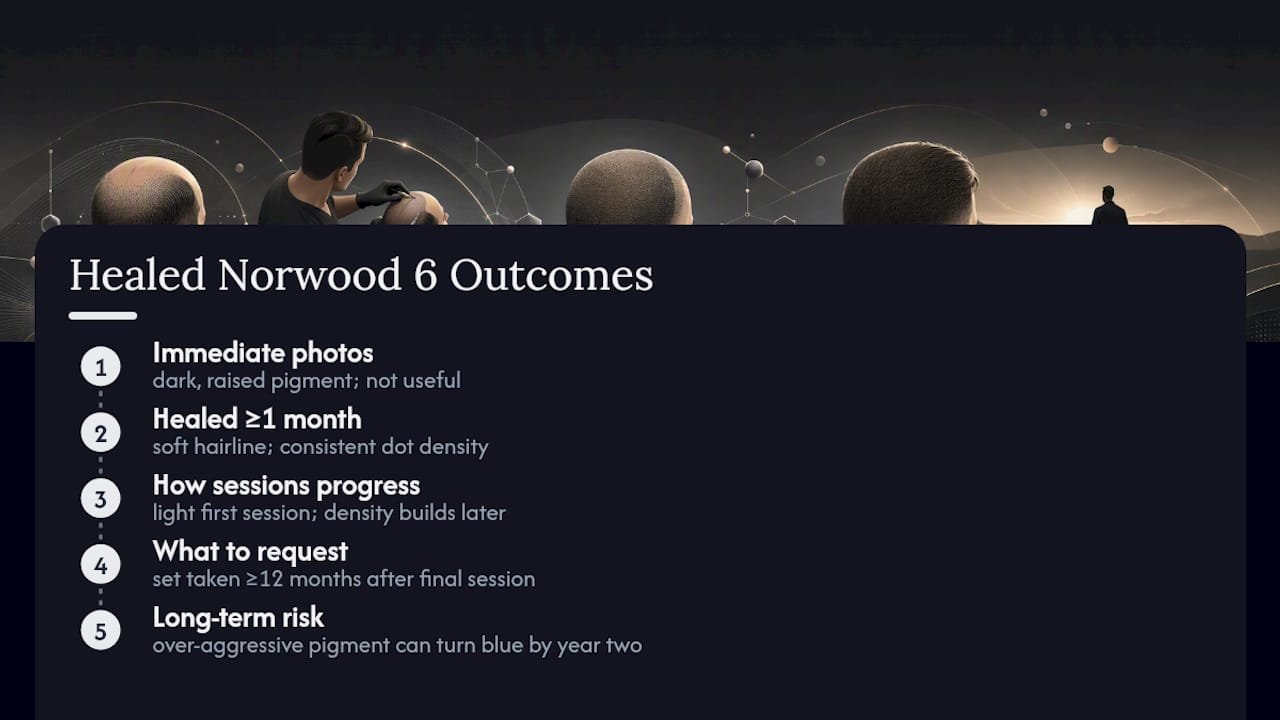
The most useful before-and-after comparisons for Norwood 6 aren’t the ones taken minutes after a session, when pigment sits dark and slightly raised from the skin. The photos that matter are healed shots, taken at least a month out, after swelling resolves and pigment settles into its final shade.
A good healed comparison typically shows three things clearly. First, the hairline sits close to the skin with soft, irregular density at the front edge rather than a hard, painted-on line. Second, the crown and vertex show consistent dot density with no visible patches or grid patterns. Third, the transition between pigmented scalp and any remaining fringe hair blends without a visible seam.
Case documentation from extensive hair loss work, including the sessions described in healed Norwood 7 results, tends to follow a similar arc: a lighter, more tentative first session, followed by density builds that fill in gaps identified once the scalp fully heals. That gradual approach is deliberate. Overcommitting to dark, heavy pigment in session one leaves no room to correct if the color reads darker than expected once healed.
When you’re evaluating a provider’s portfolio, look past the glossy same-day photos entirely. Ask specifically for a set taken 12 months or more after the final session. Pigment that was applied too aggressively often looks fine at 6 weeks and noticeably blue or gray by year two. A provider confident in their pigment selection and depth control will have no problem showing you that longer timeline, because it’s the timeline that proves the work actually holds up.
Why Color Matching Gets Harder at Norwood 6
Matching pigment tone across a Norwood 6 scalp is more complicated than it looks, mainly because of how much surface area needs to stay consistent. A small bald patch only needs pigment matched in one spot. A full Norwood 6 pattern spans the hairline, temples, crown, and vertex, areas that can have subtly different skin tones due to sun exposure, since the crown often sees more UV over the years than the sides.
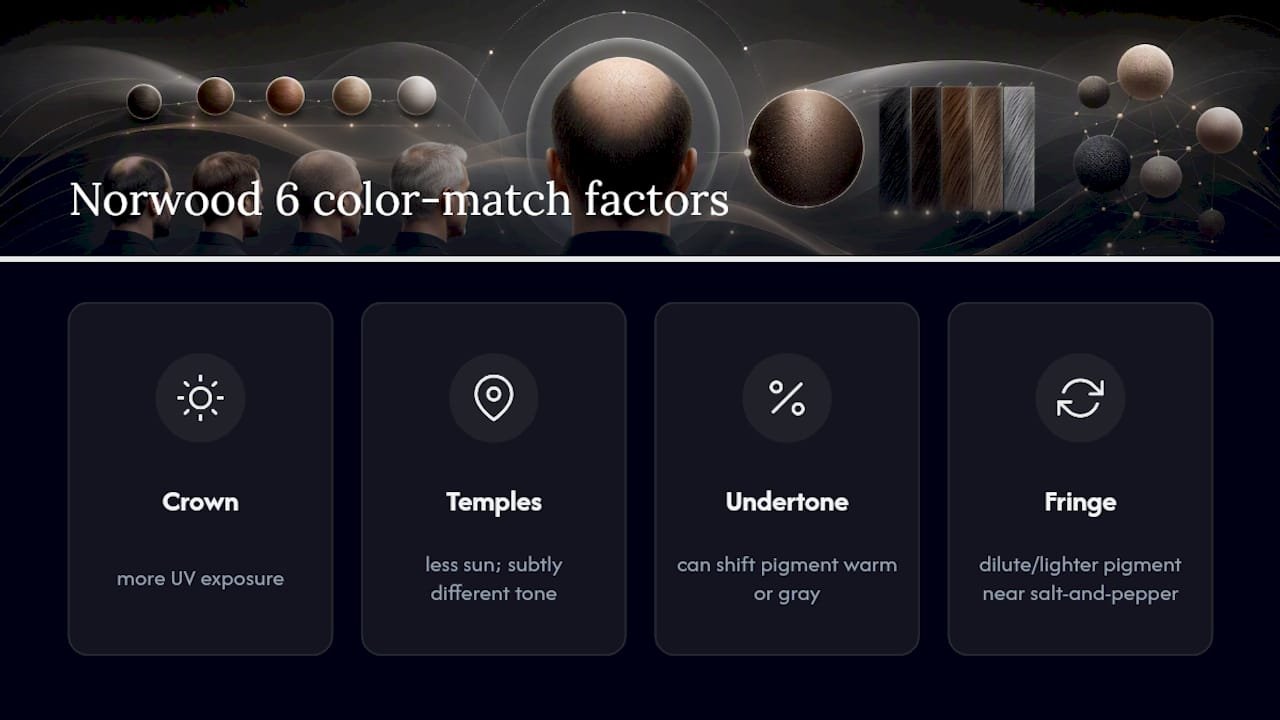
Undertone matters as much as base color. Pigment that looks correct against fair, cool-toned skin can shift warm or gray on a scalp with more olive or warm undertones, and vice versa. This is where practitioner skill separates convincing results from obviously artificial ones. A technician working with a limited pigment library, or one who eyeballs color matching without testing, is far more likely to produce a result that looks slightly off once healed.
Gray and lighter fringe hair adds another layer of difficulty. If your remaining horseshoe of hair has gone salt-and-pepper, pigment needs to be lighter and more diluted near that fringe to avoid a stark contrast between clearly artificial dark pigment and naturally lighter hair. Getting this transition wrong is one of the most common reasons men seek corrective SMP after a first treatment elsewhere.
Skin that tans easily or darkens seasonally also complicates long-term matching, since pigment doesn’t tan along with surrounding skin. A color that blends perfectly in winter can look slightly lighter than tanned summer skin, which is one more reason a skilled colorist accounts for your baseline skin tone rather than matching to how your skin looks on treatment day alone.
Does Your Skin Type Change SMP Results at Norwood 6?
Skin type affects nearly every part of an SMP outcome, from how pigment initially takes to how it ages over years. Oilier skin tends to hold pigment less precisely, and dots can soften or spread slightly faster than on drier skin, which is one reason technicians sometimes recommend an extra maintenance session sooner for naturally oily scalps.
Skin thickness plays a role too. Thinner, more sun-damaged skin, common on scalps that have been exposed and unprotected for years before treatment, holds pigment differently than thicker, less weathered skin. This is part of why practitioners doing extensive Norwood 6 work adjust needle depth and pigment volume based on how the scalp responds during the first session, rather than using identical settings on every client.
Scalp condition matters just as much as skin type. Active seborrheic dermatitis, psoriasis plaques, or any inflamed, flaking skin interferes with even pigment uptake and increases infection risk. Most reputable providers will delay treatment until a flare clears rather than working over compromised skin. Scar tissue from a prior failed transplant behaves differently still. Scarred skin often has reduced blood flow and altered texture, which is why a test spot on scar tissue before full treatment is standard practice rather than an optional extra.
Darker skin tones generally show excellent SMP results because pigment blends more seamlessly with the base tone, though the risk of visible hypopigmentation or hyperpigmentation at treatment sites is something a careful technician screens for during consultation.
Why We Push for Conservative, Long-Term SMP Design
The biggest mistake in Norwood 6 SMP isn’t a bad pigment match. It’s a hairline set too low or too dark too fast, decisions that look great on day one and age poorly. Conservative design and honest healed documentation exist because they protect the result a decade out, not just the photo taken at checkout.
Setting realistic expectations upfront, this creates a shaved-head aesthetic, not regrowth, cuts down dramatically on revision work later. Men who understand the limits going in tend to be the ones still happy with their results years later.
— James Christopher
How Enhanced Scalp Approaches Norwood 6 Treatment Plans
Some clinics offer conservative hairline design processes, multi-session density building, and document healed results rather than just fresh, swollen photos. The clinic also handles corrective work for men who received poor SMP elsewhere or are dealing with scarring from a prior failed transplant.
At an assessment, bring a photo of your preferred fringe length and any prior transplant or SMP documentation you have. Enhanced Scalp will walk you through a realistic session plan, a cost estimate that reflects your actual scalp area and skin condition, and examples of healed work so you know what to expect months out, not just on treatment day. Full Norwood 6 coverage through Enhanced Scalp’s scalp micropigmentation treatment is priced at $3,000 to $4,000 as a one-time cost, and men dealing with transplant scarring specifically can review the clinic’s scar camouflage treatment options during the same consultation. Book an assessment to get a plan built around your actual scalp, not a generic quote.
Sources
- Micropigmentation of the Scalp | ISHRS
- Clinical SMP series reporting session protocols and outcomes (PMC)
- Scalp micropigmentation (SMP): Benefits, costs, results | Medical News Today
This article is general information, not a substitute for advice from a qualified doctor. Consult a qualified healthcare professional about your own circumstances before acting on anything here.
FAQ
Is Norwood 6 Too Late for SMP?
No. SMP works especially well at Norwood 6 because the large, uniform bald area is ideal for replicating a shaved-head look, and the ISHRS specifically notes SMP’s value in advanced hair loss stages.
What Are the Disadvantages of SMP for Hair Loss?
SMP doesn’t regrow hair, requires strict aftercare in the first week, and pigment can fade or shift in tone over years, which means periodic touch-ups every 4 to 6 years are part of the long-term commitment.
Is SMP Better Than a Hair Transplant for Norwood 6?
For full Norwood 6 coverage, SMP is generally more practical than transplant surgery alone because donor hair supply usually can’t cover that much bald area convincingly; some men combine a small transplant with SMP when donor density allows it.
Is SMP a Good Solution for Baldness?
Yes, when the goal is a clean shaved or stubble aesthetic rather than restored hair; it’s a non-surgical option with no daily maintenance once healed, though it requires 2 to 4 sessions to complete properly.
How Much Does Norwood 6 SMP Cost?
Industry pricing typically runs $2,000 to $4,000 for full coverage; Enhanced Scalp prices its scalp micropigmentation treatment at $3,000 to $4,000 as a one-time cost.

