 Skip to content


Scalp micropigmentation (SMP) has very little downtime compared with surgery, but it is not zero. Expect redness and tightness for a day or two, some light flaking in the first week or so, and a short list of restrictions (no soaking, sweating or direct sun) while the scalp settles. Most people go back to desk work quickly. What changes is how you wash, train and spend time outdoors for a while. Because SMP is done in several sessions, you go through this window more than once.
Below, we break down what happens day by day, what to avoid, how the multi-session schedule affects your calendar, and which warning signs mean you should call a health provider.
TL;DR
- Immediate redness and swelling are common and temporary; one clinical source describes redness that appears on the day and disappears in 1 to 2 days.
- The real “downtime” is behavioural: keep the scalp dry, protected from sun and away from heavy sweating until your practitioner clears you.
- SMP is a multi-session procedure, so plan your calendar around each session’s healing window, not just one appointment.
- Worsening redness, pain or swelling means contacting a health provider within 24 hours.
- Downtime is mostly about protecting a skin wound from infection and pigment loss, so who does the work matters as much as how you heal.
Table of Contents
- What SMP downtime actually means
- The healing timeline, stage by stage
- Quick reference: what to expect and when
- What you should avoid while healing
- How multiple sessions change your downtime
- When downtime is a warning sign
- Why the provider changes your recovery
- Our perspective on recovery
- Planning your SMP around real life
- Book a consultation with Enhanced Scalp
- FAQ
- Sources
What SMP downtime actually means
People searching “SMP downtime” usually want to know one thing: can I be seen in public, go to work and live normally afterward? For most clients the answer is yes, with caveats.
There is no incision, no stitches and no donor area, which is why SMP is often compared favourably with hair transplant surgery. But the skin barrier is broken during treatment. Ontario’s public health guidance is clear that the infection risks of personal services such as tattooing and micropigmentation include blood-borne viruses as well as localized skin infections, and that aftercare matters most in the days right after the procedure.
So think of downtime in two parts:
- Visible recovery: redness, mild swelling, tightness, light scabbing or flaking.
- Protective recovery: the rules that keep the pigment where it belongs and the skin free of infection.
The first part is short. The second part is where most people go wrong, and it is the part you control.
The healing timeline, stage by stage
No two scalps heal identically. Skin type, how much pigment was placed, and how the area responds all vary, and your practitioner’s written instructions override any general timeline, including this one. What follows is the general pattern described in clinical literature.
The first 24 to 48 hours
Expect redness, a warm or tight feeling and possibly mild swelling. A clinical review of SMP for scalp deformities notes that redness on the day of the procedure typically fades within one to two days. A review of micropigmentation side effects puts the common, temporary effects of the first week at mild swelling, redness and localized discomfort.
This is also when the area is most vulnerable. Public health guidance for operators says the scalp should be kept dry to prevent infection and pigment loss, and that clients should avoid washing until their provider tells them to.
Days 3 to 7
The redness settles, and the skin may feel dry or itchy as it starts to flake. Tiny scabs or flakes can appear. Do not pick them. Picking is the classic way to pull pigment out and leave gaps that need correcting later.
This is the window where sweating and sun exposure do the most harm. Operator guidance stresses protecting the area from sun exposure and excessive sweating during the initial healing phase, because both can change how the pigment looks as it settles.
Weeks 2 to 4
Surface flaking finishes and the dots can look lighter or softer than they did right after the session. That is normal: the top layer of skin sheds. Pigment placed too superficially is exfoliated with the outer skin layer within about three to four weeks, which is one reason experienced practitioners aim for the correct depth and why a single session rarely gives the final result.
This is also when delayed reactions, though uncommon, can show up. The same micropigmentation review notes that delayed hypersensitivity reactions, including foreign body granulomas, may appear two to four weeks after the procedure. A new lump, persistent itching or a raised area at that stage is a reason to have a doctor look at it.
One to three months
The skin is fully healed and the pigment has settled. This is when you can judge colour and density honestly, and when your practitioner will decide whether another session or a touch-up is needed.
Quick reference: what to expect and when
| Stage | What you may notice | What to do |
|---|---|---|
| Day 0 to 2 | Redness, warmth, tightness, mild swelling | Keep the scalp dry; follow your written aftercare |
| Day 3 to 7 | Fading redness, dryness, light flaking | Do not pick; avoid sweat and direct sun |
| Weeks 2 to 4 | Lighter-looking pigment, finished flaking | Wait for the next session or review; report lumps or persistent irritation |
| Months 1 to 3 | Settled, final-looking colour | Assess the result with your practitioner |
What you should avoid while healing
Exact timings differ between clinics, so ask for them in writing. Ontario public health guidance expects operators to give both verbal and written aftercare instructions, and a reputable clinic will. In general, the restrictions cover:
- Washing: not until your provider says so, then gently, as instructed.
- Sweating: skip intense workouts, hot yoga and saunas until cleared.
- Sun: keep the scalp covered or shaded; do not sunbathe or use tanning beds.
- Soaking: no pools, hot tubs or long baths.
- Touching: no scratching, picking or peeling flakes.
- Products: nothing on the scalp that your practitioner has not approved.
Once you are cleared, ask what a normal routine looks like. Habits like scalp exfoliation and its benefits are best resumed only on your practitioner’s say-so, because aggressive scrubbing too early can lift pigment.
Canadian specifics: winter and summer
In Ontario, the calendar matters. A summer session means more sweat and stronger sun, so you will need a hat or shade plan and fewer outdoor workouts. A winter session lets you cover up easily, but a tight wool toque that rubs the scalp is not ideal. Choose something soft and breathable, and ask your practitioner what is acceptable. Booking around a vacation, a wedding or a sports season saves you from awkward trade-offs.
How multiple sessions change your downtime
SMP is not a one-visit fix. A study on standardizing the procedure explains that multiple sessions are standard to reach the intended density, since some pigment fades and touch-ups are needed over time. The number depends on your scalp, how much hair loss you have and how your skin accepts pigment. Another clinicopathologic review adds that two sessions are often only a starting point, and that complex cases, such as scarring from failed transplants, call for a more conservative, staged approach to avoid blurring.
That has practical consequences:
- Each session restarts a short healing window. Expect the same pattern of redness, flaking and restrictions each time, usually milder as the work becomes lighter.
- Your result looks unfinished between sessions. That is by design. Do not judge the density after session one.
- Spacing is not a delay, it is quality control. Spaced sessions let the practitioner see how your skin heals and how much pigment it holds before adding more.
- Scarred skin is the exception. Skin from previous surgery resists differently, so a test spot is a sensible first step. We cover this in our article on SMP on scar tissue after a transplant.
For a walk-through of what each visit involves, see what to expect from the SMP process, session by session, and for how many visits different cases tend to need, read our guide to how Norwood stage, scars and skin decide the number of sessions.
When downtime is a warning sign
Most redness and flaking is just healing. Some symptoms are not. Ontario public health guidance tells clients to contact a health provider within 24 hours if redness, pain or swelling gets worse rather than better.
See a doctor or walk-in clinic promptly if you notice:
- Redness that spreads or intensifies after the first couple of days.
- Increasing pain, heat or swelling.
- Pus or fluid from the treated area.
- Fever or feeling unwell.
- Intense itching, hives or swelling soon after the session, which can signal an allergic reaction to pigment. These can occur within the first week.
Tell your practitioner too, but do not wait for a callback if symptoms are getting worse. Your family doctor or a nearby urgent care is the right first stop for suspected infection, and your local public health unit handles complaints about hygiene at a personal service setting.
Why the provider changes your recovery
Downtime is not only a question of how well you follow instructions. It also depends on who is holding the machine. A 2025 study in the International Journal of Dermatology on patients seeking correction found that 89.2% of 120 patients had been treated in non-clinical settings such as beauty salons, and it links unsatisfactory outcomes to lack of operator expertise.
Technique affects healing directly. Pigment deposited too shallow washes out within weeks, and pigment deposited too deep can spread into blotchy or enlarged dots, as the standardization study describes. Heavy-handed work also means more trauma, more inflammation and a longer recovery.
Before booking anywhere, ask:
- Do you give written aftercare instructions?
- How are needles and equipment handled? (Toronto’s public health unit publishes infection prevention and control rules for micropigmentation that operators in the city are expected to meet.)
- Can I see healed photos, not just fresh ones?
- What happens if I need a correction?
On that last point, healed photos are the only ones that tell you how the work looks after the skin has settled. Our guide on how to spot AI-edited SMP results explains why you should ask for them.
Our perspective on recovery
We approach downtime as part of the design of the treatment, not an afterthought. A conservative hairline, realistic follicle replication and properly chosen pigment all aim at the same thing: a healed result that looks natural months and years later, not just on the day you walk out.
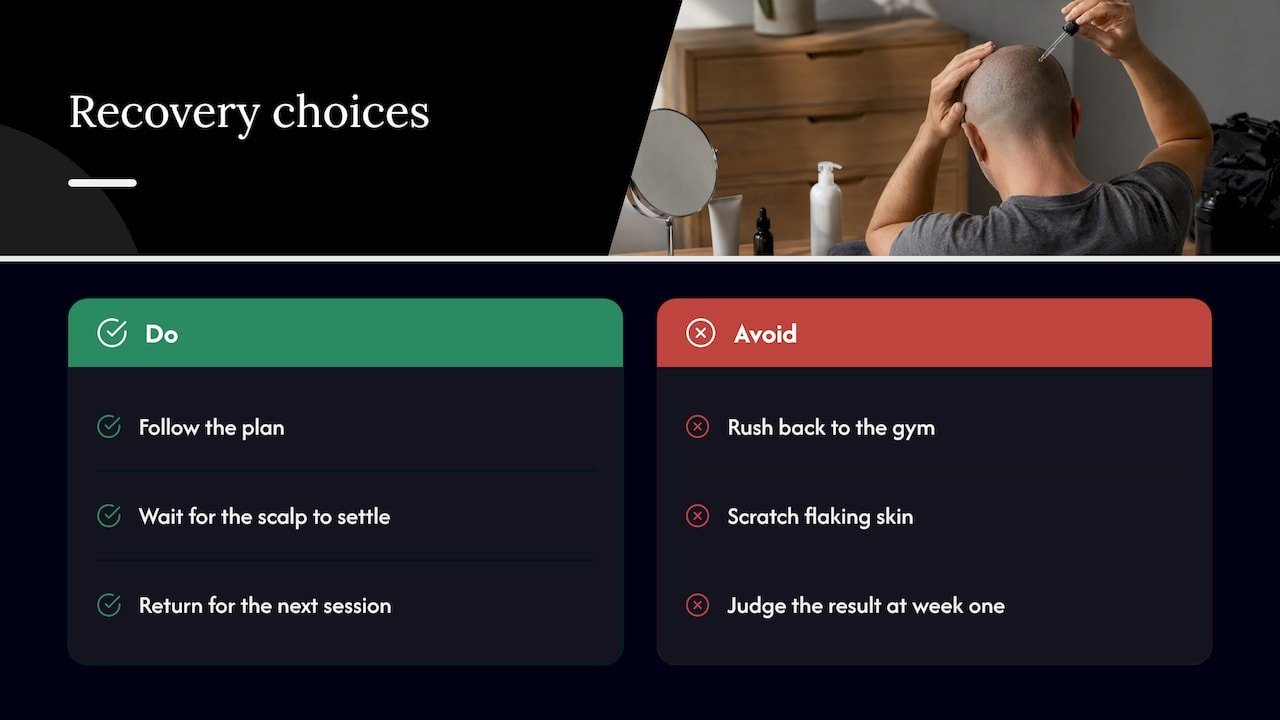
In practice, we tell clients that the first days are not what decides the outcome. Calm, patient healing is. Clients who rush back to the gym, scratch at flaking skin or judge the result at week one tend to be the ones who worry most. Clients who follow the plan, wait for the scalp to settle and come back for the next session usually see exactly what we planned.
We also see many clients arriving after a failed transplant or a poor previous SMP job. In those cases, healing can behave differently, because scarred skin takes pigment unpredictably. That is why we favour a staged, conservative approach and documentation of healed work over speed.
— James Christopher
Planning your SMP around real life
A few practical tips to reduce the impact on your schedule:
- Book the first session before a quiet stretch, not before a big presentation, a wedding or a trip.
- Plan your workouts. Pick low-sweat activity for the first week, or arrange a break from the gym.
- Organize head coverage. Have a clean, loose, breathable hat or a plan for shade ready, and ask your practitioner what is acceptable.
- Travelling in for treatment? If you are coming from outside the GTA, allow a day or two nearby before a long flight or drive, and confirm your practitioner’s instructions for travel.
- Keep the follow-up dates. Skipping a scheduled session leaves an unfinished result that looks patchy.
Long-term, plan for touch-ups too. Pigment fades with time, and our guide to SMP touch-up timing explains when minor and full refreshes usually make sense.
Book a consultation with Enhanced Scalp
If you are weighing SMP and want a straight answer on what recovery would look like for your scalp, we are happy to walk you through it. Enhanced Scalp is based in Vaughan, Ontario, and serves Toronto, the GTA, the rest of Canada, the United States and international clients. Scalp micropigmentation is priced at 3000-4000 CAD for the treatment, and you can see the details on our scalp micropigmentation treatment page. We also offer female scalp micropigmentation and scar camouflage, including for hair transplant scars.
FAQ
How long is the downtime after SMP?
The visible part, redness and mild swelling, usually settles within a few days. The protective part, keeping the scalp dry, out of the sun and away from heavy sweat, lasts longer and varies by clinic, so follow your practitioner’s written instructions. Because SMP takes several sessions, you repeat a short recovery window each time.
Can I go to work after scalp micropigmentation?
Most people can, since there is no surgery or stitching. Redness may be noticeable for a day or two, and flaking can appear in the first week. If your job involves heavy sweating, dust or direct sun, ask your practitioner how long to hold off.
Can I exercise after SMP?
Not right away. Sweat and friction during the initial healing phase can affect pigment and increase the risk of irritation, so public health guidance advises protecting the area from excessive sweating. Your practitioner will tell you when you can return to full workouts.
Does SMP fade, and does that mean more downtime later?
Yes, SMP fades gradually, and touch-ups are part of keeping it looking sharp, as the clinical literature notes. Touch-up sessions are usually lighter, so recovery tends to be brief, but follow the same aftercare rules each time.
What if my scalp looks worse before it looks better?
Some redness, flaking and a patchy or lighter look during the first weeks is part of normal healing. Worsening pain, spreading redness or swelling is not, and should be checked by a health provider within 24 hours.
Sources
- Micropigmentation review, PMC (2023)
- Standardization of SMP Procedure and Its Impact On Outcome, PMC
- Scalp Micropigmentation: A Clinicopathologic Correlation, PMC
- Scalp Micropigmentation: A Concealer for Hair and Scalp Deformities, PMC
- Guidance for Operators: Tattooing and Micropigmentation, public health fact sheet
- Personal Services and Infection Risks, Public Health Ontario
- Revision for unsatisfactory outcomes of scalp micropigmentation, International Journal of Dermatology (2025)
- Micropigmentation: Infection Prevention and Control, City of Toronto

