Skip to content

For most people who want to hide a hair transplant scar, scalp micropigmentation is the most effective non-surgical camouflage available, especially if you plan to keep your hair buzzed or shaved short. It works better on some scars than others, and timing matters more than most people realize before booking a session.
The caveats are real. Recent transplants usually need to heal for close to a year before pigment goes anywhere near the scar. Wide, stretched, or raised scars sometimes need laser treatment, steroid injections, or surgical revision first. And not every technician who advertises SMP has actually worked on scar tissue, which behaves nothing like healthy skin once a needle touches it.
Here’s the practical path forward:
- Book a consultation with a practitioner who specializes in scar work, not just general SMP.
- Ask for healed-result photos of scars similar to yours, not just fresh hairline work.
- Request a test spot on the scar itself before committing to a full session plan.
- If your scar is hypertrophic, keloid-prone, or still red and raised, get a physician evaluation first.
Enhanced Scalp treats scar camouflage as its own specialty rather than an add-on to standard SMP, which is the kind of distinction worth asking about at any clinic you’re considering.
Key Takeaways
Scalp micropigmentation camouflages most hair transplant scars effectively, but the outcome depends heavily on scar subtype, timing, and whether the practitioner tests pigment retention on the scar before committing to full treatment.
| Point | Details |
|---|---|
| SMP works best on FUE dot scars | Scattered dot scars blend most naturally into surrounding pigment patterns. |
| Wait roughly 11 to 12 months | The ISHRS recommends this window so grafts mature and scars finish remodeling before pigment work. |
| Test spots are non-negotiable | A small test area on the scar shows how that tissue retains pigment before full treatment begins. |
| Some scars need pre-treatment | Hypertrophic scars, keloid tendency, or over-harvested areas often need laser, steroids, or revision first. |
| Enhanced Scalp treats scars as a specialty | Its scar camouflage service documents healed results separately from standard density or hairline work. |
Table of Contents
- How Scalp Micropigmentation Conceals Hair Transplant Scars
- Which Scar Types Camouflage Best With SMP?
- When Should You Wait Before Getting SMP?
- What Happens During Treatment and Healing?
- What Are the Risks and Red Flags to Watch For?
- How Do You Choose a Provider for Scar Camouflage?
- What Does a Scar-Focused SMP Clinic Actually Offer?
- Where to Verify This Guidance
- Why the Standard Advice on Scar Camouflage Falls Short
- Where to Start If You’re Ready for Scar Camouflage
- Sources
- FAQ
How Scalp Micropigmentation Conceals Hair Transplant Scars
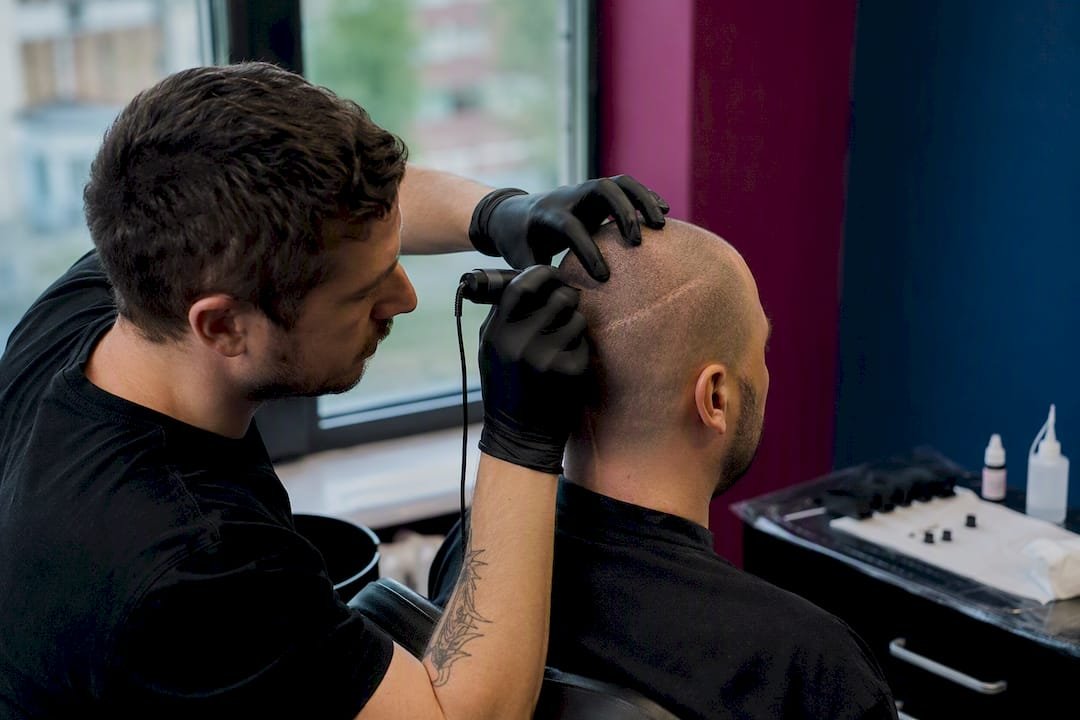
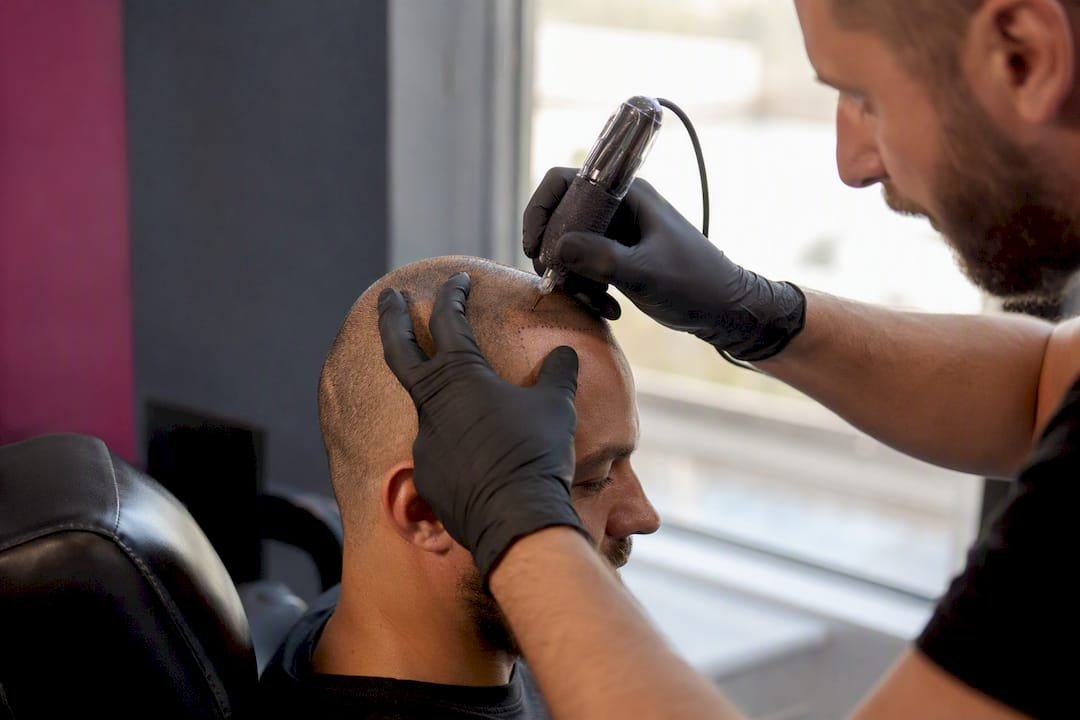
SMP works by depositing medical grade pigment into the upper layers of the skin, creating thousands of tiny dots that mimic the look of closely shaved hair follicles. It’s a visual trick, not a biological one. The pigment sits shallower than an actual hair follicle would, which is exactly why technique matters so much when scar tissue is involved.
Normal skin takes pigment predictably because it has consistent blood flow and an intact layer structure. Scar tissue does not. It’s fibrous, often has reduced blood supply, and can absorb pigment unevenly, causing it to spread slightly under the skin, fade faster than surrounding pigment, or shift toward a blue or gray tone over time. This is why a practitioner who treats normal scalp skin the same way they treat a scar is asking for trouble.
Scar-experienced technicians handle this by layering pigment conservatively across multiple passes rather than trying to achieve full density in one sitting, and by running a small test spot directly on the scar before committing to the whole area.
- Pigment goes shallow, not follicle-deep, so it reads as stubble rather than actual hair.
- Scar tissue can hold pigment unpredictably, which is why single-pass, heavy-handed work is risky.
- A test spot on the scar itself tells you how that specific tissue will respond before the practitioner commits to the full treatment.
Pro Tip: Ask your practitioner to show you healed test-spot results on scar tissue specifically, not just their general hairline portfolio. Scar retention and normal-skin retention are genuinely different skills.
Which Scar Types Camouflage Best With SMP?
Not all transplant scars respond the same way, and the scar-type treatment matrix used by clinics like Charles Medical Group maps out realistic expectations by subtype rather than promising uniform results.
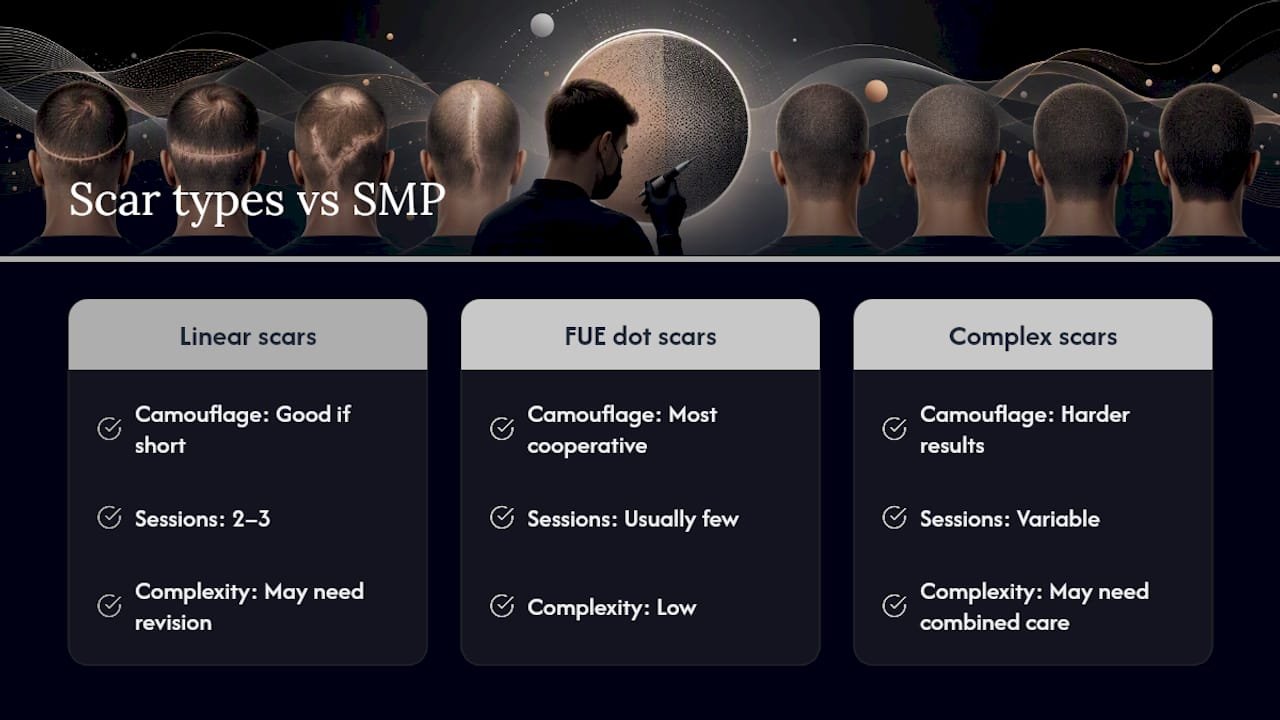
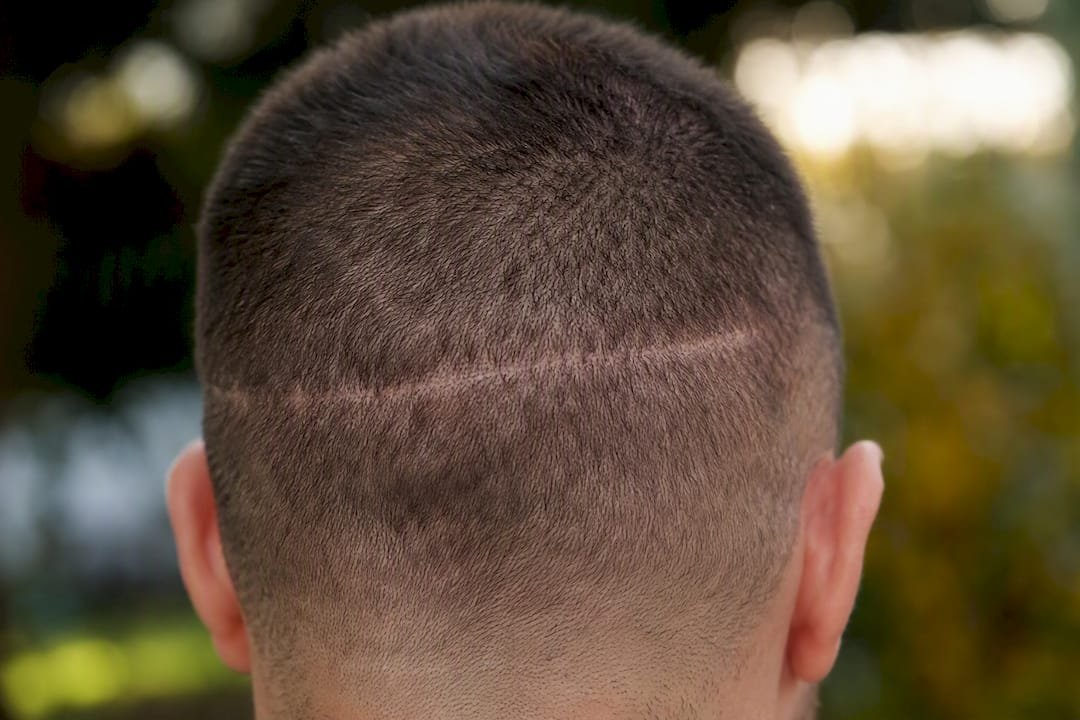
FUT linear scars, the thin line left behind from strip harvesting, generally camouflage well when hair is kept short, often needing two to three sessions for solid coverage. Wider or stretched linear scars, the kind that happen when a scalp was under tension during closure, sometimes need surgical revision or a small grafting procedure before pigment work begins.
FUE dot scars tend to be the most cooperative candidates for SMP. Because each scar is small and scattered rather than one continuous line, pigment blends into the surrounding pattern more naturally, and short buzzed styles usually show excellent concealment.
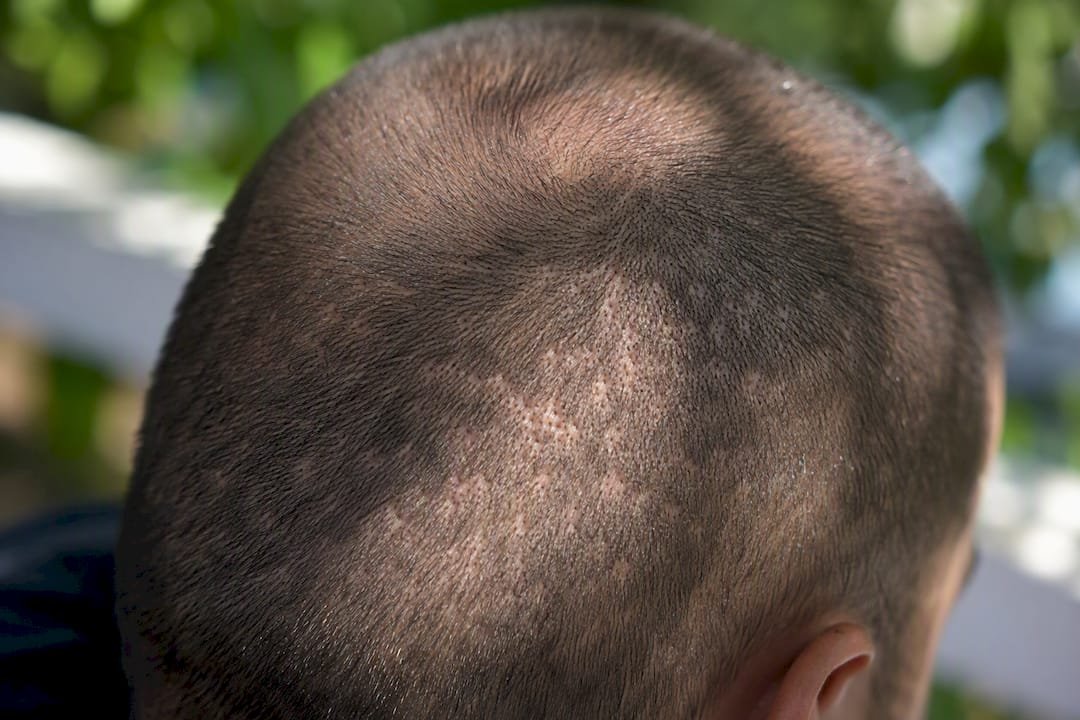
Hypertrophic and atrophic scars are harder. Raised, hypertrophic tissue can reject pigment unevenly, while sunken, atrophic tissue may show shadowing even after treatment. Over-harvested donor areas, where too much hair was removed relative to the surrounding density, often need a combined approach: SMP plus careful styling guidance, sometimes alongside a density-focused hair restoration technique in the donor zone itself.
None of these are absolutes. A consultation and, where appropriate, a physician evaluation should set your specific range before you commit to a session count.
When Should You Wait Before Getting SMP?
Timing is the part people most often get wrong, usually because they want results faster than the healing process allows.
The International Society of Hair Restoration Surgery advises waiting roughly 11 to 12 months after a hair transplant before pursuing SMP on or near the scar. That window lets transplanted grafts fully mature and lets the scar itself finish remodeling. Pigment placed too early risks fading unevenly or settling into tissue that’s still changing shape and color.
If your scar needs help beyond what SMP alone can camouflage, a few adjuncts typically come first:
- Laser treatment can soften raised or discolored scar tissue before pigment work begins.
- Microneedling sometimes improves texture and can make a scar more receptive to even pigment retention.
- Intralesional steroid injections treat hypertrophic or keloid-tendency scars that are still actively raised or thickened.
- Surgical revision or grafting addresses scars that are too wide, too visible, or too textured for pigment alone to solve.
Each of these needs its own healing window, often several months, before SMP should start. A rushed sequence undermines the whole plan, which is why a physician-coordinated timeline matters more here than in standard SMP work.
What Happens During Treatment and Healing?
Most scar camouflage plans run two to three sessions, spaced a few weeks apart, with each session lasting two to four hours depending on scar size and density needed. Topical anesthesia keeps discomfort manageable. Scar tissue can feel slightly different under the needle than regular skin, sometimes numbing less evenly, which is another reason experienced practitioners work slowly here.
Fresh pigment always looks darker and more saturated than the final result. It softens over two to four weeks as the skin heals, so judging results immediately after a session is a mistake almost every first-time client makes. Give it the full healing window before deciding whether a touch-up session is needed.
Aftercare in the days following treatment determines a lot of the final outcome:
- Keep the area out of direct sun for at least a week, and use SPF long after that.
- Avoid soaking the scalp in pools, hot tubs, or long showers while pigment is settling.
- Watch for excessive redness, swelling, or discharge, which can signal infection and needs prompt medical attention.
- Expect a touch-up every few years as pigment naturally softens over time, more frequently on scar tissue than on regular skin.
What Are the Risks and Red Flags to Watch For?
Scar tissue is the most unpredictable canvas in SMP work. The ISHRS notes that pigment placed in scar tissue can spread, fade unevenly, or shift toward unwanted color tones more often than pigment placed in healthy skin, which means touch-ups tend to happen sooner and more often on scarred areas.
There are medical contraindications worth flagging before treatment, too. A history of keloid formation, active inflammation, or a scar that’s still changing shape all warrant a physician evaluation before any pigment goes near the area.
A handful of red flags should end a consultation immediately:
- No healed-result photos of prior scar work, only fresh or staged photos.
- Pressure to skip the test spot and move straight to full treatment.
- Vague “lifetime guarantee” language with no explanation of what triggers a free touch-up.
- Pricing dramatically below the market range for scar-specific work, often a sign of inexperience with scar tissue specifically.
Scar camouflage rewards patience and a practitioner who treats the test spot as mandatory, not optional.
How Do You Choose a Provider for Scar Camouflage?
The consultation is where you separate a general SMP technician from someone who actually knows scar tissue. A few direct questions tell you almost everything you need to know within the first ten minutes.
- Ask to see healed photos of scars similar to yours, not just hairline density work. FUT linear results look different from FUE dot results, and you want to see your specific scar type.
- Ask whether they perform a test spot on the scar itself before committing to full treatment, and how long they wait to evaluate retention.
- Ask if a physician evaluates complex cases, particularly raised, keloid-prone, or still-changing scars, and whether they coordinate with dermatologists or plastic surgeons when needed.
- Confirm pigment brand and color-matching method, since scar tissue often needs a slightly different tone than surrounding skin to avoid a visible halo effect.
- Get a clear session estimate and total pricing, including what future touch-ups cost, before booking.
Pro Tip: If a clinic can’t show you a single healed photo of scar-specific work after 60 to 90 days, that’s a bigger warning sign than price ever is.
What Does a Scar-Focused SMP Clinic Actually Offer?
Enhanced Scalp treats scar camouflage as a distinct service line rather than a footnote to standard SMP, which shows up in how the clinic documents its work.
- A dedicated scar camouflage page outlining protocols separate from general hairline or density SMP.
- A healed-results gallery showing outcomes weeks and months after treatment, not just fresh sessions.
- Conservative pigment selection and technique standards built around natural, realistic outcomes rather than maximum darkness.
Quality documentation in any clinic looks like this: real healed photos at realistic time intervals, honest session-count ranges instead of one-size-fits-all promises, and a willingness to loop in a physician when a scar calls for it.
Where to Verify This Guidance
For deeper reading, the ISHRS overview of scalp micropigmentation and the Charles Medical Group scar treatment matrix cover clinical timing and scar-specific protocols in detail.
Why the Standard Advice on Scar Camouflage Falls Short
Most articles on this topic treat scar camouflage as a simple extension of regular SMP, same technique, same timeline, same session count. That framing sets people up for disappointment. Scar tissue doesn’t take pigment the way healthy skin does, and pretending otherwise is how clients end up with uneven fading eighteen months later and no idea why.
What the research actually supports is narrower and more useful: outcomes vary by scar subtype, timing before treatment matters more than most patients assume, and a test spot isn’t a formality, it’s diagnostic information you can’t get any other way. The conventional advice skips straight to “get SMP” without addressing whether the scar is even ready for it.
If you take one thing from this guide, prioritize the test spot and the healed photo request over price or convenience. A clinic that resists either of those isn’t ready for scar work, no matter how confident the sales pitch sounds.
Where to Start If You’re Ready for Scar Camouflage
If you’ve been hiding a transplant scar under longer hair or awkward styling for years, SMP gives you a way to buzz down without worrying about the line showing through. Enhanced Scalp built its scar camouflage service around the exact caveats covered above: conservative test spots, honest session estimates, and physician coordination for scars that need it before pigment goes anywhere near them.
What separates this approach from a generic SMP add-on is specificity. The clinic documents healed scar results separately from standard hairline work, so you’re evaluating actual scar outcomes, not borrowed density photos. If your scar is FUT linear, FUE dot, or something more complicated like an over-harvested donor area, that distinction matters when you’re choosing who touches it.
The next step is simple: request a consultation for scar camouflage and ask to see healed results for a scar type similar to yours before you commit to a session plan.
Sources
- Scalp Micropigmentation (SMP): All You Need to Know – ISHRS
- Scalp Micropigmentation for Hair Transplant Scar Camouflage – Charles Medical Group
FAQ
How can I hide my hair transplant scar?
Scalp micropigmentation is the most common non-surgical option, working best on FUE dot scars and shorter FUT linear scars, though some wider or raised scars need laser treatment or revision first.
How much does scar camouflage cost?
Pricing varies by scar size, subtype, and number of sessions needed, and most clinics quote it separately from standard SMP because of the extra time and technique scar tissue requires. Ask for a full quote including future touch-up costs during your consultation.
What did Elon Musk use to regrow his hair?
Public reporting has linked his changed appearance to hair transplant surgery rather than a single product, and there’s no verified detail confirming any specific camouflage or regrowth treatment he used.
How much does SMP scar camouflage cost?
Cost depends on scar length, subtype, and session count, with wider or more complex scars typically requiring more sessions and higher total investment than a simple dot-scar touch-up. A clinic experienced in scar work, like Enhanced Scalp, can give you a session-based estimate after seeing the scar directly.
How long after a hair transplant can I get SMP on the scar?
The ISHRS recommends waiting about 11 to 12 months so the graft and scar tissue fully mature before pigment placement. Getting SMP earlier risks uneven fading and pigment placement issues.