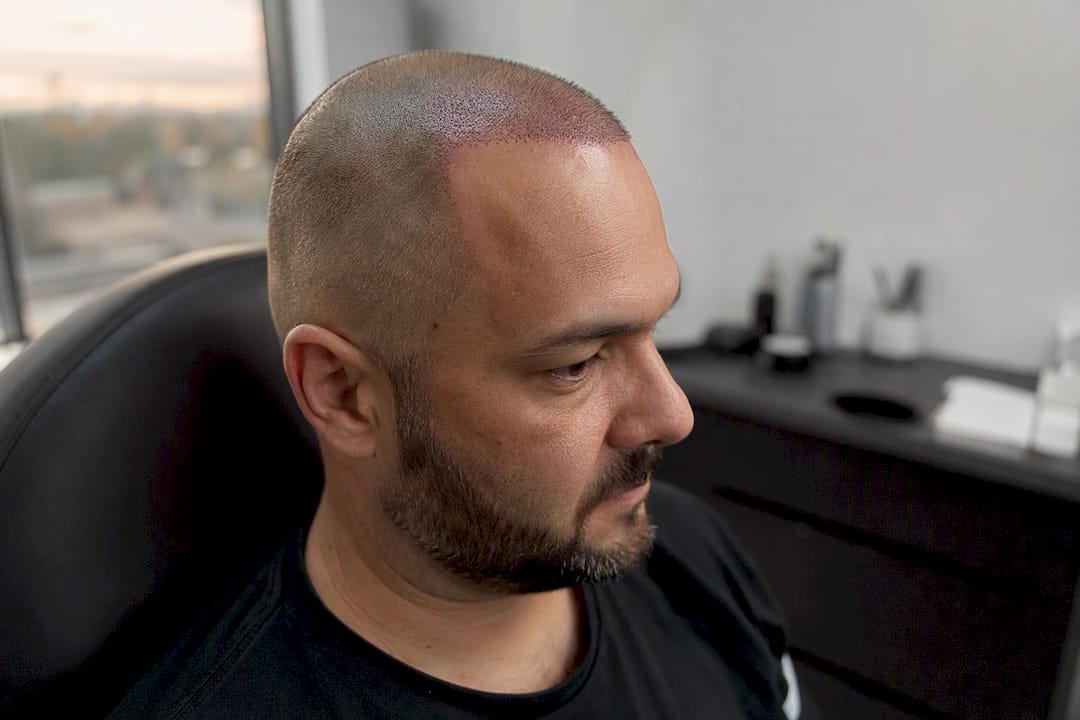
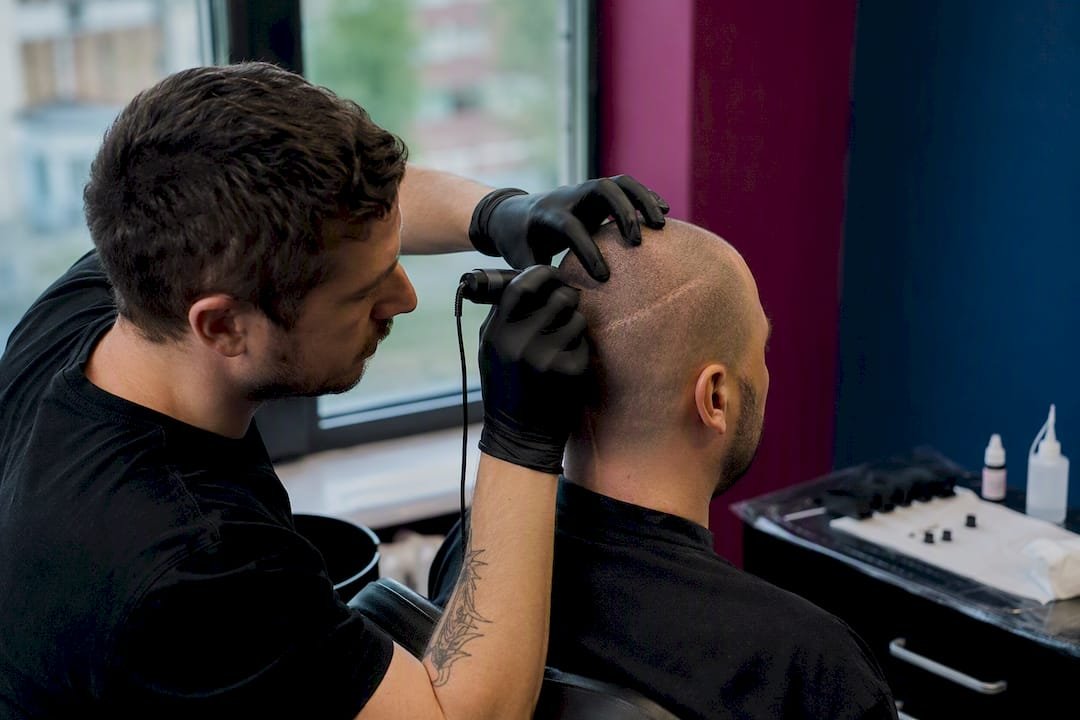
Skip to content

Most SMP side effects are mild and temporary: redness, tenderness, and light swelling that fade within a few days. A smaller set of complications, including pigment migration, color shift, granulomas, and scarring, can persist for months or years and usually trace back to technique, pigment choice, or a scalp condition the practitioner missed.
In the first 48 to 72 hours, expect:
- Redness and tenderness across the treated area
- Mild to moderate swelling, especially near the hairline
- Pinpoint scabbing as the skin seals over the pigment
Contact your provider immediately if you notice spreading warmth, pus, fever, or a rash that worsens instead of fading. Those signs point to infection or an allergic reaction, not normal healing, and both the Cleveland Clinic and Medical News Today flag them as reasons to seek care rather than wait it out.
Key Takeaways
Most SMP side effects resolve within weeks, but pigment permanence means technique, pigment choice, and practitioner screening determine whether rare complications become long-term problems.
| Point | Details |
|---|---|
| Short-term effects are normal | Redness, tenderness, and swelling typically resolve within 48 to 72 hours, with crusting clearing over one to two weeks. |
| Scarred skin fades differently | Pigment diffusion reached 55.6% by six months in scarring alopecia cases studied by JCAS, faster than on unscarred scalp. |
| Immunologic reactions outrank infection | Granulomas and delayed hypersensitivity appear more often in adverse-event data than straightforward infections. |
| Pigment choice prevents color shift | Carbon-based medical pigments resist the blue or green drift associated with older, iron-based tattoo inks. |
| Screening reduces risk most | Patch testing, sterile technique, and a documented healed portfolio are the strongest predictors of a clean result. |
This article is general information, not a substitute for advice from a qualified doctor. Consult a qualified healthcare professional about your own circumstances before acting on anything here.
Table of Contents
- Common Short-Term SMP Side Effects and How Long They Last
- Long-Term Complications: Fading, Color Shift, and Granulomas
- Who Should Think Twice Before Booking SMP
- Reducing Your Risk: Vetting a Clinic and Getting Aftercare Right
- Fixing a Bad Result: Correction and Removal Realities
- What the Research Actually Shows About SMP Risk
- An Editorial Take on Managing SMP Risk
- Sources
- FAQ
Common Short-Term SMP Side Effects and How Long They Last
Redness and tenderness show up almost immediately after each session and typically calm down within 48 to 72 hours. Think of it the way you’d think about a deep exfoliation: the skin is irritated, not injured, and it settles on its own timeline as long as you leave it alone.
Swelling and bruising follow a similar arc but last a bit longer. In a prospective study on scalp micropigmentation for scarring alopecia published in the Journal of Cosmetic and Aesthetic Surgery, 66.7% of patients had edema at the one-week mark, and it resolved for most of them by the one-month follow-up.
Pro Tip: Sleep with your head slightly elevated for the first two nights. It cuts down on overnight fluid pooling and noticeably reduces morning puffiness around the hairline.
Crusting and light scabbing are next. Don’t pick at it. Picking pulls pigment out unevenly and can leave patchy spots that need a touch-up later.
A simple recovery sequence for the first two weeks:
- Keep the scalp completely dry for the first three to four days, no showers directly on the area, no sweating.
- Avoid direct sun exposure and skip hats that rub against the scalp.
- Resume normal washing gently after day four, patting rather than scrubbing.
- Hold off on heavy exercise, saunas, and swimming until your practitioner clears you, typically around day 10 to 14.
Long-Term Complications: Fading, Color Shift, and Granulomas
Every SMP treatment fades over time, and in the JCAS scarring-alopecia study, all patients showed measurable fading by the one-month mark. That’s expected pigment settling, not a failure of the procedure. What matters more for long-term appearance is how much the pigment spreads or shifts color, and that’s where technique and pigment choice separate a good result from a problem one.
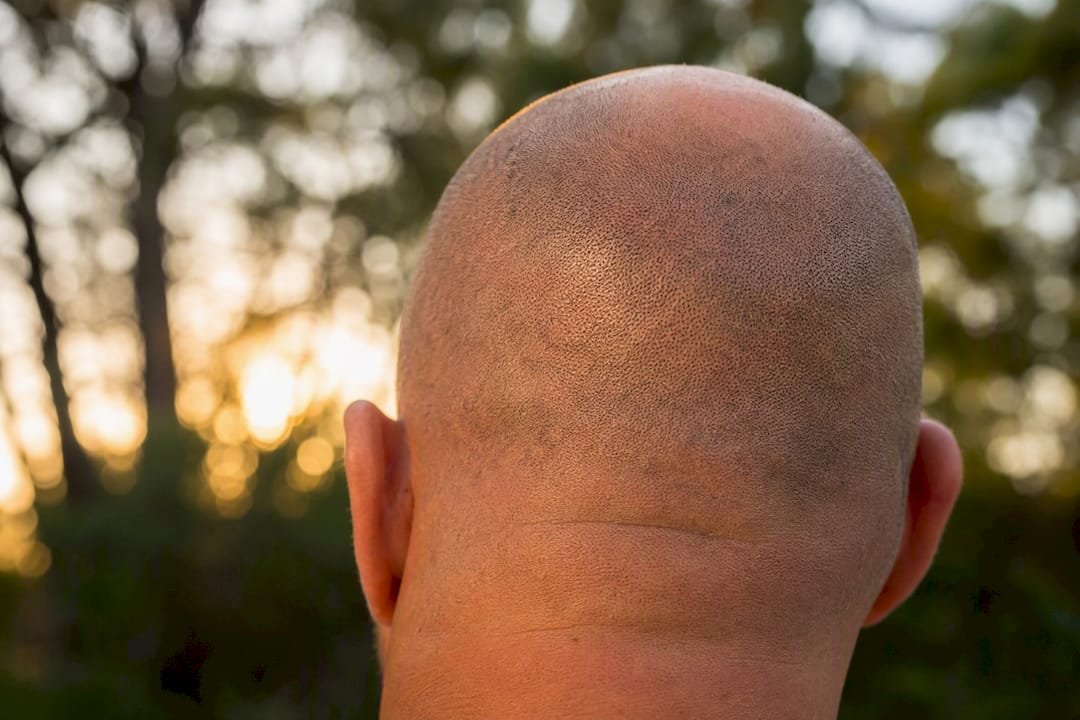
Pigment diffusion, the technical term for dots blurring into soft, blob-like shapes, is the complication most people notice first. Scar tissue holds pigment less predictably than healthy skin, so touch-ups tend to come sooner for scar camouflage work than for standard density treatments.
Color shift toward blue or green is a separate issue, and it’s almost always about pigment chemistry, not the individual’s skin. Older tattoo inks containing iron oxide oxidize under the skin and drift cool over years. Medical-grade, carbon-based pigments used in scalp micropigmentation don’t carry that same iron content, which is why practitioners who specialize in SMP avoid generic tattoo ink entirely.
- Foreign body granulomas: small, firm bumps that form around pigment particles the immune system treats as invaders.
- Delayed hypersensitivity: itching, swelling, or a papular rash that appears weeks after treatment, not days.
- Poor retention on fibrotic scar tissue, requiring earlier touch-ups than on unscarred skin
Granulomas and delayed hypersensitivity reactions are treated with intralesional corticosteroid injections in most cases, sometimes followed by laser removal if the reaction doesn’t resolve. Adverse-event data reviewed by AestheticMedGuide suggests immunologic reactions like these actually appear more often in reporting than straightforward infections, which is a strong argument for patch testing before a full session.
Who Should Think Twice Before Booking SMP
Some conditions rule SMP out entirely, at least for now. Active scalp infections, open wounds, a flaring scarring alopecia, and pregnancy all fall into that category, and a responsible practitioner will decline or postpone treatment rather than work around them. Keloid-prone skin is another common exclusion, since the trauma of repeated needle passes can trigger raised, thickened scarring in people predisposed to it.
Other situations call for caution rather than an outright no:
- Blood thinners, which raise the risk of excessive bruising and pinpoint bleeding during treatment
- Hair loss that’s still actively progressing, since the pigment pattern may need redesigning later
- Very fair or red natural hair color, where matching pigment tone precisely is harder
For scarring alopecias specifically, both the JCAS research and ISHRS guidance recommend waiting for two to three years of documented disease inactivity before treating the area. Scarring alopecias can reactivate, and pigmenting active disease risks locking in an uneven, hard-to-correct result.
Pro Tip: If you have any autoimmune or dermatologic condition affecting the scalp, get dermatology clearance in writing before booking. It protects you and gives your SMP practitioner the information they need to plan around it.
Reducing Your Risk: Vetting a Clinic and Getting Aftercare Right
The single biggest lever you control is who does the work. Medical News Today points directly at unlicensed or undertrained practitioners as a leading driver of SMP complications, which means your vetting process matters as much as the treatment itself.
- Ask to see a healed portfolio, not just fresh work. Pigment settles differently at six months than it looks at six days.
- Confirm sterile technique in writing: single-use needles, documented sanitation protocols, and disposable ink caps.
- Ask what pigment they use. Carbon-based medical SMP pigment is the safer, more color-stable choice over multi-purpose tattoo ink.
- Request a patch test, especially if you have any history of skin sensitivity, and expect to wait three to seven days to observe the reaction before committing to a full session.
- Get the aftercare instructions in writing before you leave, not verbally on your way out the door.
Enhanced Scalp’s approach to female and male treatment plans leans on conservative hairline design specifically because a slightly softer, more natural placement is easier to adjust later than an overly aggressive one.
Pro Tip: A short redness or minor itch after a patch test is normal and usually fades within a day. A raised welt, spreading rash, or intense itching that lasts more than 48 hours means that pigment isn’t right for your skin, full stop.
Fixing a Bad Result: Correction and Removal Realities
Not every SMP problem needs removal. An experienced technician can often correct uneven density, poor hairline shape, or overly dark pigment with additional sessions layered over the existing work.
Full removal is a heavier lift. Laser removal typically takes multiple sessions spread over months, responds unevenly depending on pigment composition, and carries its own risk of scarring or a residual color change where the pigment used to sit, a limitation confirmed by Cleveland Clinic’s patient guidance. Reserve removal for cases where color shift is severe or a granuloma isn’t responding to steroid treatment. For everything else, budget time and money for corrective SMP first, since it’s usually faster and cheaper than starting over from scratch.
What the Research Actually Shows About SMP Risk
Those figures inform how Enhanced Scalp screens candidates, particularly for scar camouflage cases where retention behaves differently than on healthy scalp.
Pigment placed under the skin is meant to be permanent. That’s the whole point of SMP, but it also means every design decision, from hairline shape to dot density, has to be treated as a long-term commitment rather than something to adjust casually next year.
Enhanced Scalp’s screening includes patch testing, carbon-based pigment selection, and conservative hairline design as standard practice, not upsells, because the treatment process works better when expectations are set correctly from the first consultation.
An Editorial Take on Managing SMP Risk
The conventional advice on SMP risk treats it like a checklist: pick a good clinic, follow aftercare, you’re fine. That’s not wrong, but it undersells how much the type of hair loss you’re treating changes the risk profile. Scarring alopecia isn’t a variation on standard density work; it’s a different treatment with different retention physics, faster fading, and a real chance you’ll need touch-ups sooner than you’d expect on unscarred skin.
What gets overrated is the fear of infection. The data suggests immunologic reactions, granulomas, and delayed hypersensitivity show up more often than straightforward infections do. That should shift how you think about prevention: a patch test matters more than obsessing over how sterile the studio looks.
What gets underrated is pigment chemistry. Most people research practitioners for hours and never ask what’s actually going into their scalp. Carbon-based pigment versus iron-oxide tattoo ink is the difference between stable gray tones a decade out and a slow drift toward blue. Ask that question before you ask about price.
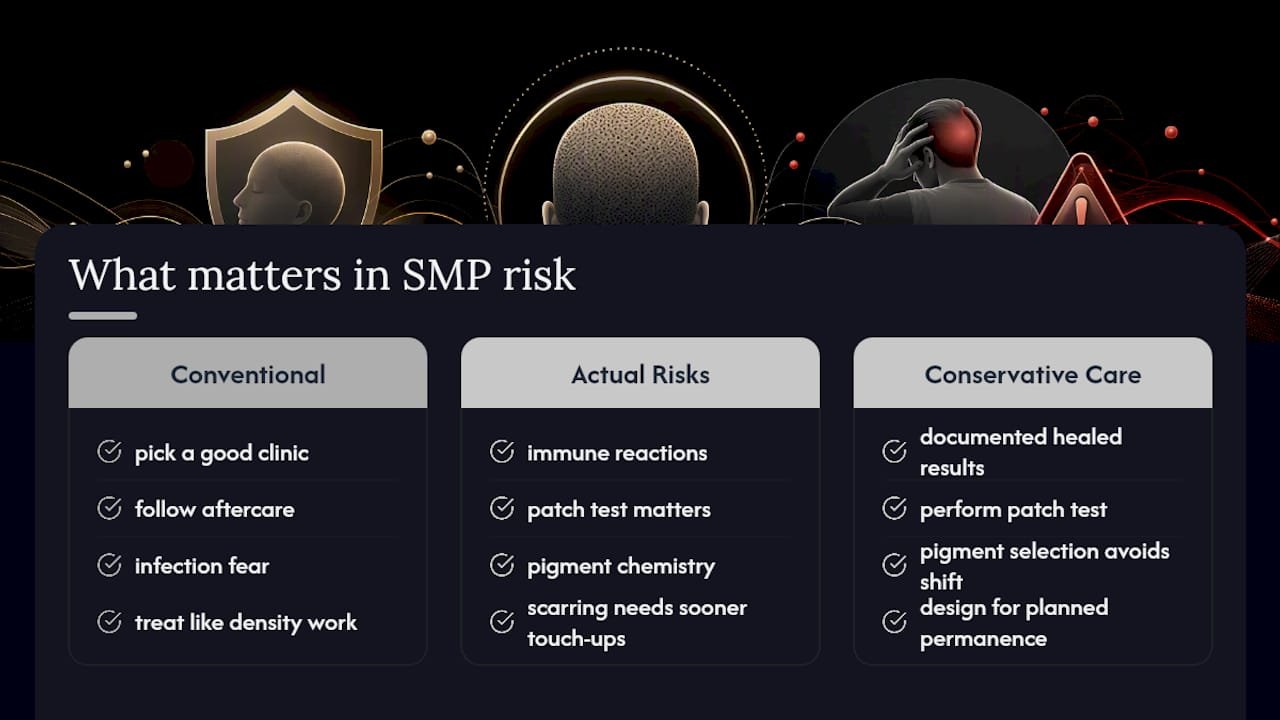
If you’re weighing SMP against the risks above, Enhanced Scalp’s conservative, natural-first approach is built around exactly the safeguards this article covers: documented healed results, pigment selection that avoids color shift, and a design philosophy that treats permanence as something to plan for carefully. Explore Enhanced Scalp’s scalp micropigmentation services or browse the healed results gallery to see what conservative, well-executed SMP looks like months and years after treatment.
Sources
- Efficacy, safety, and patient-reported outcomes of scalp micropigmentation in scarring alopecia – JCAS
- Scalp Micropigmentation – Cleveland Clinic
- Permanent Scalp Micropigmentation | Plastic Surgery Key
- Scalp micropigmentation (SMP): Benefits, cost, results – Medical News Today
FAQ
What are the disadvantages of SMP?
The main drawbacks are permanence, gradual fading that requires touch-ups, and a small risk of complications like pigment migration, color shift, or granulomas if the pigment or technique used is poor.
How long does SMP typically last?
SMP results generally last four to six years before a touch-up is needed, though fading happens gradually rather than all at once, and scarred skin tends to fade faster than unscarred scalp.
How does SMP look after 10 years?
After a decade, most SMP will have faded and likely needs at least one touch-up session to restore density and correct any color drift, particularly if the original pigment wasn’t carbon-based.
What should I avoid doing after SMP?
Avoid getting the scalp wet, sweating heavily, sun exposure, and picking at scabbing for the first three to four days, and hold off on swimming, saunas, and intense exercise for about two weeks.
When should I be concerned about a reaction after SMP?
Spreading redness, warmth, pus, fever, or a rash that worsens instead of improving after a few days points to infection or an allergic reaction, and you should contact your provider immediately.