 Skip to content

Scalp micropigmentation can address most of the visible damage from a failed hair transplant. SMP camouflages linear and dot scarring, fills in the gaps that make grafted areas look patchy, and can rebuild a clean, natural hairline at short lengths. It will not regrow hair or move a single graft. The right first move is a medical-grade scalp assessment to confirm your scars are mature and your candidacy is solid before anyone picks up a needle. Some clinics build their corrective work around exactly this kind of case and document healed results rather than day-one photos.
TL;DR:
- Scar tissue from FUT procedures ranges from 60% to 95% concealment, with wider or textured scars being harder to hide effectively.
- Scar tissue absorbs pigment inconsistently, requiring layered, cautious application over multiple sessions rather than a single pass.
- Optimal results depend on waiting six to twelve months after transplant surgery to ensure scars and grafts fully mature before SMP treatment.
- Patients with active scalp conditions or recent transplant trauma need medical treatment and stabilization before SMP, and consultation should include medical screening.
- SMP cannot replace lost density in over-harvested donor zones, but it effectively camouflages dot scars at short hair lengths, with longevity influenced by sun exposure and skin type.
Table of Contents
- Is SMP Right for Your Failed Transplant?
- What to Expect From Corrective SMP
- How Scar Type Changes What’s Realistic
- Pre-Treatments and Timing: Laser, Microneedling, and Patience
- How to Pick the Right Clinic for Corrective SMP
- A Practitioner’s Perspective on Corrective SMP
- How Enhanced Scalp Approaches Corrective SMP
- Sources
- FAQ
Is SMP Right for Your Failed Transplant?
The first question to answer honestly: is your problem cosmetic contrast, or is it structural? If your grafts took but look sparse, oddly angled, or scattered in an unnatural pattern, that’s a visibility issue. Pigment can soften it dramatically. If grafts failed to survive, if there’s active infection, or if the scalp itself is scarred from surgical trauma, you’re dealing with something SMP alone can’t fully solve, though it can still help once the underlying issue is stable.
A few signs point straight to a medical review before any pigment work happens:
- Ongoing redness, swelling, or drainage at the transplant site
- A personal or family history of keloid or hypertrophic scarring
- Grafts placed within the last several months that haven’t fully matured
- Any active scalp condition (psoriasis, folliculitis, seborrheic dermatitis) in the treatment zone
The ideal SMP candidate has scars that have fully matured, wants to wear hair short rather than grow it long to hide the damage, and has a stable, disease-free scalp. If that describes you, you’re likely a strong fit. If it doesn’t, that’s not a dead end. It just means the sequencing needs to start somewhere else first.
What to Expect From Corrective SMP
Corrective work on scar tissue moves differently than SMP on healthy, unscarred skin. Scar tissue absorbs pigment inconsistently, so practitioners typically build coverage in layers rather than one pass. The first session is deliberately conservative. Later sessions add density once the practitioner sees how the tissue is holding ink.
Here’s the general arc most cases follow:
- Session one: light, test-oriented application to gauge pigment retention on the scar itself.
- Session two (10 to 14 days later): deeper density added where the first pass held well.
- Sessions three and four (as needed): further layering, blending into surrounding hair, and refining the hairline shape.
Most scar-focused cases run two to four sessions spaced roughly ten to fourteen days apart, more than the typical two or three sessions for standard density SMP. Expect the pigment to look darker and crisper right after each session, then soften as it heals.
Pro Tip: Don’t judge your results at the two-week mark. Wait the full four to six weeks after your last session before deciding whether you need a touch-up, since scar tissue continues settling long after healthy skin has finished healing.
Longevity runs several years for most clients, though sun exposure and skin type both accelerate fading, and scar tissue tends to need touch-ups sooner than pigment applied to healthy scalp.
How Scar Type Changes What’s Realistic
Not all transplant scarring behaves the same way under a needle, and pretending otherwise sets you up for disappointment.
FUT linear scars (the strip-harvest line at the back of the head) are the trickiest. They’re often stretched, shiny, or slightly raised, which makes pigment uptake uneven. Depending on scar width and texture, concealment ranges roughly from 60% to 95%, with wider or more textured scars sitting at the lower end. Pre-treatment usually improves the number.
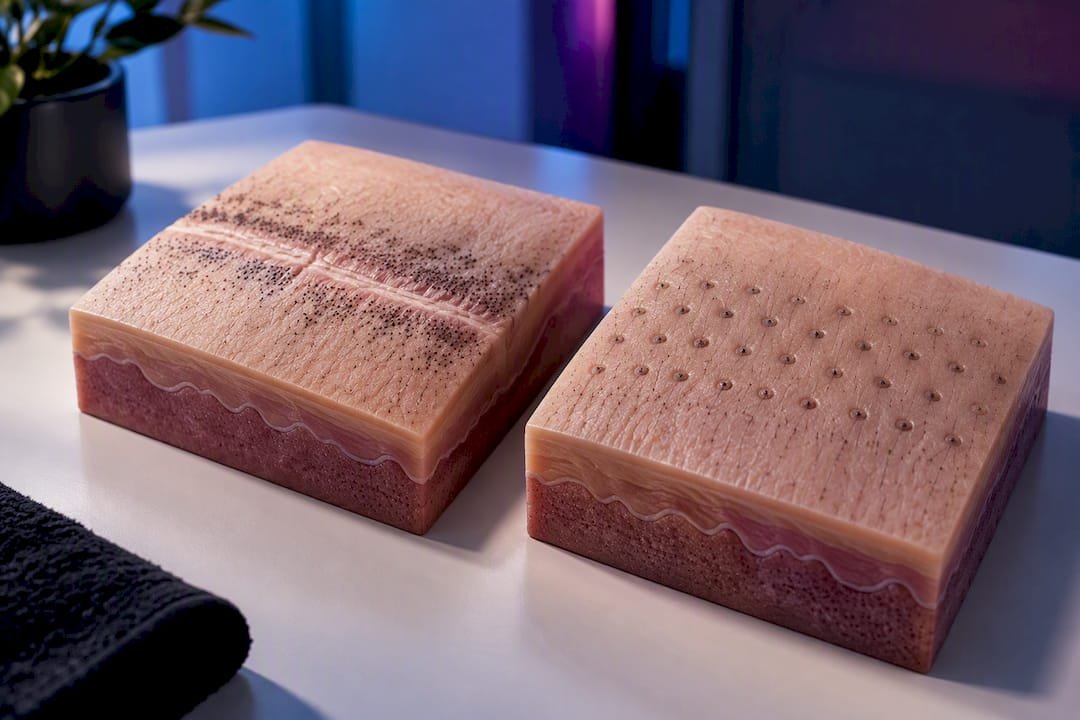
FUE dot scars, the tiny circular marks left by individual graft extraction, respond better. At short buzzed lengths, concealment is often near-complete. The limitation isn’t the scarring itself, it’s donor thinning. If the donor zone was over-harvested during the original transplant, SMP can hide the dots but can’t replace the density that’s actually gone, especially under bright light or when hair is worn very close.
Hypertrophic or atrophic scars (raised or sunken tissue) frequently need medical intervention before pigment goes anywhere near them. Flattening a raised scar or filling a depressed one first gives the ink a far more even surface to sit in.
The single biggest variable across all three types is hair length. SMP reads as real at buzzed and short-crop lengths. The illusion gets harder to sell the longer hair grows around it, because pigment can’t mimic hair movement or shaft thickness the way real follicles do. Enhanced Scalp’s scar camouflage work and its dedicated FUT scar repair guide both walk through these distinctions in more detail if you want to see how a specific scar type typically resolves.
- FUT scars: variable concealment, pre-treatment often recommended
- FUE dot scars: strong concealment at short lengths
- Donor over-harvest: SMP hides the dots, not the missing volume
- Hypertrophic/atrophic tissue: may need medical prep first
Pre-Treatments and Timing: Laser, Microneedling, and Patience
Getting the sequencing right matters as much as the pigment work itself. Laser and microneedling are commonly used to flatten and resurface scar tissue before SMP, improving how evenly pigment sits. Raised hypertrophic scars sometimes respond to cortisone injections first. Depressed or sunken scars can benefit from filler or subcision to bring the surface level with surrounding skin.
Timing is where impatience causes the most damage. Industry guidance generally recommends waiting six to twelve months after transplant surgery, sometimes longer for complex cases, before starting SMP. Grafts and scars both need time to fully mature. Pigment applied too early into immature tissue retains unpredictably and can force a redo.
- Laser/microneedling: flattens and resurfaces before pigment work
- Cortisone: addresses raised hypertrophic scarring
- Filler or subcision: levels depressed, sunken scars
- A test spot on the actual scar tissue before full coverage tells the practitioner how that specific scar will hold ink
A physician-aware plan weighs all of this before committing to a schedule, which is exactly why the consultation should feel more like a medical review than a tattoo appointment.
How to Pick the Right Clinic for Corrective SMP
Ask these questions before you book anything:
- How many transplant-scar cases have you treated, and can I see healed (not day-one) results?
- Do you screen for keloid history or active scalp disease before treatment?
- Will you coordinate with a dermatologist if my scar needs laser or filler first?
- Do you offer a test spot before committing to full coverage?
- What’s your maintenance plan for touch-ups on scar tissue specifically?
Pro Tip: A provider who wants to jump straight into a full session without discussing scar maturity or a test spot is skipping steps that protect your outcome. Walk away.
Red flags are usually easy to spot once you know what to look for: studios that treat SMP as a standard tattoo procedure with no scalp-specific training, zero healed-result documentation, pressure to book immediately after a “failed” transplant instead of waiting for tissue to settle, or blanket promises of “full restoration.” No provider can promise regrowth from pigment.
A strong consultation looks like the opposite: a real medical review of your scar type, honest classification of what you’re dealing with, and a phased plan built around your specific tissue rather than a one-size template. Enhanced Scalp’s SMP treatment guide outlines what that process typically involves.
A Practitioner’s Perspective on Corrective SMP
Conservative hairline design isn’t a limitation, it’s the entire point. A hairline built too dark or too low on scarred tissue ages badly and can’t be undone easily. What matters is healed-work transparency, real screening for scalp disease and keloid risk, and sequencing that respects how scar tissue actually behaves. If your transplant didn’t go the way you hoped, that disappointment is real, and it deserves a plan built on evidence, not another oversold promise.
— James Christopher
How Enhanced Scalp Approaches Corrective SMP
Some practices specialize in cases that traditional clinics may not prioritize: scarring, patchy density, and hairlines that didn’t turn out the way a transplant promised. The advantage here isn’t another surgery, but a non-surgical route that camouflages scar tissue, builds the illusion of density in thinning zones, and reconstructs a natural short hairline, coordinated around the scar’s actual maturity rather than a rushed calendar.
A consultation starts with a scar assessment and medical screening, moves into an individualized sequencing plan, and includes test-spot options before any full session begins. Scalp Micropigmentation for men runs $3,000 to $4,000 CAD one-off, scoped to your scarring and session count. Pricing for the Scar Camouflage Treatment specifically is available on request. If you’re ready to see what a phased, physician-aware plan looks like for your scalp, book a consultation through Enhanced Scalp’s treatment page to get started.
Sources
- Scalp Micropigmentation for Hair Transplant Scars: The Physician-Led Scar Concealment Protocol – Charles Medical Group
- Scalp Micropigmentation for Hair Transplant Scars: Comprehensive Scar Camouflage Protocol – INeedMoreHair
- Scalp micropigmentation for a thin hair transplant – Diamond Hair Clinic
FAQ
Can SMP Fully Fix a Failed Hair Transplant?
SMP camouflages scarring and builds the appearance of density, but it doesn’t regrow hair or reposition failed grafts. For visible-damage cases, though, concealment can reach 95% depending on scar type and pre-treatment.
How Long Should I Wait After a Failed Transplant Before Getting SMP?
Most guidance suggests waiting six to twelve months for scars and grafts to fully mature. Starting SMP too early risks uneven pigment retention.
How Many SMP Sessions Does Correcting Scar Tissue Take?
Scar-focused SMP typically runs two to four sessions spaced ten to fourteen days apart, more than standard SMP because scar tissue holds pigment less predictably.
What Does Corrective SMP Cost at Enhanced Scalp?
Scalp Micropigmentation at Enhanced Scalp runs $3,000 to $4,000 CAD one-off. Pricing for scar-specific camouflage work is available on request through the clinic’s Scar Camouflage Treatment page.
Will SMP Look Natural if My Donor Zone Was Over-Harvested?
SMP hides the individual dot scars from an over-harvested donor zone effectively at short lengths, but it can’t restore the density that’s actually gone. Very short buzzed styles under bright light are where the limitation shows most.

