 Skip to content

Scalp micropigmentation works well for most crown thinning, whether the goal is added density or a clean shaved look. It’s not the right call in two situations: when you plan to keep hair long everywhere except the treated crown, or when the area has significant scarring alopecia, which tends to fade and diffuse faster than normal scalp skin. Everything below covers who qualifies, what a session actually looks like, and what maintenance really costs over time.
TL;DR:
- SMP is most effective for crown thinning when the surrounding hair is kept short or shaved, as longer hair causes visible contrast and less convincing results.
- Candidates with diffuse crown thinning, healthy scalp conditions, and clear hair length goals are more likely to achieve natural results, especially if they avoid significant scarring alopecia.
- The procedure typically requires two to four sessions over a few weeks, with long-term fading occurring gradually over four to six years on healthy tissue.
- Fading accelerates with sun exposure, sweating, or scar tissue, requiring periodic touch-ups to maintain color and density.
- For scalp scarring or complex cases, a conservative approach with test spots and careful pigment selection reduces risks of premature fading and design mismatch.
Table of Contents
- Is SMP For Crown Thinning Actually Effective?
- Who Is A Good Candidate For Crown SMP?
- What Happens During An SMP Session For The Crown?
- How Long Does Crown SMP Last Before It Fades?
- What Are The Risks And Limitations Of Crown SMP?
- How Enhanced Scalp Approaches Crown Thinning Cases
- Get Real Answers About SMP For Your Crown
- A Realistic Take On SMP For Thinning Crowns
- Sources
- FAQ
Is SMP For Crown Thinning Actually Effective?
SMP treats crown thinning by depositing tiny dots of pigment into the scalp, mimicking the look of closely cropped hair follicles. Done well, it reads as texture, not tattoo. The Cleveland Clinic describes it as a non-surgical cosmetic treatment that covers thinning or bald areas by creating the visual illusion of thicker hair, and crown balding is one of the most common patterns it addresses.
There are two distinct goals a technician can design toward, and picking the wrong one is the single biggest reason people end up unhappy with results.
- Optical density: pigment blended between existing crown hair to make thinning look fuller, often paired with male pattern baldness treatment planning when the rest of the scalp is also thinning.
- Shaved-head finish: a fuller, more uniform pattern designed for scalps that are shaved or kept very short, replicating a buzzed follicle look.
The ISHRS is blunt about the tradeoff here: SMP is pointillistic and shallow by design, which is exactly what makes it convincing at the right hair length, and exactly what makes it look wrong at the wrong one. A crown treated for a shaved finish, surrounded by hair left long everywhere else, creates a visible contrast that no amount of technique can hide. If you want to keep length on top and sides, optical density is almost always the better design choice.
Who Is A Good Candidate For Crown SMP?
Crown thinning candidacy comes down to five practical checkpoints. Work through them before you book anything.
- Hair length consistency. Plan to keep the surrounding hair short and uniform, or fully shaved, especially if you’re going for a shaved-head finish. Mixing long hair with a treated crown is the most common cosmetic complaint.
- Thinning pattern. Diffuse thinning across the crown (common in early Norwood stages 3 vertex and 4) generally responds better to optical density work than an isolated, sharply defined bald patch.
- Scalp condition. Active scalp disease, open lesions, or dense scarring alopecia are red flags that call for extra caution and, often, a smaller test area first.
- Realistic goals. Decide upfront whether you want more visible density or a clean shaved look, since that choice drives the entire design.
- Consult prep. Bring photos of your crown from multiple angles, ask to see the technician’s healed results (not just fresh work), and ask directly about their touch-up and maintenance policy.
A short test spot on a small section of the crown, especially if there’s any scarring, tells you more about how your skin will hold pigment than any consultation conversation can.
What Happens During An SMP Session For The Crown?
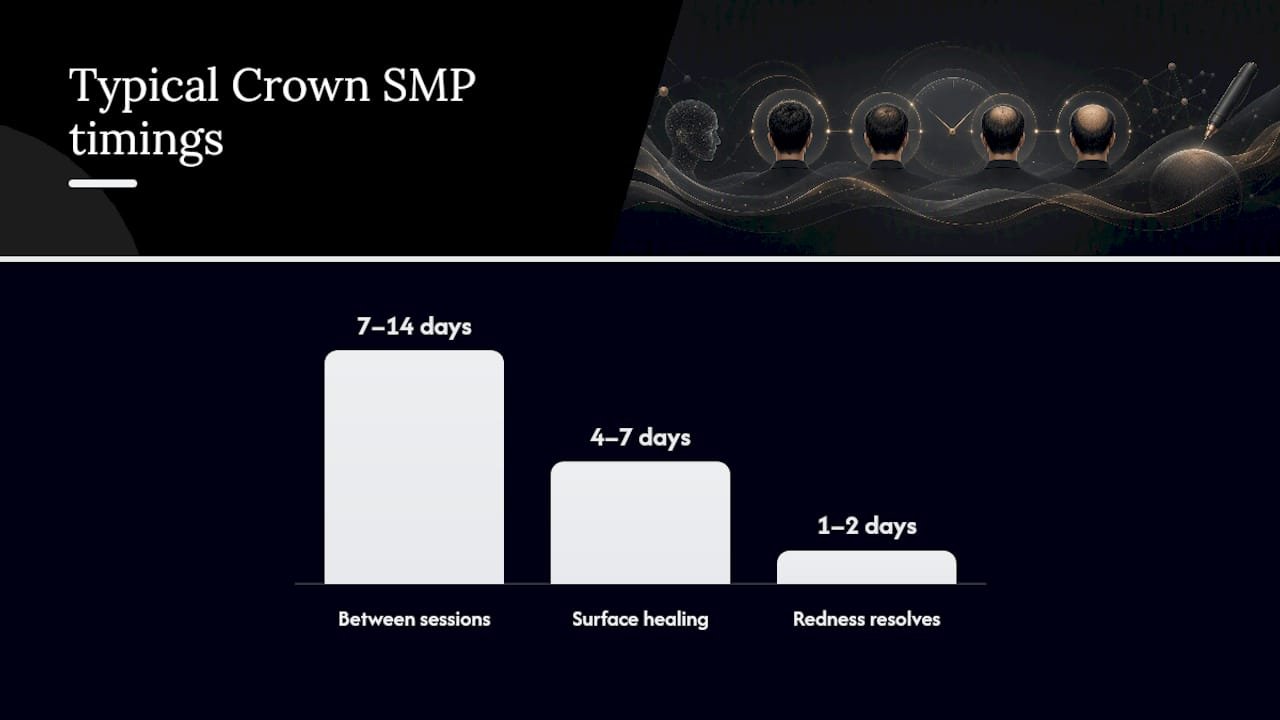
Crown SMP is typically completed over two to four sessions, spaced roughly one to two weeks apart, letting pigment settle and healing progress before layering more detail. The crown itself presents a specific technical challenge: the curvature of the head and the whorl pattern where hair naturally spirals mean a technician has to vary needle angle and dot placement more than on flatter areas like the frontal hairline.
Needle depth control matters everywhere in SMP, but the ISHRS flags it as especially important at the crown, where skin thickness can vary and going too deep risks pigment blowout or a blurry, faded look years sooner than expected. Pigment color selection also has to account for how the crown catches light differently than the sides of the head.
What a typical session flow looks like:
- Consultation and design mapping directly on the scalp
- First pass with lighter pigment saturation to establish the base pattern
- Follow-up sessions to build density and refine irregular areas
- Healing period between sessions, usually four to seven days for surface healing
The Cleveland Clinic notes that mild redness is the most common short-term reaction and it typically resolves within a day or two when the procedure is done by a skilled technician. Avoid sweating heavily, swimming, or direct sun exposure on the treated area for at least four days after each session.
Pro Tip: Ask your technician to photograph the crown under bright, direct light immediately after healing. Overhead lighting is the least forgiving test for pigment blending, and it’s exactly the lighting your bathroom mirror will use every morning.
How Long Does Crown SMP Last Before It Fades?
Pigment fading is gradual, not sudden. Most clients on healthy, non-scarred scalp tissue see a subtle softening of pigment over four to six years before a touch-up is worth considering, according to Enhanced Scalp’s own fading timeline data. Scarring alopecia cases move on a much faster clock.
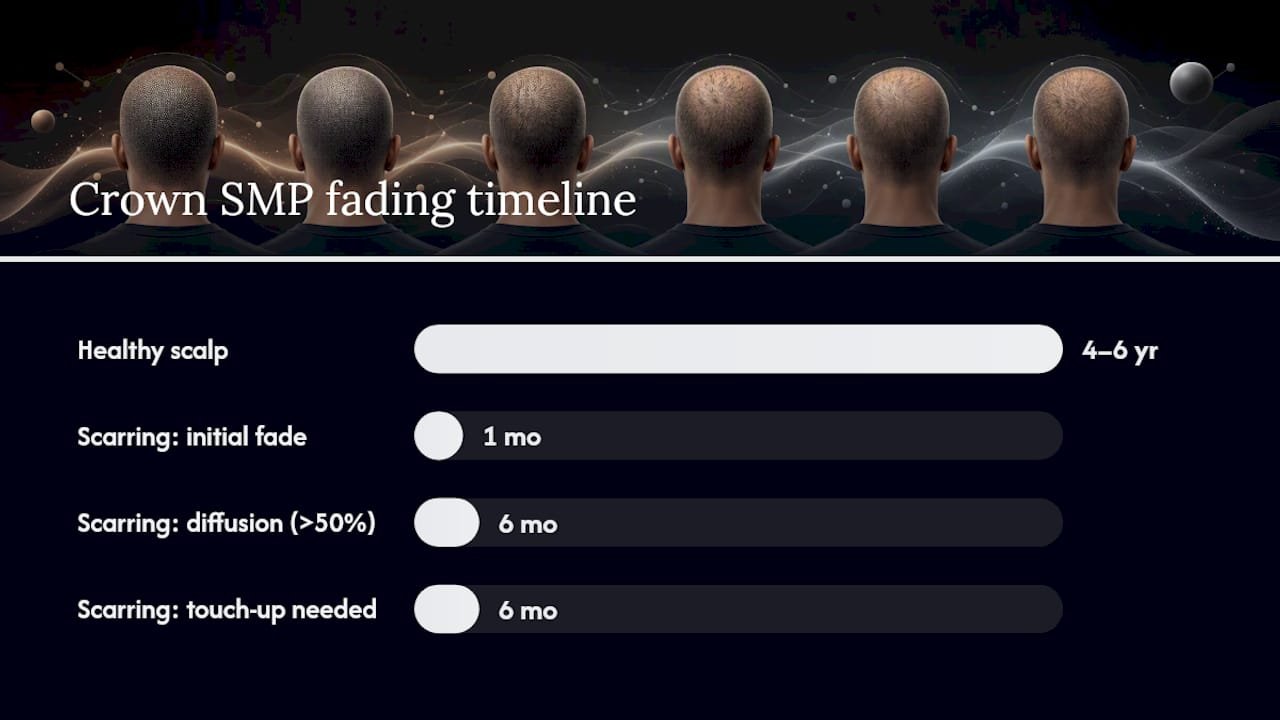
A 2026 clinical study of 18 patients with scarring alopecia found pigment fading in all participants by one month, with diffusion appearing in more than half of cases by six months and touch-ups needed in every patient. That’s a dramatically compressed maintenance timeline compared to standard crown work.
What accelerates fading generally:
- Frequent sun exposure without SPF or a hat
- Excessive sweating or chlorine exposure from swimming
- Scarred or fibrotic tissue, which holds pigment less predictably than healthy scalp
A touch-up session is usually shorter than the original treatment, refreshing color saturation and tightening any areas that have softened unevenly.
What Are The Risks And Limitations Of Crown SMP?
The clearest evidence-backed risk applies to scarring alopecia. The same JCAS 2026 study recorded color changes in many patients, alongside universal touch-up need within months. If your crown thinning is tied to a scarring condition rather than standard pattern baldness, plan for a more active maintenance relationship with your technician, not a one-and-done treatment.
The second major limitation is design mismatch. The ISHRS warns that SMP looks convincing only when hair length around the treated area stays consistent. Grow your hair out after a shaved-finish crown treatment and the contrast becomes obvious fast.
Ways to reduce both risks:
- Request a test spot before committing to full treatment on scarred tissue
- Choose conservative pigment density over aggressive coverage on your first session
- Work with a technician who documents healed results, not just fresh photos
How Enhanced Scalp Approaches Crown Thinning Cases
Enhanced Scalp treats crown thinning as a design problem first and a pigmentation problem second. Conservative density planning, careful pigment selection, and test spots on any scarred or fibrotic tissue guide every case before a full session gets scheduled. That approach matters most for clients who’ve had a rough SMP experience elsewhere, or who are dealing with transplant scarring on top of thinning.
Case types the clinic sees regularly include diffuse crown thinning in early pattern baldness, isolated crown bald spots, and corrective work on prior SMP that was applied too dark or too dense. Outcome framing stays honest throughout: healed results, not day-one photos, are what get shown and what get promised.
Get Real Answers About SMP For Your Crown
Enhanced Scalp gives you something most first-time SMP research can’t: a direct look at healed results, not marketing photos taken the day treatment ends. That distinction matters more for crown work than almost any other area, since the crown’s curvature and whorl pattern are where design mistakes and premature fading show up first.
A consultation with Enhanced Scalp starts with an honest look at your thinning pattern, your hair length goals, and whether your scalp shows any signs of scarring that would call for a test spot first. If you’re weighing SMP against a growth-focused option, treatments like PRP address hair regrowth rather than camouflage, and some clients combine both. Enhanced Scalp’s core Scalp Micropigmentation treatment pricing details are available on their website, and the clinic also offers scar camouflage and female scalp micropigmentation for diffuse thinning patterns specific to women. Book a consultation to get a design plan built around your actual crown, not a generic template.
A Realistic Take On SMP For Thinning Crowns
SMP earns its reputation when the design matches the client’s actual life, not an idealized photo. It’s a strong option for crown thinning when someone commits to keeping hair short and understands maintenance isn’t optional, especially on scarred tissue. Skip the guesswork: get a test spot if there’s any scarring, plan density conservatively, and book a consult before assuming your case is too complicated to treat.
— James Christopher
Sources
- Scalp Micropigmentation: Before & After, Benefits, Side Effects — Cleveland Clinic
- Scalp Micropigmentation (SMP) — ISHRS
- Efficacy, safety, and patient-reported outcomes of scalp micropigmentation in scarring alopecia — JCAS (2026)
FAQ
What Is The Most Effective Treatment For Crown Thinning?
The right treatment depends on whether you want camouflage or regrowth. SMP is among the most effective cosmetic options for creating visible density or a shaved look at the crown, while options like PRP target follicle stimulation rather than appearance.
How Does SMP Look After 10 Years?
Pigment softens gradually over years rather than disappearing, with most clients on healthy scalp tissue needing a touch-up around the four to six year mark based on Enhanced Scalp’s fading timeline guidance. Regular touch-ups every several years keep the result looking sharp well past a decade.
What Are The Disadvantages Of SMP Hair Treatment?
The main disadvantages are fading over time and a poor cosmetic match if you grow your hair long after a shaved-finish treatment. Scarring alopecia cases fade notably faster, with one 2026 clinical study finding touch-ups were needed in all 18 patients within months.
How Much Does An SMP Treatment Cost?
Enhanced Scalp’s Scalp Micropigmentation treatment runs 3000-4000 CAD for the full multi-session series. Pricing for female SMP and scar camouflage work is available on request depending on the case.

