 Skip to content


Yes, you can pair finasteride with scalp micropigmentation (SMP), and for many men the combination makes sense because the two do different jobs. Finasteride is a prescription drug that works on the hair loss process. SMP is a cosmetic tattoo technique that places pigment in the scalp to recreate the look of hair follicles. One does not replace the other. The medication is a medical decision for you and your doctor. The SMP plan is built around whatever your scalp is doing, on or off medication.
TL;DR
- Finasteride is a daily prescription tablet for male pattern hair loss. SMP is a non-surgical cosmetic procedure that adds the look of density or a shaved head. They are not substitutes.
- Finasteride needs daily use for three months or more before any effect shows, and the effect reverses within 12 months of stopping, according to the Canadian monograph.
- Finasteride carries serious warnings, including psychiatric symptoms and a Health Canada safety review on muscle-related effects. Decide on it with a physician, not with an SMP clinic.
- If you take finasteride, tell your SMP practitioner. Your hair’s future direction affects how the hairline should be designed.
- SMP is also an option if you decide not to use medication, or if medication has not been enough.
Table of Contents
- What finasteride does, and what SMP does
- Can you use finasteride and SMP together?
- How long finasteride takes, and why timing matters for SMP
- Finasteride safety in Canada: what to know before you start
- What to discuss before you plan both
- What the SMP process looks like
- Our perspective: design for the hair you will have, not only the hair you have
- When SMP does the heavy lifting
- Booking an SMP consultation in the Toronto area
- FAQ
- Sources
What finasteride does, and what SMP does
The two treatments sit in different categories, which is why the question “finasteride or SMP?” is usually the wrong one.
Finasteride is indicated for male pattern hair loss in men, at a recommended dose of 1 mg daily, according to the Canadian product monograph for finasteride 1 mg tablets. It is taken by mouth, it needs a prescription, and its aim is to slow or stabilize the loss you have and, in some men, help hair that is still alive to look fuller.
Scalp micropigmentation does nothing to the hair follicle. Tiny deposits of pigment are placed in the upper layers of the skin to look like short hairs, either as a shaved-head look or as added density between existing hairs. It grows nothing. What it gives you is an immediate visual result that holds regardless of what your hair does next.
That difference explains the whole topic:
| Finasteride | Scalp micropigmentation | |
|---|---|---|
| Type | Prescription medication | Cosmetic, non-surgical procedure |
| What it targets | The hair loss process | The look of the scalp |
| Commitment | Daily, ongoing | A short series of sessions, then touch-ups as needed |
| Visible effect | Takes months | Builds visibly session by session |
| If you stop | Effect reverses | Pigment stays in the skin and fades gradually over the years |
| Who decides | You and your doctor or pharmacist | You and your SMP practitioner |
If you are comparing SMP with other options more broadly, our page on male pattern baldness treatment explains where it fits.
Can you use finasteride and SMP together?
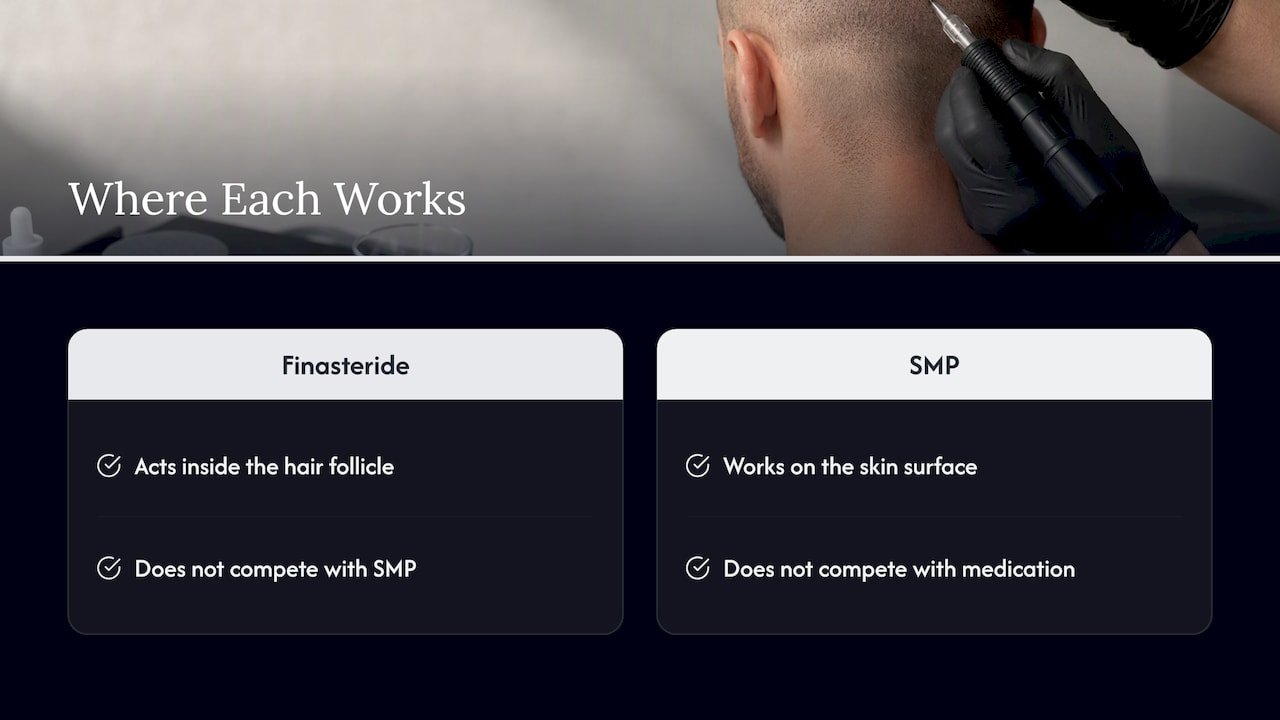
In our practice, yes. Men who take finasteride come in regularly for SMP, and the two do not compete. The medication works inside the follicle. SMP works on the surface of the skin. We are not aware of anything in how SMP is done that requires you to stop or start a hair loss medication, but your medication list is something we always ask about, along with allergies, skin conditions and the history of your hair loss.
A caution on evidence: we cannot point you to a controlled study on finasteride’s effect on SMP pigment or healing, and we will not pretend there is one. What we can say is that published medical literature treats the two as complementary. A 2025 academic review of androgenetic alopecia management notes that cosmetic approaches like scalp micropigmentation remain valuable for psychosocial support alongside medical treatment. If you have a specific health question about your medication and a procedure that breaks the skin, that belongs with your prescribing doctor.
What the combination can realistically give you
There are three situations where pairing them makes sense.
- You are early in your loss and still have a lot of hair. Finasteride may help keep what you have. SMP can add density where the scalp shows through, so the thinning is less visible while you wait out the medication timeline.
- You are on finasteride but a receding hairline or crown is still advancing. Medication does not always hold everything. SMP can define a hairline now, designed with an eye on where the loss may go. See our guide to SMP for a receding hairline.
- You want a shaved look and no more worry about what happens next. Some men decide that daily medication is not for them. A shaved-head SMP result does not rely on keeping any hair at all.
What it will not do
SMP cannot make finasteride work better, and finasteride cannot make pigment look better. If you are hoping one will fix the other’s limits, reset the expectation. Medication will not guarantee regrowth, and SMP will not regrow hair. Together they give you a medical strategy and a visual strategy.
How long finasteride takes, and why timing matters for SMP
This is the part that shapes the planning. According to the Canadian monograph, finasteride generally needs daily use for three months or more before effects appear, and if you stop, the effect reverses within 12 months.
Two practical consequences follow.
Your hair may change after your SMP is done. If you start finasteride and it helps, hair that was thin may thicken. If you stop, or if it was never going to hold, more hair may be lost. A hairline designed for the hair you have today can look wrong in two years if the hair around it changes a lot. That is why we design conservatively, and why we ask you about medication at the consultation.
Do not rush a decision in either direction. Many people book SMP the same month they start finasteride, then wonder whether they needed it. There is no wrong answer. But it helps to know your own plan first: are you going to stay on the medication for years, or trial it for a year and reassess? If you are unsure, tell us. For a man who plans to shave his head anyway, timing matters little. For a man hoping to keep a longer style, it matters a lot.
If you are also looking at over-the-counter options while you decide, browse a range of hair loss care products and speak to a pharmacist about what suits you.
Finasteride safety in Canada: what to know before you start
We are an SMP clinic, not a medical practice, so this section is a pointer to official Canadian information, not advice. Read it, then talk to a physician.
Psychiatric symptoms. The Canadian monograph reports serious psychiatric symptoms, including depressed mood, depression, self-harm and suicidal ideation, which in some cases continued after the medication was stopped. If your mood changes while on finasteride, contact your doctor promptly and do not wait for your next appointment.
Muscle-related effects. Health Canada’s safety review, published on June 22, 2017, concluded that the risk of serious muscle-related side effects could not be ruled out and encourages people to report side effects. Reporting goes through Health Canada’s MedEffect program.
Who should not use it. Finasteride is contraindicated for women who are pregnant or who may become pregnant, because of the risk to a developing fetus, and it is generally not authorized for children or the elderly. If you are a woman with thinning hair, finasteride is not a route to explore on your own; see a physician or dermatologist. Our page on scalp micropigmentation for women covers the non-medication option.
These are the reasons many men first ask about SMP instead: they would rather not take a drug long term. That is a reasonable preference, and it is also a reasonable choice to take the drug and add SMP. Neither is the “correct” one.
What to discuss before you plan both
Bring a short list to each appointment.
To your doctor or pharmacist:
- Whether finasteride is right for your type and stage of hair loss
- Your mental health history, since the monograph flags psychiatric symptoms
- What to watch for, and who to call if something changes
- How long to trial it before judging the result
- Whether you are planning a procedure, such as SMP, and whether any of your other medications matter
To your SMP practitioner:
- Every medication and supplement you take, including how long you have taken finasteride
- How fast your hair has been changing in the last year
- Whether you intend to stay on medication, stop, or try something new
- Whether you want to wear your hair short, buzzed or fully shaved
- Any previous transplant or SMP work, and photos of it
A practitioner who skips these questions is designing a hairline for a head they do not understand yet.
What the SMP process looks like
Most clients need multiple sessions, spaced apart so we can see how the pigment heals before adding more. We lay down the pattern gradually, since pigment looks different fresh than healed, and we would rather build up than correct a result that is too dark. You can read the detail in our session-by-session guide to the SMP process and our treatment guide.
Our scalp micropigmentation treatment is published at $3,000 to $4,000 CAD, one-off, on our treatment page. The final figure depends on the area and your plan, which we settle at your consultation.
Our perspective: design for the hair you will have, not only the hair you have
The question we hear most from men on finasteride is whether SMP will “look wrong” if their hair thickens. It is a fair worry, and the answer is in the design.
We use a conservative hairline, set higher and softer than many men first ask for, with realistic follicle replication rather than a hard, dark line. We do this for every client, but it matters most for anyone with a changing scalp. A soft design blends with new growth. A heavy, dense, low hairline does not. Pigment selection matters as well: it should look like hair that sits on your skin tone, not like ink.
We also document healed work, not just fresh photos, because fresh pigment is always darker and sharper than the final result. That is the version that tells you whether a clinic’s work will look natural in a year.
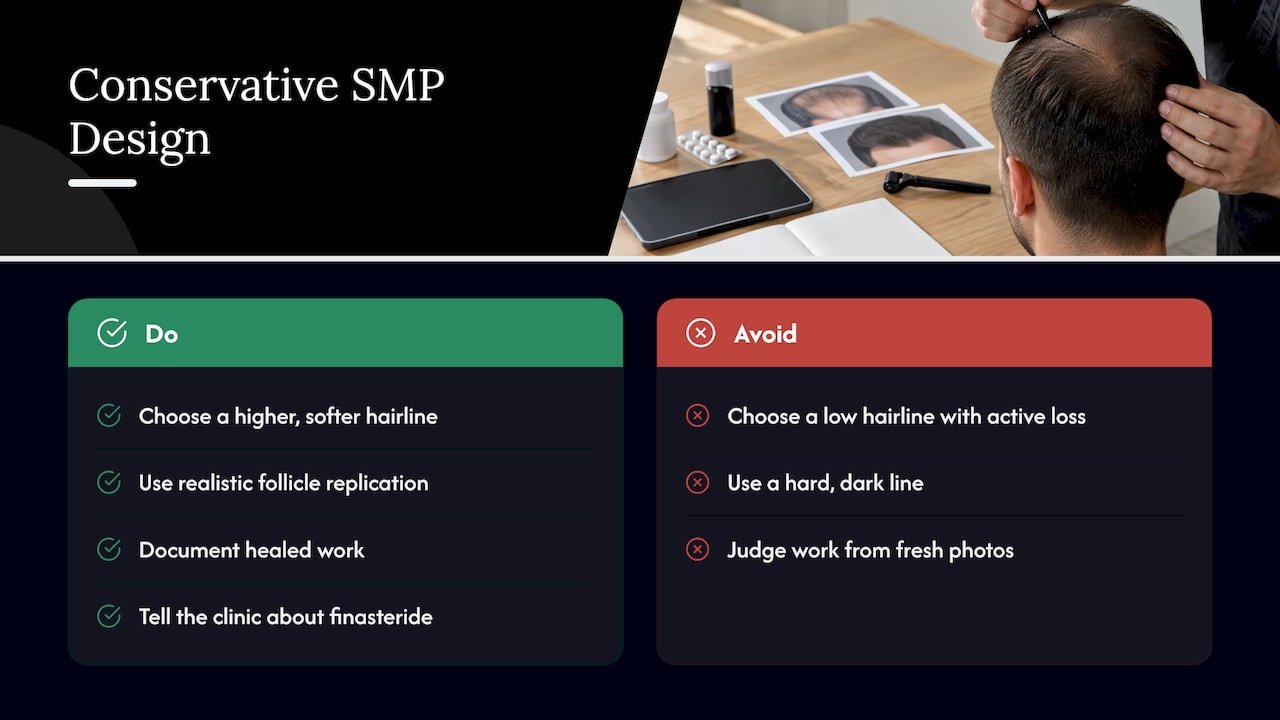
And when someone arrives with a plan we think is too aggressive, a low hairline at 28, say, with active loss ahead, we will tell them so and suggest something more modest. We would rather lose a booking than make a man a hairline he will regret at 35.
If you take finasteride, our advice is simple: tell us, keep taking it as your doctor directs, and let the design leave room for change.
— James Christopher
When SMP does the heavy lifting
Sometimes medication is not an option, or has not been enough, and SMP becomes the main solution.
- Advanced loss. Once follicles are gone, no tablet brings them back. SMP can restore a shaved look or define a hairline. See SMP for male pattern baldness.
- Alopecia. Medical hair loss conditions differ, and SMP can offer coverage in some cases. Our guide to SMP for alopecia goes through it.
- Transplant scars. The 2025 review above also lists scar camouflage, including for FUT and FUE scars, as a use of SMP. If you carry a linear scar, read our pages on FUT scar repair and FUE scar repair.
- A transplant that did not deliver. Men on finasteride sometimes come to us after a transplant left a thin or uneven result. Our approach to hiding a failed hair transplant is built around the corrective work.
Booking an SMP consultation in the Toronto area
We are based in Vaughan, Ontario, and work with clients across Toronto, the GTA, Canada, the United States and abroad. If you are on finasteride, thinking about it, or have decided against it, a consultation is the right place to talk through what your scalp is likely to do and what design suits it. You can start on our scalp micropigmentation page or contact us through the Enhanced Scalp homepage.
FAQ
Can I get SMP while taking finasteride?
Yes. Finasteride and SMP work in different ways, and many men use both. Tell your practitioner about the medication at the consultation, and ask your doctor if you have a specific health concern about a skin procedure.
Does finasteride change how SMP looks?
We have no evidence that it changes the pigment itself. What it can change is the hair around the pigment, since finasteride may thicken or hold the hair you have. That is why we design a softer, conservative hairline that blends with whatever the hair does later.
Should I start finasteride before or after SMP?
There is no fixed rule, and it is a question for your doctor as well as your practitioner. Because the medication takes three months or more to show any effect, many men start it first and book SMP once they know how their hair is responding. If you plan to shave your head regardless, the order matters much less.
What happens to my SMP if I stop finasteride?
The pigment stays. The hair around it may thin again, since the Canadian monograph says the medication’s effect reverses within 12 months of stopping. A conservative design copes better with that, and touch-ups can adjust the look later.
Is SMP a safer alternative to finasteride?
They are different things, so “safer” is not quite the comparison. SMP does not treat hair loss and carries its own considerations, such as choosing an experienced practitioner and healing properly. Finasteride carries the warnings described above. Discuss your own risks with a physician.
Sources
- RIVA-FINASTERIDE product monograph, Health Canada Drug Product Database
- Summary Safety Review: Finasteride, Health Canada
- A decade of progress in androgenetic alopecia management, 2025

