 Skip to content


Scalp micropigmentation (SMP) is long lasting but not permanent. Most clinics quote a range of roughly three to six years before the pigment softens enough that clients want a refresh, and many people go longer. Where you land in that range depends on your skin, your sun habits, the pigment and depth the artist used, and whether your hair loss keeps progressing.
This guide covers what actually happens to SMP over the years, what speeds fading up or slows it down, how to tell normal aging from a problem, and what a refresh involves.
TL;DR
- SMP is semi-permanent: expect gradual softening, with a refresh typically considered somewhere in the three to six year window, sometimes later.
- Sun exposure is the biggest controllable factor. Daily sunscreen on a shaved scalp matters more than any product.
- Some lightening in the first months is normal. Judge the result only after the scalp has fully healed.
- Artist technique, pigment choice and depth set your ceiling before you ever leave the chair.
- A refresh is usually a short, lighter session than the original work, and it is also the moment to adjust for ongoing hair loss.
Table of Contents
- Is scalp micropigmentation permanent?
- How long does SMP last? A realistic timeline
- What makes SMP fade faster or last longer
- Normal aging or a problem? How to tell
- When to get a touch-up
- How to make your SMP last
- SMP longevity for different situations
- Our perspective on SMP longevity
- Cost and what a refresh means for the budget
- FAQ
- Sources
Is scalp micropigmentation permanent?
No, and a clinic that tells you otherwise is overselling. SMP deposits pigment in the upper layers of the skin, not deep in the dermis the way a traditional body tattoo sits. The International Society of Hair Restoration Surgery notes that “permanent” pigments can fade over time, and that UV light in particular fades scalp pigment faster.
That shallow placement is deliberate. Dots that are too deep can spread and shift color, which is how old-style tattoos end up blurred or bluish. Pigment placed at the right depth lightens gradually and predictably instead. Fading is part of how the treatment is designed, not a defect.
So the honest answer to “does micro scalp pigmentation fade?” is yes, slowly. What matters is how fast, and how much of that you can influence.
How long does SMP last? A realistic timeline
Published numbers vary from clinic to clinic, which is a sign that no one can promise an exact figure. The commonly quoted window is three to six years before a refresh is considered. Some people with darker skin tone contrast, low sun exposure and strong healing keep a convincing result for longer. Others who spend a lot of time outdoors or have oily skin may want a touch-up sooner.
Here is what the years usually look like.
| Stage | What you typically see | What to do |
|---|---|---|
| Days 1 to 14 | Redness, tightness, scabbing or flaking, pigment looks darker | Follow aftercare exactly |
| Weeks 2 to 8 | Pigment settles and lightens, can look patchy before it evens out | Wait, do not judge yet |
| Months 2 to 12 | Final tone emerges as the skin finishes healing | Book any finishing session after healing |
| Years 1 to 3 | Stable, natural look with very slight softening | Daily sun protection |
| Years 3 to 6 | Noticeable lightening or slight dot softening in some areas | Consider a refresh when it bothers you |
| Beyond 6 years | Varies widely, often a clear need for a refresh | Refresh or adjust the design |
The table is a guide, not a guarantee. Your own timeline is set by the factors below.
The first year is not the same as year three
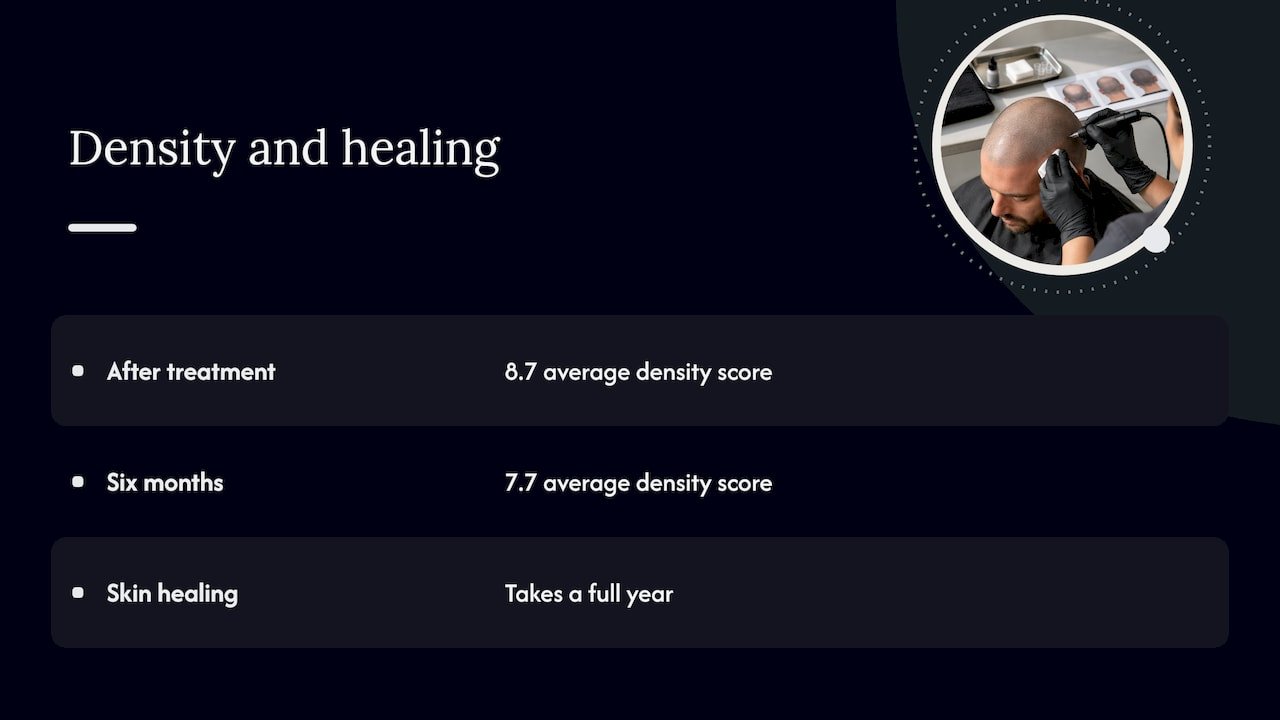
The first few months involve a visible change that has nothing to do with long-term fading. The ISHRS explains that healing takes a full year, and that cells in the skin during healing are the same cells that clear pigment, so work placed too early risks premature fading. In a small case series of ten patients with localized alopecia, the visual density score averaged 8.7 right after treatment and 7.7 at the six-month follow-up. A modest early drop is expected, and it is why a good plan builds density in layers across sessions rather than all at once.
If you want a session-by-session view of how that build works, see what to expect from the SMP process.
What makes SMP fade faster or last longer
Sun exposure
UV is the factor you control most. A shaved scalp is permanently exposed, and the ISHRS names UV as a key reason scalp pigment fades more quickly. Sun protection is also just good skin care: the Public Health Agency of Canada recommends broad-spectrum, water-resistant sunscreen with SPF 30 or higher when the UV Index is 3 or higher, and says UV radiation damages the DNA in skin cells. A bare scalp is one of the most exposed patches of skin you own.
In Ontario, that UV Index threshold is crossed for a large part of the year, not only in July. Use a hat for long outdoor stretches and sunscreen the rest of the time. We go deeper in our guide to SMP and sun exposure.
Skin type and oil production
Oily skin tends to push pigment out and soften dot edges faster. Dry, thin or very sun-damaged skin behaves differently again. This is one reason a conservative artist tests how your skin takes pigment before committing to a full design, particularly on scarred or unusual skin.
Artist skill, pigment and depth
This is the factor you cannot fix at home. Depth, needle choice, pigment quality and color matching decide whether your result ages gracefully. Pigment that is too dark at the start will lighten into something that looks more natural, but pigment that was placed too deep can spread and look blurry. Even work done by a skilled hand will not match a strong early result with a poor design. If you are weighing a clinic, look for photos of healed work, not only fresh results. Our checklist on spotting AI-edited SMP results explains why.
Aftercare in the first two weeks
Picking scabs, soaking the scalp, sweating heavily or exposing fresh work to sun in the early days can pull pigment out before it has set. The routine is short and not complicated. We lay it out in SMP maintenance and the first 14 days of aftercare.
Lifestyle and skin products
Harsh exfoliants, strong acids and aggressive scrubbing over the scalp can lighten pigment over years. Regular swimming in chlorinated water without a hat or sunscreen adds up too. None of this means avoiding normal life. It means treating your scalp like the skin on your face.
Ongoing hair loss
Sometimes what looks like fading is really your hair loss progressing. If you had SMP on a hairline and the natural hair behind it keeps thinning, the pigment can start to look disconnected even though it has barely changed. That is a design question, not a pigment one, and a refresh is the right moment to solve it. For men with advancing pattern loss, see our page on male pattern baldness treatment in Toronto.
Normal aging or a problem? How to tell
Not every change calls for a call to the clinic. Use this as a rough split.
Normal, no action needed
- Pigment looks lighter at weeks 2 to 8 than on day one.
- Slight, even softening of tone over a few years.
- Dots look a little less crisp up close but still read as stubble at conversation distance.
Worth getting looked at
- Uneven fading, with some areas clearly lighter than neighbors.
- A color shift toward blue, gray or red.
- Dots merging into blotches or visibly spreading.
- Persistent redness, swelling, itching or pain well beyond the first weeks. See SMP side effects: what is normal and what is a warning sign.
- A hairline that looks wrong or sits too low or too sharp.
A color shift or spreading is more likely to point to pigment or depth issues from the original work than to normal aging. If that is your situation, there are options: SMP editing, correction or removal covers what can be fixed, what can be camouflaged and what needs removal first.
When to get a touch-up
Book a refresh when you can see the change, not on a calendar schedule. Typical triggers are:
- The overall tone has lightened enough that the scalp shine or contrast is back.
- The hairline edge looks soft or has lost definition.
- Your natural hair loss has moved and the design needs extending.
- You simply want a darker or denser look than you had.
A refresh usually takes less work than the first treatment, because the base is already in place. It is typically a shorter and lighter session, and the artist can match the existing healed tone. Wait until the scalp is fully settled after your original work before judging whether you need one, and ask your clinic how they handle follow-up sessions.
If your goal is to reduce shine on a shaved head, our piece on how SMP reduces scalp shine explains why density, not just darkness, drives that effect.
How to make your SMP last
- Protect from the sun every day. SPF 30 or higher, broad-spectrum and water-resistant, on the scalp whenever the UV Index is 3 or higher, as the Public Health Agency of Canada advises. A hat is better still for long outdoor days.
- Follow the first two weeks of aftercare to the letter. No picking, no soaking, no heavy sweating, no sun.
- Keep the scalp moisturized and clean once healed. Healthy, hydrated skin holds a cleaner-looking result. A light leave-on product such as a scalp nourishing spray can fit into a routine, but sunscreen stays the priority for exposed skin.
- Go easy on exfoliation and harsh actives. Gentle cleansing is enough.
- Choose your artist for healed results. Ask to see photos of work that is a year or more old.
- Plan for progression. If your hair loss is still active, design conservatively so the hairline can age with you.
SMP longevity for different situations
Hair transplant scars and alopecia
Scar tissue takes pigment differently. It can hold less evenly, fade faster or need extra passes, which is why a test spot is a sensible first step. We cover that in testing SMP on scar tissue after a transplant and in our scar camouflage treatment page. For alopecia areata and similar conditions, the ISHRS advises that scalps should be stable and disease-free for two to three years before SMP is applied. Read our guide to SMP for alopecia before booking.
Women with thinning
For women, SMP is generally a density tool, adding the look of fullness between existing hairs rather than a shaved look. Longevity follows the same rules, and light, soft work is usually the aim. See scalp micropigmentation for women.
Previous SMP that faded badly
If an earlier treatment went gray, blurred or patchy, the fix depends on how deep and how dense the old pigment is. Correction is a specialty of its own, and it begins with a proper assessment rather than adding more pigment on top.
Our perspective on SMP longevity
We would rather tell you that SMP fades than let you find out in year four. Our whole approach is built around how a result looks once it has healed, not how it looks the day you leave. That is why we favor a conservative hairline, realistic follicle replication and careful pigment selection over a heavy, very dark finish that looks dramatic on day one and unnatural later.
A result that is slightly understated at the start has room to age well. A result pushed too dark leaves nowhere to go. We also document healed work, because healed photos are the only honest answer to the longevity question.
The other thing we tell every client is that a refresh is not a failure. Hair loss is not static, skin changes, and a short session in a few years to sharpen the edges or extend the design is a normal part of owning this result.
— James Christopher
Cost and what a refresh means for the budget
Our scalp micropigmentation treatment is priced at 3,000 to 4,000 CAD as a one-off, with the final amount depending on the size and complexity of the area. Because SMP lasts years rather than weeks, the cost per year is low next to ongoing products or repeat procedures, but plan for an eventual refresh. Ask any clinic you are considering how they price follow-up work before you commit.
If you are in Toronto, the GTA or traveling in for the work, you can see the full treatment on our scalp micropigmentation treatment page or start with the overview of scalp micropigmentation at Enhanced Scalp. Not sure it suits you? Read am I a candidate for SMP first.
FAQ
Does micro scalp pigmentation fade?
Yes, gradually. The pigment lightens over years, and sun exposure speeds it up. Some lightening in the first weeks and months is part of normal healing and does not mean the result is failing.
How long before I need a touch-up?
Clinics commonly quote about three to six years, though it can be sooner or later depending on skin, sun habits and original technique. A better rule is to refresh when you notice lightening, softer edges or hair loss that has moved past the design.
What should I not do after SMP?
Avoid picking scabs, soaking the scalp, heavy sweating and direct sun during the early healing period, and follow your clinic’s instructions exactly. Long term, protect the scalp with sunscreen and avoid harsh scrubs. Our 14-day aftercare guide walks through it.
Can hair grow over micropigmentation?
Yes. SMP sits in the skin and does not stop natural hair from growing, so any hair you still have continues to grow through it. If you keep a longer cut, the design should be planned around your real hair, which is why length and loss pattern are assessed before work begins.
Sources
- Scalp Micropigmentation (SMP): All You Need to Know, ISHRS
- Skin cancer, Public Health Agency of Canada
- Scalp Micropigmentation Is an Effective Treatment for Localized Alopecia: Technical Analysis and a Series of Ten Case Reports

