 Skip to content

Yes, you can camouflage shock loss in most cases, but not until the scalp has fully healed. Wait until scabs and crusting are gone, grafts sit flush, and there’s no redness or drainage. If anything looks off, get your clinician to clear you before applying fibers, powders, or sprays. The timeline and method breakdown below tells you exactly what to expect and which option fits your situation.
TL;DR:
- Camouflage products can only be used once the scalp fully heals, with no open wounds, crusting, or signs of infection.
- Shedding from shock loss usually begins 2 to 8 weeks post-surgery, with regrowth starting around 3 to 6 months, depending on pre-existing hair conditions.
- Fibers, powders, or sprays should be applied with proper color matching and light layers to avoid making thinning more noticeable during healing.
- Using scalp micropigmentation is only appropriate after the scalp has completely stabilized and shedding has ceased.
- Persistent or spreading thinning beyond 10 months or signs of infection require immediate follow-up with the transplant clinic.
Table of Contents
- What Is Shock Loss and Why Does It Happen?
- When Does Shedding Start, and When Does Hair Come Back?
- Is It Safe to Use Camouflage Yet? A Healing Checklist
- Camouflage Options: Fibers, Powders, Sprays, Toppers, and SMP
- How to Apply Camouflage Without Making Thinning Look Worse
- When to Get a Clinical Reassessment
- A Practitioner’s Perspective on Shock Loss and Monitoring
- A Longer-Term Camouflage Option Once Your Scalp Is Stable
- Sources
- FAQ
What Is Shock Loss and Why Does It Happen?
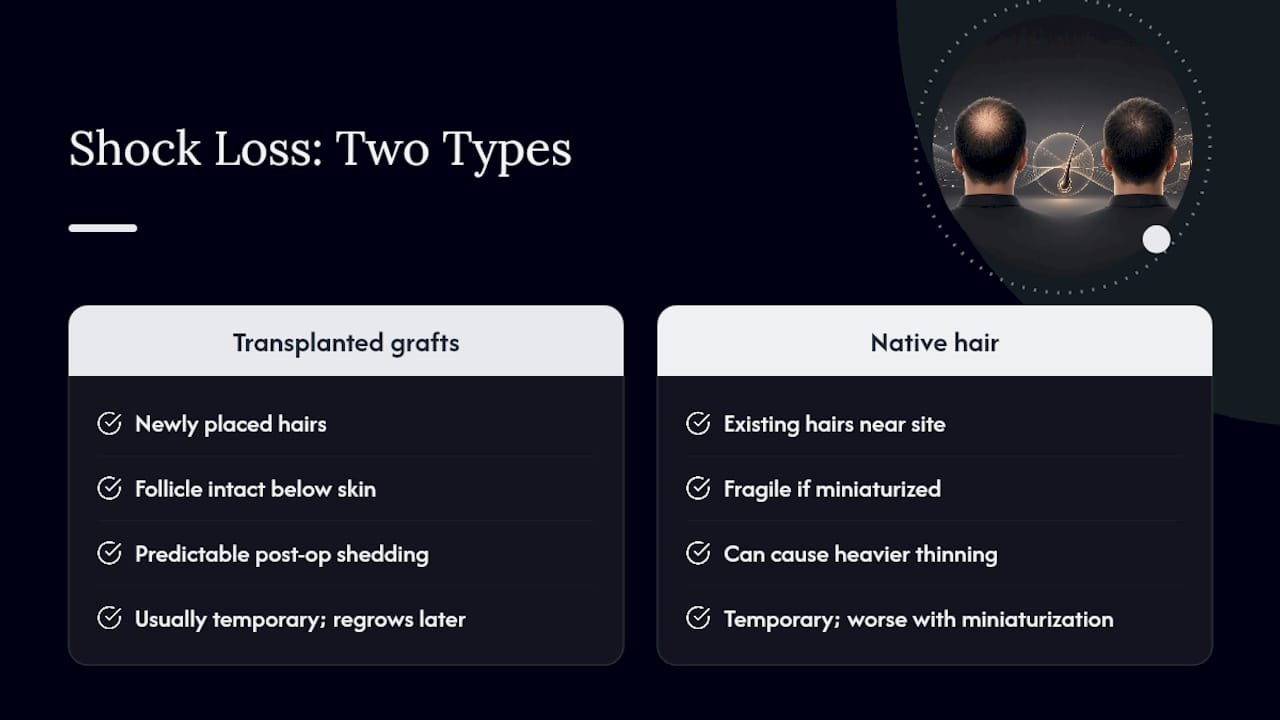
Shock loss is a form of telogen effluvium triggered by the trauma of transplant surgery. Hair shafts, transplanted or native, get pushed into a resting phase and shed, even though most of the follicles underneath stay alive and viable. It looks alarming. It’s also one of the most predictable parts of transplant recovery.
The mechanism comes down to a handful of overlapping stresses on the scalp. Vascular disruption during extraction and implantation temporarily interrupts blood flow to nearby follicles. Inflammatory signaling from the healing process pushes hairs out of their growth cycle early. Mechanical pressure from swelling and the physical act of grafting adds to the load, and local anesthetic, which constricts blood vessels to control bleeding, can compound the effect for a short window after surgery.
Clinicians generally separate shock loss into two categories. The first is transplanted graft shedding, where the newly placed hairs themselves fall out while the follicle stays intact underneath the surface, waiting to restart growth. The second is native hair shedding, where existing hair around the transplant site (or, less often, at an FUT donor strip) thins temporarily because of the same inflammatory and mechanical triggers. Native shedding tends to hit harder in people who already had some miniaturization before surgery, since those follicles were more fragile to begin with.
When Does Shedding Start, and When Does Hair Come Back?
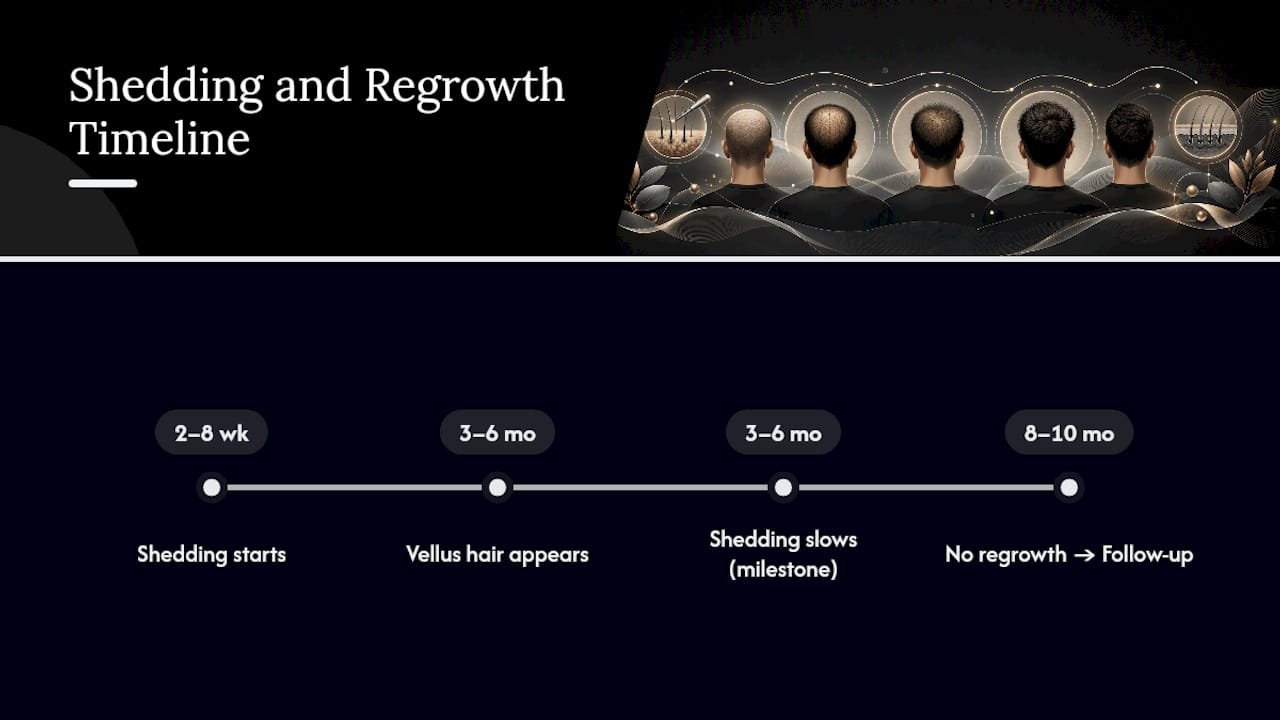
Most shock loss follows a fairly consistent window. Shedding typically starts 2 to 8 weeks after surgery, often catching patients off guard because it happens well after the initial post-op swelling has resolved. Regrowth is slower to show. New growth, usually starting as fine vellus hairs before thickening, tends to begin somewhere around 3 to 6 months post-transplant.
That range varies. Someone with significant pre-existing miniaturization may see a longer runway to visible regrowth than someone whose native hair was healthy going in. Two things worth tracking as milestones: the appearance of soft, colorless vellus hairs (a good early sign the follicle survived) and a clear slowdown in daily shedding, which usually signals the resting phase is wrapping up.
If you’re past 8 to 10 months with no visible regrowth, or the thinning seems to be spreading rather than stabilizing, that’s not a “wait it out” situation anymore. It’s worth a follow-up with the clinic that did your procedure, since clinical decision-making at that stage leans on distribution and timeline, not just how much hair you’ve lost.
Is It Safe to Use Camouflage Yet? A Healing Checklist
Before reaching for fibers or powder, run through a short mental checklist. Camouflage products are cosmetic tools, not medical ones, and applying them too early can complicate healing or hide a problem that needs attention.
Safe to apply once all of the following are true:
- No open scabs or crusting anywhere on the treated area
- Graft sites sit flush with the surrounding skin, not raised or oozing
- No spreading redness, warmth, or tenderness around the scalp
- Your surgeon or clinic has given the go-ahead if you’re at all unsure
The reason this matters isn’t just aesthetics. ISHRS patient guidance is explicit that concealers should never go over open wounds, since powders and fibers can trap bacteria or irritate healing tissue. Camouflage products can also mask early signs of infection, which is the opposite of what you want during a recovery window when your clinic is relying on you to flag problems early.
One more practical point: if you’re using any topical medication, such as minoxidil, let it fully dry before applying fiber or powder products on top. And if you have a follow-up visit or clinical photos scheduled, remove any concealer beforehand. Your provider needs to see the actual scalp, not a cosmetically adjusted version of it.
Camouflage Options: Fibers, Powders, Sprays, Toppers, and SMP
Each camouflage method solves a slightly different problem, and picking the wrong one for your healing stage or hair length is the most common reason people end up disappointed.
- Keratin fibers. These attach to existing hair strands electrostatically, adding instant visual density. They work best when you still have some hair to anchor them, since fibers need something to cling to or they just sit on the scalp and look unnatural. They wash out easily with shampoo, which is convenient, but overapplication causes visible caking.
- Powder and cream colorants. These are the better choice for camouflaging a widening part line or a small patchy area rather than full coverage. Cream-based versions applied slightly damp tend to hold up better against wind and light sweat than dry powders.
- Sprays. Fast to apply and good for a short-term touch-up before a photo or event, but they transfer easily onto pillows, collars, and hats. Treat sprays as a same-day solution, not a daily habit.
- Wigs and toppers. Useful for larger areas of visible thinning where fibers and powders can’t do enough. Pay attention to how the piece attaches. Adhesive-based toppers can create traction on healing grafts or trigger skin reactions if worn too soon.
- Scalp micropigmentation (SMP). A semi-permanent tattooing technique that replicates the look of short hair follicles or adds density between existing strands. Unlike the other options, SMP requires a healed, stable scalp and should wait until shedding has fully stabilized, not while you’re still in an active shock loss window.
Pro Tip: Don’t judge a fiber or powder product by how it looks under bathroom lighting. Check the color match outdoors or under daylight bulbs, since most bathroom lighting washes out warm and cool undertones that become obvious the moment you step outside.
How to Apply Camouflage Without Making Thinning Look Worse
Bad application is more noticeable than the thinning itself. A few adjustments make a real difference:
- Match color before committing. Test a small amount against your natural hair color in daylight, not artificial light, before using it on the full area.
- Apply in light layers. Dust fibers or powder in thin passes rather than one heavy application, checking progress in a mirror under a strong side light so you can catch buildup before it cakes.
- Avoid fresh graft sites and edges. Keep concealer away from areas that are still healing or close to the hairline where product tends to look most obvious.
- Leave enough hair length. Fibers need a few centimeters of hair to grip onto. A very short buzz cut during the shock loss phase often makes thinning more visible, because there’s nothing for the fibers to hold onto.
- Wash gently. Remove products with a mild shampoo and light finger pressure, never vigorous scrubbing, especially over areas that are still in the healing window.
When to Get a Clinical Reassessment
Certain signs mean it’s time to call your clinic, not wait it out. Open sores, pus, spreading redness, or severe pain around the graft sites are red flags that need prompt attention. So is any systemic symptom like fever, or thinning that spreads well outside the original surgical zone.
Timing matters too. No visible regrowth by 8 to 10 months, or shedding that keeps expanding instead of leveling off, is a reasonable trigger for a follow-up appointment. Come prepared: monthly photos taken in the same lighting, a list of any medications or supplements you’re taking, and a plain description of any scalp symptoms you’ve noticed.
A Practitioner’s Perspective on Shock Loss and Monitoring
Shock loss unsettles almost everyone who goes through it, and in the overwhelming majority of cases, it resolves on its own. The mistake is checking the mirror every morning looking for change you won’t see day to day. Take one consistent photo a month instead. Camouflage has its place, but it works best as a bridge, not a permanent fix, until the scalp proves it’s stable enough for something longer term.
— James Christopher
A Longer-Term Camouflage Option Once Your Scalp Is Stable
Fibers and powders buy you time, but they’re a daily routine, not a solution. Once shock loss has stabilized and your clinician has confirmed the scalp is healed, scalp micropigmentation gives you a camouflage result that doesn’t wash out in the shower or transfer onto your pillow. Enhanced Scalp specializes in exactly this kind of post-transplant work, including scar camouflage for donor sites and corrective SMP for clients whose prior pigmentation or transplant didn’t heal the way they expected.
A consultation is straightforward: bring photos of your scalp at a few points along your transplant timeline, along with any notes from your surgeon about graft density and healing status. From there, Enhanced Scalp can map out whether density-focused SMP or a scar-focused approach fits your goals, and walk you through realistic timing once your scalp has cleared the shock loss phase. If you’re ready to look at what a stable, natural result could look like, book a consultation and bring your questions.
Sources
- Camouflage treatments — ISHRS
- Cosmetic camouflage techniques (PMC article)
- Shock loss after hair transplant — Hair Restoration Authority
FAQ
What Does Shock Loss Mean?
Shock loss is temporary hair shedding triggered by the trauma of transplant surgery, affecting either the newly transplanted grafts, the surrounding native hair, or both, typically starting 2 to 8 weeks after the procedure.
Is 5,000 Grafts Overharvesting?
Whether a graft count is appropriate depends on donor density, scalp laxity, and the surgeon’s assessment of what the area can safely support, not a fixed number, so this is a question for the clinician who evaluated your specific donor site.
How Common Is Shock Loss After a Hair Transplant?
Shock loss is a widely recognized and common part of transplant recovery, and in most patients it resolves on its own as grafts move out of the resting phase and into regrowth around 3 to 6 months.
When Can I Safely Start Using Camouflage Products?
Once scabs and crusting have fully cleared, graft sites sit flush with the skin, and there’s no redness, swelling, or drainage, most people can safely use fibers, powders, or sprays, confirming with a clinician first if anything looks uncertain.
Is Scalp Micropigmentation an Option During Active Shock Loss?
No. SMP works best on a healed, stable scalp, so it’s typically reserved for after shedding has stopped and regrowth has settled, which is generally decided by the clinic during a case-by-case consultation.

