 Skip to content


Scalp micropigmentation (SMP) can be done before a hair transplant, and in some cases it is the smarter first step. The usual clinical guidance is to wait about 3 to 6 months after SMP before surgery. Going the other way, you wait roughly a year after the transplant before pigmenting. Whether SMP first is right for you depends on how stable your hair loss is, how much donor hair you have, and what your surgeon needs to see on your scalp.
TL;DR
- Standard guidance: wait 3 to 6 months after SMP before surgery so the scalp heals and the pigment settles.
- If you transplant first, plan on at least 12 months before SMP. Our own guidance for clients is 11 to 12 months.
- SMP is most useful with low donor supply or advanced loss, because it lets fewer grafts look fuller.
- Progressive hair loss is the main risk of SMP first. Your surgeon and your SMP artist need to agree on the plan before either starts.
- SMP is camouflage. It does not add hair, and it cannot restore a depleted donor area.
Table of Contents
- Why people ask about SMP first
- The two orders, compared
- Why wait after SMP before surgery
- Why wait a year after a transplant
- When SMP first makes sense
- When to hold off
- Donor area questions: what SMP can and cannot do
- Our perspective
- Choosing who does your SMP
- Planning SMP around your transplant with us
- FAQ
- Sources
Why people ask about SMP first
Most people reach this question from one of three places.
- You are still deciding on surgery. You want to see how you look with a shaved or very short head before committing to grafts.
- Your donor supply is limited. You have advanced loss and a surgeon has told you grafts alone will not cover the area.
- You have already had one transplant and are considering a second, but the first left thin or patchy results.
SMP deposits tiny pigment dots in the upper layers of skin. Done well, the dots read as closely cropped hair follicles. A stippled pattern of dots can create the look of a normal head of hair where none exists. That is why it pairs naturally with surgery: the transplant supplies real hair, and SMP supplies the density illusion behind it.
The two orders, compared
| SMP first, transplant later | Transplant first, SMP later | |
|---|---|---|
| Typical wait | 3 to 6 months after SMP before surgery | At least 12 months after surgery before SMP |
| Main advantage | You can judge the look of pigment density before grafting, and the surgeon plans around it | You see how much real hair grew before deciding how much pigment you need |
| Main risk | Your hair loss keeps progressing, so the pigment pattern and the surgical plan can drift apart | Pigmenting too early risks poor retention and can disturb healing grafts |
| Best fit | Stable loss, low donor density, a wish to preview a shaved look | Most first-time transplant patients with decent donor supply |
Neither order is universally correct. The right one is the one your surgeon and SMP artist have both signed off on.
Why wait after SMP before surgery
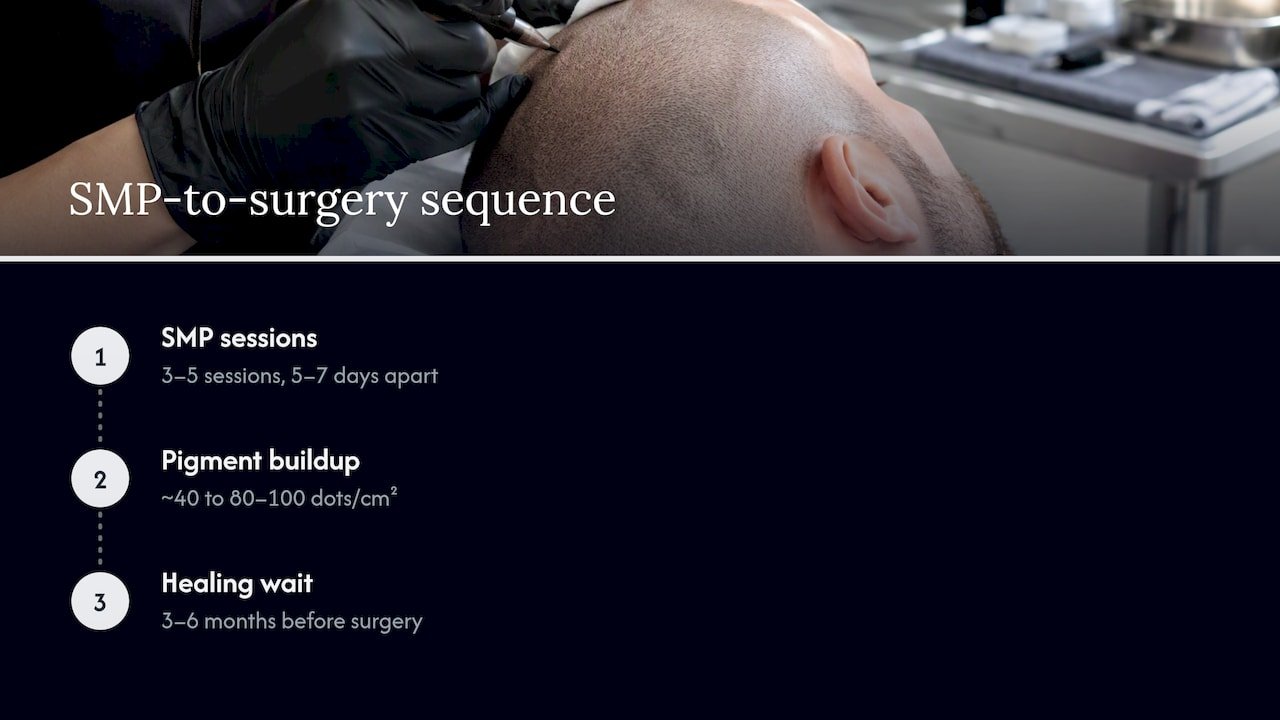
The 3 to 6 month window exists for two reasons: full healing and pigment stabilization. Fresh pigment looks darker and sharper than it will once it settles. A surgeon who operates too soon is working on a scalp that is still changing.
SMP itself is a multi-step process. A standardized protocol typically runs 3 to 5 sessions, spaced 5 to 7 days apart, building pigment density gradually from about 40 dots per cm² in the first session toward 80 to 100 dots per cm² by the last. Some clients need a corrective session after a longer evaluation of how well the pigment held. Add the healing wait, and an SMP-first plan realistically takes several months before surgery can be scheduled. Our own session-by-session guide walks through what each visit involves.
Why wait a year after a transplant
Grafts need time. Transplanted hair goes through a shedding phase and then regrows, and the final result is not visible for roughly 9 to 12 months. Pigmenting over grafts that have not matured risks poor pigment retention and can damage them. It also means you would be matching pigment to a result that is still changing.
For clients who come to us after surgery, we apply this conservatively. See our guide on waiting 11 to 12 months for SMP after a hair transplant for the detail.
When SMP first makes sense
Low donor density or advanced loss
This is the strongest case. A surgeon can only move so much hair. Writing in the ISHRS Hair Transplant Forum, Dr. William Rassman described patients with low donor density and a Class 4 or 5 pattern or greater as the group where the combination helps most. SMP provides a dark background that reduces scalp show-through, so the surgeon can reach an acceptable look with fewer grafts than would otherwise be needed.
That has a practical effect on your plan: grafts are a finite resource. If pigment can carry part of the density, the grafts you do have can go where real hair matters most, typically the hairline and frontal zone.
You want to try the shaved look first
Some men are not sure they want to keep hair at all. SMP lets you live with a closely shaved result before you commit to surgery. If you love it, you may skip the transplant entirely. If you do not, you have learned that before spending on grafts. Our page for men’s scalp micropigmentation explains the shaved-head approach.
Scarring from a previous procedure
If an earlier transplant left linear or dotted scarring, camouflage can come first. Scar tissue behaves differently from normal skin, so a small test patch matters. Practitioners use test patches to gauge scalp resistance, especially on scarred or atrophic tissue. Read our notes on test spots and SMP on scar tissue and hair transplant scar camouflage.
When to hold off
Your hair loss is still progressing
This is the question behind “progressive hair loss SMP.” SMP is static. Your natural hair is not. If you pigment a hairline today and keep losing hair behind it, you can end up with a pigmented line and a gap of bare scalp or thinning hair behind it. A transplanted hairline faces the same problem if loss continues, which is why surgeons often want stability or medical treatment first.
In a published case series on localized alopecia, researchers used as an inclusion criterion a stable condition with no progression for at least 6 months. That is a useful reference point, though it comes from a clinical study and not a rule for every client. If your pattern is still moving fast, a conservative, slightly higher hairline leaves room for change. Our guide to SMP for a receding hairline covers hairline design when loss is ongoing.
You change your hair color often
Pigment cannot be dyed. Patients who frequently change their natural hair color are poor candidates because they end up locked into one shade or struggling with hard-to-match touch-ups. If you are planning to keep and color transplanted hair, discuss this first.
You have an active scalp condition
Inflammation, redness or infection on the scalp is a reason to wait. Conditions such as psoriasis need to be stable first, as we explain in our psoriasis and SMP article. For a broader checklist, see am I a candidate for SMP.
Donor area questions: what SMP can and cannot do
Men often search for donor area SMP, donor depletion fixes and donor overharvest SMP after a transplant leaves the back or sides thin. Here is the honest version.
What it can do. When the donor area has healed, SMP can soften the contrast between short hair and visible scalp, and it can help hide small extraction marks or linear scars if you wear your hair short. The ISHRS notes that SMP can supplement a transplant, so the eye sees fullness and coverage where no additional hair exists.
What it cannot do. It cannot put hair back. It will not create real hair volume, texture, direction or movement, and it cannot fix raised or uneven scar texture. Pigment changes optical contrast. It does not change density. If a donor area is severely overharvested, SMP is camouflage, not repair and not new donor supply.
The practical consequence: if you are planning surgery, protect the donor area. Ask your surgeon how many grafts the area can safely give over your lifetime, not just for this procedure. Extra pigment before surgery can reduce how many grafts you need, and that keeps more donor hair in reserve for later.
Our perspective
We see the same pattern again and again. A man has a transplant, uses up much of his donor supply chasing density, and then comes to us to fix what grafts alone could not. Much of that could have been planned differently. Pigment is a good tool for density behind and between hair, and it is a poor tool for repairing something that has already been taken from the donor area.
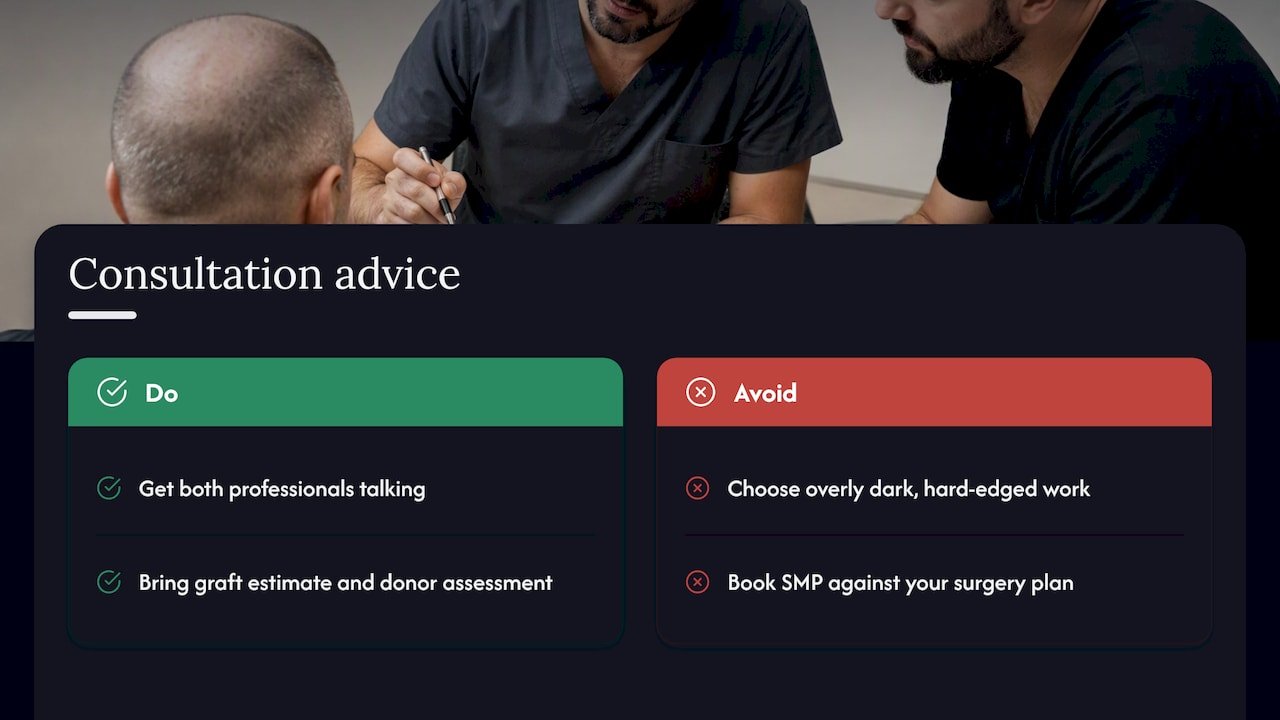
Our approach is conservative on purpose. We design hairlines that sit where they will still look right as you age, we choose pigment to suit your skin and your hair, and we document healed work so you can judge results after the pigment has settled, not just on the day. Overly dark or hard-edged work is the thing we see most often when we correct someone else’s SMP. It is much harder to lighten than to build.
Our advice for anyone weighing SMP before a transplant is to get the two professionals talking. Bring your surgeon’s graft estimate and donor assessment to your consultation. We would rather tell you that surgery should happen first, or that you do not need it at all, than book a session that works against your plan.
— James Christopher
Choosing who does your SMP
SMP breaks the skin, so hygiene and technique are not optional. The most frequent botched outcomes, such as blue-tinted pigment or unnatural hairlines, are typically linked to unlicensed practitioners, excessive pigment depth, or not accounting for how skin and aging shift the ink. Ask any provider for clear documentation of their sterilization process and the products they use, and look for single-use needles. Ask to see healed photos, not just fresh ones. Our results gallery shows work at different stages.
Also ask how touch-ups work. SMP fades gradually, and experts expect touch-ups every 5 to 10 years. We explain our own timing for existing clients in our touch-up schedule.
Planning SMP around your transplant with us
Enhanced Scalp is a scalp micropigmentation clinic based in Vaughan, Ontario, serving Toronto, the GTA and clients who travel from elsewhere in Canada and the United States. Our scalp micropigmentation treatment is priced at 3,000 to 4,000 CAD as a one-off. If you already have transplant scarring, our scar camouflage treatment is the relevant page, and women with thinning hair can read about female scalp micropigmentation. Start with a consultation and bring any surgical notes you have.
FAQ
How long should I wait between SMP and a hair transplant?
The standard recommendation is 3 to 6 months after SMP so the scalp heals and the pigment stabilizes. Your surgeon has the final say, so confirm the date with them before scheduling.
Will SMP damage my donor hair or stop a transplant from working?
SMP sits in the upper layers of skin, and transplant planning can account for it. The risk is more about timing and a stable plan than about the pigment itself. Tell your surgeon exactly where and when you were pigmented.
Can SMP fix an overharvested donor area?
Not in the sense of restoring hair. Once healed, it can soften scalp show-through and camouflage marks, but it is camouflage and not new donor supply.
Is SMP a good idea if my hair loss is still progressing?
It can be, with caution. A conservative hairline leaves room for change, but pigment will not move as your hair recedes. Many people wait until the pattern has settled or choose a design that allows for it.
Sources
- Scalp Micropigmentation (SMP): All You Need to Know, ISHRS
- Combining Scalp Micropigmentation and Hair Transplantation, Hair Transplant Forum International
- Scalp Micropigmentation Is an Effective Treatment for Localized Alopecia, PMC
- Combining Follicular Unit Extraction and Scalp Micropigmentation for the Cosmetic Treatment of Alopecias, PMC
- Standardization of SMP Procedure and Its Impact On Outcome, PMC
- Donor SMP Camouflage Limits, Diamond Hair Clinic

