 Skip to content


SMP dot size is the width of each tiny pigment deposit on your scalp, and it decides whether a shaved head looks like real stubble or like a dotted pattern. Natural follicle openings are roughly 0.1 to 0.2 mm across. The dots a skilled technician places are meant to read as follicles from a normal distance. Needle choice matters, but the bigger factors are depth, spacing and pigment, and a good result also depends on how those dots look after they heal, not on how they look on day one.
TL;DR
- Real follicle openings measure about 0.1 to 0.2 mm. Sources disagree on the exact target, so judge a clinic by healed photos rather than a single number.
- Depth drives dot size more than the needle does. Pigment placed too deep spreads, and dots grow blurry or blotchy over time.
- Dots shrink and soften as they heal, so a well-planned treatment is built in layers over several sessions rather than made as dark as possible on the first pass.
- Dot size, spacing and pigment tone work together. Changing one without the others is what produces the “painted on” look.
- Ask any provider to show healed results, ideally years old, and ask how they adjust technique across different parts of the scalp.
Table of Contents
- What a good SMP dot actually is
- How big are the dots, in numbers?
- Why depth matters more than the needle
- Dots shrink and fade: plan for it
- Dot size, spacing and pigment work as a system
- Special cases: scars, afro-textured hair and thinning hair
- Our perspective on dot size
- How to judge a provider’s dot work before you book
- What the process looks like
- Book a consultation with Enhanced Scalp
- FAQ
- Sources
What a good SMP dot actually is
Scalp micropigmentation (SMP) is a cosmetic tattoo technique. The ISHRS describes it as microscopic, pointillistic and shallow, with needle penetration depths usually around 0.5 mm across the scalp. Instead of drawing lines, the technician builds up thousands of small dots between the pores of the scalp. A paper in the Journal of Cutaneous and Aesthetic Surgery explains that this stippled effect is similar to a stippled painting, and that it can be done on a shaved head or with hair left longer.
So a “good” dot is not simply a small dot. It is a dot that:
- is close to the size of the follicle it imitates when viewed at a normal talking distance;
- has a soft, round edge rather than a bleeding, feathered one;
- sits at a consistent depth, so it fades evenly;
- has a tone that matches your natural hair colour and skin contrast.
SMP does not grow hair. It creates the look of density, and as dermatologists and hair specialists note through the ISHRS, it works best for people who want the appearance of a fuller head of closely cropped hair.
How big are the dots, in numbers?
This is where the internet gets confusing, because different sources describe different things: the needle, the deposit in the skin, and the dot as seen from outside.
| What is being measured | Typical figure | Comment |
|---|---|---|
| Natural follicle opening | About 0.1 to 0.2 mm | The visual target a dot imitates, per a technician certification resource |
| Visual stippling as perceived from the surface | About 0.1 mm | Cited by the same source as a clinical standard, though it notes opinions vary |
| Dot target for a grade 1 buzz cut | 0.8 to 1.2 mm | Same resource; this reads as the visible cluster or dot pattern matched to a short shaved look, not a single deposit |
| Needle depth | About 0.5 mm | ISHRS |
The sources do not fully agree, and we would rather say so than pick the neatest number. What they agree on is the principle: the visible dot should be small and follicle-like, not a blob. A single pigment deposit in the skin also looks slightly different from the same deposit viewed through the top layer of skin, which is why an artist working at a micro level cares about how a dot looks once it has settled.
If a clinic quotes you one confident millimetre figure as though it were a law of nature, treat it as marketing. A sound answer sounds more like: “It depends on your hair colour, your skin tone, how short you shave, and which part of the scalp we are working on.”
Why depth matters more than the needle
Most people assume a smaller needle gives a smaller dot. That is only half the story. According to the JCAS standardization paper, the visual size of a dot is determined at least as much by how deep the pigment goes as by the needle’s diameter.
Placed in the upper papillary dermis, pigment stays where it was put and looks crisp. Placed too deep, in the reticular dermis, it spreads. The result is a larger, blurrier dot, and over months it can look blotchy. A 2026 article from a hair loss resource makes the same point: SMP deposits pigment into the upper dermis to mimic closely shaved follicles.
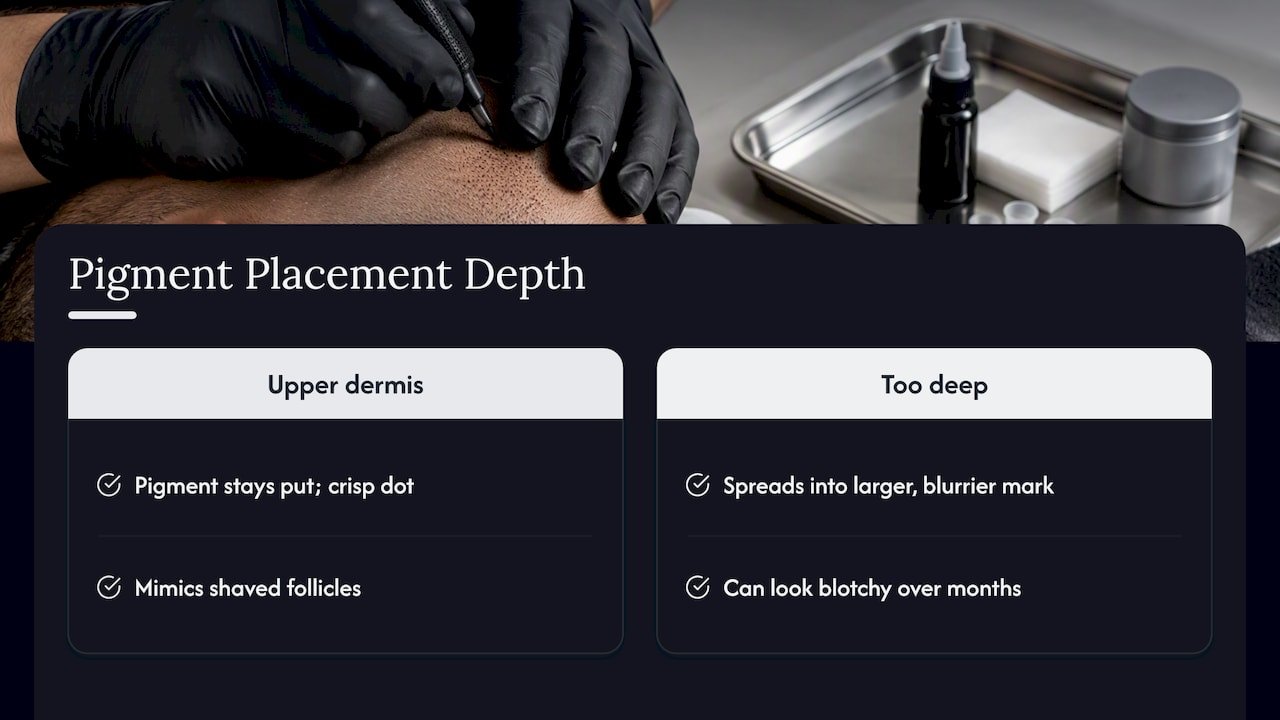
This is the mechanism behind the heavy, smudged look some people notice years after a poor treatment. The dots did not “grow” on their own. They were placed too deep, or too densely, and the pigment diffused.
The scalp is not one surface
The skin on your scalp is not uniform. An article in the Hair Transplant Forum International notes that epidermal thickness varies across the scalp, so a one-size-fits-all depth fails. A technician has to adjust pressure and penetration in real time, depending on the resistance they feel at the hairline, the crown, thinning areas or scar tissue.
That is why two clinics using the same needle can produce very different dots. The skill is in the hand, not just the hardware.
Dots shrink and fade: plan for it
Fresh dots look darker and slightly larger than they will once healed. Over the first days and weeks, the skin sheds the surface layer and the pigment settles. This is normal, and it is why one session is rarely the whole story.
Long term, fading is expected. Practitioners quoted in the JCAS paper’s summary describe the idea of permanence as more of a marketing term than biology, since the upper dermis turns over continuously. Another source puts touch-ups at roughly every 3 to 5 years, with oily skin, sun exposure and pigment type all influencing the speed. The same article suggests daily SPF 30 to 50 as the most effective way to slow UV-related fading.
If you want to understand how skin type, UV and upkeep play into how long a result looks sharp, a clinic guide on non-surgical hair restoration and aftercare is a useful additional read.
From a dot-size point of view, the practical lesson is this: a technician who builds density gradually, in layers, gives you the best chance of dots that stay crisp. One who goes heavy to give an instant “wow” is borrowing from your future appearance.
Dot size, spacing and pigment work as a system
You will see “smp pigment selection” and “dot spacing” discussed as separate topics online. In practice they are one decision.
Spacing
Spacing creates the impression of density. Dots placed too evenly look like a grid. Dots placed too tightly merge into a solid block. Real hair is irregular, so a believable result uses varied, random spacing, and denser placement in some zones than others. The hairline in particular should be softer, with sparser and slightly smaller dots at the very front, then increasing density behind it.
Pigment
Pigment type affects how a dot ages. Carbon-based pigments are described as preferable because they tend to fade toward a lighter version of the original tone rather than shifting to a blue or green cast that older tattoo inks can produce. Plastic surgery literature describes the move to newer carbon-based pigments as one of the most significant changes in SMP technique.
Matching pigment to your hair and skin matters because the dot is only convincing if its contrast against your skin is similar to what a real follicle would have. Pigment that is too dark for your natural hair colour is a classic giveaway.
Putting it together
| Choice | Too far one way | Too far the other way |
|---|---|---|
| Dot size | Large dots read as spots or a tattoo | Too tiny can look faint and need more sessions |
| Spacing | Gridlike or solid patches | Sparse, patchy, little density gain |
| Pigment tone | Harsh, flat black | Washed out, grey quickly |
| Depth | Blurs and spreads | Falls out and fades fast |
A conservative approach to all four is almost always the one that still looks natural five years later.
Special cases: scars, afro-textured hair and thinning hair
Scar tissue
Scarred skin behaves differently from healthy scalp skin. Pigment often fades faster there and the skin may take it unpredictably. The JCAS paper points toward a cautious, phased approach that starts with a small test patch to see how the specific scar tissue responds. Dot size and depth are often adjusted for these areas to blend them with surrounding hair-bearing skin. If you have transplant scars, our page on scar camouflage and our article on how a test spot predicts success on scar tissue explain the approach.
Afro-textured hair
Different hair texture and skin tone change needle, pigment and test choices. We cover this in what technicians change for afro-textured SMP.
Thinning hair and alopecia
When you still have hair, the aim is to reduce the contrast between hair and visible scalp. A study of localized alopecia cases describes SMP as an effective treatment for covering patches, and our guide to SMP for alopecia covers what to expect. For women with diffuse thinning, dots are typically planned around a part line and a shorter density goal, which is why we treat female scalp micropigmentation as its own service.
Our perspective on dot size
We think the obsession with a single “perfect” dot size misses the point. Nobody looks at your head under a microscope. They see a pattern from a few feet away, and the pattern has to behave like hair: irregular, slightly soft, and right for your colouring.

What we focus on instead is conservative hairline design, realistic follicle replication, and pigment chosen for your skin and hair. We would rather build a result across sessions and let it heal than push for a dark, dramatic first session that settles into something heavy. We also document healed work, because healed results are the only honest proof of dot size, spacing and depth. Anyone can show a photo taken the day after a session. Fewer can show it two years later.
We also see a lot of people who arrive after a previous treatment where dots were too large or too deep. Correcting that is harder than doing it right the first time, which is why we tell people to choose a provider on skill and evidence, not on the lowest price. A guide to when tattoo blowout calls for a cover-up versus laser shows why: once pigment has spread, your options narrow quickly.
— James Christopher
How to judge a provider’s dot work before you book
You do not need a ruler. You need the right questions and the right photos.
- Ask for healed photos. Look for results at least one year old, taken in natural light, with and without a close-up. The dots should look crisp and the hairline soft.
- Ask about depth and variation. A provider who can explain how they adjust for the hairline, crown, thin zones and scars understands the skin. One who says they use the same setting everywhere does not.
- Ask how many sessions they plan. Layering across sessions is a good sign. Promising a finished head in one sitting is not.
- Ask about pigment. You want a clear answer on the pigment type, how it ages, and how it is matched to you.
- Ask about the hairline. A conservative design that suits your age and face is better than a low, sharp, youthful line that will look odd as you age. Our piece on a low hairline that holds up over touch-ups goes deeper.
- Check the setting is regulated. In Ontario, SMP falls under personal service settings rules: premises are regulated under the Health Protection and Promotion Act and O. Reg. 136/18 and inspected by the local public health unit. In Toronto, that is handled through BodySafe. Ask to see the clinic’s current compliance, and ask which infection-control standards they follow.
One caution: if you have an active scalp condition such as psoriasis or seborrheic dermatitis, the ISHRS advises that it should be managed or resolved before treatment to avoid infection and poor pigment retention. See your dermatologist or family doctor first.
What the process looks like
A typical treatment is spread over multiple sessions so the dots can settle between visits and density can be added where it is needed. Our session-by-session guide to the SMP process describes what happens at each step, and our treatment guide covers preparation and aftercare. You can also browse our results gallery to see how healed work looks.
If you want to understand where SMP sits among other options, our overview of non-surgical hair loss solutions in Canada compares them honestly. For men with a classic pattern, see our pages on male pattern baldness and scalp micropigmentation for men.
Book a consultation with Enhanced Scalp
Enhanced Scalp is a clinic based in Vaughan, Ontario, serving Toronto, the GTA, the rest of Canada, the United States and international clients. Our scalp micropigmentation treatment is priced at $3,000 to $4,000 CAD as a one-off. We also treat people who need corrective work after a poor previous SMP, a failed transplant or laser removal. If you are not sure whether your current dots are the problem, send us photos and we will tell you honestly what we see.
Practitioners looking to learn can see our SMP training page.
FAQ
How big is an SMP dot?
There is no single agreed figure. Natural follicle openings are roughly 0.1 to 0.2 mm, and a technician aims for dots that read as follicles at normal viewing distance. The visible result also depends on depth, spacing and how the skin heals.
Do SMP dots get bigger over time?
Not by themselves, but pigment placed too deep can spread and look blurry or blotchy. Dots from skilled work generally shrink and soften as they heal and then fade gradually. If your dots look heavier than before, see a corrective specialist.
Does SMP fade, and how often are touch-ups needed?
Yes. One source suggests a touch-up is typically needed every 3 to 5 years, depending on skin type, sun exposure and pigment. Daily sunscreen helps slow fading on exposed scalp.
Can SMP make thin hair look thicker?
It can reduce the contrast between hair and scalp, which makes hair look denser. It does not grow hair, and it works best with a high contrast between your hair colour and skin, per the ISHRS.
What should I do if my SMP dots look too large or too dark?
Do not try to fix it yourself. Book an assessment with a corrective specialist who can look at the dots up close and tell you whether camouflage, lightening or laser is realistic. Laser can be expensive and carries a risk of scarring or pigment change, which is why provider skill matters up front.
Sources
- Standardization of SMP Procedure and Its Impact On Outcome, JCAS
- Scalp Micropigmentation (SMP): All You Need to Know, ISHRS
- Scalp Micropigmentation: A Concealer for Hair and Scalp Deformities, PMC
- Combining SMP and Hair Transplantation, Hair Transplant Forum International
- SMP Techniques & Tools 2, practice questions
- Scalp Micropigmentation: What to Know Before You Book
- Permanent Scalp Micropigmentation, Plastic Surgery Key
- Scalp Micropigmentation for Localized Alopecia, PMC
- Personal Service Settings in Ontario, Hadri Law
- About BodySafe, City of Toronto

