 Skip to content

Scalp micropigmentation can be an option for people with a history of scalp psoriasis, but only once the scalp is stable and free of active flares. Active inflammation is a genuine contraindication, not a minor caveat. Some clinics experienced with conservative designs and healed-work documentation treat this as a two-step decision: get cleared by a dermatologist, then get assessed by a qualified SMP practitioner before booking anything.
TL;DR:
- SMP should only be performed when the scalp is completely stable with no active psoriasis flares or lesions for at least several months, often years for scar-prone skin.
- Active inflammation, recent treatment changes, or infections on the scalp greatly increase the risk of poor pigment retention and complications during healing.
- Proper depth control and staged sessions are critical, especially on scarred or inflamed tissue, to prevent pigment migration or uneven fading.
- Treatments typically last four to six years before requiring touch-ups, with scar tissue potentially fading faster than healthy skin.
- A dermatologist’s clearance and detailed medical history are essential for assessing if a patient is suitable for SMP and to ensure safe and effective results.
Table of Contents
- Who Is a Good SMP Candidate With Scalp Psoriasis?
- How Does SMP Actually Work on Sensitive Skin?
- What Results Can You Realistically Expect?
- What Are the Risks and When Should You Avoid SMP?
- How Do You Prepare for and Recover From SMP?
- How Enhanced Scalp Evaluates Clients With Prior Scalp Inflammation
- What Actually Matters More Than the SMP Itself
- Ready to Talk to a Clinic That Handles These Cases?
- Sources
- FAQ
Who Is a Good SMP Candidate With Scalp Psoriasis?
A “stable” scalp means no active flares, no open or scaling lesions, and no recent change in your psoriasis treatment regimen. Most experienced practitioners want to see that stability hold for a meaningful period, not just a brief good week. Professional guidance from the International Society of Hair Restoration Surgery treats active scalp inflammation as a contraindication and recommends waiting until the disease is quiet before treatment begins. For conditions with active scarring behavior, some practitioners talk in terms of years rather than months.
Beyond active flares, several other factors can push a consultation toward “not yet” or “not here”:
- Active infection anywhere on the scalp
- A personal or family history of keloid scarring
- Uncontrolled systemic conditions affecting immune response or wound healing
- Certain medications that thin blood or suppress immune function, pending physician clearance
- Recent changes to topical or systemic psoriasis treatment within the past few weeks
Dermatology clearance matters here because psoriasis behaves unpredictably. A patch that looks calm today can flare under mechanical stress, and repeated needle contact is exactly that kind of stress. A joint evaluation, dermatologist plus SMP practitioner, catches things a cosmetic consult alone would miss, especially on scalps that have dealt with alopecia alongside inflammatory skin issues.
Pro Tip: Bring your dermatologist’s notes to your first SMP consultation, even informal ones. A practitioner who knows your flare history and treatment timeline can plan a much more conservative first session than one working blind.
How Does SMP Actually Work on Sensitive Skin?
SMP replicates the look of hair follicles by depositing pigment into the scalp’s upper dermis, roughly half a millimeter deep, using techniques similar to those in permanent makeup. That depth matters enormously. Go too shallow and the pigment fades fast or looks blotchy. Go too deep and it migrates, spreading and blurring under the skin, which is a bigger risk on scalps with altered texture from past inflammation or scarring.
- Depth and needle selection. Practitioners choose single or triple-pronged needles depending on the zone being worked and the skin’s current condition, adjusting for any fibrosis or unevenness left behind by prior flares.
- Randomized microdot placement. Dots under half a millimeter wide are placed in a deliberately irregular pattern, since real hair follicles never grow in neat rows.
- Staged density building across three sessions. Density is layered in gradually rather than achieved in one pass, which reduces the risk of over-saturation and gives the skin time to show how it’s responding.
- Pigment chemistry suited to the skin. Iron-oxide and carbon-based formulations are standard because they hold their tone and resist the color shifts (often a blue or green cast) that lower-quality pigments develop over years.
On previously inflamed or scarred tissue, a skilled practitioner slows the whole process down. That can mean lower initial density, longer gaps between sessions to properly assess healing, and a willingness to stop early if the skin isn’t responding the way it would on unaffected scalp. This is also where practitioner experience shows up directly in the training and technique behind the work, since consistent depth control takes real repetition to master.
What Results Can You Realistically Expect?
The best available evidence on SMP outcomes comes from a peer-reviewed case series that tracked ten patients through a standardized three-session protocol.
By the numbers: Patients in the study averaged a visual density score of 8.7 out of 10 immediately after treatment, with a mean patient satisfaction score of 2.7 out of 3, according to the case series published on scalp micropigmentation outcomes. Scarring cases faded somewhat faster than standard androgenetic cases over the following six months.
That last detail is directly relevant if your scalp carries any psoriasis-related scarring or texture change. Fibrotic tissue holds pigment less evenly than smooth, unaffected skin, so touch-ups may land on a shorter cycle for scarred zones than for the rest of the scalp.
A few practical expectations to set going in:
- Final healed appearance typically settles 4 to 6 weeks after your last session, not right after you leave the chair.
- Most people get 4 to 6 years out of a treatment before a touch-up is needed, depending on sun exposure and skin type.
- SMP is a cosmetic camouflage technique, not a hair regrowth treatment. It won’t change what’s happening biologically under the skin.
That last point trips people up more than any other. SMP makes hair loss look better. It does nothing to your psoriasis itself, and it won’t stop future flares.
What Are the Risks and When Should You Avoid SMP?
Active inflammation is the single biggest risk multiplier here. It raises the odds of infection during healing and makes poor pigment retention far more likely, since inflamed tissue simply doesn’t hold ink the way calm skin does. Keloid-prone skin and pigment allergies deserve equal weight as contraindications, even though they get discussed less often than the psoriasis question itself.
Technical complications add another layer:
- Pigment migration from needle placement that goes too deep, causing blurred or smudged dots months later.
- Uneven fading on fibrotic or scarred tissue, since scar tissue absorbs and holds pigment differently than healthy skin.
- Patchiness in areas where prior scarring created inconsistent skin texture across the treated zone.
- Infection or allergic reaction, both flagged by Cleveland Clinic as standard procedural risks that unsterile technique or unsuitable pigment can trigger.
Pro Tip: If a practitioner doesn’t ask about your inflammation history before quoting you a price, that’s a red flag. Sterile technique and a genuine intake process should come before any conversation about scheduling.
The mitigation here isn’t complicated: work with a medically trained practitioner, confirm sterile technique before you sit down, and get dermatology clearance whenever there’s any doubt about current scalp status.
How Do You Prepare for and Recover From SMP?
Preparation starts well before your appointment, and aftercare determines whether the result holds up.
- Before your appointment, document your psoriasis history and bring dermatology notes if you have any. Only pause topical treatments on your clinician’s specific instruction, and avoid blood thinners unless a physician has cleared it.
- In the first 7 to 14 days, skip washing, heavy sweating, and any chlorinated or salt water contact. Follow the clinic’s topical aftercare exactly, and watch for signs of infection like unusual redness, warmth, or discharge.
- Expect a temporary dip in color, sometimes called a “phantom fade,” during that same healing window as the outer skin sheds. Don’t judge your results from photos taken in week one. The real baseline only shows up around 4 to 6 weeks out.
- Long term, protect the scalp from sun exposure with SPF or physical coverage, and plan on periodic touch-ups as pigment naturally softens over the years.
How Enhanced Scalp Evaluates Clients With Prior Scalp Inflammation
Some scalp micropigmentation providers specialize in ultra-natural shaved-head results and corrective work, including cases where a previous SMP attempt or a challenging scalp condition needs careful handling. Every consultation for a client with a history of scalp inflammation starts with a straightforward question: is this scalp actually stable right now, or does it just look that way today?
When history warrants it, Some providers encourage coordination with a client’s dermatologist before committing to a treatment plan. Pigment selection and hairline conservatism get adjusted accordingly, favoring density and tone choices that age well on tissue that’s been through inflammation before. The goal is a healed result that still looks right in five years, not just on day one.
What Actually Matters More Than the SMP Itself
The conventional advice on this topic treats “can I get SMP with psoriasis” as a yes or no question. It isn’t. It’s a timing question, and most of the anxiety around it comes from treating a management issue like a permanent verdict.
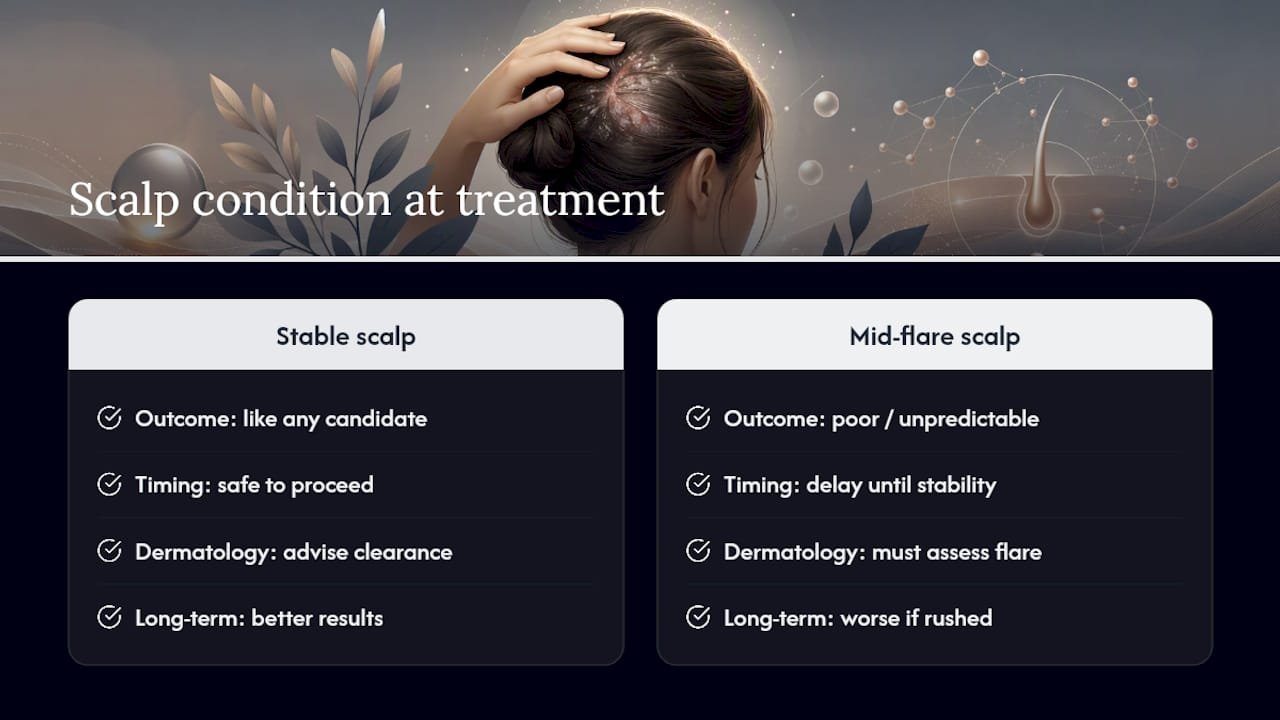
Here’s what the evidence actually supports: SMP outcomes depend far more on tissue condition at the time of treatment than on whether psoriasis ever existed in someone’s history. A scalp that’s been stable for a meaningful stretch behaves like any other candidate scalp. One that’s mid flare doesn’t, regardless of how much someone wants ink that day.
Where most guidance falls short is skipping the dermatology handoff. Plenty of SMP marketing implies a technician alone can make this call. They can’t, not responsibly. The people getting the best long-term results are the ones who treated the waiting period as part of the process instead of an obstacle to rush past. If you’re reading this because you’re impatient to book, that impatience is exactly the thing to manage first.
— James Christopher
Ready to Talk to a Clinic That Handles These Cases?
If your scalp history includes psoriasis, prior scarring, a previous SMP that didn’t heal well, or a laser removal attempt, you need a consultation that treats those details as central, not incidental. Enhanced Scalp works with density SMP for thinning hair, scar camouflage, corrective SMP for failed prior work, and coverage for alopecia, always starting from a conservative design philosophy rather than pushing for maximum darkness on day one.
Bring photos of your scalp at rest, any dermatologist notes you have, and a current medication list to your consultation. A responsible clinic will assess scalp stability, walk through realistic timeline expectations, and build a design plan around what your skin can actually support long term, not just what looks good in a mockup. For readers whose main concern is scarring specifically, the scar camouflage service page covers that scenario in more depth. To get started, book a scalp micropigmentation consultation and bring your questions with you.
This article is general information, not a substitute for advice from a qualified doctor. Consult a qualified healthcare professional about your own circumstances before acting on anything here.
Sources
- Scalp micropigmentation is an effective treatment for localized alopecia: technical analysis and a series of ten case reports
- Scalp micropigmentation: before & after, benefits, side effects — Cleveland Clinic
- ISHRS: Micropigmentation of the scalp
FAQ
Can you get SMP if you have scalp psoriasis?
You can be a candidate if your psoriasis is currently stable with no active flares, open lesions, or recent treatment changes, and a dermatologist has cleared the skin for the procedure.
How long should scalp psoriasis be inactive before SMP?
There’s no universal number, but professional guidance treats active inflammation as a contraindication and generally calls for an extended flare-free period, sometimes discussed in years for scarring-prone conditions, confirmed case by case with your dermatologist.
Does SMP make psoriasis worse?
SMP doesn’t treat or worsen the underlying disease itself, but performing it during an active flare raises the risk of infection and poor pigment retention, which is why timing matters so much.
How long does SMP last on a scalp with a psoriasis history?
Most people see 4 to 6 years before a touch-up is needed, though areas with prior scarring may fade faster than unaffected skin and need earlier attention.
Is SMP the same as a psoriasis treatment?
No. SMP is a cosmetic tattooing technique that camouflages hair loss and scalp discoloration. It does nothing to treat psoriasis itself, and ongoing dermatologic care still matters separately.

