 Skip to content

Yes, SMP can be edited. Professionally performed corrective SMP or a targeted touch-up by a specialist is usually the best first option. Removal is possible but more involved. The right path depends on what went wrong, how deep the pigment sits, and whether the existing work is salvageable.
Here is what to do next:
- Consult a corrective SMP specialist before committing to any approach. A consultation should include a review of your healed scalp, not just fresh photos.
- Evaluate the portfolio. Ask to see healed corrective cases specifically, not just initial SMP results. Clinics like Enhanced Scalp document healed before-and-after work for exactly this reason.
- Decide between touch-up and removal based on pigment depth, color shift, and whether the original design is worth keeping. Superficial, faded, or unevenly distributed pigment often responds well to corrective SMP. Deeply placed or badly discolored pigment may require laser removal first.
Key Takeaways
Professional corrective SMP from a specialist is the most reliable first option for fixing poor or aging scalp micropigmentation, with removal reserved for deeply placed or severely color-shifted pigment.
| Point | Details |
|---|---|
| Corrective SMP beats DIY fixes | Specialist corrective work addresses pigment depth, color, and design in ways no at-home product can. |
| Removal is gradual and multi-session | Laser removal typically requires 6–10 sessions spaced 4–8 weeks apart before new SMP can begin. |
| Well-placed SMP lasts 5–10 years | UV exposure is the primary driver of premature fading; SPF 30–50+ after healing extends results. |
| Red flag: single-session fix promises | Any provider promising dramatic correction in one session is not being realistic about the biology. |
| Enhanced Scalp for corrective cases | Enhanced Scalp specializes in corrective SMP, scar camouflage, and removal pathways with documented healed results. |
Table of Contents
- What does SMP editing mean, and what problems usually cause it?
- What are the real options for fixing SMP?
- Why is corrective SMP technically harder than initial work?
- What should you expect from the timeline and aftercare?
- How do you choose the right specialist for corrective work?
- What are the real risks and limitations?
- How does a specialist clinic approach corrective SMP?
- What affects the cost of SMP correction?
- The honest truth about when not to add more pigment
- Enhanced Scalp specializes in corrective SMP
- Sources
- FAQ
What does SMP editing mean, and what problems usually cause it?
“SMP editing” is an informal phrase for what the industry calls corrective scalp micropigmentation: touch-ups, color correction, camouflage, targeted densification, or removal performed after an initial SMP treatment. The Cleveland Clinic describes SMP as a noninvasive cosmetic procedure that uses fine needles to deposit medical-grade pigment into the scalp. When that process goes wrong, or when results age poorly, corrective work becomes necessary.
The most common problems that prompt editing:
- Overly dark or oversized dots that look like a solid block rather than individual follicles
- Blurring and migration, where pigment spreads beyond the original dot boundary, often from excessive depth or overworking the skin
- Unnatural hairline design, including hairlines placed too low, too sharp, or geometrically inconsistent with the face
- Uneven density, with patchy areas or visible gaps between treated zones
- Color shift to blue or green, a sign of pigment placed too deep or the wrong pigment type used
- Scarring complications, including transplant scars or alopecia-related scarring that retained pigment differently than surrounding skin
- Fading and contrast loss over time, prompting a refresh
On permanence: ISHRS guidance notes that well-placed SMP commonly lasts 5–10 years, with UV exposure and immune clearance gradually fading the pigment. That fading is normal. What is not normal is rapid color shift, blurring within months, or uneven fading that creates a patchy, unnatural appearance. Those outcomes usually point to technique errors, not just time.
What are the real options for fixing SMP?
Each corrective method suits a different problem. Choosing the wrong one wastes time and money, and can make the scalp harder to work on afterward.
| Method | Best For | Typical Sessions | Key Limitation |
|---|---|---|---|
| Targeted touch-up | Faded patches, minor density gaps | 1–2 | Only works if design is sound |
| Corrective SMP / blending | Hairline redesign, density redistribution | 3–5+ | Requires conservative layering |
| Laser removal (picosecond) | Deep pigment, severe color shift | 6–10 | Gradual; 4–8 week spacing needed |
| Saline / salabrasion | Partial lightening before new SMP | Variable | Higher irritation risk, inconsistent results |
| Topical removers | Surface-level lightening | Variable | Limited penetration; niche use |
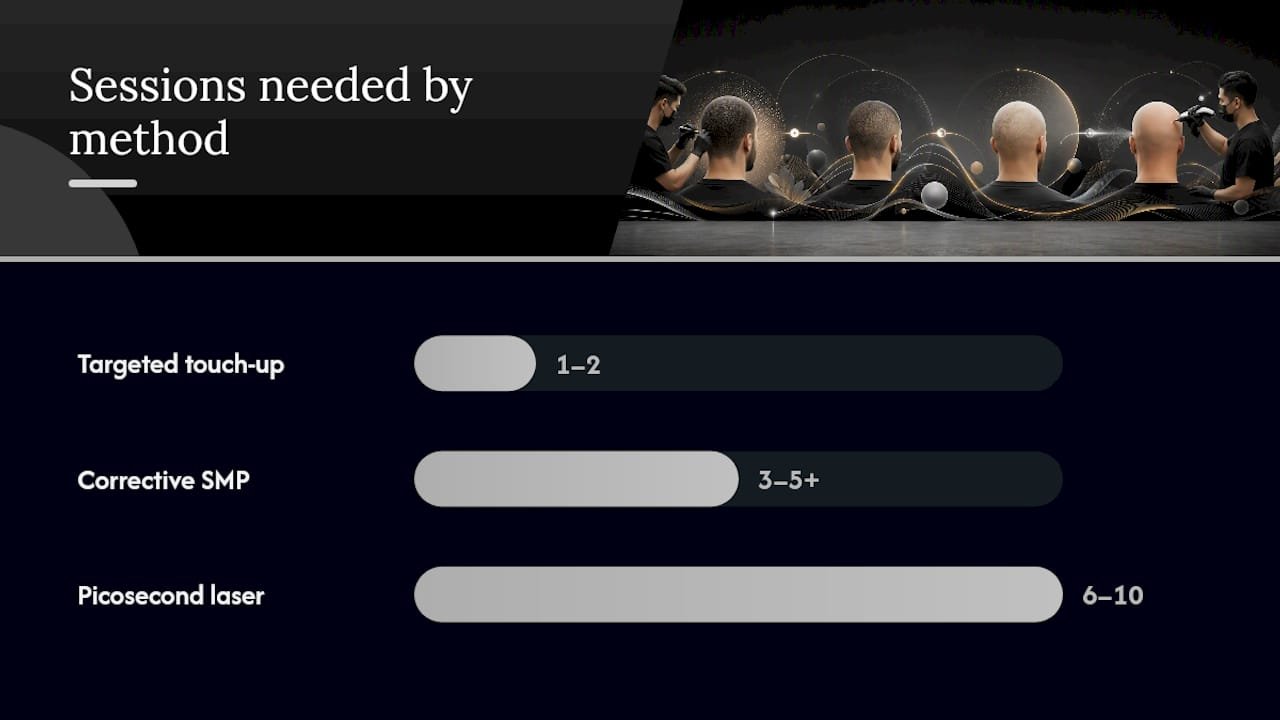
Touch-ups and corrective SMP are the right call when pigment is superficial and the original design is salvageable. A specialist will layer conservatively over one to several sessions, using randomized dot patterns and soft edge work to blend old pigment with new.
Laser removal becomes necessary when pigment has shifted to blue or green, sits too deep for blending, or when starting fresh is the only realistic option. Picosecond lasers fragment pigment gradually, and most cases need 6–10 sessions spaced 4–8 weeks apart. Pigment placed deeper takes longer to clear.
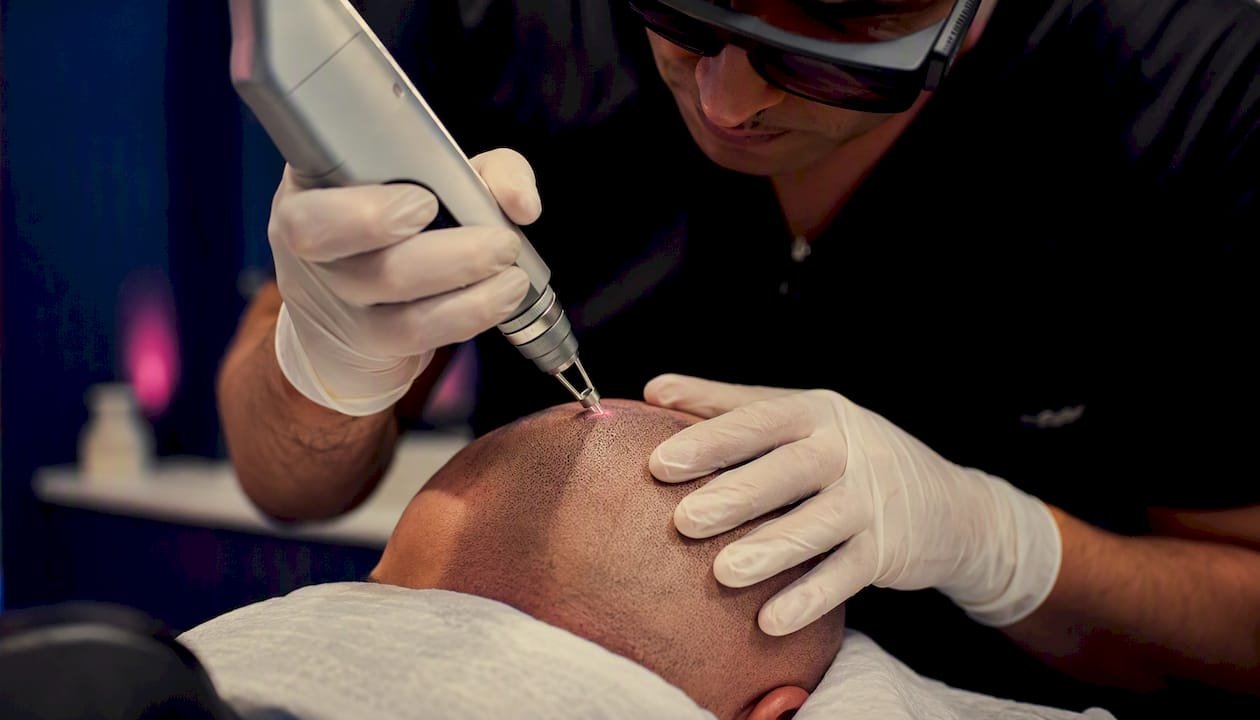
Saline and salabrasion are niche tools, sometimes used to lighten a specific zone before new SMP is applied. Results vary more than laser, and irritation risk is real. Topical removers have even more limited penetration and are rarely a standalone solution.
A key principle from ISHRS: partial removal is often visually mismatched. Full-area strategies tend to produce more even results than spot removal.
Why is corrective SMP technically harder than initial work?
Starting fresh on a clean scalp is straightforward compared to working over existing pigment. Several factors compound the difficulty:
- Scar tissue changes skin resistance. Instrument settings often need adjustment, including rotor speed and needle configuration, and healed photos must be tracked across months because scar tissue retains pigment unpredictably.
- Existing pigment constrains color matching. You cannot simply layer a new tone over a blue-shifted base and expect a neutral result. The underlying color bleeds through.
- Depth control is more critical. The Journal of Cosmetic Dermatology notes that pigment should stay above the dermal papillary layer and below the basal epidermal layer. Hemorrhage during application signals over-penetration. On a scalp with prior pigment, the margin for error narrows.
- Zero-bleeding protocol matters more. Overworking already-treated skin increases migration and blurring. A conservative, stepwise approach is not optional.
Pro Tip: Plan for staged layering across multiple sessions rather than trying to fix everything at once. A single heavy correction session almost always creates new problems. The goal is gradual improvement, not a dramatic single-session transformation.
What should you expect from the timeline and aftercare?
A corrective SMP path typically mirrors the incremental protocol of initial SMP. The Journal of Cosmetic Dermatology documents protocols using 3–5 sessions with staged dot-density progression from approximately 40 to 80–100 dots per cm². Corrections follow the same incremental principle, adjusted for existing pigment.
Healing after each SMP session:
- Immediate darkening is normal; pigment softens over 7–14 days
- Redness typically resolves within 24–72 hours
- Microdot technique avoids heavy scabbing when done correctly
Aftercare essentials:
- Avoid washing or soaking the scalp for at least 72 hours after each session
- Apply SPF 30–50+ consistently once healed; UV exposure is the primary driver of premature fading
- Avoid alcohol-based products on the scalp during the early healing window
- Follow your clinic’s specific product guidance, which may differ from generic aftercare advice
If laser removal is part of the plan, expect a different healing course: more redness, possible blistering, and longer spacing between sessions (4–8 weeks). The overall timeline from consultation to a fully healed corrective result can range from a few weeks for a simple touch-up to many months when removal precedes new SMP.
Timeline reality check: A simple touch-up may be complete in 4–6 weeks. A full corrective path involving laser removal followed by new SMP can take 6–12 months or longer.
How do you choose the right specialist for corrective work?
Corrective SMP is a different skill set from initial SMP. Not every practitioner who does standard treatments is equipped for corrections.
Checklist before booking:
- Specialized SMP training with documented certification, not general tattooing credentials
- A portfolio of healed corrective cases, not just fresh results
- A documented conservative design philosophy, with written notes on hairline decisions
- Safety protocols: sterility standards, patch testing, and a zero-bleeding approach
- Experience with laser removal or established medical partnerships for cases requiring it
- A clear, staged consultation process before any deposit is taken
Questions to ask during your consultation:
- “Can you show me healed photos of corrective cases similar to mine?”
- “How many sessions do you expect, and what is your revision policy if results are unsatisfactory?”
- “Do you offer laser removal in-house, or do you refer out? Who are your partners?”
- “What pigment types do you use, and how do they behave over time?”
Red flags in the answers:
- Promises of a single-session fix for complex corrections
- Reluctance to show healed corrective photos
- Use of traditional tattoo equipment on the scalp
- Pressure to pay in full before a staged plan is agreed upon
What are the real risks and limitations?
Corrective SMP carries genuine risks, and anyone considering it deserves a clear picture.
- Allergic reaction to pigment, though rare, is possible; patch testing before a full session reduces this risk
- Blurring and migration can worsen if a correction is applied too aggressively over existing pigment
- Hairline mismatch, where a corrected line does not align with natural facial proportions
- Uneven fading after correction, particularly over scar tissue, which retains pigment differently
- Removal is often all-or-nothing. Partial laser removal frequently leaves visible demarcation lines
Retrospective clinical observations published on PubMed link the majority of poor SMP outcomes to procedures performed in non-specialized settings. Correcting those results is significantly harder than initial work and often requires a multidisciplinary approach.
Attempting corrective SMP without a thorough assessment of pigment depth, skin condition, and prior technique is one of the most reliable ways to make a bad result worse. The most important decision is not which method to use, but who performs it.
Red flags to avoid:
- Treatments offered in beauty salons or general tattoo studios without dedicated SMP training
- Technicians who cannot explain pigment depth or dot-density protocols
- Providers who guarantee dramatic results in one session
- No documentation of healed cases, only fresh post-treatment photos
How does a specialist clinic approach corrective SMP?
A well-run corrective SMP clinic follows a structured process that prioritizes long-term healed appearance over immediate visual impact.
- Conservative consultation: assessment of existing pigment depth, color, and skin condition before any plan is proposed
- Staged sessions: no single-session overload; each pass builds on the last with healing time between
- Careful pigment selection: matching to existing skin tone and underlying pigment, not just the desired final color
- Conservative hairline design: soft, age-appropriate edges that account for potential future hair loss
- Clear removal pathways: when correction is not viable, a referral or in-house laser option should be available
Trust signals to request from any clinic:
- Healed before-and-after gallery with case notes, not just immediate post-treatment photos
- Practitioner certifications and training history, including any specialist SMP training
- Written documentation of safety protocols: sterility, patch testing, zero-bleeding approach
- Written aftercare guidance specific to corrective work
A clinic that cannot show you healed corrective cases is a clinic that has not done enough of them. Healed photos are the only honest measure of a practitioner’s real-world results.
Enhanced Scalp documents healed corrective cases, including clients with prior poor SMP, failed hair transplants, and transplant scar camouflage, as part of its standard consultation process.
What affects the cost of SMP correction?
Corrective SMP pricing varies widely because the scope of work varies widely. No single figure applies across cases.
Primary cost drivers:
- Area size and complexity: a small patch correction costs far less than a full-scalp redesign
- Whether removal is needed: laser sessions add significant cost and time before new SMP can begin
- Degree of scar tissue: scarring alopecia or transplant scars require adjusted technique and often more sessions
- Number of corrective sessions: a simple touch-up may need one or two; a full correction can require five or more
- Practitioner expertise and location: specialist corrective clinics command higher rates than general studios, for good reason
- Aftercare products and revision guarantees: some clinics include these; others charge separately
Pricing advice: get a phased quote that breaks down consultation, per-session costs, and a removal estimate if applicable. A very low up-front price for corrective work is a warning sign, not a bargain. The cost of fixing a botched correction is always higher than the cost of doing it right the first time.
Cost reality: Touch-up sessions for minor fading are the least expensive corrective option. Full corrective paths involving laser removal followed by new SMP represent the most significant investment, both financially and in time.
The honest truth about when not to add more pigment
Corrective SMP done well is about long-term healed appearance and mental well-being, not quick cosmetic fixes. That distinction matters in practice, not just in principle.
SMP is a 2D illusion. Pigment reduces the contrast between the scalp and existing hair, but it cannot create actual hair, texture, or volume. For women with diffuse thinning, density SMP can work extremely well when enough existing hair remains to provide real 3D texture. The pigment fills in the visual gaps; the hair does the structural work.
For men wearing longer hair, the calculus is different. Male pattern hair loss can continue progressing. A density treatment that looks natural today can become exposed as the surrounding hair disappears, leaving a pigmented scalp with no hair to blend into.
This is the slippery slope of density SMP: continually adding pigment to compensate for advancing hair loss eventually creates an oversaturated scalp that no longer looks natural. The responsible recommendation, sometimes, is to stop adding pigment and consider transitioning to a shaved look instead. Good corrective SMP includes knowing when correction is not the answer.
Enhanced Scalp specializes in corrective SMP
Corrective SMP requires a different level of skill than standard initial treatments, and the difference shows in healed results. Enhanced Scalp focuses specifically on clients with prior poor SMP, failed hair transplants, and challenging scalp conditions, using conservative staged sessions, careful pigment selection, and clear removal pathways when needed.
View the healed-case gallery to see documented corrective results, then book a consultation to discuss your specific situation. The consultation covers pigment depth assessment, a realistic session estimate, and removal options if applicable. No pressure, no single-session promises.
Sources
- Retrospective observations: poor SMP outcomes from non-specialized settings
- Scalp micropigmentation: technical analysis and case series (Journal of Cosmetic Dermatology)
- Scalp micropigmentation — Cleveland Clinic
This article is general information, not a substitute for advice from a qualified doctor. Consult a qualified healthcare professional about your own circumstances before acting on anything here.
FAQ
Can SMP be corrected after a bad result?
Yes. Corrective SMP, laser removal, or a combination of both can address most poor outcomes. The right approach depends on pigment depth, color shift, and whether the original design is salvageable.
How many sessions does corrective SMP take?
Most corrective paths require multiple sessions. Simple touch-ups may need 1–2; full corrections or redesigns typically follow the same 3–5 session incremental protocol as initial SMP, sometimes more.
How long does SMP last before it needs a touch-up?
Well-placed SMP commonly lasts 5–10 years, per ISHRS guidance. Most clients need a first touch-up around 12–18 months after initial treatment, with maintenance every 2–4 years depending on sun exposure and skin type.
What are the biggest red flags when choosing a corrective SMP clinic?
Promises of a single-session fix, no healed corrective case portfolio, use of traditional tattoo equipment, and pressure to pay in full before a staged plan is agreed upon are all serious warning signs.
Does Enhanced Scalp handle corrective SMP cases?
Yes. Enhanced Scalp specializes in corrective SMP for clients with prior poor work, failed hair transplants, and scar tissue, using conservative staged sessions and documented healed results. Consultations include a pigment depth assessment and a realistic treatment plan.

