 Skip to content

Most scalp micropigmentation treatments typically fall within a common price range, depending on coverage area, clinic location, and practitioner experience.
Here’s what that looks like in practice:
- Small area (hairline, temples, or scar patch) usually costs less than medium coverage.
- Medium coverage (partial density, receding hairline with crown thinning) falls into a mid-range price band.
- Full scalp coverage (complete shaved-head illusion) is more expensive, reflecting the increased work involved.
Most treatments require multiple sessions, typically several spaced out over weeks; a single session quote generally does not reflect the total cost. The sections below break down what drives those numbers, how to read a quote, and what a professional package should actually include.
Pro Tip: Ask for a total-treatment price upfront, not a per-session rate. Clinics that quote only per-session often add sessions later, and the final bill can exceed what a transparent package would have cost from the start.
Key Takeaways
Full-scalp SMP typically costs $2,500–$5,000 USD (or $3,200–$6,500 CAD) across 3–4 sessions, with touch-ups every 3–6 years running $200–$800 USD each.
| Point | Details |
|---|---|
| Realistic price bands | Small area: — USD; medium: $2,000–$3,500 USD; full scalp: $2,500–$5,000 USD. |
| Six cost drivers | Area, practitioner experience, sessions, city overhead, pigment quality, and skin/scar complexity explain nearly every quote difference. |
| Always request a total-treatment quote | Per-session pricing often omits additional sessions and touch-ups, making the final cost higher than a transparent package. |
| Touch-up costs and longevity | Expect touch-ups every 3–6 years at $200–$800 USD; a 10-year full-scalp cost runs approximately $4,500 USD total. |
| Enhanced Scalp | Offers total-treatment packages with documented healed results, written touch-up policies, and corrective experience for complex cases. |
Table of Contents
- What makes SMP cost vary so much between quotes?
- What are realistic SMP price ranges by coverage area?
- How do multiple sessions add up in time and cost?
- How long does SMP last, and what do touch-ups cost?
- How do you evaluate an SMP quote and spot red flags?
- How does SMP cost compare with hair transplants and medical therapy?
- Why does cheap SMP often cost more in the long run?
- What does a professional SMP package actually include?
- What the price conversation is really about
- Enhanced Scalp offers transparent pricing and documented healed results
- Sources
- FAQ
What makes SMP cost vary so much between quotes?
Price differences in scalp micropigmentation aren’t random. A 6-factor framework accounts for nearly every meaningful gap between quotes:
- Treatment area and extent: A hairline touch-up takes 2–3 hours. A full Norwood 6 scalp takes 4–6 hours per session. More surface area means more time, more pigment, and more sessions.
- Practitioner experience and reputation: A technician with 500 completed cases and documented healed results commands a different rate than someone 30 cases in. Clinics that also offer SMP training typically sit at the top of the quality band, and their pricing reflects that.
- Number of sessions required: Complex cases, dense scarring, or correction work from prior poor SMP add sessions. Each additional session adds cost.
- City and clinic overhead: A clinic in Toronto or Vancouver carries significantly higher rent and operating costs than one in a mid-size Canadian city. That overhead lands in your quote.
- Pigment and equipment quality: Medical-grade pigments formulated specifically for scalp use cost more than generic tattoo inks. The difference shows up in how the work heals and how long it holds color.
- Skin and scar complexity: Scar tissue absorbs pigment differently and often requires more passes, more sessions, and more precision. Scar camouflage work is consistently priced higher than standard coverage for that reason.
Female SMP adds another variable. Techniques for women with thinning hair differ from the shaved-head approach used for men. The work is often more intricate, blending pigment into existing hair rather than creating a uniform follicle pattern, which can push pricing toward the upper end of the medium-coverage band.
When you look at a quote, each line item should map to one of these factors. Physician supervision, medical-grade pigment disclosure, and a documented healed-photo portfolio are signals that the higher price reflects real overhead, not just marketing.
Pro Tip: When comparing quotes, ask specifically: “What pigment brand do you use, and is it formulated for scalp?” A clinic that can’t answer that clearly is worth noting.
What are realistic SMP price ranges by coverage area?
The benchmarks below reflect 2026 pricing across the U.S. and Canada, covering typical professional clinics and dedicated SMP studios. They exclude training-clinic discounts and outlier premium artists.
A few practical notes on reading these ranges:
- Under $2,000 USD for a full scalp is a red flag. That price point typically signals entry-level work, limited coverage, or a training-clinic model where you’re part of someone’s learning curve.
- $2,500–$4,500 USD is the professional sweet spot for most full-scalp treatments in mid-size North American markets.
- $5,000+ USD usually reflects premium artists in high-demand metros like Toronto, New York, or Los Angeles, or genuinely complex corrective cases.
Toronto and Vancouver often have higher pricing than smaller Canadian cities for similar SMP work. Traveling to a lower-cost market can look attractive on paper, but factor in flights, accommodation, and the reality that touch-ups and corrections mean return trips.
Package pricing almost always beats per-session pricing. A clinic quoting $900 per session sounds affordable until session 3 arrives and you’re at $2,700 with no touch-up policy included.
How do multiple sessions add up in time and cost?
SMP is not a one-appointment procedure. The standard structure runs 2–3 sessions, each spaced 7–14 days apart to allow the scalp to heal and the pigment to settle before the next layer goes in.
Here’s what each session actually accomplishes:
- Session 1 (base layer): The largest session by time and often by cost. The technician establishes the hairline, maps the coverage zone, and lays the foundational pigment layer. Session 1 typically represents 40–55% of the total treatment cost because it requires the most planning, the most pigment, and the longest chair time.
- Session 2 (density build): Adds depth and density over the healed base. The technician adjusts dot size, pigment shade, and placement based on how the first session healed. This session accounts for roughly 30–40% of total cost.
- Session 3 (refinement): Used when needed to address uneven density, refine the hairline edge, or blend scar areas. Not every client needs a third session, but complex cases and corrections almost always do. This session runs 20–30% of total cost.
For a full-scalp treatment at $3,500 USD total, that math looks like: roughly $1,575 at session 1, $1,225 at session 2, and $700 at session 3. Some clinics split it differently, but the first session is nearly always the heaviest.
The SMP treatment guide at Enhanced Scalp walks through what to expect at each stage, including aftercare between sessions and what a healed result should look like before the next appointment.
How long does SMP last, and what do touch-ups cost?
SMP fades. That’s not a flaw; it’s how the procedure is designed to work safely. Pigment sits in the upper dermis rather than deeper layers, which means the body gradually processes it over time. Sun exposure, skin cell turnover, and the natural aging of the scalp all accelerate that process.
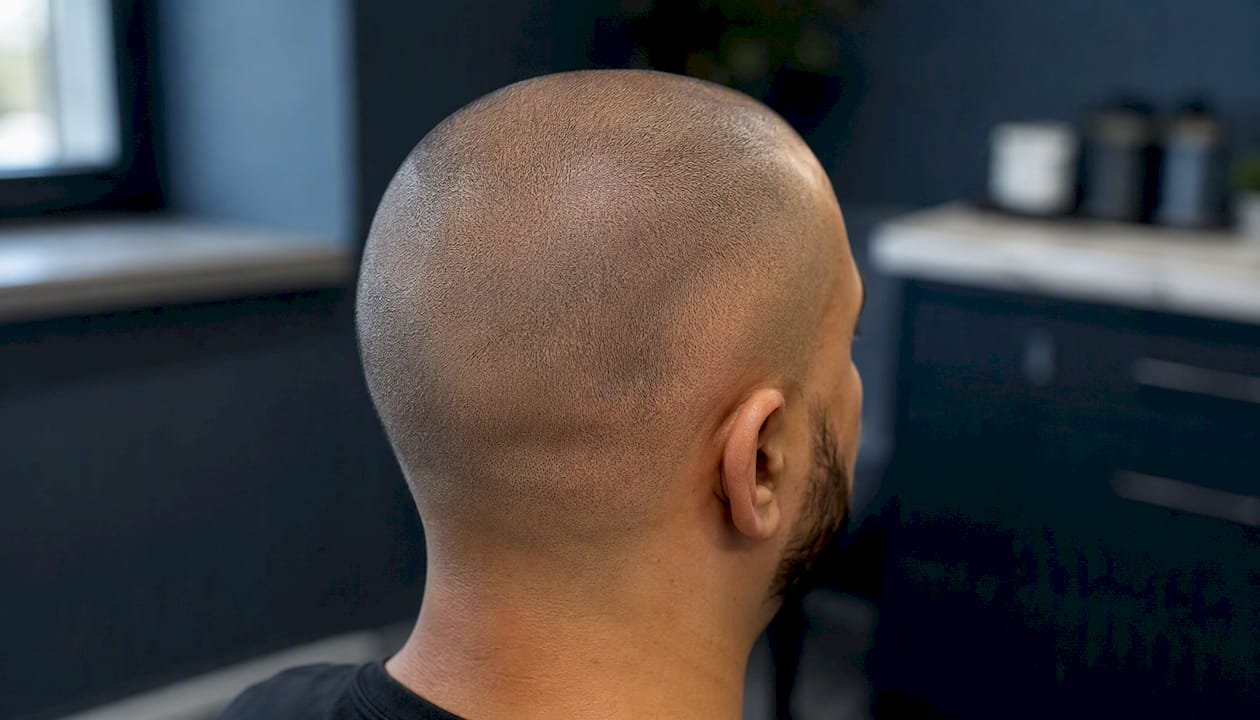
Most clients see their first meaningful fading at 3–6 years, though some go longer with good sun protection habits. Scar tissue fades faster. A small published cohort of 10 patients showed measurable visual density decline within months over scar areas specifically, which is why scar camouflage cases often need touch-ups sooner than standard coverage.
Touch-up costs typically run $200–$800 USD per session, depending on how much area needs refreshing and how much the original work has faded.
A simple 10-year cost picture for a full-scalp treatment:
- Initial treatment: $3,500 USD
- Two touch-ups over 10 years (at $500 each): $1,000 USD
- 10-year total: approximately $4,500 USD, or roughly $450 per year
That’s a meaningful contrast with hair transplant surgery or ongoing medical therapy, which carry their own long-term cost structures.
Pro Tip: Before booking, ask the clinic three specific questions: Does the package include a short-term follow-up session? What’s the touch-up policy within the first 12 months? Do they document healed results with photos? A clinic that can’t answer all three clearly is telling you something.
How do you evaluate an SMP quote and spot red flags?
Getting three quotes and picking the middle one isn’t a strategy. Here’s what actually matters when comparing proposals:
What a complete quote should include:
- Total treatment price (not per-session)
- Number of sessions included and what triggers an additional session
- Touch-up policy: what’s covered, for how long, and at what cost
- Pigment and equipment disclosure
- Before-and-after healed portfolio (not just fresh-work photos)
- Practitioner credentials and training background
- Deposit amount, refund policy, and payment schedule
Red flags worth walking away from:
- Per-session pricing with no total-treatment cap
- Portfolio showing only fresh work, no healed results at 6–12 months
- No medical screening or skin assessment before booking
- No written touch-up policy
- Pigment described only as “professional” with no brand or formulation detail
Trust signals that justify higher pricing:
- Documented corrective experience (prior poor SMP, failed transplant scarring)
- Physician oversight or medical-grade facility standards
- Training credentials: clinics that teach SMP practitioners have a demonstrable stake in technique quality
- Transparent healed-photo gallery, not just before-and-after composites
Requesting a total-treatment quote rather than a per-session price is the single most effective way to compare clinics fairly.
Three questions to ask on your consultation:
- “Can I see healed results at 6 months or longer for cases similar to mine?”
- “What happens if I need a fourth session — is that included or billed separately?”
- “What is your touch-up policy in the first year, and do you have it in writing?”
Pro Tip: SMP is categorized as a cosmetic procedure and is generally not covered by standard health insurance. However, if medical necessity can be documented, HSA or FSA funds may be applicable. Confirm eligibility with your plan administrator before assuming it qualifies.
How does SMP cost compare with hair transplants and medical therapy?
| Solution | Price Range (USD) | Visits / Sessions | Touch-Up Cost | Downtime | Result Type |
|---|---|---|---|---|---|
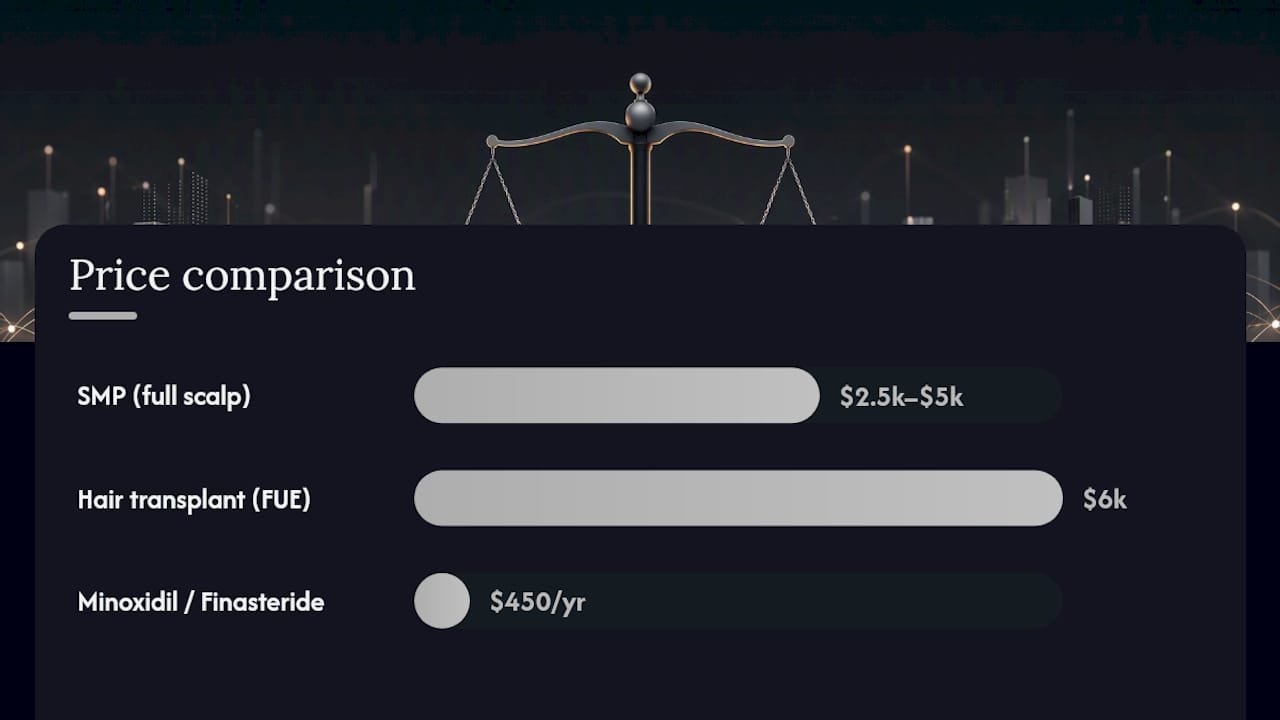
| SMP (full scalp) | $2,500–$5,000 | 3–4 | $200–$800 / 3–6 yrs | 1–2 days | Cosmetic illusion |
| Hair transplant (FUE) | $6,000 | 1–2 surgeries | Possible 2nd surgery | 7–14 days | Actual regrowth |
| Minoxidil / Finasteride | $450 per year | Ongoing daily use | Indefinite ongoing cost | None | Partial retention |
Finasteride is FDA-indicated for men only. Women who are or may become pregnant must not handle crushed or broken finasteride tablets, due to the risk of harm to a male fetus. It can also cause sexual side effects (reduced libido, erectile dysfunction) in a minority of men, which usually resolve after stopping treatment. Discuss these risks with a physician before starting.
SMP tends to be most cost-effective in three specific situations:
- Shaving-style solutions: For men who prefer or are comfortable with a shaved-head look, SMP delivers a permanent-looking result at a fraction of transplant cost.
- Scar camouflage: Hair transplant scars, FUE dot scarring, and alopecia patches respond well to SMP when donor supply is limited or surgery isn’t viable.
- Low donor supply cases: Candidates who don’t have enough donor hair for a meaningful transplant result often find SMP the only realistic option for full coverage.
A combined approach, transplant first for density, SMP second for hairline definition and scar coverage. It can make financial sense for some clients. The treatment overview at Enhanced Scalp covers how these approaches interact and when a combined strategy is worth considering.
Why does cheap SMP often cost more in the long run?
Low initial pricing is the most reliable predictor of corrective work down the line. Common failure modes from under-priced SMP include:
- Color shift: Pigment turns blue, green, or purple as it ages, usually from ink formulated for skin tattoos rather than scalp-specific use
- Blown-out follicles: Pigment placed too deep spreads under the skin, creating blurry, oversized dots that look nothing like natural follicles
- Patchy density: Inconsistent technique leaves visible gaps that worsen as the work fades
- Poor hairline design: An unnaturally straight or geometrically perfect hairline ages badly and reads as artificial within a few years
Corrective SMP is more expensive than starting fresh. Laser removal adds sessions and cost before corrective pigment can even be applied. A realistic corrective scenario might look like this:
Correction work and laser removal are consistently among the most expensive SMP-related expenses, and they’re almost always avoidable when the initial work is done well.
What does a professional SMP package actually include?
Here’s what a transparent, professional package at a clinic like Enhanced Scalp typically covers:
- Small-area package (hairline, temples, or scar patch): 2 sessions, initial consultation, custom hairline design, 30-day follow-up check, touch-up policy within the first 6 months
- Medium-coverage package (partial density, recession): 2–3 sessions, consultation, design session, 60-day follow-up, documented healed photos, touch-up policy within 12 months
- Full-scalp package (Norwood 5–7 or complete coverage): 3–4 sessions, full consultation and design, healed-result documentation at each stage, 12-month touch-up window, deposit required at booking
Every package should include a consultation before any deposit is taken. Virtual consultations are available for clients traveling from outside the GTA, which matters when you’re comparing clinics across cities or provinces.
The healed-work gallery at Enhanced Scalp documents results at multiple stages post-treatment, not just the day-of photos that look sharp regardless of technique quality. That distinction is worth more than any marketing claim.
Pro Tip: Always ask to see healed photos specifically, not fresh-work photos. Pigment looks crisp immediately after application on almost any client. How it looks at 6 and 12 months healed is the real test of technique and pigment quality.
What the price conversation is really about
The instinct to shop on price alone is understandable. SMP isn’t cheap, and the range between quotes can feel arbitrary. But the gap between a $1,800 quote and a $3,800 quote almost never reflects the same outcome at two different price points. It reflects two different levels of risk.
What I watch for in a quote isn’t the number itself. It’s whether the clinic can show me healed work at 12 months, explain their pigment selection, and put their touch-up policy in writing. Those three things tell you more about long-term value than any price comparison. A clinic that teaches SMP to other practitioners has an additional accountability layer: their technique is on display not just to clients, but to the industry.
The clients who end up spending the most on SMP are rarely the ones who paid premium prices upfront. They’re the ones who paid twice.
Enhanced Scalp offers transparent pricing and documented healed results
Pricing at Enhanced Scalp is structured around total-treatment packages, not per-session billing. Every quote covers the full course of treatment, including sessions, consultation, and a defined touch-up window, so there are no surprise invoices after session 3.
What’s included in a standard Enhanced Scalp package:
- In-person or virtual consultation before any deposit is collected
- Custom hairline design and pigment selection matched to your skin tone and hair characteristics
- 2–4 treatment sessions depending on coverage and complexity
- Documented healed-result photos at each stage
- Written touch-up policy with a defined coverage window
- Corrective experience for prior poor SMP, failed transplants, and complex scarring
Enhanced Scalp serves clients in Toronto, the GTA, and across Canada, with virtual consultations available for clients traveling from the U.S. and internationally. Book a consultation to get an accurate total-treatment quote for your specific coverage needs.
Sources
These references were used to build the pricing benchmarks, session-structure data, and fading evidence in this guide. Use them to cross-check city-level ranges and clinical notes for your own market.
- Scalp Micropigmentation Cost Guide 2026 (US & Canada Pricing Breakdown)
- Scalp Micropigmentation Prices: The 6-Factor Cost Framework That Explains Every Quote in 2026 – Charles Medical Group
- Scalp Micropigmentation: Cost, Fading, and the Safety Gap Nobody Discloses · AestheticMedGuide
- Scalp Micropigmentation Cost: What Affects Price – Acibadem Hospitals Group
- SMP Cost: 2026 Complete Price Breakdown | MyHairline
FAQ
How much does SMP cost in Canada?
Full-scalp SMP in Canada typically runs $3,200–$6,500 CAD, with small-area work starting around $1,500 CAD.
Why is SMP so expensive?
SMP pricing reflects practitioner skill, medical-grade pigments, multi-session treatment time, and clinic overhead. A full-scalp treatment requires 3–4 sessions of 4–6 hours each, and the pigment and technique quality directly determine how the result holds over years.
How long does SMP last?
Most clients see meaningful fading at 3–6 years, with touch-ups running $200–$800 USD. Scar tissue tends to fade faster. With proper sun protection, some clients go longer between touch-ups.
How does SMP look after 10 years?
With one or two touch-ups over a decade, well-executed SMP retains a natural shaved-head appearance. Poor-quality work, especially with non-scalp-specific pigments, often shifts to blue or green tones and requires corrective treatment or laser removal before the 10-year mark.
Is SMP covered by insurance or financing?
SMP is classified as a cosmetic procedure and is not covered by standard health insurance in Canada or the U.S. HSA or FSA funds may apply in rare cases where medical necessity is documented. Many clinics offer financing plans; ask about payment structure and deposit requirements during your consultation.

