Skip to content

Scalp micropigmentation can cosmetically help most people with alopecia by camouflaging scalp visibility and creating the appearance of a closely shaved head or denser hair. Whether it works well for you specifically depends on your alopecia subtype and whether your scalp condition is stable. SMP does not regrow hair or treat the underlying disease. It is a cosmetic procedure, full stop.
Who benefits most:
- People with androgenetic (pattern) hair loss, stable scarring from surgery or trauma, or small-to-moderate patchy loss
- Those with traction alopecia where the scalp is no longer actively inflamed
Who needs extra caution:
- Active inflammatory scarring alopecias (lichen planopilaris, frontal fibrosing alopecia) where pigment retention is unreliable
- Alopecia areata with unpredictable regrowth cycles, where new hair can grow through SMP and create a mismatched appearance
Immediate next steps: Get your scalp assessed by a dermatologist to confirm disease stability. Then book a specialist SMP consultation that includes a patch test or test area before committing to a full series.
Pro Tip: Ask any SMP provider whether they have documented healed results specifically for your alopecia subtype. Before-and-after photos taken immediately post-procedure tell you almost nothing about long-term retention.
Key Takeaways
SMP is a clinically supported cosmetic option for many alopecia types, but subtype, scalp stability, and technician skill determine whether results hold.
| Point | Details |
|---|---|
| SMP is cosmetic, not curative | It camouflages scalp visibility and mimics follicles; it does not regrow hair or treat the underlying disease. |
| Subtype determines suitability | Androgenetic and stable scarring cases retain pigment best; dense fibrotic conditions (LPP, morphea) show lower retention at six months. |
| Disease stability is required | Most practitioners and dermatologists recommend at least six months of documented stability before SMP in inflammatory or autoimmune alopecia. |
| Results last three to six years typically | A mean visual density score drops from 8.7 to 7.7 at six months; touch-ups every two to four years maintain the result. |
| Enhanced Scalp | Offers alopecia-specific SMP protocols, scar camouflage, and corrective work from Vaughan, Ontario, serving Toronto, the GTA, and beyond. |
Table of Contents
- How does scalp micropigmentation work for alopecia?
- Which types of alopecia are good candidates for SMP?
- What does the SMP treatment process actually look like?
- How long do SMP results last, and when will you need a touch-up?
- What are the safety risks and contraindications of SMP?
- How do you choose a qualified SMP provider in Canada?
- How should you prepare for SMP, and what does aftercare involve?
- What does the clinical evidence actually say about SMP for alopecia?
- An honest perspective on SMP for alopecia
- Enhanced Scalp offers alopecia-specific SMP in Toronto and beyond
- Sources
- FAQ
How does scalp micropigmentation work for alopecia?
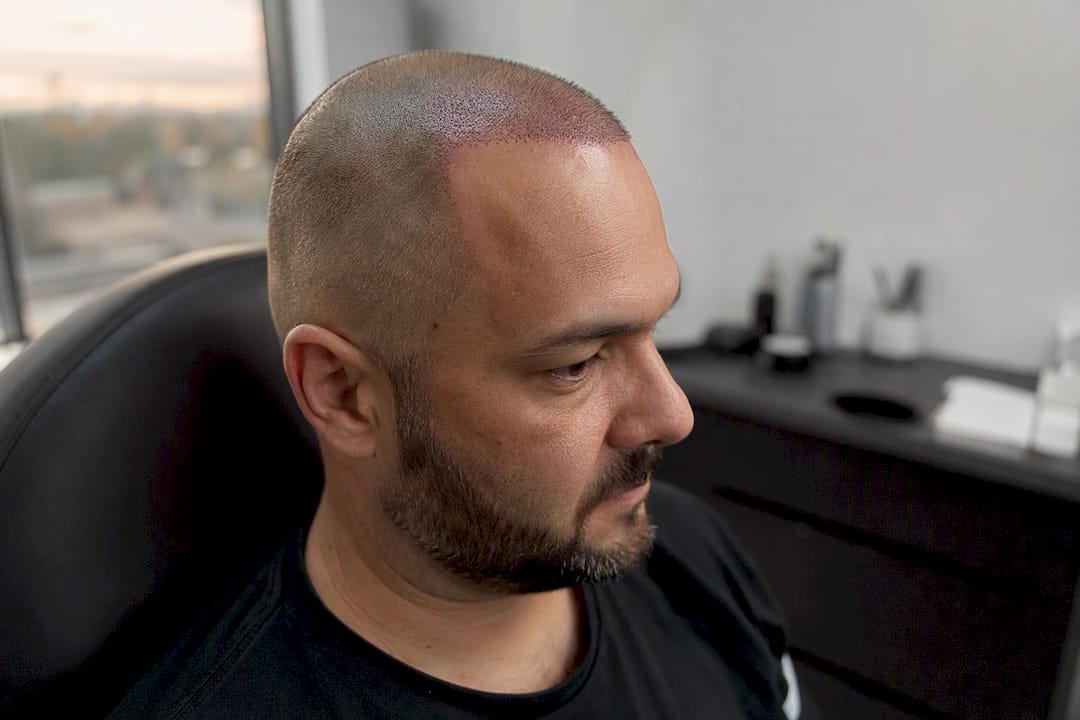
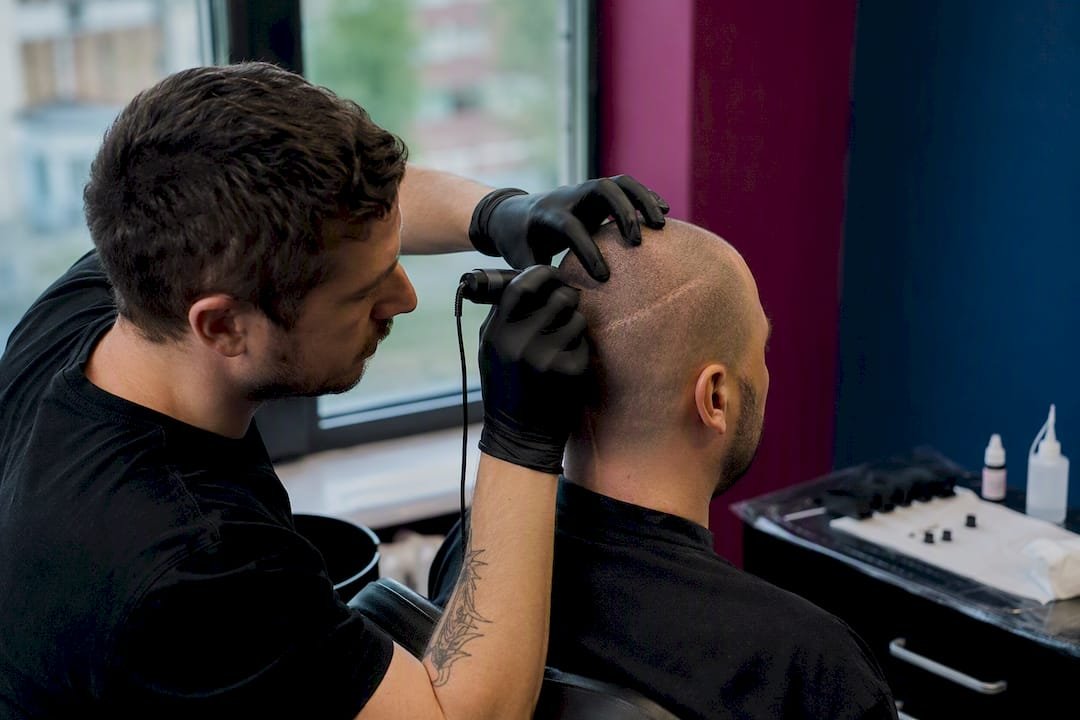
Scalp micropigmentation, often called a hair tattoo, is a cosmetic procedure that deposits pigment into the upper-to-mid papillary dermis in precise microdots. Each dot is sized and spaced to mimic the cross-section of a shaved hair follicle. The result is a stippled pattern that, viewed from a normal social distance, reads as a closely cropped head of hair or, for people with existing hair, as increased density.
The technical process involves cosmetic-grade pigments delivered through fine needle cartridges, typically single-point or small-cluster configurations. Trichoscopy of treated scalps shows homogenous black or grey circular dots, larger than adjacent natural follicles, distributed across the treated zone. Histopathology reveals clusters of coarse pigment in the dermis, with the depth of placement sitting in the papillary dermis rather than the deeper reticular layer. Depth control is critical: pigment placed too superficially fades rapidly; placed too deep, it can migrate and blur over time.
What creates the convincing illusion is not any single dot but the distribution of thousands of them. Skilled technicians randomize dot size, spacing, and angle rather than applying a uniform grid. That randomization is what separates a natural-looking result from something that reads as a stippled tattoo.
Key technical elements:
- Fine needle cartridges (single-point for hairline, small clusters for density fill)
- Cosmetic-grade pigments formulated for color stability in the dermis
- Depth targeting: upper papillary dermis
- Randomized dot placement to avoid geometric uniformity
- Multiple sessions to build density incrementally
SMP does not stimulate follicles or produce living hair. A published case report described complete hair regrowth following scalp tattooing in a single patient with alopecia universalis, but this is an isolated, idiosyncratic finding and not a predictable or generalizable outcome. Treat it as a curiosity, not a treatment rationale.
Pro Tip: When reviewing a technician’s portfolio, look for variation in dot size and placement across the scalp. A result where every dot looks identical and evenly spaced is a red flag for mechanical, template-style work. Natural follicle distribution is irregular.
Which types of alopecia are good candidates for SMP?
Not all alopecia is the same, and the answer to “will SMP work for me?” depends heavily on your specific diagnosis. The two biggest variables are scalp stability (is the disease active or quiet?) and the degree of dermal fibrosis (has scarring altered the tissue’s ability to hold pigment?).
Androgenetic alopecia (male and female pattern loss)
This is where SMP performs most consistently. The scalp is structurally normal, pigment retention is predictable, and the procedure can address both full-coverage shaved-head looks for men and density work for women with diffuse thinning. Results from a published case series showed the highest visual density scores and lowest fading rates in androgenetic cases at six months.
Alopecia areata (patchy)
SMP can camouflage discrete patches effectively when the disease is stable. The complication is regrowth: if hair returns through a treated area, the contrast between pigmented scalp and new hair can look inconsistent. Candidates should have stable patches for at least six months and understand that future flares may require touch-ups or redesign.
Alopecia totalis and alopecia universalis
Total scalp coverage is achievable, and many people with alopecia totalis report strong satisfaction with a shaved-head SMP result. For alopecia universalis, the absence of eyebrows and lashes means the scalp result needs to be designed with the full facial picture in mind. Pigment retention on a scalp with no follicular activity is generally good, though the scalp may be more sensitive.

Traction alopecia
When the cause of traction has been removed and the scalp is no longer inflamed, SMP works well for filling in hairline recession. Scar camouflage techniques apply here when traction has produced linear scarring.
Surgical and traumatic scars
SMP is one of the most effective cosmetic options for scar camouflage. Scar tissue takes pigment differently than normal scalp, often requiring adjusted needle depth and pigment concentration, but results are generally good when the scar is mature and stable.
Primary scarring alopecias (LPP, FFA, morphea)
This is where SMP becomes genuinely complicated. Research on scarring alopecia outcomes shows that fibrosis degree strongly predicts pigment retention. Conditions with less fibrosis (FFA, early traction) retain pigment better than dense fibrotic conditions like morphea and lichen planopilaris, where a significant proportion of patients may not achieve a favorable esthetic response at six months.
Clinical rule of thumb: Most experienced SMP practitioners and dermatologists recommend a minimum of six months of documented disease stability before proceeding with SMP in any inflammatory or autoimmune alopecia. A dermatology sign-off is not optional for scarring subtypes.
Pro Tip: If you have a scarring alopecia diagnosis, ask your dermatologist to grade your current fibrosis level before your SMP consultation. That single piece of information will tell you more about your likely outcome than any before-and-after photo.
What does the SMP treatment process actually look like?
A full SMP series for alopecia typically involves two to four sessions, spaced roughly seven to fourteen days apart. Each session runs two to four hours depending on coverage area. The staged approach is not just scheduling convenience. It is how density is built correctly.
The layered-session logic:
This incremental approach lets the technician assess how your scalp heals and retains pigment between appointments, then adjust tone and density before the final session. It also prevents over-darkening, which is one of the most common reasons people seek corrective SMP.
Numbered steps at your consultation:
- Scalp assessment: the technician examines your scalp condition, existing hair, skin tone, and scarring
- Color matching: pigment shade is selected to match your natural hair color and skin undertone
- Hairline or coverage design: drawn and discussed before any needles touch skin
- Patch test or test area: a small area is treated and reviewed at a follow-up before full commitment
- Photographic documentation: baseline photos are taken for comparison at each subsequent session
During the procedure itself, a topical anesthetic is applied 30–45 minutes before needling begins. Most people describe the sensation as mild scratching or pressure rather than sharp pain. Immediately after each session, expect redness, mild swelling, and a slightly darker appearance than the healed result. That initial darkness fades significantly over the first ten to fourteen days as the skin heals and the pigment settles.
Pro Tip: The healed result at day 14 is not the final result either. Pigment continues to soften for up to 30 days. Avoid judging the outcome until the full healing cycle is complete.
How long do SMP results last, and when will you need a touch-up?
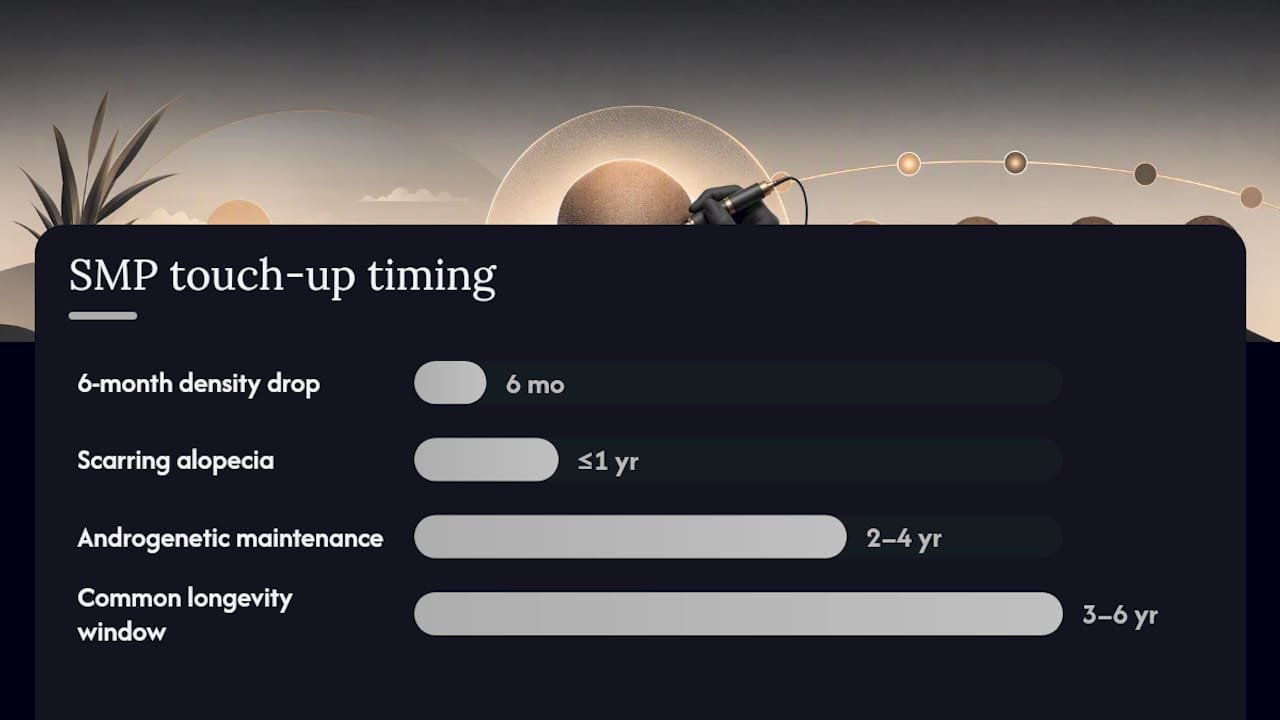
The commonly cited longevity window for SMP is three to six years before a meaningful touch-up is needed, though individual results vary considerably. Skin type, UV exposure, pigment chemistry, and the presence of scarring all shift that window.
What drives fading:
- UV exposure is the single biggest accelerant. Unprotected sun exposure breaks down pigment faster than almost anything else.
- Oily skin types tend to push pigment out more quickly than dry skin.
- Pigment placed too superficially fades faster; placed too deep, it can diffuse and blur rather than fade cleanly.
- Scarred tissue retains pigment less predictably than normal scalp, sometimes requiring touch-ups within the first year.
A published case series measured a mean visual density score of 8.7 immediately post-treatment, falling to 7.7 at six months. Patient satisfaction remained high (mean score 2.7 out of 3), but the data confirmed that scarring alopecia cases faded more than androgenetic ones over that same period. That six-month fading is normal and expected; it is part of why the initial series includes multiple sessions.
A typical maintenance plan looks like this: one touch-up session every two to four years for androgenetic cases on normal scalp, potentially more frequently for scarring subtypes or people with high UV exposure. Touch-up sessions are shorter and less expensive than the initial series.
For longer-term scalp health between sessions, some people use adjunctive topical products after clinic approval. A GHK-Cu scalp serum is one option that some practitioners recommend for scalp condition maintenance, though it should not be applied to freshly treated skin without clearance from your SMP provider.
What are the safety risks and contraindications of SMP?
SMP is a low-risk cosmetic procedure when performed by a trained technician using sterile equipment and quality pigments. That said, it is not risk-free, and certain conditions require medical clearance before proceeding.
Common short-term side effects (typically resolve within one to two weeks):
- Redness and mild swelling at the treatment site
- Tenderness or sensitivity during healing
- Light crusting as the skin heals
- Temporary darkening that softens as pigment settles
Less common complications:
- Allergic reactions to pigment components, which is why a patch test matters
- Pigment migration or diffusion if depth control is poor
- Granulomatous reactions, documented in histopathology of some treated scalps
- Infection if aftercare protocols or sterile technique are inadequate
Contraindications and caution scenarios:
- Active inflammatory scalp disease (do not proceed during a flare)
- Unstable autoimmune activity without dermatology sign-off
- Recent chemotherapy without oncologist clearance (scalp sensitivity and immune status are altered)
- Keloid-prone skin, which may respond unpredictably to needling
- Pregnancy (most clinics defer treatment as a precaution)
The Cleveland Clinic’s clinical overview notes that SMP is generally noninvasive with a short recovery, but emphasizes that it is a cosmetic procedure, not a medical one. For anyone with a scarring or autoimmune alopecia, coordination with a dermatologist before and during the SMP process is not a formality. It directly affects whether the procedure is appropriate and when.
Pro Tip: Ask any clinic what pigment brand and formulation they use, and whether they can provide the ingredient list. Because no SMP-specific pigment carries a unique regulatory approval for this application in Canada, pigment composition varies widely between providers. Knowing what goes into your scalp matters.
How do you choose a qualified SMP provider in Canada?
Canada has no single national licensing body specifically for SMP technicians, which means the burden of vetting falls on you. Here is what to look for and what to avoid.
Essential credentials and experience markers:
- Documented healed results (not just fresh post-procedure photos) for alopecia cases specifically
- Formal SMP training with verifiable hours, not a weekend course
- Infection-control protocols: single-use needles, autoclave or sterile disposables, clean-room standards
- Medical collaboration or referral relationships with dermatologists for complex cases
- Willingness to do a patch test or test area before full commitment
Consultation checklist — ask these questions:
- What pigments do you use, and can I see the ingredient information?
- Do you perform a patch test before the first full session?
- How many sessions do you recommend for my specific pattern, and what is the spacing?
- Can I see healed results (at least 30 days post-procedure) for cases similar to mine?
- What is your protocol if I have an adverse reaction?
- How do you handle touch-ups, and what do they cost?
- Do you have experience with my specific alopecia subtype?
- What aftercare instructions will I receive in writing?
- What is your policy if I am unhappy with the result?
- Do you have relationships with dermatologists for pre-procedure medical clearance?
Red flags to walk away from:
- Promises of a single-session result for full-coverage work
- No patch-test policy
- Portfolio showing only fresh results with no healed documentation
- Vague or evasive answers about pigment sources
- Blanket guarantees of permanence or zero fading
Cost considerations:
According to Alopecia UK’s patient guidance, typical costs range from around $400–$800 CAD for a small patch to $2,500–$4,500 CAD or more for full scalp coverage, with touch-up sessions priced separately. Budget for the initial series plus at least one touch-up within the first three to four years. The Cleveland Clinic notes that SMP sits between ongoing medication costs and the higher upfront cost of hair transplant surgery in terms of overall investment.
Reviewing a clinic’s healed results gallery before booking gives you the clearest picture of what their work actually looks like after the skin has fully settled.
How should you prepare for SMP, and what does aftercare involve?
Before your appointment:
- Avoid blood-thinning medications and supplements (aspirin, ibuprofen, fish oil, vitamin E) for at least 48 hours unless medically required
- Do not arrive with sunburned or peeling scalp
- Avoid chemical peels or aggressive scalp treatments for two weeks prior
- Bring your scalp history: any dermatology reports, current medications, and photos of your hair loss progression
- Wash your scalp the morning of your appointment with a gentle, fragrance-free shampoo
Immediate aftercare (first 14 days):
- Keep the scalp dry for the first four days. No washing, heavy sweating, or steam.
- From day four onward, gently rinse with lukewarm water and a mild, unscented cleanser.
- Apply a light, unscented moisturizer to prevent excessive dryness and flaking.
- Stay out of direct sun. If you must be outside, wear a hat or use SPF 50+ on the treated area after the skin has closed.
- Sleep on a clean pillowcase and avoid friction on the treated scalp.
- No swimming, saunas, or steam rooms for at least two weeks.
- No aggressive scalp scrubs, exfoliants, or laser treatments over SMP sites until cleared by your technician.
Longer-term maintenance:
Daily SPF application to the scalp is the single most effective thing you can do to extend pigment longevity. Book your first touch-up assessment at the two-year mark, or earlier if you notice significant fading or color shift. Avoid prolonged chlorine exposure, which accelerates fading.
What does the clinical evidence actually say about SMP for alopecia?
The evidence base for SMP is favorable but built primarily on case series and observational studies rather than large randomized controlled trials. That context matters when interpreting the results.
Key findings from peer-reviewed literature:
- A three-session standardized protocol produced a mean visual density score of high values immediately post-treatment, with a modest decline at six months, with patient satisfaction scores remain high. Androgenetic alopecia cases retained pigment better than scarring cases over that period.
- Trichoscopic and histopathologic analysis confirmed that SMP deposits pigment in the papillary dermis as clusters of coarse pigment, with focal granulomatous infiltrates observed in some cases. Superficial versus deep placement produces meaningfully different long-term outcomes.
- In scarring alopecia cohorts, fibrosis degree was the strongest predictor of pigment retention. Conditions with dense fibrosis (morphea, LPP) showed markedly lower retention, with a substantial proportion of patients showing limited pigment retention at six months. Less fibrotic conditions (FFA, traction alopecia) performed considerably better.
Technical refinements that improve outcomes:
- Zone-specific needle selection (finer needles at the hairline, slightly larger for density fill)
- A hierarchical density layering strategy: gradual density build-up across multiple sessions, starting low and increasing each session
- Randomized dot distribution to avoid a geometric, tattooed appearance
- Strict depth control to target the papillary dermis without going deeper
Limitations of the current evidence:
- Most studies involve small cohorts (fewer than 50 patients)
- Techniques and pigments vary significantly between practitioners, making cross-study comparisons difficult
- Long-term randomized controlled trials are absent from the literature
- Review material suggests satisfaction rates above 80% in some cohorts, but methodology varies
Key data point: The six-month visual density score drop from 8.7 to 7.7 in the published case series reflects normal, expected fading. It is not treatment failure. It is why a touch-up plan is built into any honest SMP protocol from the start.
An honest perspective on SMP for alopecia
The conversation around SMP for alopecia tends to split into two camps: practitioners who oversell it as a near-universal solution, and skeptics who dismiss it because it does not regrow hair. Both miss the point.
What the clinical record actually shows is a procedure with a genuinely strong track record for specific presentations, a more complicated picture for others, and a set of technical variables that matter enormously. The difference between a result that looks natural for five years and one that looks faded and patchy at eighteen months is not luck. It is pigment selection, depth control, session sequencing, and the technician’s ability to read how a particular scalp is responding.
The piece most people underestimate is the dermatology coordination requirement for inflammatory and scarring subtypes. Proceeding with SMP on an active or undertreated scarring alopecia is not just a cosmetic risk. It can complicate the dermatological picture and make future treatment decisions harder. A dermatologist sign-off is not bureaucratic caution. It is the thing that determines whether SMP is appropriate at all.
For people with stable androgenetic alopecia or stable scarring, the evidence is solid and the satisfaction data is consistent. For those with active or unpredictable disease, the honest answer is: wait, stabilize, and then revisit. Photographic documentation of healed results, not fresh post-procedure photos, is the only meaningful evidence a clinic can show you. Insist on it.
Enhanced Scalp offers alopecia-specific SMP in Toronto and beyond
People with alopecia need more than a standard SMP session. They need a provider who understands subtype-specific technique, has documented healed results for complex cases, and knows when to refer back to a dermatologist.
Enhanced Scalp, based in Vaughan, Ontario, specializes in alopecia coverage, scar camouflage, female density work, and corrective SMP for clients who have had poor results elsewhere. Every treatment plan starts with a consultation that includes scalp assessment, color matching, and a patch-test policy before any full session begins. Healed results are documented and available in the gallery. The clinic serves Toronto, the GTA, and clients across Canada and the United States, including a New York City service location. Practitioners looking to train in SMP can also access formal training programs through Enhanced Scalp.
Book a consultation or review the full service overview to take the next step.
Sources
- Scalp Micropigmentation: A Clinicopathologic Correlation – PMC
- Scalp Micropigmentation Is an Effective Treatment for Localized Alopecia: Technical Analysis and a Series of Ten Case Reports
- Scalp Micropigmentation: Before & After, Benefits, Side Effects – Cleveland Clinic
- Efficacy, safety, and patient-reported outcomes of scalp micropigmentation in scarring alopecia – JCAS
- Scalp micropigmentation – Alopecia UK
This article is general information, not a substitute for advice from a qualified doctor. Consult a qualified healthcare professional about your own circumstances before acting on anything here.
FAQ
What are the disadvantages of SMP for alopecia?
SMP does not regrow hair, requires multiple sessions, and needs periodic touch-ups every two to four years. In scarring alopecia with significant fibrosis, pigment retention can be poor, and results may fade substantially within six months.
Will hair grow back through SMP?
Yes, if your alopecia is in remission and follicles become active again, hair can regrow through treated areas. This is most relevant for alopecia areata; the new growth may contrast with the pigmented scalp and require touch-up or redesign.
How long does scalp micropigmentation last?
Most people see meaningful results for three to six years before a touch-up is needed. A published case series recorded a visual density score of 8.7 immediately post-treatment, dropping to 7.7 at six months, with higher fading in scarring alopecia cases.
Is SMP better than a hair transplant for alopecia?
They solve different problems. A hair transplant produces living hair but requires donor hair, surgery, and recovery time. SMP gives an immediate cosmetic result without surgery, at a lower upfront cost, but produces no living hair. For alopecia totalis or universalis, where there is no viable donor hair, SMP is often the only realistic cosmetic option.
Can Enhanced Scalp treat all types of alopecia?
Enhanced Scalp offers alopecia-specific SMP protocols including coverage for patchy loss, traction alopecia, scarring, and full-coverage work for totalis cases. Complex or active inflammatory cases are assessed individually, and medical coordination with a dermatologist is recommended before treatment begins.