 Skip to content

Density SMP works by placing microscopic pigment dots between your existing hairs to reduce scalp show-through, and it can make thinning hair look noticeably fuller within a session or two. It’s the right call if you still have real hair covering the area, whether that’s a widening part, a see-through crown, or diffuse thinning across the scalp. It’s the wrong call if you’re trying to blend a fully bald patch against hair longer than a few millimeters, since that contrast is exactly what makes SMP look artificial.
Here’s the part most articles skip: density SMP is a two-dimensional illusion. The pigment tricks the eye by reducing contrast, but it never adds a single strand of real hair, texture, or volume. That distinction shapes everything else in this guide.
- Best candidates: diffuse thinning, widening part, thinning crown with hair still present
- Poor candidates: bald patches sitting next to hair longer than ~3mm, active scalp conditions, recent transplants
- Next step: book an in-person scalp assessment before any pigment goes near your head
Key Takeaways
Density SMP creates the visual appearance of thicker hair by placing pigment between existing follicles, but it requires real hair remaining nearby to look convincing.
| Point | Details |
|---|---|
| It’s a 2D illusion | Pigment reduces scalp-to-hair contrast; it never adds real hair, volume, or texture. |
| Best for existing hair | Diffuse thinning, widening parts, and thinning crowns respond best; adjacent bald patches don’t. |
| Sessions run in stages | Most plans use a small number of progressive sessions with touch-ups every 3 to 5 years. |
| Progression is the real risk | Continued hair loss around treated pigment can expose it and tempt over-saturation. |
| Enhanced Scalp’s approach | Prioritizes conservative layering, healed-photo documentation, and honest candidacy assessments. |
Table of Contents
- How Does Density SMP Create the Look of Thicker Hair?
- Who Is a Good Candidate for Density SMP?
- What Does Density SMP Actually Look Like Once It’s Healed?
- How Many Sessions Does Density SMP Take, and What Does It Cost?
- Is Density SMP Safe? Risks and Aftercare
- Can SMP Work Alongside Hair Transplants or Scar Camouflage?
- What Should a Responsible SMP Clinic Actually Do?
- Ready to See What Density SMP Looks Like on You?
- Sources
- FAQ
How Does Density SMP Create the Look of Thicker Hair?
Density SMP works by exploiting a basic optical trick: your eye reads “thinning hair” as scalp visibility, and it reads “full hair” as an absence of visible scalp. A practitioner places thousands of tiny pigment deposits directly on the skin between your existing follicles, each one mimicking the shadow a hair follicle casts. String enough of those shadows together and the scalp stops reflecting light in the pattern your brain associates with baldness. The ISHRS describes this mechanism plainly: the goal is to blend thinning zones by mimicking shadow, not to construct a new hairline from nothing.
The technique depends on more than just adding dots. A few variables determine whether the result looks like hair or looks like a tattoo:
- Needle depth, kept extremely shallow (roughly 0.5mm), so the pigment sits in the upper skin layer rather than bleeding into deeper tissue
- Dot size and tone, matched to your natural hair color and undertone rather than a generic black
- Randomized placement, since real hair never grows in a uniform grid
- Layered sessions, building density gradually instead of maxing out contrast on day one
That layering approach matters more than most people realize. Clinic-level protocols often start conservatively around 40 dots per square centimeter and build toward 60 or more across sessions, which lets the practitioner assess how the pigment settles and heals before committing to a final density. Go too dark too fast and there’s no dialing it back.
Different thinning patterns respond differently to this layering. A widening part needs a narrow band of concentrated dots right along the exposed line. A thinning crown needs a wider radius of lighter, more diffuse pigment that tapers at the edges instead of stopping abruptly. General diffuse thinning across the whole scalp needs the most restraint, since overworking any one zone creates a patch that reads as denser than everything around it.
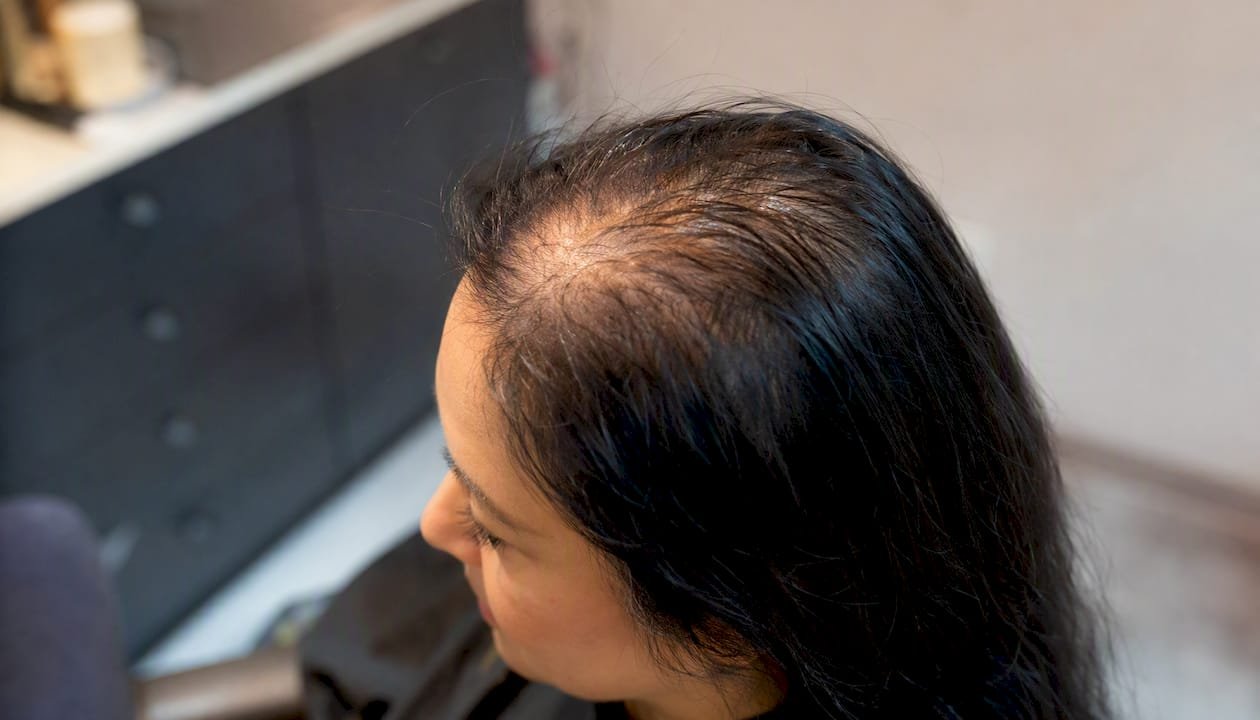
The physics behind this is straightforward. Scalp skin reflects light differently than a field of individual hair shafts does, and that reflectivity difference is what your eye interprets as “thin” or “full.” Introducing thousands of small, irregular, non-reflective points changes how the scalp scatters light, which is why density SMP can look convincing even under bright bathroom lighting where thinning is usually hardest to hide.
Pro Tip: Ask any practitioner you’re considering how they handle dot randomization. If the answer is vague or if their healed photos show a uniform, stippled pattern, that’s a sign the work will look flat rather than dimensional once it settles.
Who Is a Good Candidate for Density SMP?
The single biggest factor in whether density SMP will look natural on you is how much real hair remains in the treatment area. Enough existing hair provides genuine 3D texture that the 2D pigment illusion can hide behind. Take that hair away, and the illusion has nothing to blend into.
Good candidates typically include:
- Men with early to moderate pattern loss (often Norwood 1 through 4) who still have coverage across the treated zone
- Women with female pattern hair loss and a visibly widening part, provided hair density on either side remains reasonably even
- Anyone with diffuse thinning where the scalp shows through but no area is fully bald
- People whose hair loss has stabilized, either naturally or through treatments like minoxidil or finasteride
Finasteride is FDA-indicated for men only. Women who are or may become pregnant must not handle crushed or broken finasteride tablets, due to the risk of harm to a male fetus. It can also cause sexual side effects (reduced libido, erectile dysfunction) in a minority of men, which usually resolve after stopping treatment. Discuss these risks with a physician before starting.
Women with diffuse thinning tend to be some of the strongest candidates for this technique specifically because density SMP doesn’t require shaving and blends directly into longer hair when enough density remains on either side of the treated area.
Contraindications are just as important to understand. The ISHRS is direct about this: SMP should generally be avoided where a completely bald area sits next to hair longer than roughly 3mm, or where the local density contrast is too extreme (their threshold references areas exceeding roughly 30 follicles per square centimeter adjacent to bare scalp). That contrast is what makes the pigment read as fake rather than as hair. Active scalp conditions, unhealed transplant sites, and certain scarring patterns also need a specialist’s eye before anyone reaches for a pigment machine. If you’ve had a transplant, the ISHRS recommends waiting about 11 to 12 months before SMP so the grafts fully settle and the scalp heals.
| Category | Examples |
|---|---|
| Suitable | Diffuse thinning, widening part, early crown thinning with hair present |
| Use with caution | Recently stabilized shedding, mild scarring, borderline density contrast |
| Avoid or defer | Bald patches beside long hair, active scalp disease, recent transplant (under 11 months) |
Bring a few specifics to your consultation so the practitioner can give you an honest answer instead of a sales pitch: your target hair length and styling habits, any current treatments you’re using, scarring history, and photos taken in both normal room light and bright direct light. Bright light is unforgiving, and a good practitioner wants to see your scalp the way it looks on your worst-lit day, not your best one.
What Does Density SMP Actually Look Like Once It’s Healed?
The visual change from density SMP is immediate, but it’s worth repeating: what you’re seeing is an illusion, not new hair. No volume gets added. No texture changes. What changes is contrast, and contrast is doing all the work.
That distinction shows up most clearly under scrutiny. Fresh SMP work often looks slightly darker and flatter than it will once it heals, since pigment settles and softens over the following weeks. Good healed results hold up under bright light, from steep angles, and up close, because the dot placement was randomized and layered rather than uniform. Over-saturated or rushed work tends to fall apart under exactly those same conditions. Look for a slightly grayish, matte tone rather than jet black. Real hair follicles aren’t pure black up close, and pigment that reads as true black tends to look stamped rather than grown.
Typical target zones each behave a little differently:
- Part-line filling holds up well long term since the area is narrow and easy to touch up precisely
- Crown fill requires more ongoing attention since crown thinning often continues to progress
- Mid-scalp diffusion is the most forgiving zone visually, but also the easiest to overdo across multiple sessions
The real limit here is progression. If the hair surrounding a density-treated area keeps thinning, the pigment that once blended seamlessly can start to stand out. That’s a legitimate risk, and it’s the same reason density SMP isn’t a substitute for a full hair replacement when you’re covering a large bald patch next to hair that’s staying long. Piling on more pigment to chase further hair loss is how scalps end up over-saturated and visibly artificial rather than naturally full.
Pro Tip: When you’re evaluating a clinic’s before-and-after photos, ask specifically for healed results photographed weeks or months later, not just the day-of shots. Fresh pigment always looks more dramatic than settled pigment, and that gap is where unrealistic expectations start.
How Many Sessions Does Density SMP Take, and What Does It Cost?
Most density SMP treatment plans run through a small number of progressive sessions, spaced days to a few weeks apart, with touch-ups needed every few years after that.
- Session one establishes the baseline pattern and conservative dot density, giving the practitioner a chance to see how your skin takes pigment
- Session two, usually scheduled after initial healing, builds on that base and refines tone and coverage
- Session three (when needed) fine-tunes density in areas that need extra blending, particularly around a part line or crown
- Touch-ups, typically recommended every 3 to 5 years as pigment naturally softens
The full healed result isn’t visible until several weeks after your last session, since pigment continues to settle and lighten slightly as the skin heals completely. Clinic-reported protocols back this staged structure, with layered density built from roughly 40 dots per square centimeter up toward 60 or more across the sessions rather than delivered all at once.
Cost varies by a wider margin than most people expect, and the honest answer is that anyone quoting a single flat number without seeing your scalp first probably hasn’t looked closely enough. The main factors driving price:
- Treatment area size, since a full crown or widespread diffuse thinning takes more time than a single part line
- Practitioner skill and reputation, particularly for anyone with a strong portfolio of healed (not just fresh) results
- Corrective work, which almost always costs more than a first-time treatment because it requires undoing or working around prior pigment
- Geographic market, since clinic pricing reflects local cost of living and demand
- Hybrid coordination, if density SMP is being planned alongside or after a hair transplant
Given how much these variables shift the final number, treat any price you see online as a starting reference point, not a quote. A proper consultation and scalp assessment is the only reliable way to get an accurate figure for your specific case.
Is Density SMP Safe? Risks and Aftercare
Density SMP is a form of shallow tattooing, and it carries the same category of risks as any tattoo procedure. The FDA’s consumer guidance on tattoo safety flags infection risk, allergic reactions to pigment, and the importance of informed consent before treatment, all of which apply directly to SMP. Poor technique, particularly needle depth that’s too deep, can also cause pigment to spread under the skin, leading to blurry or blotchy retention instead of crisp dots. Peer-reviewed dermatology literature on tattoo pigment behavior confirms that migration and immune response are real variables in how pigment settles and fades over years, not just a theoretical concern.
Everyday aftercare after each session typically includes:
- Avoiding sweating, swimming, and pools for the first week or so while the skin closes
- Gentle, fragrance-free cleansing rather than harsh shampoos
- Consistent sun protection on the treated area, since UV exposure accelerates fading
- Skipping strong exfoliants or scalp treatments until fully healed
- Moisturizing only as your practitioner specifically advises
What’s normal versus what’s not:
- Mild redness and tightness for the first day or two is expected and typically resolves quickly
- Light scabbing or flaking during healing is normal and shouldn’t be picked at
- Persistent swelling, pus, spreading redness, or fever are not normal and need medical attention promptly
- Unexpected color shifts weeks after healing (particularly a blue or greenish cast) can signal a pigment reaction worth discussing with your practitioner
A conservative, reputable practitioner will patch test pigment beforehand and choose color formulations built to age gracefully rather than shift tone over time. That upfront caution costs you almost nothing and prevents a much bigger problem down the line.
Can SMP Work Alongside Hair Transplants or Scar Camouflage?
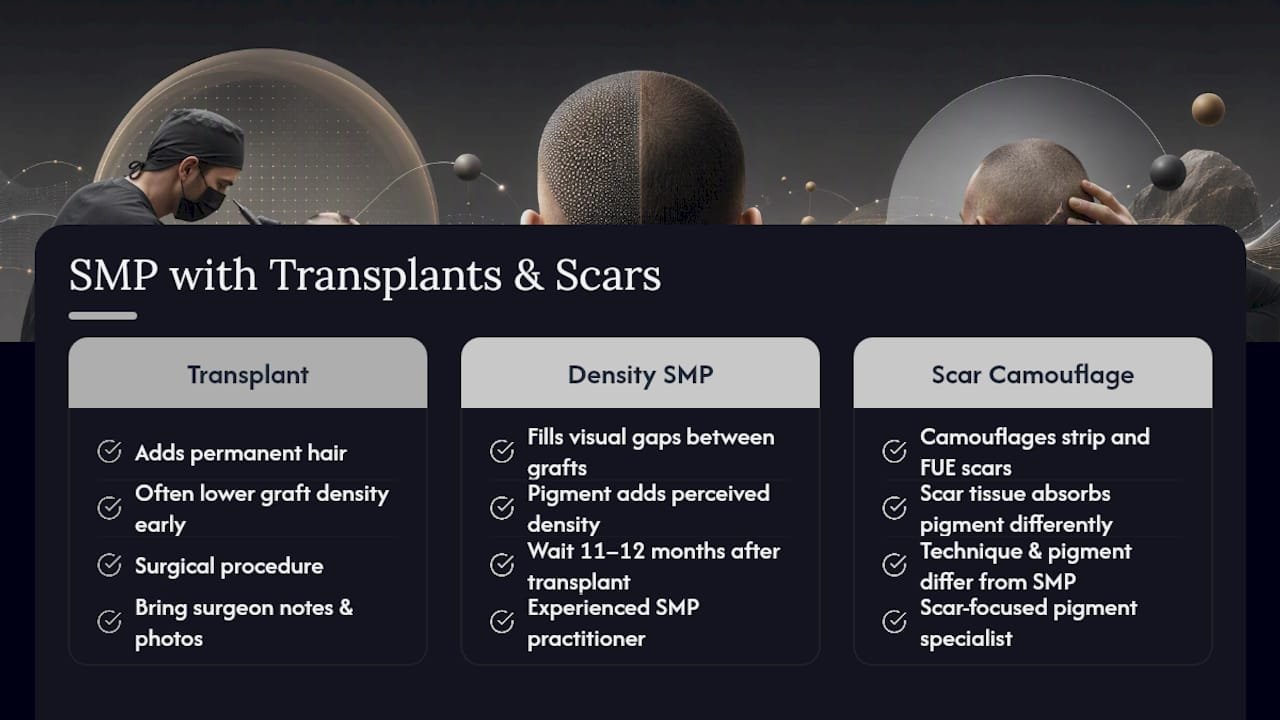
Density SMP and hair transplants solve different problems, and combining them often produces a more convincing result than either one alone. SMP fills the visual gaps between transplanted grafts, adding perceived density in areas where graft count alone can’t achieve full coverage. The ISHRS recommends waiting about 11 to 12 months after a transplant before starting SMP, giving the scalp time to fully heal and the grafts time to establish before pigment goes anywhere near the site.
The logic behind pairing them is straightforward: transplants add real, permanent hair, but graft density is often lower than natural density, especially in the first year or two of growth. SMP pigment placed strategically between those grafts closes the visual gap, creating a result that reads as more three-dimensional than transplant coverage alone.
Scar camouflage is a related but distinct use case. Linear scars from strip harvesting and small circular scars from FUE donor extraction both respond well to targeted pigment work, though the technique and pigment choice differ from standard density SMP since scar tissue takes pigment differently than healthy skin. This isn’t a job for generalists. It calls for specific experience in scar-focused pigmentation.
If you’re considering this combination, bring your transplant dates, surgeon’s notes, and graft photos to any SMP consultation. That history changes how a practitioner approaches your treatment plan, and skipping it is one of the more common reasons combination results underperform. Enhanced Scalp’s scar camouflage service addresses this specific overlap between transplant history and pigment work directly.
What Should a Responsible SMP Clinic Actually Do?
A clinic worth trusting with density SMP prioritizes restraint over drama. Conservative pigment selection, realistic healed documentation, and a clear session-by-session plan matter more than how dramatic the before-and-after photos look on day one.
Look for a few concrete markers before booking anywhere:
- Documented training and a portfolio of healed results, not just fresh, dramatically saturated photos
- Corrective SMP experience, since practitioners who can fix bad work understand pigment behavior far more deeply than those who’ve only done first-time treatments
- A written or verbally clear consultation process that includes scalp assessment, patch testing, and honest discussion of your specific candidacy
- Willingness to say no or recommend a different approach when density work isn’t the right fit for your pattern of loss
Enhanced Scalp builds its density work around conservative hairline planning, careful color matching to your natural tone, and staged layering rather than maximum saturation in a single visit. That approach costs a little more patience upfront, but it’s the difference between a result that still looks natural in five years and one that needs corrective work in eighteen months. Reviewing a gallery of healed results before booking gives you a much clearer sense of what “natural” actually looks like at scale.
Pro Tip: Ask directly how a clinic handles corrective cases. A practitioner who regularly fixes over-saturated or poorly placed work from other providers has a far more nuanced understanding of pigment behavior than one who’s never had to undo a mistake.
A candid take on when to say yes, and when to wait
I recommend density SMP without hesitation for women with diffuse thinning who still have real hair providing texture. For men wearing their hair longer, I’m more cautious, because progressive pattern loss can expose pigment that looked great a year ago. Chasing further loss with more pigment is how scalps end up over-saturated. Sometimes the responsible answer is a conservative test area now, or planning for a shaved look later, not maximum density today.
Ready to See What Density SMP Looks Like on You?
A photo consultation can only tell you so much. The real answer to whether density SMP will work for your specific pattern of thinning comes from an in-person scalp assessment, where a practitioner can see your actual hair density, skin tone, and scalp texture under the same bright light that reveals thinning in the first place. Enhanced Scalp builds every density treatment plan around that assessment first, whether you’re a woman with diffuse thinning looking to restore a fuller part line or a man weighing density work against a future shaved option.
Enhanced Scalp also handles corrective work for anyone dealing with prior SMP that’s over-saturated, discolored, or unevenly placed, along with hybrid planning for clients coordinating density work with hair transplants or scar camouflage. If you’re an aspiring practitioner rather than a client, the clinic’s SMP training program covers the same conservative, anatomy-first approach described throughout this guide.
The next step is simple: book a consultation, bring photos taken in bright light, and get a straight answer about whether density SMP fits your situation or whether a different plan makes more sense. Start with Enhanced Scalp’s scalp micropigmentation services page to see the full range of density and corrective options available.
Sources
Readers who want to go deeper on the clinical and safety side of scalp micropigmentation can check the ISHRS’s overview of SMP, which covers candidacy, contraindications, and post-transplant timing from a specialist society perspective. The FDA’s tattoo safety guidance is worth reading before any pigment procedure, since SMP shares the same core risks as tattooing. For technique-level detail on needle depth and anatomy-specific design, the Charles Medical Group’s anatomy-first framework breaks down how practitioners adjust technique across scalp zones. Beyond written sources, a clinic’s own healed-photo gallery and documented case studies remain the most practical evidence of what real, settled results look like months after treatment.
This article is general information, not a substitute for advice from a qualified doctor. Consult a qualified healthcare professional about your own circumstances before acting on anything here.
- Scalp Micropigmentation (SMP): All You Need to Know – ISHRS
- SMP for Thinning Hair: The Density Solution
- Think you ink? Tattoo safety – FDA
- How Does SMP Create a Realistic Hair Density Effect?
FAQ
What Is SMP Density Treatment?
Density SMP is a non-surgical cosmetic technique that places microscopic pigment dots between existing hairs to reduce scalp show-through, creating the visual appearance of fuller, thicker hair without adding any actual hair.
What Are the Disadvantages of SMP for Density?
The main drawbacks are that it’s a purely visual illusion with no added texture or volume, it can look over-saturated if pigment is repeatedly added to compensate for progressive hair loss, and it carries standard tattoo-related risks like infection or pigment reactions.
How Long Does SMP Last Before Needing a Touch-Up?
Density SMP results typically need touch-ups every 3 to 5 years as pigment gradually softens, though this varies based on skin type, sun exposure, and how the pigment was originally applied.
Does SMP Actually Make Hair Look Thicker?
Yes, SMP makes hair look thicker by reducing the contrast between scalp and hair, which is effective visually as long as enough real hair remains in the treated area to provide the texture the illusion blends into.

