 Skip to content

Yes, a legitimate temporary option exists, but the industry blurs the term constantly. The technique is properly called trichopigmentation, or STP, and it uses a different pigment formula placed closer to the skin’s surface so it fades on its own, usually within one to two years. Conventional scalp micropigmentation, by contrast, is designed to last for many years with only occasional refreshing. Some clinics also slap the word “temporary” on marketing pages loosely, so the label alone won’t tell you which treatment you’re actually getting.
Here’s what to look for as you keep reading:
- How the pigment and placement depth actually differ between the two approaches
- What a realistic fade timeline looks like, month by month
- What it costs to maintain either option over two years, and how to vet a clinic before booking
Key Takeaways
Temporary SMP is real when it means trichopigmentation, a technique using micronized, non-carbon pigment placed superficially so it fades within roughly 12 to 24 months, unlike permanent SMP which lasts years longer.
| Point | Details |
|---|---|
| The label has two meanings | Trichopigmentation is a real fading technique; “temporary” as pure marketing shorthand is not. |
| Fade timeline runs 6 to 24 months | Most STP results fade within 6 to 24 months, sun and skin type permitting. |
| Cost adds up over time | Temporary sessions often start near half the cost of permanent SMP, but retouches every year or two narrow that gap. |
| Removal depends on pigment type | Non-carbon STP pigment fades naturally; deeper carbon-based SMP resists laser removal more. |
| Enhanced Scalp discloses pigment and healed timelines | Consults include pigment disclosure, healed case photos, and training credentials on request. |
Table of Contents
- What People Mean by “Temporary SMP”
- How Does Fading SMP Differ From Permanent SMP?
- How Long Does Temporary SMP Actually Last?
- Advantages and Disadvantages of a Fading Approach
- Can You Remove or Reverse Temporary SMP?
- What Should You Ask Before Choosing a Technique?
- A Clinic Note From Enhanced Scalp
- Ready to See What Your Options Actually Look Like?
- Sources
- FAQ
What People Mean by “Temporary SMP”
The phrase gets used two different ways, and mixing them up leads to bad consult conversations. The first is a real clinical technique: trichopigmentation, often shortened to STP, which uses hypoallergenic, non-carbon pigments deliberately formulated to break down and fade over time. A peer-reviewed chapter on trichopigmentation describes it as a distinct protocol with its own machine settings and pigment chemistry, not a lighter version of standard SMP.
The second use is just marketing shorthand. A clinic might call any SMP session “temporary” because pigment naturally softens a little over the years, or because they want to make the commitment sound lower stakes. That’s not the same claim as a technique engineered to disappear on a schedule.
Conventional or permanent SMP uses carbon-based pigment placed slightly deeper in the dermis, built to hold its shape and tone for a decade or more with periodic touch-ups. When you call a clinic, ask specifically: “Is this trichopigmentation, or standard SMP marketed as low-commitment?” That single question filters out a lot of confusion fast.
How Does Fading SMP Differ From Permanent SMP?
The difference comes down to three technical choices, and each one has a measurable effect on how long the result holds.
- Pigment formulation: STP pigments skip carbon and use organic, absorbable compounds. Permanent SMP relies on carbon-based ink, which resists breakdown and can shift color over years, sometimes developing a blue or gray cast as particles degrade unevenly, a pattern documented in clinical literature on tattoo pigment behavior.
- Particle size: Temporary pigments are micronized to under 15 microns, according to technical breakdowns of trichopigmentation, small enough for the body’s macrophages to gradually clear them out.
- Implantation depth: STP sits in the upper dermis, roughly 0.5 to 1.0 millimeter deep. Standard SMP goes deeper, anchoring the pigment where skin turnover can’t reach it as easily.
Picture it like watercolor near the surface of paper versus ink pressed into the fibers. One washes out with time and light exposure; the other stays put.
Pro Tip: Ask any clinic to show you healed photos of the same client at 6, 12, and 24 months using the exact pigment they’d use on you. If they can’t produce a timeline, they likely aren’t tracking fade behavior closely.
How Long Does Temporary SMP Actually Last?
Expect a fairly predictable arc if the technique and pigment are genuine STP.
- Initial sessions: Most STP protocols run two to four sessions spaced three to four weeks apart to build density gradually.
- Healed baseline: Full healing typically takes four to six weeks, after which the true color and density become visible.
- Peak appearance: The look holds closest to its original density for the first several months post-healing.
- Fade window: Pigment breakdown commonly runs 6 to 24 months, with most STP cases landing in the 12 to 24 month range based on pigment micronization and placement depth.
Sun exposure speeds things up considerably, and so does frequent exfoliation or a scalp that runs on the oilier side. Immune response varies person to person too, since macrophages are doing the work of clearing the pigment. Most clients schedule a retouch somewhere between year one and year two, and clinics typically price that follow-up lower than the original sessions.
Advantages and Disadvantages of a Fading Approach
Temporary SMP suits a specific kind of client: someone who wants to see how a fully shaved, dense look feels before committing, or someone managing hair loss from a medical treatment that might reverse, such as discussed in detail regarding causes and effects in Does Creatine Cause Hair Loss? The Evidence. It also sidesteps the long-term color-shift risk that comes with carbon pigment sitting deep in skin for years.
What works in its favor:
- Lets you trial a shaved-head aesthetic without a permanent commitment
- Avoids the blue or gray discoloration risk tied to aging carbon pigment
- Fits transitional situations, like hair loss from chemotherapy that may regrow
Where it gets more complicated:
- Requires repeat sessions to maintain the look, which adds up over several years
- Even fading pigment can fade unevenly if skin tone, sun exposure, or aftercare vary across the scalp
- Total cost over two to three years can approach or exceed a single permanent treatment
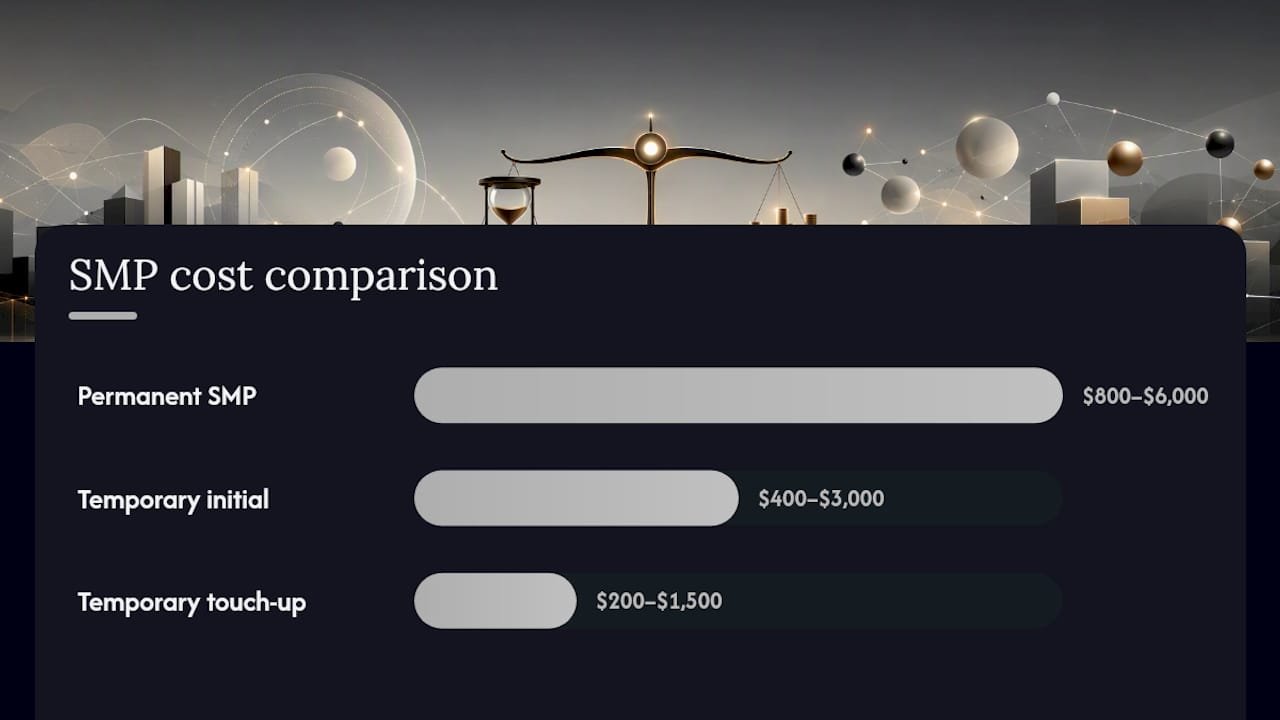
On pricing, permanent SMP generally runs $800 to $6,000 depending on scope and scarring involved, while temporary approaches often start around half that for the initial sessions, with touch-ups priced near half the original session cost. Run the math over two years, not one, before deciding which route actually saves money.
Pro Tip: Before booking, ask the clinic to write out a 24-month total cost estimate, including at least one retouch. Comparing that number to a single permanent SMP quote is the only fair way to judge value.
Can You Remove or Reverse Temporary SMP?
If you change your mind, you have more than one path forward, though the pigment type dictates how easy that path is.
- Let it fade naturally. This is the intended outcome for STP and requires no intervention, just time and normal sun exposure.
- Get corrective touch-ups. A skilled technician can adjust tone or density rather than start over.
- Pursue laser removal. This works better on carbon-based, deeper pigment than on micronized STP ink, and it carries its own risks of scarring or incomplete clearing.
- Cover with a new pattern. Some clients layer a fresh design once old pigment has faded enough to blend.
Because tattoo inks and pigments aren’t FDA-approved as a category, ask any clinic for full ingredient disclosure and a patch test before your first session, regardless of which technique you choose.
What Should You Ask Before Choosing a Technique?
Walk into a consult with this checklist, and you’ll get a much clearer picture of what you’re actually paying for.
- What pigment brand and formulation do you use, and is it carbon-based or organic?
- What particle size or micronization spec does that pigment carry?
- How deep does the pigment get placed?
- What’s your realistic fade timeline for this specific pigment?
- What does a retouch cost, and how often will I need one?
- Can I see healed photos of the same client at 6, 12, and 24 months?
- Where were you trained, and do you hold recognized credentials?
- What’s your patch test policy?
- What aftercare will speed or slow fading in my case?
- What will it cost me to keep this look for two full years?
Red flags worth walking away from: vague answers about pigment ingredients, no healed photos beyond the initial result, pressure to skip straight to a permanent treatment, or no visible training background. Groups like the ISHRS publish practitioner standards worth checking against.
A Clinic Note From Enhanced Scalp
- We disclose pigment composition and walk clients through placement depth before any needle touches skin.
- We show a gallery of healed cases at real timelines, not staged day-one photos.
- Our team’s training lineage and credentials are available on request, not buried.
- Corrective work on prior poor SMP or failed transplants gets staged conservatively rather than rushed.
Managing Expectations Matters More Than the Label
The clinic conversations that go well are the ones where expectations get set before the first session, not after. A conservative hairline design and honest fade timeline beat a bold promise every time. Trust healed photos and training records over whatever word a website uses for its technique.
Ready to See What Your Options Actually Look Like?
If you’ve been comparing a fading STP approach against permanent SMP and still aren’t sure which fits your situation, a consult clears that up faster than another hour of research. At Enhanced Scalp, that consult includes a review of healed case photos matched to your hair loss pattern, full disclosure of the pigment we’d use, and a realistic timeline estimate for how long results should hold before any retouch is needed.
Bring reference photos of looks you like, and bring the questions from the checklist above. Whether you’re dealing with early thinning, a receding hairline, transplant scarring, or a previous SMP treatment that didn’t heal the way you wanted, we’ll tell you plainly which approach fits your scalp and your goals. If male pattern baldness is the main concern, our male pattern baldness page walks through candidate profiles in more depth. Book a consult and get a straight answer instead of another marketing page.
Sources
- “Temporary” Scalp Micropigmentation (Trichopigmentation) — DOI (chapter)
- Temporary scalp micropigmentation (trichopigmentation) — Plastic Surgery Key
- Micropigmentation of the scalp — ISHRS
- Think you ink? Tattoo safety — FDA
FAQ
What Is Temporary Scalp Micropigmentation?
It’s a technique, usually called trichopigmentation or STP, that uses micronized, non-carbon pigment placed superficially so it naturally fades within about 12 to 24 months.
What Are the Disadvantages of SMP Treatment?
Ongoing costs for retouches, potential uneven fading across the scalp, and the risk of color shift in carbon-based pigments over many years are the main tradeoffs to weigh.
Can SMP Be Removed if I Don’t Like the Result?
Trichopigmentation typically fades on its own without intervention, while deeper, carbon-based SMP usually requires laser removal, which carries its own risk of scarring or incomplete clearing.
Is SMP Better Than a Hair Transplant?
They solve different problems: SMP creates the appearance of density or a shaved look without surgery, while a transplant physically moves hair follicles, and many clients choose SMP for corrective work after a transplant that didn’t heal well.
How Do I Know if My Clinic Uses Real Temporary Pigment?
Ask directly whether the pigment is carbon-free and micronized, and request healed photos at 6, 12, and 24 months to see how that specific formulation behaves over time.

