 Skip to content

Fundamentals-level scalp micropigmentation training runs CAD $4,500 + HST for a 2-day, hands-on program that includes a live model, a full kit, a manual, a certificate, and 6 months of mentorship. Serious students who want to work directly under a master trainer through an entire client case can expect to pay CAD $10,000 + HST for a 1-on-1 program covering all 3 SMP sessions.
That’s the top-line answer. But SMP training cost varies enormously depending on what’s actually inside the box, and cheap courses often leave out exactly the components that make a technician employable.
Here’s how the market generally breaks down:
- Entry-level (roughly $2,000 to $3,000): Short workshops, often without a live model or with limited supervised hours.
- Mid-range (roughly $3,500 to $5,000): Multi-day in-person courses with a kit, live-model practice, and a manual.
- High-end / 1-on-1 (roughly $6,000 to $10,000+): Extended mentorship, full case completion, and direct supervision from an experienced practitioner.
Key Takeaways
The right SMP training program depends on matching your experience level and support needs to a course that documents healed results, not just tuition price.
| Point | Details |
|---|---|
| Fundamentals pricing | Enhanced Pigment SMP Academy’s 2-day program is CAD $4,500 + HST, including a live model, full kit, manual, certificate, and 6 months mentorship. |
| Advanced 1-on-1 pricing | The advanced option is CAD $10,000 + HST and includes completing an entire live model across all 3 SMP sessions with James Christopher. |
| Market range varies widely | Industry pricing spans roughly $2,500 to $8,200+ depending on format, live-model inclusion, and mentorship length. |
| Evaluate healed results first | Prioritize trainers who show healed-work portfolios and correction experience over follower counts or edited photos. |
| Budget beyond tuition | Factor in travel, supplies, advanced modules, and possible certification renewal costs beyond the base course price. |
| Enhanced Scalp offers both tiers | Enhanced Pigment SMP Academy publishes transparent pricing for both the 2-day fundamentals and the 1-on-1 advanced program. |
Primary Sources and Internal Pages to Visit Next
- Enhanced Scalp Training Programs
- Enhanced Scalp Treatment Results Gallery
- Scalp Micropigmentation Treatment Pricing
Table of Contents
- How Much Does SMP Training Cost Across the Market?
- What’s Included in the Course Fee, and What Costs Extra?
- How Do You Choose the Right SMP Trainer?
- How Fast Can You Recoup Your Training Investment?
- What Should You Budget for Payment and Travel?
- Enhanced Pigment SMP Academy: Programs and Pricing
- What Does the Training Timeline Look Like?
- What Other Costs Should You Expect Beyond Tuition?
- Why Value Matters More Than the Price Tag
- Ready to Train With Enhanced Pigment SMP Academy?
- Sources
- FAQ
How Much Does SMP Training Cost Across the Market?
Course pricing in scalp micropigmentation training isn’t standardized, and that’s the first thing a serious student needs to understand before comparing programs by price alone. A $2,500 course and a $10,000 course can both call themselves “SMP certification,” yet deliver wildly different amounts of supervised hands-on time.
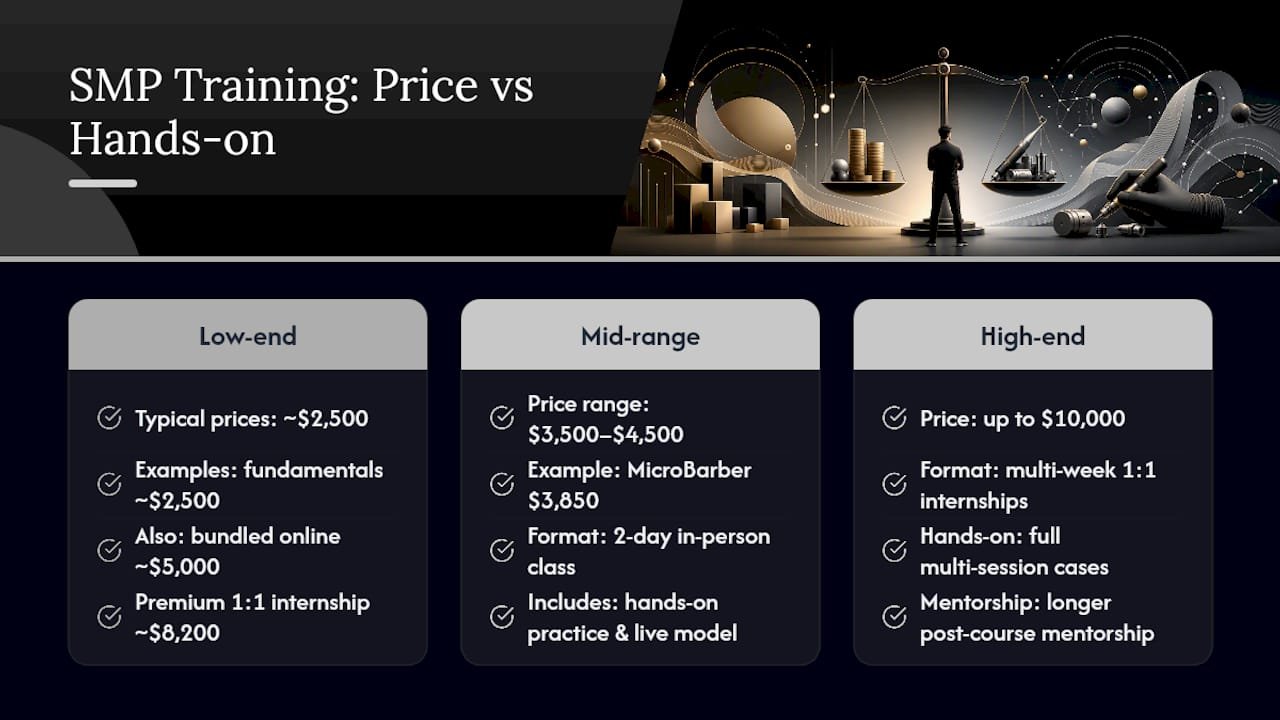
At the low end, SMP Institute advertises fundamentals training starting around $2,500, with bundled online packages closer to $5,000 and premium 1:1 internships around $8,200. That spread inside a single provider’s catalog tells you most of what you need to know: price climbs with the amount of direct, supervised time a student gets on a live model.
In the middle of the market, Elite Permanent Makeup & Cosmetology College lists SMP class fees around $3,500 to $4,500, with financing available and some packages including a model. MicroBarber offers a 2-day in-person certification at $3,850 that includes hands-on practice, a full kit, a live model, and ongoing support, which lines up closely with what most reputable 2-day programs deliver.
The jump from mid-range to high-end almost always comes down to three factors: how many days you spend with the trainer, whether you complete a full multi-session case rather than a single practice pass, and how long mentorship lasts after the course ends. A 2-day group class and a multi-week 1-on-1 internship aren’t really the same product wearing different price tags. They’re different levels of training entirely.
What’s Included in the Course Fee, and What Costs Extra?
Before comparing prices, get a written breakdown of inclusions. Course pages can be vague about what “training” actually means, and the gaps usually show up after you’ve paid.
Standard inclusions in a legitimate SMP course typically cover:
- Hands-on instruction time with a working live model, not just observation.
- A starter kit with a machine, needles, and pigment.
- Written training materials or a manual you can reference later.
- A certificate of completion.
- A defined period of mentorship, commonly 3 to 6 months, according to Elite Permanent Makeup & Cosmetology College.
Costs that commonly sit outside the base tuition include premium machine upgrades, additional live models beyond the one included, extra practice sessions, and advanced modules covering corrective work or scar camouflage. Group classes also split time-on-model across several students, while 1-on-1 formats give you the trainer’s full attention and, often, a completed case rather than a single practice session.
Pro Tip: Ask exactly how many hours you’ll spend hands-on with a live model, not just how many days the course runs. A 2-day course with 4 hours of actual needle time is very different from one with 10.
How Do You Choose the Right SMP Trainer?
Picking a program by price alone is how students end up with a certificate and no real skill. The stronger filter is evidence: what does this trainer’s healed work actually look like 6 to 12 months out, not on day one when the pigment is still settling?
Look for these signals before you commit:
- A visible portfolio of healed results, not just fresh before-and-afters taken under studio lighting.
- Active, ongoing client volume, meaning the trainer still practices SMP regularly rather than teaching from old work.
- Real correction experience, since fixing failed transplants, botched SMP, and laser-removal cases requires a different skill set than hairline work on clean scalps.
- Transparency about mentorship length, class size, and what happens if you need extra help after the course.
Red flags include courses built entirely around edited or filtered photos, no healed-result documentation anywhere, vague or undefined mentorship, and no live model included at all. A trainer who leans on awards, follower counts, or star ratings instead of showing actual healed work is telling you something by omission. Reddit threads on becoming an SMP artist are full of students who paid for cheap weekend certifications only to discover they’d gotten a few hours of supervised practice and no follow-up support.
How Fast Can You Recoup Your Training Investment?
Treatment pricing gives you the clearest way to estimate payback time. Micropigmentation Academy reports typical treatment prices between $1,600 and $3,500 depending on case complexity, with first sessions running 3 to 4 hours and follow-ups around 2 to 3 hours.
Two quick scenarios show how tuition gets recovered:
- Conservative pace: 1 to 2 treatments per week at an average of $2,000 puts you at $4,000 in revenue within your first two weeks of active client work, before factoring in overhead.
- Aggressive pace: 4 or more treatments weekly at the same average price point covers a $4,500 fundamentals course in a single week of full bookings, assuming you already have a client pipeline.
Payback speed depends heavily on variables outside the course itself: how well you market locally, whether you build a client base before finishing training, and whether you specialize in corrective SMP or scar camouflage. Technicians who take on corrective cases often charge premium rates over standard hairline work, which shortens the runway to profitability.
What Should You Budget for Payment and Travel?
Tuition is rarely the whole bill. Many programs, particularly higher-tier ones, offer payment plans or financing partners rather than requiring the full amount upfront, and it’s worth asking directly rather than assuming.
Build these into your total budget:
- Travel and accommodation if the course isn’t local, especially for multi-day or 1-on-1 formats.
- Model fees if the course doesn’t include a live model or requires you to source your own.
- Machine or kit upgrades beyond the starter equipment provided.
- A written list of exact inclusions before paying a deposit, plus the trainer’s cancellation and refund policy.
If you’re training remotely from another province or country, ask specifically how mentorship works after you leave. Some programs promise support but never define the schedule or response time.
Enhanced Pigment SMP Academy: Programs and Pricing
Enhanced Scalp runs Enhanced Pigment SMP Academy under lead trainer James Christopher, with two program tiers built around how much direct time a student actually needs.
- Fundamentals (2 days): CAD $4,500 + HST. Includes hands-on training, a live model, a full kit, a manual, a certificate, and 6 months of mentorship.
- Advanced 1-on-1: CAD $10,000 + HST. The student completes an entire live model through all 3 SMP sessions directly with James Christopher, with deeper, closer supervision throughout.
The fundamentals program suits students who are new to SMP but already comfortable with the fundamentals of skin work, tattooing, or cosmetic procedures, and who want a structured foundation plus follow-up support. The 1-on-1 option fits students who want to walk away having completed a full client case start to finish, under direct supervision, rather than a single practice session split across a group.
Pro Tip: Before booking either program, ask to see James Christopher’s healed-result gallery, not just recent work. Healed pigment tells you far more about a trainer’s skill than day-one photos ever will.
What Does the Training Timeline Look Like?
Most students move through SMP training in a predictable sequence, though the pace varies by program tier.
Enrollment typically starts with a consultation or application, where the trainer confirms your background and program fit. Fundamentals-level students then attend the 2-day intensive itself, which covers pigment theory, machine handling, hairline design principles, and live supervised practice on a model. You leave with your kit, manual, and certificate in hand.
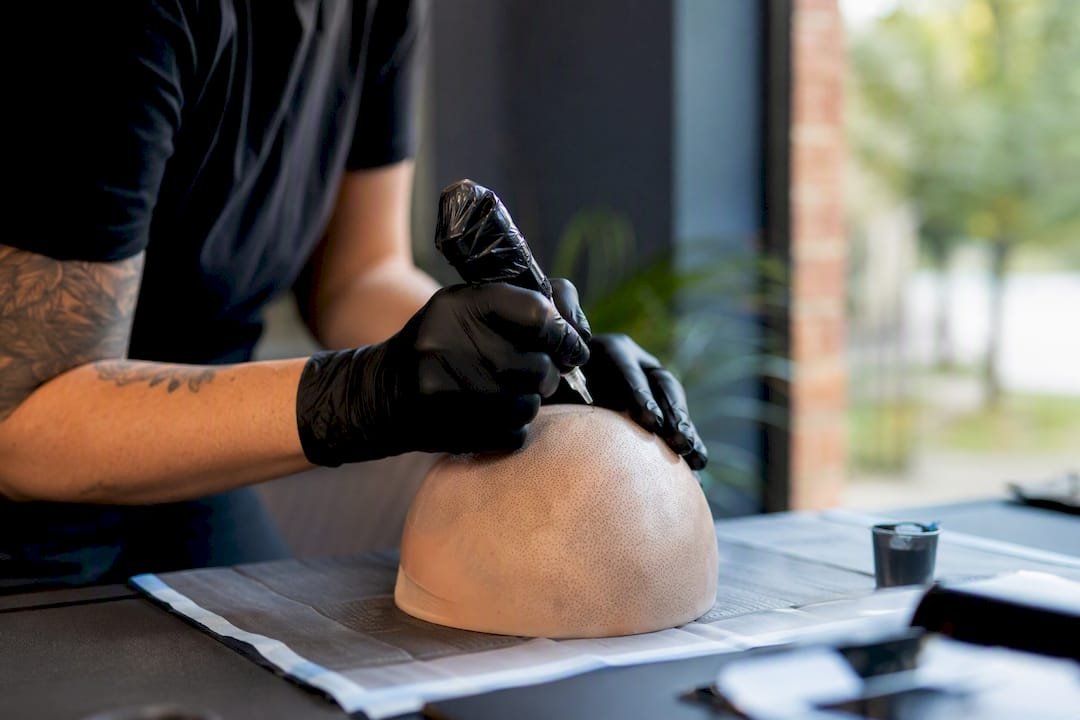
The 6-month mentorship period that follows is where a lot of real skill-building happens. Students bring questions from their first solo clients, share photos for feedback, and troubleshoot problems that only show up once you’re working without direct supervision. This stretch matters more than most students expect going in.
For the advanced 1-on-1 track, the timeline extends further because it’s built around a real client case. You complete all 3 SMP sessions with James Christopher directly, typically spaced a few weeks apart to allow pigment to settle between sessions, mirroring the actual treatment timeline you’ll offer your own clients later.
Certification is issued after the hands-on component is complete, but competency keeps developing throughout the mentorship window. Treat the certificate as the start of your development, not the finish line. Students who lean on the mentorship period, rather than disappearing after the course ends, tend to reach consistent, healed-safe results faster.
What Other Costs Should You Expect Beyond Tuition?
The advertised course price is rarely the final number. A few categories of additional cost show up consistently across the industry, whether you train with Enhanced Scalp or elsewhere.
Ongoing supplies top the list. Pigment, needles, and machine maintenance are recurring costs once you start treating your own clients, since your initial kit is meant to get you started, not sustain a full practice indefinitely. Budget for restocking within your first few months of active work.
Some providers also charge separately for certification exams or renewal fees tied to continuing education, though this varies by program and jurisdiction. Ask directly whether your certificate requires any renewal or recertification down the line, since not all programs structure it the same way.
Advanced modules are another common add-on. Corrective SMP, scar camouflage, and work on more challenging scalp conditions often require additional training beyond the fundamentals, particularly if you want to serve clients with prior poor SMP or failed transplants. Enhanced Scalp’s own corrective and scar camouflage work illustrates the kind of specialized skill this niche demands.
Finally, factor in business costs unrelated to the course itself: liability insurance, a treatment space or chair rental, and basic marketing to build your first client base. None of these appear on a course price sheet, but all of them affect how quickly your training pays for itself.
Why Value Matters More Than the Price Tag
The conventional advice in this industry tells students to compare course prices side by side like they’re shopping for a laptop. That’s backward. A $2,500 course and a $4,500 course aren’t the same product at different prices. They’re often different products entirely, one with a few hours of practice and a kit, the other with genuine supervised time on a live model and months of follow-up support.
What the research on this topic actually supports is simple: mentorship length and supervised live-model hours predict early competency far better than course duration or price alone. A 2-day course with real hands-on time and 6 months of mentorship will usually produce a more capable technician than a 5-day course that skips the model entirely.
I’d push back hard on students who chase trainers with the biggest social following or the most polished before-and-after grid. Filtered photos taken under studio lighting on day one tell you nothing about how that work ages. Ask for healed results at 6 and 12 months instead. Ask how many corrective cases the trainer has handled. Ask what happens when your first solo client’s hairline doesn’t come out the way you hoped. Those answers separate a real education from an expensive weekend.
— James Christopher
Ready to Train With Enhanced Pigment SMP Academy?
Most SMP courses ask you to choose between a cheap weekend workshop with almost no live-model time or a vague “premium” program that never shows its actual healed results. Enhanced Pigment SMP Academy solves that gap directly: every price point is published upfront, every inclusion is listed in writing, and the training is built around real supervised work on a live model, not slides and theory.
If you’re weighing SMP training cost against what you’ll actually walk away with, start by reviewing the full training program details, including exact inclusions for both the 2-day fundamentals and the 1-on-1 advanced option. Students travel from across Canada and internationally for this exact reason: the mentorship period and correction-focused experience aren’t something a local weekend course typically offers. Reach out to ask about upcoming session dates and confirm which program fits your experience level before you book.
Sources
- Scalp Micropigmentation – Micropigmentation Academy
- SMP Institute
- Scalp Micropigmentation Classes – Elite Permanent Makeup & Cosmetology College
FAQ
Is SMP Training Worth the Cost?
For students who commit to a program with real supervised live-model hours and ongoing mentorship, yes. The technicians who struggle to see returns are usually the ones who chose the cheapest course available and skipped the mentorship follow-through.
How Much Does SMP Training Cost?
Prices typically range from around $2,500 for basic fundamentals courses to $10,000 or more for advanced 1-on-1 programs, with most reputable 2-day courses falling between $3,500 and $4,500.
Why Is SMP Training So Expensive at the High End?
High-end 1-on-1 programs cost more because they include extended, direct mentorship and often a full multi-session client case completed with the master trainer, which requires far more time and supervision than a group workshop.
How Do I Know if an SMP Trainer’s Results Actually Hold Up Long-Term?
Ask to see healed results from 6 to 12 months post-treatment, not just fresh photos, and ask how many corrective cases the trainer has handled for prior poor SMP or failed transplants.
What’s Included in a Typical 2-Day SMP Course?
A standard 2-day course, like Enhanced Pigment SMP Academy’s fundamentals program, typically includes hands-on training, a live model, a full kit, a manual, a certificate, and a defined mentorship period.

