 Skip to content

Yes, minoxidil and scalp micropigmentation work well together when you sequence them correctly. Topical minoxidil acts on hair follicles beneath the skin, while SMP deposits pigment into the upper dermis, so the two don’t compete biologically. The real issue is timing: pause topical minoxidil around your sessions, and get sign off from both your SMP practitioner and your prescribing clinician before restarting anything, especially oral medication.
TL;DR:
- Pausing topical minoxidil at least 48 hours before SMP sessions minimizes irritation and bleeding risks that can affect pigment placement.
- Foam formulations are preferred during healing periods due to their lower alcohol content and reduced skin irritation compared to liquids.
- Waiting one to four weeks after the final SMP session before restarting minoxidil helps protect the pigment while acknowledging temporary shedding.
- Combining minoxidil with SMP carries minor, temporary risks of blurring or fading, which are usually correctable with touch-ups.
- An individualized treatment plan, guided by consultation, accounts for medication use, healing response, and specific scalp conditions to optimize results.
Table of Contents
- Minoxidil With SMP: How the Medication Actually Works
- What SMP Does to the Scalp (and Why Healing Matters)
- The Protocol: Timing Minoxidil Around Your SMP Sessions
- Risks Worth Knowing Before You Combine the Two
- When to Watch Closely and When to Call Someone
- Enhanced Scalp’s Approach to Medication and SMP Planning
- What the Evidence Actually Supports
- Ready to Plan Your SMP and Medication Timeline?
- Sources
- FAQ
Minoxidil With SMP: How the Medication Actually Works
Minoxidil is a topical vasodilator. It widens blood vessels near the follicle and appears to extend the growth phase of hair, which is why it slows shedding for many users. It doesn’t touch pigment sitting in the dermis, which is where SMP lives, so the two treatments target different tissue layers entirely.
Formulation matters more than most people realize. Liquid minoxidil contains propylene glycol and alcohol, both of which can sting or dry out skin that’s already irritated. Foam skips most of those irritants, which is why it’s often the better pick around a healing scalp.
Medical caution matters here too. Common side effects include scalp irritation, itching, and unwanted facial hair from product transfer, according to Mayo Clinic. People with cardiovascular conditions, and anyone pregnant or breastfeeding, should talk to a doctor before starting or continuing minoxidil at all, topical or oral.
Low-dose oral minoxidil requires medical supervision: it can cause fluid retention, a faster heart rate, and lowered blood pressure, so clinicians typically monitor blood pressure and ask about heart conditions before prescribing. It is not recommended during pregnancy or breastfeeding. Discuss these risks with a physician before starting.
- Topical minoxidil: vasodilator, works at the follicle, does not affect dermal pigment
- Foam: fewer irritants, generally gentler on compromised skin
- Liquid: faster absorption but higher irritation risk from alcohol content
- Oral minoxidil: systemic, requires physician oversight regardless of SMP plans
What SMP Does to the Scalp (and Why Healing Matters)
Scalp micropigmentation uses a fine needle to place pigment into the upper dermis, creating the illusion of density or a closely shaved hairline. It’s a cosmetic tattoo technique, not a hair restoration procedure. It doesn’t regrow a single follicle.
Most clients need three to four sessions spaced about a week or two apart, giving the skin time to close each round of micro wounds before the next pass. That healing window is exactly why surface conditions matter so much.
Anything that increases bleeding, irritation, or moisture on the scalp during this stretch can interfere with how pigment settles. A peer-reviewed look at topical agents and skin healing backs up what most practitioners already assume: substances applied to healing skin can shift how that skin recovers and how well anything embedded in it holds.
- Pigment sits in the upper dermis, not the follicle
- Multiple sessions are standard, with healing time built in between
- Bleeding or excess irritation during healing can affect pigment placement
- Active topical products on broken skin raise the stakes for both healing and results
The Protocol: Timing Minoxidil Around Your SMP Sessions
Getting the sequence right is mostly about discipline, not complexity. Here’s the practical order most clinics follow.
- Stop topical minoxidil before your first session. Clinic convention typically calls for pausing topical minoxidil at least 48 hours before a session, though some practitioners prefer longer. Wash your scalp thoroughly beforehand and tell your practitioner about every medication you’re on, oral or topical.
- Decide your between-session strategy. You have two real options during a multi-session SMP course: stay off minoxidil entirely until treatment finishes, or resume briefly between sessions and pause again before the next one. Staying off minimizes any risk to developing pigment. Resuming between sessions protects your regrowth progress but adds a step you have to remember every single time.
- Wait before restarting after your final session. Most practitioners recommend waiting one to four weeks after the last SMP appointment before reintroducing topical minoxidil, based on clinic-reported convention. Oral finasteride is systemic and generally doesn’t require this same pause, but check with your prescriber regardless.
- Choose foam over liquid when you resume. Practical aftercare guidance favors foam because it carries less alcohol and fewer irritants than liquid formulations, which matters on skin that’s still settling.
- Pat, don’t rub. Apply with gentle pressure using your fingertips or the foam applicator. Rubbing motion can disturb pigment that hasn’t fully stabilized, even weeks after your last session.
Finasteride is FDA-indicated for men only. Women who are or may become pregnant must not handle crushed or broken finasteride tablets, due to the risk of harm to a male fetus. It can also cause sexual side effects (reduced libido, erectile dysfunction) in a minority of men, which usually resolve after stopping treatment. Discuss these risks with a physician before starting.
Pro Tip: Keep a simple log on your phone: the date of each SMP session, the date you stopped or restarted minoxidil, and any skin reaction you notice. That timeline is the first thing a clinician will ask for if something looks off, and it saves you from guessing later.
The trade-off is real and worth naming directly. Pausing minoxidil, even for a few weeks, can cause shedding as your follicles adjust, and any regrowth gains you built up may reverse. That’s not a sign anything went wrong. It’s a known and temporary consequence of stopping, and a good practitioner will walk you through it before you ever pause.
Risks Worth Knowing Before You Combine the Two
The biggest risk isn’t the medication itself. It’s applying it at the wrong moment. Liquid minoxidil’s alcohol content can increase irritation and, in some cases, minor bleeding risk if applied too close to a session, which can interfere with how the SMP procedure goes and how pigment settles afterward.
Pigment issues from combining the two incorrectly tend to be minor and temporary: slight blurring in the first week or two, or faster than expected fading in a small area where irritation was worse. Clinics usually address this with a touch up session rather than a full redo.
One point worth sitting with: Mayo Clinic notes that scalp irritation is among the most commonly reported side effects of topical minoxidil on its own, before you even add a healing tattoo procedure into the mix. Stacking an irritant on top of healing skin is simply asking for more of the same problem, at a worse time.
- Alcohol-based liquid minoxidil raises irritation and bleeding risk near procedure dates
- Blurring or early fading is usually minor and correctable with a touch up
- Persistent redness, oozing, or unusual pigment changes need clinical attention, not a wait-and-see approach
When to Watch Closely and When to Call Someone
Normal healing looks like mild redness and light flaking for roughly the first week, fading steadily after that. Anything that gets worse instead of better deserves a second look.
Watch for excessive redness that spreads, oozing, unusual swelling, or a sudden patch of pigment looking noticeably different from the rest. Take a photo the moment you notice something, and keep a short note of what products you’ve used and when.
Route the right issue to the right person. Contact your SMP clinic for pigment concerns, healing questions, or touch up scheduling. Contact your prescribing physician for anything related to oral minoxidil, cardiovascular symptoms, or an allergic reaction.
- Mild redness and flaking in week one: expected
- Spreading redness, oozing, or sudden pigment shift: not expected, contact your clinic
- Chest pain, dizziness, or swelling with oral minoxidil: contact your physician immediately
Pro Tip: Photograph your scalp in the same lighting and angle every few days during healing. Side-by-side comparison catches subtle changes faster than memory ever will.
Enhanced Scalp’s Approach to Medication and SMP Planning
Some clinics ask clients to pause topical minoxidil for the full course of SMP to reduce variables during the most sensitive healing windows. It’s a conservative call, and it comes with the shedding trade-off already covered above, but it’s one worth discussing openly rather than assuming.
Consultations start with a full medication history, including any oral or topical hair loss treatment, to build a schedule around each client’s specific situation rather than a generic timeline. Bring a current medication list, recent photos of your scalp, and a clear sense of what you want the end result to look like. Our SMP treatment guide covers session sequencing and aftercare in more depth if you want to read ahead before booking.
What the Evidence Actually Supports
Most of what circulates online about minoxidil and SMP timing is convention, not clinical trial data. That distinction gets lost constantly. Clinics converge on similar pause windows because they’ve watched what happens when clients don’t follow them, not because a controlled study proved a 48 hour cutoff is the biologically correct number.
That’s not a knock on the convention. It’s a reason to treat it as a floor, not a rulebook. If your scalp is unusually reactive, or you’re on oral minoxidil for a cardiovascular reason unrelated to hair loss, the standard timeline may need adjusting, and no generic guide can make that call for you.
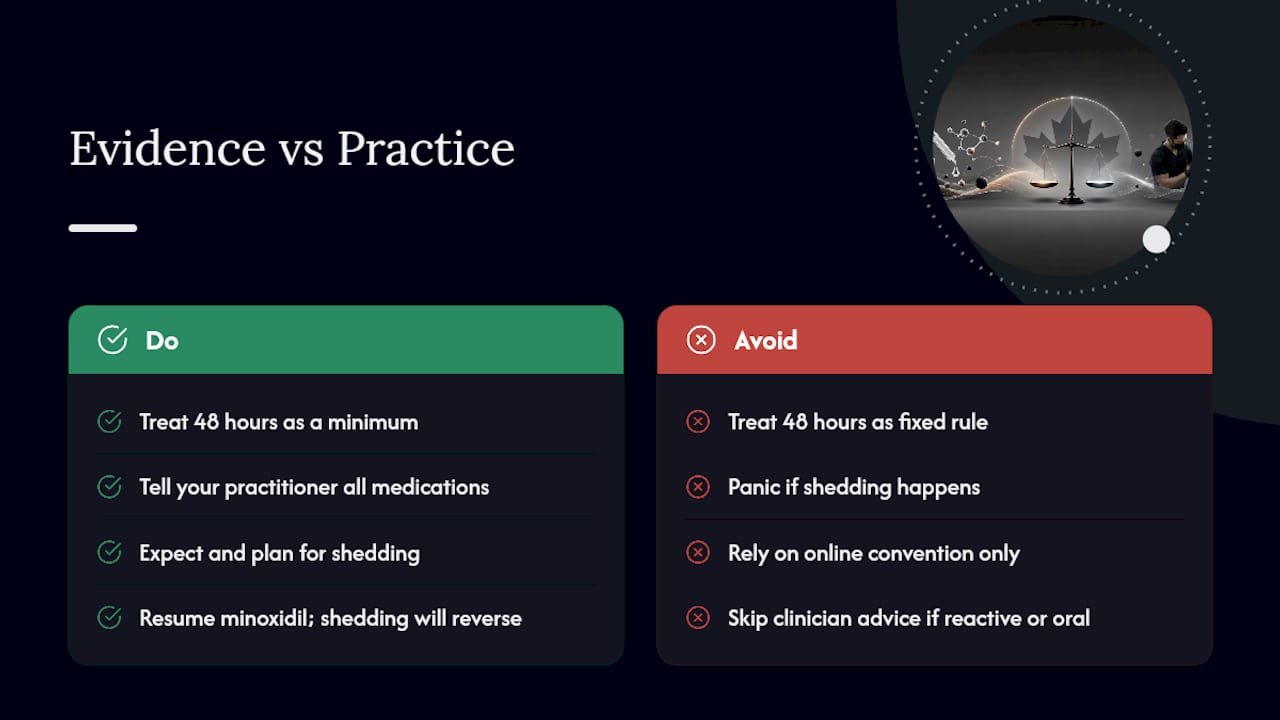
Where I think most advice undersells the situation is the shedding trade-off. Articles mention pausing minoxidil almost as an afterthought, when in practice it’s the part that rattles people most. Expect it, plan for it, and don’t panic when it happens. It reverses once you resume.
Prioritize the conversation with your practitioner over the calendar math. The exact number of days matters less than whether the person doing your SMP actually knows your full medication picture.
— James Christopher
Ready to Plan Your SMP and Medication Timeline?
Figuring out the right sequence on your own, from scattered forum threads and drug labels, is exactly the kind of guesswork experienced practitioners exist to remove. A consultation gets you a specific plan built around your medications, your scalp, and your goals, not a generic pause window pulled from an internet thread.

During a consultation, clients can review their full medication history, including topical and oral minoxidil, assess current density and hairline, and create a session schedule that accounts for when to pause and resume treatment. If you’re weighing corrective work, hairline design, or coverage for thinning at the crown, our scalp micropigmentation services page walks through what a full course looks like. Women considering SMP for diffuse thinning can find specifics on our female scalp micropigmentation page, and anyone who wants to see healed outcomes before committing should browse our results gallery. Reach out to book a consultation and get a medication timeline built specifically around your scalp.
This article is general information, not a substitute for advice from a qualified doctor. Consult a qualified healthcare professional about your own circumstances before acting on anything here.
Sources
- Minoxidil (Topical route) side effects — Mayo Clinic
- Peer-reviewed article on skin healing and topical agents — NCBI/PMC
- Can I use hair loss treatments (finasteride, minoxidil) after scalp micropigmentation? | Tressless
FAQ
Does SMP Make Hair Grow?
No. SMP deposits pigment into the upper dermis to create the visual impression of density or a shaved look. It doesn’t stimulate follicles or produce actual hair growth.
What Are the Disadvantages of SMP Hair Treatment?
Pigment can fade or shift tone over years, it’s not reversible without laser removal, and results depend heavily on practitioner skill, which is why corrective SMP for poor prior work is common.
What Should I Avoid After SMP?
Avoid sweating heavily, swimming, direct sun exposure, and applying active topical products like minoxidil until your practitioner clears you, typically one to four weeks after your final session.
Can I Use Minoxidil With SMP if I’m Already on It Before Treatment?
Yes. Tell your practitioner during consultation, pause topical minoxidil roughly 48 hours before each session, and follow their guidance on when to resume once healing is confirmed.
Does Pausing Minoxidil for SMP Cause Permanent Hair Loss?
No, the effect is temporary. Any shedding from pausing minoxidil typically reverses once you resume the medication after your SMP sessions are complete.

