 Skip to content

Scalp micropigmentation is the most practical non-surgical option for men at Norwood 7 who can accept a shaved or close-cropped look, since donor hair at this stage rarely supports full transplant coverage. Hair systems and hybrid transplants remain alternatives, and medical therapy still has a narrow role in protecting whatever fringe remains. The rest of this guide covers how SMP for Norwood 7 actually works, what healed results look like, and how to pick a practitioner who won’t botch a procedure you can’t easily undo.
TL;DR:
- SMP at Norwood 7 typically requires two to three sessions spaced two to four weeks apart to achieve natural healing and consistent density.
- The procedure relies on uniform pigment application over an open scalp, making the result more straightforward but highly dependent on precise practitioner technique.
- Long-term durability varies with skin type and sun exposure, with most clients maintaining effective results for several years before needing a touch-up.
- Cost ranges from $2,000 to $4,000 for full coverage, with touch-ups every three to five years costing less, making SMP a potentially more economical long-term option.
- Choosing a qualified, experienced practitioner is critical, and must include verifying healed work, proper sterilization, and pigment quality to avoid discoloration or poor results.
Table of Contents
- What SMP Achieves at Norwood 7
- How the Treatment Process Works
- Realistic Results and How Long They Last
- Comparing SMP With Hair Systems and Transplants
- Vetting an SMP Practitioner
- What Full-Scalp SMP Costs Over Time
- Why We Treat Norwood 7 as a Different Kind of SMP Case
- Booking Your Norwood 7 Consultation With Enhanced Scalp
- Sources
- FAQ
What SMP Achieves at Norwood 7
At Norwood 7, hair loss leaves only a narrow horseshoe of hair at the sides and back, with the entire crown and top bald. Scalp micropigmentation fills that space by depositing thousands of tiny pigment dots into the dermis, replicating the look of closely buzzed stubble across the whole scalp.
Ironically, this is one of the more straightforward SMP cases to execute well. A fully bald scalp gives a technician a uniform canvas, no thinning patches to blend, no existing hairline to match tone against, just consistent dot density from front to back. That consistency is also why treating Norwood 7 tends to produce some of the most convincing SMP results in the field.
Good candidates for full-scalp SMP typically share a few traits:
- Comfortable maintaining a shaved or very short buzzed look indefinitely
- Realistic about wanting a stubble illusion, not literal hair regrowth
- Reasonably healthy scalp skin without active dermatological conditions
- Willing to commit to a multi-session process and future touch-ups
SMP isn’t the right match if you want visible length or you’re not willing to keep your remaining fringe closely trimmed to match the simulated area. The whole illusion depends on uniformity.
How the Treatment Process Works
Full-scalp work at Norwood 7 is almost always staged rather than done in one sitting. Covering that much surface area with the density and tonal buildup needed for a natural result takes:
- Session one: outlining the treatment zone, establishing a base layer of pigment at conservative density, usually with topical numbing applied before work begins
- Session two: adding depth and filling gaps, refining dot placement where the first layer looks too light or uneven
- Session three (often needed at this scale): final density adjustments and blending at the temples and nape where hair meets skin
Most clinics space these two to three weeks apart to let the scalp settle and let the technician judge how pigment is healing before adding more.
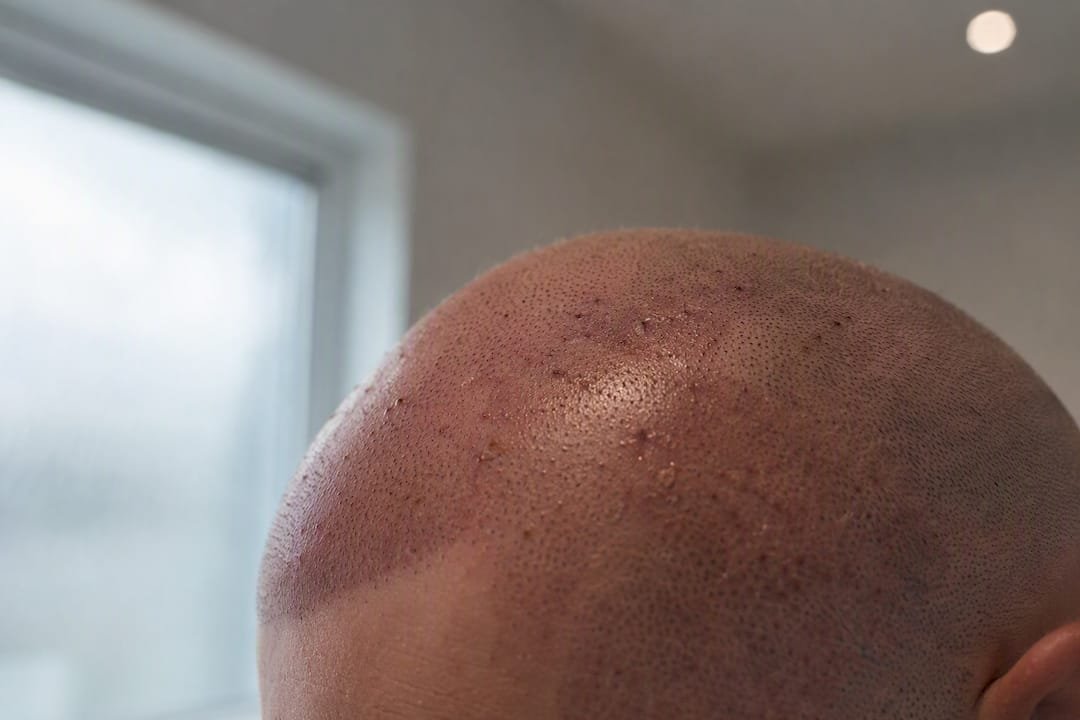
Healing follows a predictable arc. Days one through four bring some redness and a slightly darker appearance than the eventual result. By day seven, light scabbing or flaking typically resolves. The scalp continues to soften in tone over the following three to four weeks as the skin’s top layer finishes turning over, which is why the healed look always appears softer than the fresh, ink-dark look right after a session.
Pro Tip: Avoid sweating heavily, swimming, or sun exposure on treated skin for at least ten days after each session. Pigment sits shallow in fresh work and heat or UV exposure can pull color out unevenly before it settles.
Realistic Results and How Long They Last
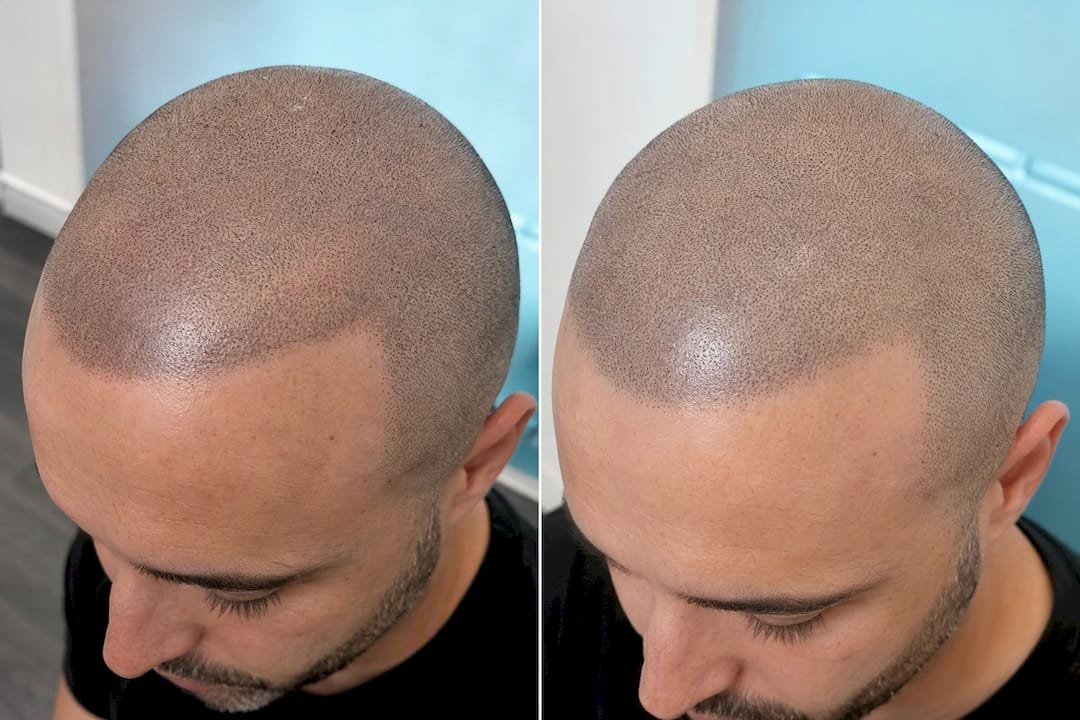
The gap between a fresh session and a fully healed result surprises almost everyone going through SMP for the first time. Right after a session, pigment looks crisp and noticeably darker than it will end up. Over the following month, it softens into something closer to an actual five o’clock shadow.
That softening is normal, not a sign of a failed treatment. Pigment particles settle deeper and diffuse slightly, which is exactly what produces the natural, slightly translucent look you see in properly healed work.
Longevity depends heavily on skin type, sun exposure, and pigment quality:
- Most clients see several years of solid color before a refresh is worth considering
- Fading tends to happen unevenly, faster at the crown where UV exposure is highest
- Lower-quality pigments (or carbon-based tattoo ink used by unqualified providers) can shift blue or gray over time instead of fading evenly
A useful reference point: multi-session SMP protocols commonly run two to four sessions for larger treatment areas, which tracks closely with what full Norwood 7 coverage requires.
Enhanced Scalp’s own case documentation for Norwood 7 clients follows this pattern consistently: a client who looked slightly overdone immediately after session two typically settles into a natural, evenly toned result by the six-week healed mark, once the pigment has finished its final settling phase.
Comparing SMP With Hair Systems and Transplants
SMP isn’t the only path at this stage, and it’s worth understanding what you’re trading off against the alternatives.
- Hair systems (toppers or full units) offer the most literal hair-like appearance and can include length and styling, but they require regular replacement, adhesive maintenance, and ongoing cost that never stops. They also carry some risk of detection during activities like swimming or in windy conditions.
- Hair transplants at Norwood 7 face a hard ceiling: donor supply at the sides and back is limited, and clinical guides generally recommend against full transplant coverage at this stage because there simply aren’t enough grafts to cover the bald area without thinning the donor zone itself. Hybrid approaches, where transplanted hair covers a hairline and SMP fills density behind it, only make sense when donor density genuinely supports it.
- Finasteride and minoxidil can help preserve the remaining fringe hair and occasionally support some regrowth in areas that still have follicles, but the American Academy of Dermatology notes these medications have limited ability to regrow hair on scalp that’s already fully bald.
Finasteride is FDA-indicated for men only. Women who are or may become pregnant must not handle crushed or broken finasteride tablets, due to the risk of harm to a male fetus. It can also cause sexual side effects (reduced libido, erectile dysfunction) in a minority of men, which usually resolve after stopping treatment. Discuss these risks with a physician before starting.
Vetting an SMP Practitioner
Full-scalp work is permanent and highly visible, which makes practitioner selection the single most consequential decision in this process. A few concrete steps cut your risk significantly:
- Ask specifically for healed Norwood 7 galleries, not just fresh post-session photos. Healed results tell you what you’ll actually be walking around with.
- Confirm formal SMP training and ask how long the practitioner has specialized in the technique, not just general tattooing.
- Check that the clinic uses single-use needle cartridges and follows standard sterilization protocols.
- Ask directly about pigment brand and composition. Poor pigment choice is the leading cause of blue or gray discoloration years later.
- Request a consultation that includes hairline and density planning specific to your scalp, not a generic template.
Regulatory bodies including the FDA caution consumers to verify credentials and be skeptical of providers making exaggerated claims, since SMP still lacks consistent licensing standards across many regions.
Pro Tip: If a provider can’t show you their own healed work past the six-month mark, that’s a red flag worth walking away from. Fresh photos hide problems that only show up once pigment settles.
What Full-Scalp SMP Costs Over Time
Pricing for Norwood 7 coverage sits at the higher end of the SMP spectrum simply because of surface area. Practitioner-reported ranges commonly land around $2,000 to $4,000 for larger treatment zones, with the final number shaped by:
- Clinic reputation and technician experience level
- Geographic market and cost of living in the clinic’s area
- Number of sessions required to reach full density
- Whether any corrective work on prior scarring or poor SMP is involved
Touch-ups typically run every three to five years and cost meaningfully less than the original treatment since they’re refreshing existing work rather than building density from scratch. Weighed against a lifetime of hair system replacements or the ongoing cost of multiple transplant procedures with uncertain donor supply, SMP’s one-time investment with periodic refreshes tends to work out as the more contained long-term budget for someone who has already accepted a shaved-head aesthetic.
Why We Treat Norwood 7 as a Different Kind of SMP Case
Working with Norwood 7 clients has taught our team that the uniform canvas is a gift and a trap in equal measure. It’s easier to achieve consistency, but that same consistency means every planning mistake, an asymmetric hairline, pigment that’s too dark, gets magnified across the entire scalp instead of hiding in existing hair. We plan conservatively on hairline placement and err toward slightly lighter initial density, since building up pigment in a second session is always easier than lightening it after it’s healed. If you want to see what healed Norwood 7 work actually looks like months later, our galleries are worth a look before you book anywhere.
*— James Christopher
Booking Your Norwood 7 Consultation With Enhanced Scalp
Compared to hair systems that need weekly upkeep or a transplant plan that runs into donor limits before you’ve even finished the top of your scalp, SMP gives you a result you wash, wake up with, and stop thinking about. Enhanced Scalp built its practice specifically around getting that first part right: conservative hairline design, careful pigment selection matched to skin tone, and healed documentation you can actually verify before committing.
Enhanced Scalp handles full-scalp SMP for Norwood 7, corrective work for clients coming from a failed transplant or a previous poor SMP job, and scar camouflage for anyone carrying strip-harvest or FUE scarring underneath their remaining fringe. Every case starts with a consultation where we map hairline placement and density before any needle touches skin. If you’re ready to see what a realistic plan looks like for your own scalp, book a consultation and bring your questions about timeline, sessions, and cost.
Sources
- Scalp micropigmentation (SMP): Benefits, costs, results — Medical News Today
- Scalp micropigmentation men: Norwood stage guide — Charles Medical Group
- American Academy of Dermatology: Hair loss
FAQ
Does SMP Regrow Hair?
No. SMP is a cosmetic tattooing technique that simulates the look of short stubble; it deposits pigment in the skin rather than stimulating follicles, so it doesn’t regrow biological hair.
How Much Does SMP Usually Cost?
Full-scalp SMP for Norwood 7 typically costs between $2,000 and $4,000, depending on the clinic, technician experience, and number of sessions needed.
Can You Recover From Norwood 7?
Norwood 7 hair loss itself is permanent since the follicles at the crown and top no longer produce hair, but SMP restores the visual appearance of a shaved head without requiring hair regrowth.
Does SMP Eventually Fade Away?
SMP pigment softens gradually over roughly three to five years due to sun exposure and natural skin turnover, at which point most clients schedule a touch-up rather than starting over.

