 Skip to content

If you have confirmed diffuse unpatterned alopecia, scalp micropigmentation can be a reliable cosmetic camouflage while a hair transplant usually cannot, because most DUPA cases lack a stable donor zone. The safe path starts with objective diagnostic mapping and medical stabilization, not a surgical consult. Once donor stability is ruled out or confirmed, SMP becomes the more predictable route to a natural-looking result.
TL;DR:
- Diffuse unpatterned alopecia involves miniaturization across the entire scalp, including the occipital donor zone, which often disqualifies hair transplant options.
- Accurate diagnosis relies on objective measures like a T:V ratio below 4:1 and trichoscopy data, not just visual assessment, to confirm donor stability.
- Medical stabilization through therapies such as minoxidil and finasteride is essential before considering any cosmetic procedures like SMP or surgery.
- SMP can effectively camouflage thinning by building density gradually over multiple sessions, with touch-ups needed every 2 to 3 years, especially if miniaturization continues.
- Choosing a practitioner with experience in diffuse thinning ensures natural-looking results and proper management of long-term changes in hair density.
Table of Contents
- What DUPA is and how it differs from typical pattern hair loss
- How clinicians diagnose DUPA and decide donor safety
- Why hair transplants often fail or are contraindicated in confirmed DUPA
- Medical management and stabilization that should come first
- How scalp micropigmentation works for DUPA: technique, sessions, outcomes, and risks
- How to choose an SMP practitioner and consultation checklist
- Historical background and epidemiology of DUPA
- Differential diagnoses and common conditions confused with DUPA
- Impact of DUPA on patient psychology and quality of life
- Detailed explanation of SMP pigment types and safety considerations for DUPA patients
- Combination therapy approaches: integrating SMP with medical treatments
- Detailed post-SMP care protocols and complication management for DUPA
- What treating DUPA clients has taught us about honest counseling
- If you want an assessment: how Enhanced Scalp helps
- Sources
- FAQ
What DUPA is and how it differs from typical pattern hair loss
Diffuse unpatterned alopecia describes a pattern of hair thinning where follicles miniaturize across the entire scalp, including the back and sides that normally stay untouched in classic male or female pattern hair loss. That distinction matters because those back-and-side zones are exactly where surgeons harvest follicles for a transplant. In typical androgenetic alopecia, the occipital and lower parietal scalp keep their terminal, non-miniaturized hair for decades, giving a surgeon a dependable donor supply. DUPA removes that guarantee.
The practical result is a diffuse, see-through thinning that can look similar to ordinary pattern loss at a glance but behaves very differently under the microscope and over time.
- DUPA involves follicular miniaturization that can extend into the occipital donor zone, not just the crown and hairline.
- Pattern hair loss (androgenetic alopecia) usually spares the back and sides, which is why transplantation works there.
- Early signs of DUPA include diffuse thinning without a clear receding hairline or bald spot, plus a texture change across the whole scalp rather than in one area.
Because the visual picture can overlap with ordinary thinning, early diagnostic mapping matters. A clinician who treats every case of thinning as standard pattern loss risks recommending a transplant that the donor area cannot actually support. Getting the distinction right before any procedure, cosmetic or surgical, changes the entire treatment conversation.
How clinicians diagnose DUPA and decide donor safety
Diagnosing DUPA is not a visual call. It relies on quantitative trichoscopy and phototrichogram data that measure how uniform the hair shafts are and how much of the donor zone has already miniaturized.
- Hair shaft diameter diversity (HSDD) is measured across multiple scalp zones; a diversity level at or above roughly 20% is a commonly used benchmark for meaningful miniaturization in androgenetic contexts.
- Occipital terminal to vellus (T:V) ratio is checked specifically in the donor zone. A recommended diagnostic workflow treats an occipital T:V ratio below 4:1 as evidence the donor area may be unsafe for harvesting.
- Paired vertex-occipital trichoscopy and phototrichogram counts compare the crown against the back of the scalp; discordant results between the two zones point toward DUPA rather than isolated pattern loss.
- An occipital biopsy is considered when trichoscopy results are ambiguous or when the numbers sit close to the threshold, since a biopsy gives a more definitive miniaturization count.
- Reassessment after medical therapy typically happens at 4 to 6 months, since early treatment response can shift the donor-safety picture.
A T:V ratio under 4:1 in the occipital scalp is a key clinical signal that the donor zone may not be safe to harvest from, according to the diagnostic considerations reviewed in hair restoration medicine. That single number, checked against a stable comparison zone, does more to guide the treatment decision than any visual impression of density.
This is also why a rushed consultation that skips trichoscopy is a red flag in itself. The diagnostic workflow exists precisely because DUPA and ordinary thinning can look alike from across the room.
Why hair transplants often fail or are contraindicated in confirmed DUPA
A hair transplant moves follicles from one part of the scalp to another. If the donor follicles are already miniaturizing, as they are in confirmed DUPA, the surgeon is relocating a problem rather than solving one.
- Transplanted follicles harvested from a miniaturizing donor zone can continue thinning after transplantation, since the underlying process that shrank them in the first place does not stop at the donor site.
- Harvesting from an already-thin donor area can leave visible scarring or patchiness in a zone that had little density to spare.
- Diffuse unpatterned alopecia often lacks a reliably stable donor zone, which is the core reason surgical planning shifts toward medical stabilization instead of harvesting.
- A very cautious transplant might be reconsidered only after sustained medical therapy produces objective, measured improvement in donor-zone T:V ratio and HSDD, not just a subjective sense that hair looks fuller.
Patients who still want a transplant despite a confirmed unsafe donor area deserve a direct, honest conversation rather than a quick yes. The counseling point is not that surgery is impossible in every case, it is that the decision has to be based on measured donor stability, not hope. Anyone pushing forward without that data is accepting a real risk of thinning out an already limited supply of donor hair, with no way to reverse the harvest afterward.
Medical management and stabilization that should come first
Before any cosmetic procedure, the priority for confirmed or suspected DUPA is slowing the miniaturization process itself.
- Topical minoxidil is a common first-line option and is available without a prescription in most markets; response is monitored over months, not weeks.
- Oral minoxidil is sometimes considered under medical supervision when topical response is limited, with monitoring for blood pressure and other effects.
- Finasteride may be appropriate for eligible patients under medical guidance, with periodic review of both benefits and side effects.
- Adjunct therapies such as PRP injections and low-level laser therapy have more limited evidence and generally modest effect sizes; they are reasonable additions but not substitutes for first-line therapy.
Finasteride is FDA-indicated for men only. Women who are or may become pregnant must not handle crushed or broken finasteride tablets, due to the risk of harm to a male fetus. It can also cause sexual side effects (reduced libido, erectile dysfunction) in a minority of men, which usually resolve after stopping treatment. Discuss these risks with a physician before starting.
Pro Tip: Ask your prescriber for a written monitoring plan, including which trichoscopy metrics will be rechecked and when, rather than relying on how your hair looks in the mirror.
A case series looking at combined finasteride and minoxidil therapy reported improved non-vellus hair density and reduced trichoscopic miniaturization at six months, supporting the practice of reassessing donor status after a defined treatment period rather than before. That reassessment window, generally 4 to 6 months, gives both the patient and any future SMP provider a clearer picture of where the scalp actually stands. Adjunct options like peptide-based research, including work on BPC-157 and hair growth mechanisms, remain in early stages and should be discussed with a physician rather than self-administered.
Stabilizing the underlying process first is not just a medical formality. It changes what a cosmetic provider can safely recommend and how a transplant surgeon would eventually evaluate donor viability, if that door ever reopens.
How scalp micropigmentation works for DUPA: technique, sessions, outcomes, and risks
SMP does not regrow hair. It deposits pigment into the scalp’s upper dermis to simulate the look of short hair follicles or added density between existing strands, which is why it works as camouflage regardless of whether the underlying miniaturization is active or stabilized.
A standardized three-session protocol builds density incrementally across sessions rather than trying to reach full coverage in one sitting. Each session adds pigment depth and dot placement is randomized to avoid a mechanical, uniform look. For diffuse thinning, practitioners generally start with a conservative initial coverage and build from there so the design can adapt if the natural hair continues to thin.
Documented outcomes from a standardized three-session SMP protocol showed immediate visual density scores averaging 8.7 ± 1.1, with 85.7% of patients reporting they were “very satisfied,” though scores eased to 7.7 at six months as pigment settled. That decline is normal and expected, which is exactly why touch-ups exist.
- Touch-ups are commonly needed every 2 to 3 years as pigment fades and the scalp’s tone shifts over time.
- Short-term side effects, including mild pain, edema, and crusting, are typically transient and resolve within about two weeks.
- Rarer long-term issues include pigment diffusion (a soft blurring of dots) or a color shift toward blue or green undertones, both of which depth control and pigment choice help prevent.
- For DUPA specifically, a soft, sparse pointillism style keeps the result looking natural as remaining hair around the SMP dots continues to thin.
The design philosophy for DUPA is different from a straightforward shaved-head look. Because hair density can keep declining, an aggressive, dense pattern applied too early risks looking painted on within a year or two as the surrounding hair thins further.
How to choose an SMP practitioner and consultation checklist
Vetting a practitioner matters more for DUPA than for straightforward pattern baldness, because the design has to account for hair that may keep changing.
- Ask to see healed photos, not just fresh work, since pigment and dot definition shift over the following weeks.
- Ask for the staged protocol details: how many sessions, how density builds across them, and how the plan adapts if thinning continues.
- Ask about pigment ingredients and patch-test policy, especially if you have sensitive skin or a history of reactions.
- Ask about infection-control and hygiene procedures, including needle disposal and workstation sterilization between clients.
- Ask how the practitioner coordinates with your dermatologist or prescriber if you are on active medical therapy.
Pro Tip: If a practitioner promises SMP will “cure” your hair loss or pushes a dense, dark design at the first session, treat both as red flags and get a second opinion.
Experience with diffuse thinning specifically, not just classic bald-head SMP, is a meaningful competence marker. Ask to see documented cases of conservative, healed results on clients with a similar starting density. A provider who welcomes ongoing communication with your medical team, rather than treating SMP as a one-time transaction, is generally a safer long-term partner for a condition that can evolve.
Historical background and epidemiology of DUPA
Diffuse unpatterned alopecia was described as a distinct clinical entity separate from classic pattern baldness because clinicians noticed cases where thinning did not follow the usual receding-hairline or crown-first progression. Instead, the miniaturization spread evenly, sometimes touching zones that pattern baldness almost never reaches.
The diagnosis has been debated for years, partly because early descriptions relied on visual assessment rather than the trichoscopic and phototrichogram measurements available now. A recent reappraisal of the diagnosis argues that better-defined, objective criteria are needed to separate genuine DUPA from severe but ordinary pattern loss, since the label carries real treatment consequences, particularly around whether a transplant is even an option.
DUPA appears to affect both men and women, though it is often discussed in the context of women’s diffuse thinning since female pattern hair loss less commonly follows the same localized pattern seen in men. The exact proportion of thinning cases that qualify as true DUPA rather than advanced pattern loss is not firmly established, which is part of why objective donor-zone testing has become the practical standard rather than relying on a visual diagnosis.
What has changed most is not the condition itself but the diagnostic rigor applied to it. Two decades ago, a diffuse thinning case might have gone straight to a transplant consultation. Today, the more careful workflow checks donor stability first, a shift that reflects lessons learned from transplants that failed specifically because the donor zone was never truly stable.
Differential diagnoses and common conditions confused with DUPA
Diffuse thinning has several causes, and DUPA is only one of them, so ruling out mimickers is part of a proper workup.
Telogen effluvium produces sudden, diffuse shedding, often triggered by illness, stress, or hormonal shifts, but it typically resolves and does not involve the same permanent follicular miniaturization seen in DUPA. Chronic telogen effluvium can persist longer and confuse the picture, which is one reason trichoscopy and, when needed, biopsy help separate it from true DUPA.
Diffuse alopecia areata causes patchy or generalized hair loss through an autoimmune mechanism rather than androgenetic miniaturization, and it can look diffuse enough to be mistaken for DUPA on casual inspection. The follicular pattern under trichoscopy, including exclamation-point hairs and yellow dots, tends to differ from the miniaturization pattern seen in DUPA.
Female pattern hair loss with a diffuse presentation is probably the most common source of confusion, since women rarely show the same localized crown or hairline pattern seen in men. Distinguishing ordinary diffuse female pattern loss from true DUPA again comes back to whether the donor zone itself is miniaturizing, which is the detail that changes the transplant conversation.
Nutritional deficiencies, thyroid dysfunction, and certain medications can all cause diffuse thinning that mimics DUPA without any structural follicular miniaturization at all. Basic blood work is a reasonable step before assuming a diffuse thinning pattern is DUPA, since some of these causes are reversible once identified and treated.
Impact of DUPA on patient psychology and quality of life
Diffuse hair thinning carries a different emotional weight than localized bald spots, because there is no clear line between “normal” hair and “affected” hair. Patients often describe a slow, unsettling loss of confidence as the thinning becomes noticeable in every angle and lighting condition rather than in one identifiable patch.
The uncertainty of DUPA compounds this. Without a clear pattern to point to, patients frequently spend months or years wondering whether what they are seeing is normal shedding, stress, or something more permanent before getting a proper diagnosis. That ambiguity period can be more distressing than a firm diagnosis, even an unwelcome one, because it removes any sense of a plan.
The transplant limitation adds another layer. Many patients arrive at a hair restoration consultation assuming surgery is simply a matter of scheduling and budget, so learning that the donor area itself may be unsafe to harvest from can feel like losing an option they had counted on. That is precisely why clear counseling, backed by objective donor-zone data rather than a subjective visual opinion, matters as much for the patient’s peace of mind as for surgical safety.
Cosmetic camouflage options like SMP can meaningfully change day-to-day confidence for patients navigating this uncertainty, since they address the visible thinning without requiring a resolved medical picture first. That immediate, visible improvement, even while medical stabilization continues in parallel, is often part of why patients pursue SMP alongside ongoing treatment rather than waiting for a final answer on the underlying condition.

Detailed explanation of SMP pigment types and safety considerations for DUPA patients
SMP pigments are formulated specifically for scalp work and differ from traditional tattoo ink, largely because scalp skin behaves differently and because SMP aims for a stable, non-shifting tone rather than the bold colors used in body tattooing. Pigment particle size and carrier composition affect how the color holds up over years and whether it shifts toward unwanted blue or green undertones as it fades.
For DUPA patients specifically, pigment choice interacts with an unusual variable: the surrounding hair may keep thinning. A pigment shade matched carefully to a patient’s current hair color and skin tone can look mismatched years later if hair color changes naturally or if the scalp’s visible skin tone shifts with continued thinning. This is part of why conservative initial density, discussed earlier, pairs with conservative pigment saturation.
Canadian Cosmetic Regulations require that providers avoid making unvalidated claims about a cosmetic product’s ability to influence skin or hair chemistry, and practitioners are expected to follow local hygiene and infection-control standards when performing cosmetic tattooing procedures like SMP. That regulatory backdrop is one reason a credible provider will talk about camouflage and appearance, not chemical hair regrowth, when describing what SMP does.
A patch test before full treatment is a reasonable safety step for anyone with a history of skin sensitivity, and asking a provider about their pigment sourcing and patch-test policy belongs on the same checklist used to vet any other aspect of their practice.
Combination therapy approaches: integrating SMP with medical treatments
SMP and medical therapy are not competing choices, they address different problems. SMP camouflages visible scalp through pigment, while minoxidil, finasteride, and other medical options aim to slow the miniaturization process itself. Patients get the most consistent results when both run in parallel rather than choosing one and abandoning the other.
A practical sequence looks like starting or continuing medical therapy first, reassessing donor and scalp status at the 4 to 6 month mark, and then scheduling SMP sessions once the trajectory is reasonably predictable. This does not mean waiting indefinitely. Camouflage can begin earlier for patients who want visible improvement sooner, but the SMP design should be built with the expectation that hair density may keep shifting, so the pigment pattern has room to be adjusted or supplemented in future sessions.
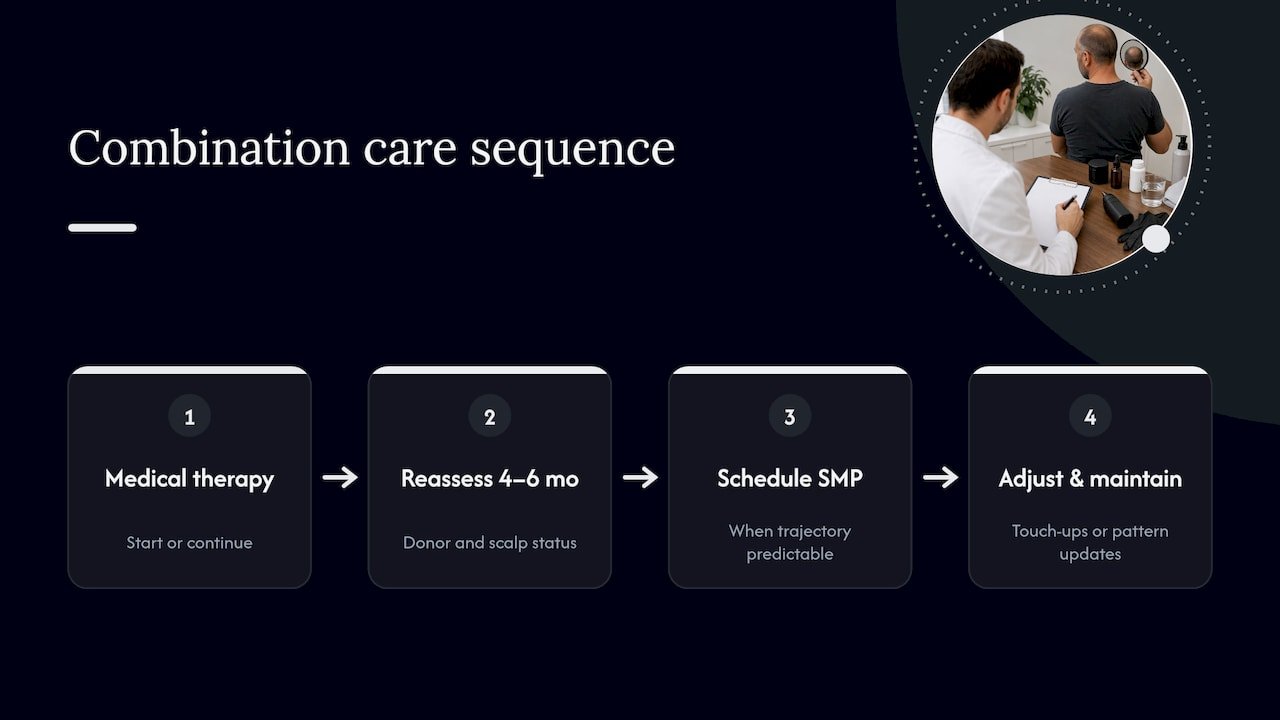
Combining the two also affects long-term maintenance. A patient stable on medical therapy may need SMP touch-ups only for normal pigment fading, roughly every 2 to 3 years, while a patient with ongoing miniaturization may need earlier adjustments to the SMP pattern itself as natural hair density around the pigment changes. Sharing trichoscopy results between the medical prescriber and the SMP practitioner, when both are willing to coordinate, gives each provider better information for their part of the plan.
The goal of combination care is not a permanent fix, since neither medical therapy nor SMP claims to be curative for DUPA. It is a coordinated approach that keeps the cosmetic result looking natural while giving the medical side of the picture the best chance to stabilize.
Detailed post-SMP care protocols and complication management for DUPA
Healing care in the first two weeks after each SMP session focuses on protecting the pigment and letting the skin recover. Patients are typically advised to avoid direct sun exposure, swimming, and heavy sweating during this window, since all three can affect how pigment settles into the skin.
Transient pain, mild edema, and crusting are the most commonly reported effects and generally resolve within about two weeks, according to documented case series on SMP outcomes. Gentle cleansing and fragrance-free moisturizing, as directed by the practitioner, support that recovery without disturbing the pigment.
Longer-term complication management for DUPA specifically centers on monitoring how the surrounding natural hair changes relative to the SMP pattern. If thinning continues faster than expected, a follow-up session can adjust density or dot placement to keep the overall look balanced rather than letting the pigment pattern become the only fixed point on an otherwise-changing scalp.
Pigment diffusion, where dots blur slightly over time, and chromatic shift, where pigment tones drift toward blue or green, are the two most relevant long-term issues to watch for. Both are usually addressed at a scheduled touch-up rather than treated as emergencies, and choosing a practitioner who documents healed results over months, not just immediately after treatment, is one way to judge how well they manage this drift. Any unexpected redness, swelling, or signs of infection beyond the normal healing window should prompt a call to the practitioner rather than a wait-and-see approach.
What treating DUPA clients has taught us about honest counseling
Working with clients who have diffuse unpatterned alopecia reinforces a simple principle: conservative hairline design and realistic follicle replication matter more than initial density. Enhanced Scalp builds SMP in staged sessions specifically so the pattern can adapt if a client’s hair continues to change, and documents healed results over the long term rather than only immediately after treatment.
Suitability decisions lean on the client’s own medical picture, including whether they are working with a dermatologist or prescriber on stabilization. When that coordination is missing, the honest answer is often to wait rather than proceed.
— James Christopher
If you want an assessment: how Enhanced Scalp helps
If SMP looks like the right camouflage option for your diffuse thinning, Enhanced Scalp offers staged scalp micropigmentation sessions built around conservative hairline design and long-term healed documentation, priced at 3,000 to 4,000 CAD for a full treatment as a one-off cost. For clients also dealing with prior transplant scarring, the clinic’s scar camouflage treatment addresses that separately, and women navigating diffuse thinning can review the clinic’s female scalp micropigmentation approach, priced on request.
A consultation focuses on evaluating your scalp honestly rather than assuming SMP fits everyone the same way.
- Bring any recent trichoscopy or dermatology notes if you have had donor-zone testing done.
- Expect questions about your current medical therapy, if any, and how long you have been on it.
- Expect an honest conversation about density expectations for diffuse thinning specifically, not a generic bald-head design.
Book a consultation through the treatment page to start with an honest assessment of what SMP can realistically do for your case.
This article is general information, not a substitute for advice from a qualified doctor. Consult a qualified healthcare professional about your own circumstances before acting on anything here.
Sources
- Scalp Micropigmentation Is an Effective Treatment for Localized Alopecia: Technical Analysis and a Series of Ten Case Reports
- Revisiting Diffuse Unpatterned Alopecia: Reappraisal of a Controversial Diagnosis | Skin Appendage Disorders | Karger Publishers
- Diffuse unpatterned alopecia: Practical diagnostic considerations – Journal of Hair Restoration and Regenerative Medicine
- Cosmetic Regulations (Canada) — full text
FAQ
Can DUPA be treated?
DUPA can be managed but is not considered curable; topical or oral minoxidil and finasteride, where appropriate, aim to stabilize follicular miniaturization rather than reverse it. Scalp micropigmentation can address the cosmetic appearance of thinning as a camouflage option once donor safety and medical stabilization have been assessed.
What is diffuse unpatterned alopecia?
Diffuse unpatterned alopecia is a form of hair thinning where follicles miniaturize across the whole scalp, including the occipital donor zone, rather than following the localized crown or hairline pattern seen in typical androgenetic alopecia. That donor-zone involvement is why hair transplantation is often contraindicated in confirmed cases.
Is a hair transplant safe if I have DUPA?
Generally no, because a transplant relocates follicles from the donor zone, and in confirmed DUPA that zone is often already miniaturizing and unable to reliably support surgery. A T:V ratio below 4:1 in the occipital scalp is one clinical signal used to flag an unsafe donor area before any surgical planning proceeds.
How often does SMP need touch-ups for DUPA?
Touch-ups are commonly needed every 2 to 3 years as pigment naturally fades, based on documented SMP outcome data. Patients with ongoing hair miniaturization may need earlier adjustments to keep the pigment pattern matched to their changing natural density.
How much does SMP cost for DUPA camouflage?
At Enhanced Scalp, a full scalp micropigmentation treatment is priced at 3,000 to 4,000 CAD as a one-off cost, covering the staged session protocol. Pricing for female-specific or scar-focused SMP options is provided during consultation.

