 Skip to content

Scalp micropigmentation is a practical, non-surgical option for many men at Norwood 5, provided the goal is a clean, shaved-head density effect rather than a return of natural hair. Extensive coverage typically requires three to five sessions, and Norwood 5 work commonly runs in a mid-to-high pricing tier relative to earlier stages. Done well, the result reads as a closely buzzed scalp with even, natural-looking density from the hairline back.
TL;DR:
- SMP at Norwood 5 creates the illusion of density through pigment deposits but does not restore actual hair volume or length.
- Achieving natural-looking results requires multiple sessions spaced at least a week apart, with careful adjustment of pigment and dot placement.
- The typical cost for extensive SMP coverage at Norwood 5 ranges from hundreds to over a thousand dollars per session, influenced by area size, sessions, and clinic experience.
- SMP is often combined with hair transplants for men wanting both density camouflage and additional length, especially given limited donor supply at advanced stages.
- Expect pigment fading over time, with touch-ups needed every three to five years, especially in scarred or fibrotic areas, to maintain appearance.
Table of Contents
- 1. What SMP can achieve for extensive hair loss
- 2. How the treatment process unfolds across sessions
- 3. What Norwood 5 SMP typically costs and what drives the price
- 4. Comparing SMP with a hair transplant at this stage
- 5. Risks, fading behavior, and long-term maintenance
- 6. Choosing a clinic and the questions worth asking
- 7. Enhanced Scalp’s approach to advanced hair loss cases
- Practical priorities if you’re at Norwood 5
- Ready to talk options? Here’s what a consult covers
- Sources
- FAQ
1. What SMP can achieve for extensive hair loss
SMP replicates the look of tiny hair follicles using pigment deposits placed just under the skin. At Norwood 5, where hair loss extends across the crown and much of the top, the technique builds an illusion of density rather than regrowing anything. Healed results that hold up rely on natural randomness in dot placement, a gradient that fades appropriately toward the temples, and pigment color matched to skin tone and undertone, not just hair color.
The technique works well for two goals at this stage: creating a convincing shaved-head aesthetic and camouflaging donor or transplant scarring that often accompanies more advanced hair loss. It has clear optical limits, though: SMP cannot restore volume the way a full head of hair would, and men expecting a “hair” look rather than a shaved-head look are usually better served by combining it with other options.
- SMP creates a density illusion; it does not regrow hair or add physical thickness.
- Natural results depend on randomized dot patterns and gradient blending, detailed in guidance on randomized microdot placement.
- The technique suits a shaved-head look or scar camouflage better than a “full head of hair” illusion.
- Men who want visible length or volume typically need SMP alongside a transplant, not instead of one.
2. How the treatment process unfolds across sessions
Norwood 5 coverage is rarely finished in one sitting. Practitioners build density gradually across sessions so the pigment blends rather than looking flat or painted on, a process outlined in how clinicians plan SMP sessions based on Norwood stage. A standardized three-session protocol described in a peer-reviewed case series produced strong cosmetic results, with immediate visual density scoring 8.7 out of 10 on average and easing slightly to 7.7 by six months, alongside high patient satisfaction across the ten-patient series.
- First session lays a lighter base layer across the scalp, establishing tone and outline.
- Second session adds density, often increasing dot concentration substantially over the initial pass.
- Third (and sometimes fourth) session refines gradient, corrects uneven spots, and fine-tunes the hairline.
Sessions are usually spaced a week or more apart to allow healing. Needle selection, strict depth control above the papillary dermis, and randomized placement all affect how natural and durable the result looks. Between visits, expect mild redness that fades within days and instructions to avoid sweating, sun, and swimming while the skin settles.
Pro Tip: Take photos in the same lighting after each session so you and your technician can track how the pigment settles before deciding on the next pass.
3. What Norwood 5 SMP typically costs and what drives the price
Clinics commonly price SMP in tiers based on Norwood stage, and Norwood 5 usually lands higher than earlier stages because of the larger coverage area and extra sessions required. Enhanced Scalp lists its scalp micropigmentation treatment at a one-off cost that generally falls within the range typical for extensive cases.
Several factors move the price within that range:
- Coverage area: a full crown-to-hairline treatment costs more than a partial touch-up.
- Session count: extensive loss requiring four sessions costs more than a three-session plan.
- Corrective work: fixing prior poor SMP or scarred donor sites adds time and skill requirements.
- Clinic experience and location: established practitioners in higher-overhead markets often price above newer studios.
Touch-ups are a separate, smaller cost down the line. To get an accurate quote, bring clear photos of your current hair loss pattern, any transplant or scar history, and be ready for an in-person consult; a test spot is often worth requesting if you have scarring.
4. Comparing SMP with a hair transplant at this stage
At Norwood 5, donor hair supply becomes a real constraint for transplants since the area available for harvesting is limited relative to the area needing coverage. SMP sidesteps that problem entirely: no surgery, no donor-site healing, and a visible result the same day treatment starts.
- SMP costs less than transplant surgery and carries no surgical downtime.
- Transplants can restore actual hair but face donor-supply limits and higher cost at advanced Norwood stages.
- Combined plans are common: SMP is typically applied only after donor-site scarring from a transplant has fully healed, a sequencing point echoed in patient guidance on transplant timing.
- Staging matters because pigmenting too early over healing tissue risks uneven retention and diffusion.
For men who accept a shaved-head look, SMP alone often makes sense. For those who want length and volume back, a transplant paired with SMP for density camouflage in thinning zones tends to produce the more complete long-term result.
5. Risks, fading behavior, and long-term maintenance
Short-term effects are mild and predictable: redness, light crusting, and some tenderness for a few days after each session. These resolve quickly with basic aftercare.
Fading follows a known pattern. A small amount of superficial pigment is lost within the first few weeks as skin heals, then fading continues gradually over months and years. The same case series recorded a modest drop in visual density scores from an average of 8.7 immediately after treatment to 7.7 at six months, which illustrates how even well-executed work settles over time. Scarring and skin type both influence how long pigment holds.
- Expect touch-ups roughly every three to five years for most healthy scalp.
- Scarred or fibrotic areas often need earlier retouching due to uneven pigment retention.
- Sun exposure and skin type can accelerate visible fading in certain zones.
- A test spot before full treatment helps predict how your skin will hold pigment long term.
6. Choosing a clinic and the questions worth asking
Portfolio quality matters more at Norwood 5 than at earlier stages, since the coverage area is larger and mistakes are harder to hide. A compact checklist helps separate skilled practitioners from rushed ones.
- Ask to see healed photos specifically from Norwood 5 or similarly extensive cases, shot in consistent lighting at a similar shaved length.
- Request the clinic’s proposed session plan and ask whether they offer a test spot for any scarred areas.
- Confirm sterile technique and allergy screening are standard practice, and ask what their revision or correction policy looks like if you’re unhappy with early results.
- Watch for red flags: anyone promising full Norwood 5 coverage in a single session, or portfolios full of overly dark, uniformly spaced dots that look printed rather than grown.
Pro Tip: Ask to see photos taken at least six months post-treatment, not just fresh healed shots, since that’s when fading patterns actually show.
7. Enhanced Scalp’s approach to advanced hair loss cases
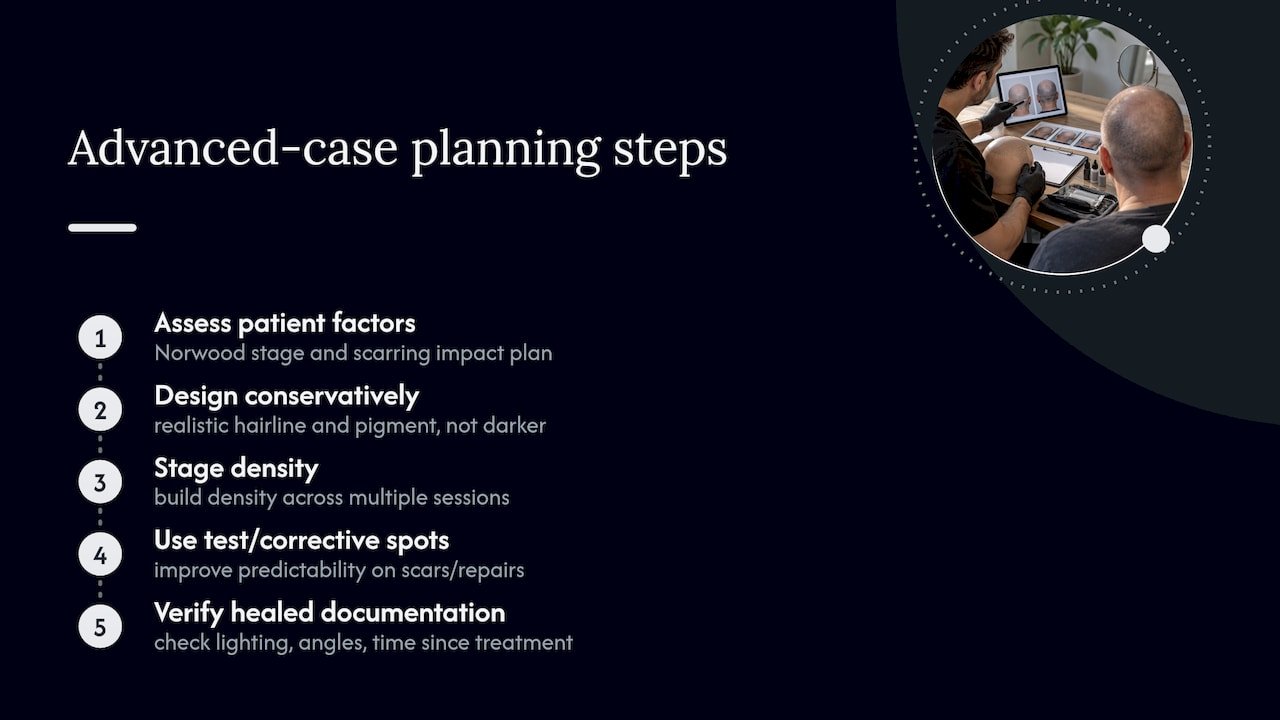
The clinic treats extensive Norwood cases and corrective SMP, including prior poor work and failed transplants, with a focus on conservative hairline design and realistic pigment selection rather than maximum darkness. Density is built in stages, matching the incremental approach described in clinical SMP protocols, with attention to how Norwood stage and scarring affect session planning.
When reviewing healed case documentation from any clinic, check the lighting consistency, the angle range shown, and how much time has passed since treatment. Some clinics offer test-spot and corrective-session options aimed at improving predictability on scarred or previously treated scalps, where retention is harder to forecast.
Practical priorities if you’re at Norwood 5
Chase a natural healed look, not maximum density on day one. Budget for staged sessions and maintenance rather than a single fix. Let test spots and real healed portfolios, not sales promises, guide your decision.
— James Christopher
Ready to talk options? Here’s what a consult covers
If you’re weighing SMP for Norwood 5 coverage, Enhanced Scalp offers the services that match this stage most directly: male scalp micropigmentation, corrective SMP for prior work or failed transplants, and scar camouflage treatment for donor-site marks. Rather than guessing at what your scalp needs from photos alone, a consult lets a practitioner map your specific pattern and scarring against a realistic session plan.
- Bring recent photos of your scalp under consistent lighting.
- Note any prior transplant or SMP history, including approximate dates.
- Mention any known scarring so a test spot can be discussed upfront.
Book a consultation or ask about a test spot through the scalp micropigmentation treatment page to see what a staged plan would look like for your case.
Sources
This article draws on a peer-reviewed SMP case series and dermatology patient guidance on hair loss management.
- Scalp micropigmentation Is an Effective Treatment for Localized Alopecia: Technical Analysis and a Series of Ten Case Reports
FAQ
Is Norwood 5 too advanced for a hair transplant?
Norwood 5 is not automatically too advanced, but donor hair supply becomes a real limiting factor since the area needing coverage is large relative to what can be harvested. Many men at this stage combine a transplant with SMP to camouflage thinning zones the surgery cannot fully address.
What are the downsides of getting SMP?
SMP does not regrow hair, so it only works as a cosmetic solution for a shaved-head look or scar camouflage. Pigment also fades gradually over time, and a small amount is typically lost within weeks of treatment before a slower decline over months and years, meaning touch-ups become part of ongoing upkeep.
Does Norwood 5 count as severe hair loss?
Norwood 5 represents extensive hair loss, with balding areas at the front and crown connected by a narrowing band of hair, and it sits toward the more advanced end of the Norwood scale used by dermatology resources to classify pattern baldness. It is not the most severe stage, but it requires more coverage and typically more sessions than earlier stages.
How does SMP look after five years?
By five years, most SMP has faded enough that a touch-up is standard practice, since retention softens gradually and scarred or fibrotic skin fades faster than healthy scalp. Clinics generally recommend planning for a refresh roughly every three to five years to keep density and color looking consistent.

