 Skip to content

Scalp micropigmentation works well for most men at Norwood stage 4, producing a convincing shaved-head look or a realistic density blend, provided the scalp is healthy, remaining hair contrast is manageable, and any prior transplant has had time to mature. The main exceptions are active skin disease, unrealistic density expectations, or jumping into SMP too soon after a graft. A consultation with an experienced SMP artist settles which scenario applies to you.
TL;DR:
- SMP for Norwood 4 results in a natural look when scalp health is maintained and prior transplants have fully matured at least 12 months before treatment.
- Pigment must be precisely matched to natural hair and skin tones, with careful planning for the blend of density, especially across the bridge, crown, and frontal zones.
- The treatment requires multiple sessions over several weeks, with healing taking from two to eight weeks and touch-ups often scheduled months later.
- Clinics with strict sterilization policies and transparent healed result documentation reduce the risk of complications and subpar outcomes.
- SMP is best used as part of a combined approach, with hair transplants or medical therapies used to support natural growth or add density, depending on individual goals.
Table of Contents
- What Norwood stage 4 looks like and why its pattern matters for SMP
- Can SMP achieve believable results at Norwood 4? Setting realistic goals
- Clinical candidacy checklist for Norwood 4
- Procedure roadmap: sessions, timing, and the healing curve
- Risks, safety checks, and verifying a clinic’s standards
- Alternatives and combination strategies for Norwood 4
- How a specialist clinic plans Norwood 4 treatment
- What a decade of practitioner judgment says about Norwood 4
- Your next step if you’re considering SMP for Norwood 4
- Sources
- FAQ
What Norwood stage 4 looks like and why its pattern matters for SMP
Norwood stage 4 marks a clear jump from earlier stages of male pattern baldness. The frontal hairline has receded significantly, the crown shows a distinct bald patch, and the two areas are separated by a band of hair, often called the bridge, that still connects the sides. That bridge is the defining feature of this stage: in Norwood 3, the crown usually hasn’t thinned enough to create a separate bald spot, and by Norwood 5 the bridge narrows and the two bald areas begin merging.
For an SMP artist, that bridge changes the whole plan. The treatment has to blend three different zones: the receded frontal area, the crown, and the strip of surviving hair between them, each with its own density, color, and growth direction. Get the transition wrong and the bridge looks like a stripe instead of natural hair.
Area size and remaining hair density also drive hairline placement decisions. A wider frontal recession means more surface to map and a more conservative hairline to design so it doesn’t look pasted on. Patchy or diffuse thinning within the bridge itself is often the trickiest part, since those areas need pigment that fills gaps without creating visible contrast against hair that is still growing.
The visual challenge SMP has to solve at this stage comes down to contrast and consistency. A scalp with some natural hair, some thinning, and significant open skin needs pigment dots that mimic hair follicles at varying densities rather than one uniform tone. That’s a more demanding mapping job than full baldness, where the whole canvas is treated the same way.
Can SMP achieve believable results at Norwood 4? Setting realistic goals
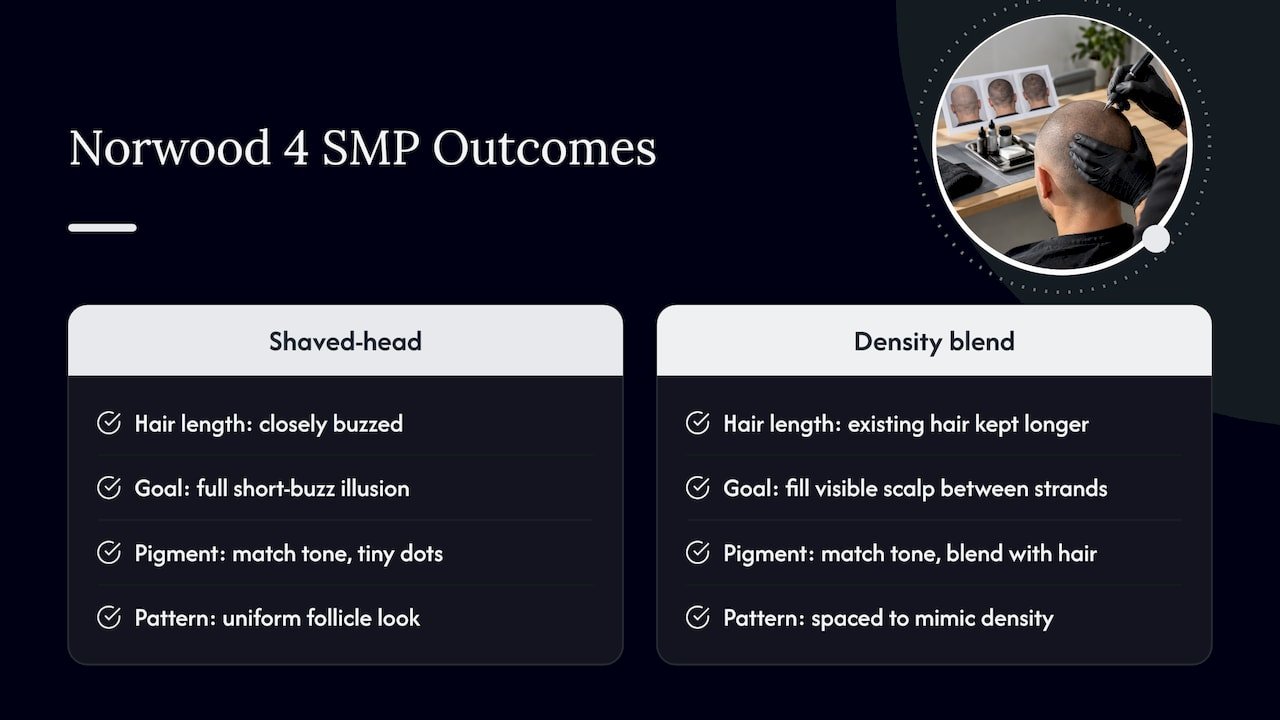
Two different outcomes are possible at this stage, and knowing which one you want changes the entire treatment plan. The first is the classic shaved-head illusion, where the scalp is kept closely buzzed and pigment recreates the look of a full, short buzz cut across the balding areas. The second is a density blend, where existing hair is kept longer and SMP fills in visible scalp between strands to make overall coverage look fuller.
Pigment selection is what separates a convincing result from an obvious one. Artists match tone to the client’s natural hair and skin color, and they calibrate dot size and spacing to the rest of the scalp so the treated area doesn’t read darker or more uniform than real follicles. A 2013 clinical review describes SMP as a sophisticated medical tattoo technique that has to be customized to each patient rather than applied with one formula, which is exactly why pigment and pattern choices matter more than the needle work itself.
A broader clinical review of SMP applications reports high patient satisfaction and few serious complications across published case series, and notes the technique works well both as a standalone treatment and as a complement to transplants for men who are not candidates for surgery or don’t want it. That evidence lines up with what Norwood 4 patients tend to need: a flexible approach that can be tailored to a mixed scalp rather than a uniformly bald one.
The limit worth understanding going in is that SMP recreates the appearance of hair density, it doesn’t grow hair. If your goal is thicker natural-looking hair at a longer length, SMP alone won’t deliver that. It’s a camouflage technique, an extremely effective one for shaved or short styles, but the result is a visual effect, not a change to your actual hair count.
Clinical candidacy checklist for Norwood 4
Before booking a consultation, it helps to know what a specialist will actually be looking for. Most assessments cover the same core areas.
- Skin and scalp health: active psoriasis, eczema, or other inflammatory skin conditions need to be stable or cleared first, and any scar tissue is usually tested with a small practice spot before full treatment begins.
- Remaining hair density and contrast: artists compare the density of your surviving hair against bald areas. Normal scalp density is often cited around 104.6 hairs per square centimeter, and the gap between that figure and your balding zones shapes how much pigment contrast the artist needs to soften.
- Transplant history: ISHRS clinical guidance recommends waiting at least 12 months after a hair transplant before starting SMP, so grafts have time to mature and settle before pigment is layered over them.
- Prior SMP work: previous pigmentation, even if done elsewhere, needs to be assessed for color, depth, and fading pattern before any new work is planned.
- Lifestyle factors: sun exposure, skin type, and how diligent you’ll be with touch-ups all affect how long results hold and how often maintenance is needed.
Pro Tip: Bring clear, well-lit photos of your scalp from the front, top, and sides to your consultation, along with a note of any past transplant or cosmetic tattoo dates, so the artist can plan accurately before you even sit down.
Procedure roadmap: sessions, timing, and the healing curve
SMP at Norwood 4 is rarely a one-visit treatment. Because the scalp has mixed zones of density, most practitioners build the result in layers across multiple sessions rather than trying to finish everything at once.
- First session establishes the hairline outline and base density across the bald areas, usually the longest single visit.
- Second session, typically scheduled one to two weeks later, adds depth and corrects any pigment that healed lighter than expected.
- Third session, if needed, refines blending at the bridge and fine-tunes contrast between treated and natural hair.
- Touch-up visit, often months later, addresses any fading once pigment has fully settled.
A 2013 review of SMP technique notes the process can run up to many hours of cumulative procedure time across sessions, which reflects how much customization a mixed-density scalp like Norwood 4 actually requires compared with a fully bald head.
Healing happens in stages: the scalp looks darker and more saturated immediately after treatment, then lightens as it settles over roughly two to eight weeks. Touch-ups are usually scheduled after that settling period, once the healed tone is clear. Shave your head the night before or morning of each session unless your artist tells you otherwise, and expect mild discomfort rather than serious pain, similar to a light scratching sensation.
Risks, safety checks, and verifying a clinic’s standards
SMP carries real but manageable risks: infection at the treatment site, pigment migration under the skin, allergic reactions to pigment, and poor color matching that turns blue or green over time. A 2024 study on SMP revisions found that nearly 90% of patients needing corrective work had their original treatment done at non-clinical beauty or permanent-makeup settings rather than specialist SMP clinics, a strong signal that venue and technique quality drive most of the bad outcomes patients experience.
Regulatory expectations exist for a reason. Toronto’s public health guidance on micropigmentation requires sterile, single-use needle cartridges with protective membranes and detailed on-site records under Ontario’s personal service settings regulation, rules designed specifically to prevent the infections and cross-contamination that unregulated studios risk.
Red flags worth watching for in any clinic:
- No written infection prevention and control policy available on request.
- Needle cartridges that aren’t visibly sealed and single-use.
- Inconsistent or missing healed-result documentation, not just fresh, swollen photos.
- Reluctance to answer direct questions about sterilization and record-keeping practices.
Ask directly whether cartridges are single-use, how records are kept, and whether you can see healed photos, not just immediate post-session shots. A clinic confident in its work will have both.
Alternatives and combination strategies for Norwood 4
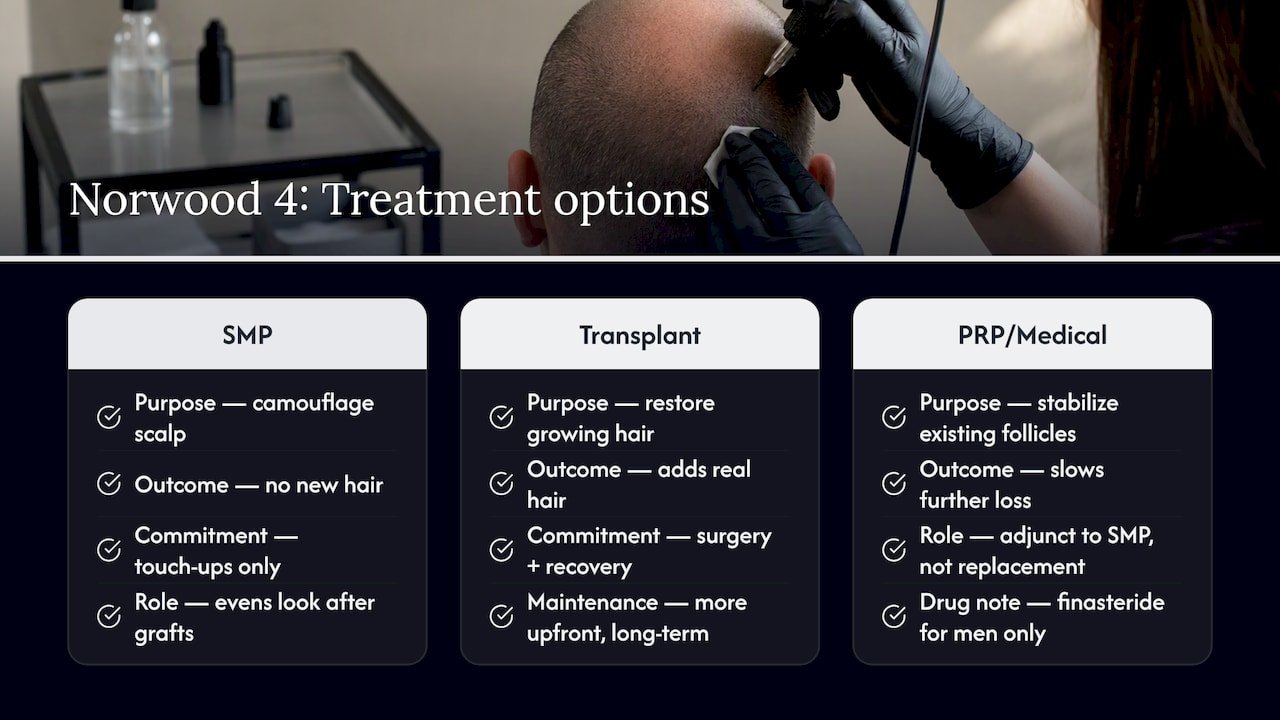
SMP isn’t the only option at this stage, and for some men it works best alongside other treatments rather than alone. A hair transplant can restore actual growing hair to the hairline or add density to the bridge, with SMP layered in afterward to even out the overall appearance and camouflage any thin spots the graft doesn’t cover. This combination suits men who want some natural hair back and are comfortable with surgery and a longer recovery.
PRP and medical therapies like minoxidil or finasteride play a different role. They’re aimed at slowing further loss or supporting existing follicles rather than creating new density on already-bald skin, so they work better as stabilization alongside SMP than as a replacement for it on fully receded areas.
Finasteride is FDA-indicated for men only. Women who are or may become pregnant must not handle crushed or broken finasteride tablets, due to the risk of harm to a male fetus. It can also cause sexual side effects (reduced libido, erectile dysfunction) in a minority of men, which usually resolve after stopping treatment. Discuss these risks with a physician before starting.
Sequencing matters. If a transplant is part of your plan, SMP should wait until grafts have matured, generally at least 12 months, so pigment isn’t applied over skin that’s still settling. Choosing between these paths comes down to donor hair supply, how much density you actually want back, and how much ongoing maintenance you’re willing to take on. SMP needs occasional touch-ups but no surgery; transplants need more upfront commitment but add real hair.
How a specialist clinic plans Norwood 4 treatment
A specialist approach to Norwood 4 starts with density mapping across the frontal, crown, and bridge zones separately, then matches pigment tone to the client’s natural hair and skin before any needle touches the scalp. Some specialist clinics use test spots on areas with scar tissue, including prior transplant scars, to confirm how pigment will heal before committing to the full treatment. Hairline design stays conservative by design, prioritizing a natural edge over a dramatic one.
Consultations may include a review of healed-result documentation rather than just fresh photos, and session planning is mapped out in advance based on scalp condition and prior SMP or transplant history, including corrective cases where previous work needs revision.
What a decade of practitioner judgment says about Norwood 4
The men who get the best SMP results at Norwood 4 are the ones who choose realistic density over a dramatic transformation. The biggest pitfall is picking a clinic by price instead of healed documentation. See a specialist before deciding what’s achievable for your scalp.
— James Christopher
Your next step if you’re considering SMP for Norwood 4
If Norwood 4 has you weighing a shaved-head look or a fuller-looking blend, plans for treatment are often built around conservative hairline design, scar and transplant-corrective work, and documented healed results rather than guesswork.
- Consultations cover density mapping, pigment matching, and test spots for any scar tissue.
- Corrective SMP is sometimes offered for men with previous poor SMP, failed transplants, or laser removal.
- Treatment pricing for scalp micropigmentation runs 3,000 to 4,000 CAD as a one-off cost.
Book a consultation through the scalp micropigmentation treatment page to see healed-case documentation and get a plan specific to your scalp.
This article is general information, not a substitute for advice from a qualified doctor. Consult a qualified healthcare professional about your own circumstances before acting on anything here.
Sources
- Revision for unsatisfactory outcomes of scalp micropigmentation
- Scalp micropigmentation: a useful treatment for hair loss
- Scalp Micropigmentation (SMP): All You Need to Know – ISHRS
- Micropigmentation – Infection Prevention and Control – City of Toronto
FAQ
Is Norwood 4 too late for SMP?
No, Norwood 4 is a common stage for SMP candidates, since the bridge of hair between the frontal and crown areas still gives artists natural detail to blend pigment into. Most men at this stage qualify as long as the scalp is healthy and expectations about density versus actual regrowth are realistic.
What does Norwood stage 4 look like?
Norwood stage 4 shows significant frontal hairline recession combined with a separate bald patch at the crown, with a band of hair called the bridge still connecting the two sides. It’s a distinct step up from Norwood 3, where the crown typically hasn’t thinned into its own bald zone yet.
Is stage 4 baldness curable?
Male pattern baldness at any stage has no cure, since it stems from a genetic and hormonal process that affects hair follicles permanently. Treatments like medical therapy, transplants, or scalp micropigmentation manage the appearance and progression rather than reversing the underlying cause.
Is Norwood 4 hair loss reversible?
Hair already lost to Norwood 4 pattern baldness generally does not regrow on its own, though medical therapies may slow further loss in some men. Scalp micropigmentation and hair transplants don’t reverse the biological process, they address how the scalp looks once hair loss has progressed.

