 Skip to content

At Norwood 3, scalp micropigmentation works two ways: as a standalone treatment that redefines your hairline and fills perceived density, or as a finishing layer after a hair transplant. Standalone SMP fits most classic Norwood 3 cases. If you have Norwood 3V, Type A recession, or loss that’s still moving fast, a hybrid plan with medical therapy or a future transplant usually makes more sense.
TL;DR:
- Most Norwood 3 clients require multiple SMP sessions over several weeks, with healing and color settling fully around 30 to 40 days.
- For Norwood 3V or rapidly receding patterns, combining SMP with medical therapy or future transplants often produces better long-term results.
- Shorter haircuts after SMP conceal dots better, while longer styles make the pigment more visible, affecting aesthetic choices.
- A conservative, future-proof hairline design that accounts for ongoing recession maintains natural appearance over time, unlike aggressive lows.
- Verified healed photos, transparent session plans, and realistic expectations are critical when choosing a clinic for proper long-term results.
Table of Contents
- What Norwood 3 SMP Candidates Actually Look Like
- Is SMP Right for You at Norwood 3? Decision Criteria
- What an SMP Session Involves at This Stage
- Results You Can Expect, and Where SMP Stops
- Pairing SMP With Transplants and Medical Therapy
- How to Vet a Clinic Before You Book
- Why Healed Documentation Should Drive Your Decision
- A Practitioner’s Take on Getting Norwood 3 Right
- Book a Consultation for Norwood 3 SMP
- Sources
- FAQ
What Norwood 3 SMP Candidates Actually Look Like
Norwood 3 is where male pattern baldness stops being “maybe I’m imagining it” and becomes visible to everyone else. The frontal hairline recedes at the temples, forming the M or V shape that marks the first clinically significant stage of the Hamilton–Norwood scale. Two variants matter for SMP planning:
- Norwood 3 vertex (3V): temple recession pairs with a thinning crown, so the design has to address two separate zones instead of one.
- Type A: the hairline recedes as a single front-to-back unit with no “island” of hair in the middle, which usually gives a cleaner, more predictable edge for pigment work.
The Norwood–Hamilton classification and its Type A subvariants are well documented in clinical literature, though researchers note some inter-rater disagreement when scalps sit between stages. That’s exactly why an experienced technician examines your scalp in person rather than matching you to a chart photo. Surface area lost and how much native hair remains around it determine whether you need a full hairline rebuild or a lighter density fill.
Is SMP Right for You at Norwood 3? Decision Criteria
Not every Norwood 3 scalp needs the same approach. Run through these factors before committing to a plan:
- Current density and hair caliber. Thin, wispy hair around the recession needs different pigment depth than coarse, dense hair.
- Donor supply. If you’re considering a transplant later, a surgeon needs to confirm your donor area can support it. SMP alone sidesteps that question entirely.
- Hairstyle preference. If you plan to keep hair on top and buzz the sides, SMP blends into existing strands. If you’re heading toward a shaved look eventually, that changes the design.
- Age and trajectory. Someone at 24 losing hair fast has a different risk profile than someone at 45 whose pattern has plateaued.
- Appetite for surgery. Some men want a non-surgical fix. Others see SMP as one piece of a bigger plan.
Clinical guidance treats Norwood 3 and 4 as a sweet spot for SMP because hairline definition alone creates a big visual shift. Finasteride and minoxidil don’t reverse existing loss, but they can slow further recession, which matters when you’re deciding how conservative your hairline design should be.
Finasteride is FDA-indicated for men only. Women who are or may become pregnant must not handle crushed or broken finasteride tablets, due to the risk of harm to a male fetus. It can also cause sexual side effects (reduced libido, erectile dysfunction) in a minority of men, which usually resolve after stopping treatment. Discuss these risks with a physician before starting.
Pro Tip: Start medical therapy conversations with your doctor before your SMP consult. Knowing whether your hairline is likely to move again in five years changes how far back the practitioner should place it now.
What an SMP Session Involves at This Stage
Most Norwood 3 clients need multiple sessions, spaced over a few weeks, with each visit lasting several hours depending on the coverage area. That range exists because density needs vary. A hairline-only refresh takes less work than a hairline plus crown blend for Norwood 3V.
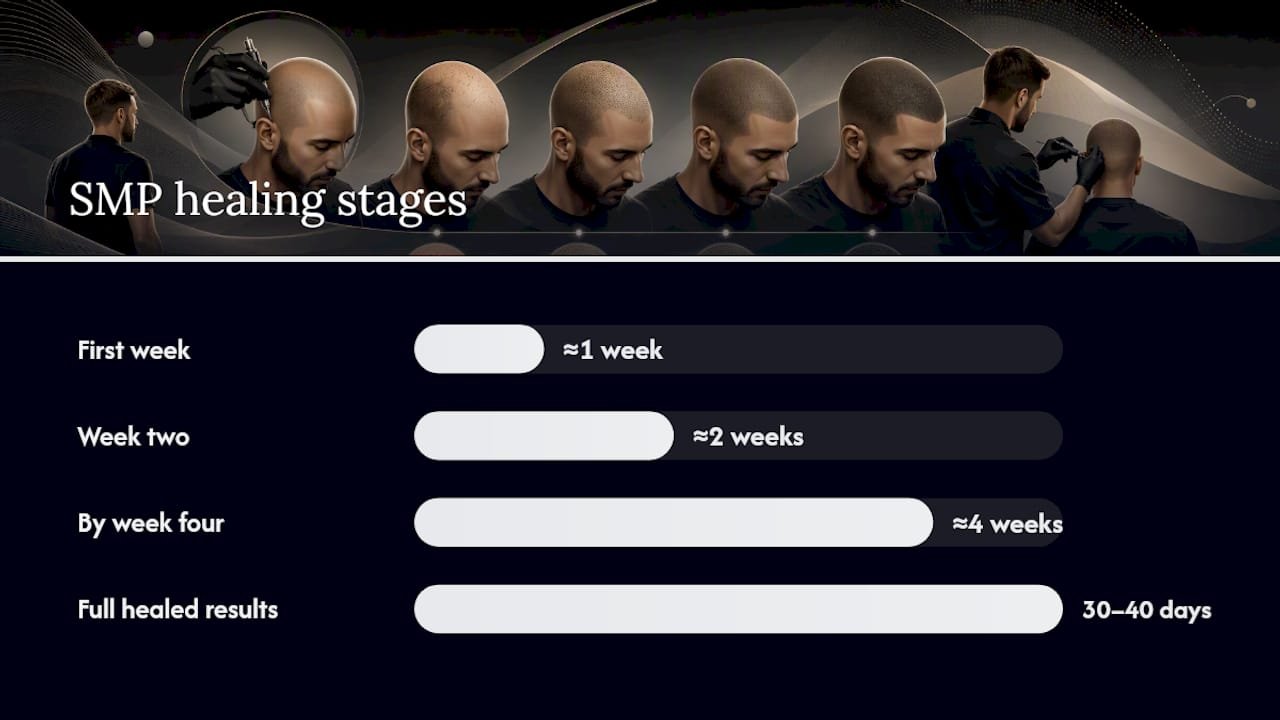
Healing happens in stages. The first week shows pigment that looks darker and slightly raw. By week two, a light scab forms and flakes off. By week four, the pigment has settled into its true, softer tone. Full healed results typically show around the 30 to 40 day mark, which is also when a practitioner assesses whether a touch-up session is needed.
Design priorities at Norwood 3 differ from later stages:
- Hairline dots stay slightly irregular and set back from where hair used to be, not where you wish it still was.
- Pigment blends into surviving native hair rather than replacing the whole zone.
- Color selection accounts for how gray hair or sun-exposed skin will read against the pigment over time.
- A small test spot on an inconspicuous area lets you and the technician confirm pigment behavior before the full session.
Results You Can Expect, and Where SMP Stops
SMP gives you a defined hairline and the visual impression of density. That’s the whole mechanism: it’s ink placed to mimic hair follicles, not a treatment that regrows anything. Understanding that distinction upfront prevents disappointment later.
Style matters more than people expect. Longer hair on top hides SMP dots almost completely, since the pigment is only visible at the scalp and short hair reveals it. Buzzed or closely cropped styles show the work clearly, which is why most Norwood 3 clients lean toward shorter cuts after treatment.
- Healed pigment fades gradually and most clients need a touch-up somewhere between two and five years out.
- If your natural hair keeps receding, the design may need adjusting so the SMP hairline doesn’t look artificially low against thinner surrounding hair.
- Overly aggressive, low hairlines placed at Norwood 3 tend to age badly. A conservative setback that accounts for future loss holds up far better than a youthful hairline chasing the appearance you had at 19.
Pairing SMP With Transplants and Medical Therapy
If you have strong donor hair and want longer styling options down the road, a transplant first, SMP second sequence often makes sense. If you’d rather avoid surgery or don’t have great donor density, SMP alone or SMP now with a transplant later both stay on the table.
- Timing after transplant: wait roughly 11 to 12 months before adding SMP, since grafts need that time to mature and settle into their final color and texture.
- What SMP adds post-transplant: it fills gaps between grafts, softens a hairline that looks too uniform, and camouflages linear or FUE scarring.
- Medical therapy’s role: finasteride or minoxidil taken consistently can stabilize your baseline, which lets a practitioner design a more permanent SMP hairline instead of guessing at a moving target.
How to Vet a Clinic Before You Book
Ask to see healed photos of Norwood 3 cases specifically, not just dramatic full-shave transformations. Healed results at 30 to 40 days tell you far more than day-one photos, which almost always look sharper than the settled outcome.
- Request session counts and timelines for cases similar to your hair color, skin tone, and density.
- Ask about their test-spot policy before a full session.
- Confirm sterile technique and single-use needle cartridges.
- Get a straight answer on touch-up costs and how they handle future progression.
Walk away from any clinic promising full results in one session or showing only heavily edited, glossy photos. Real skin has texture; real healed SMP should show it too.
Pro Tip: Ask specifically how the practitioner plans for your hairline if you lose more hair in five years. A confident answer means they’re thinking past your first appointment.
Why Healed Documentation Should Drive Your Decision
Marketing photos taken minutes after a session tell you almost nothing. What matters is staged healed documentation: photos at one week, one month, and ideally a year out, alongside notes on session count and pigment choice for each case. Enhanced Scalp builds its Norwood 3 work around conservative hairline placement precisely because an aggressive design today becomes a liability as natural hair continues to thin around it. Corrective SMP cases, where a previous artist went too dark or too low, are common enough that they should factor into how you choose a clinic the first time.
A Practitioner’s Take on Getting Norwood 3 Right
The temptation at Norwood 3 is to chase the hairline you had at 20. That’s the mistake I see repeated most: a technician gives a client exactly what they ask for, and five years later the hairline looks stranded above thinning hair. A good consult treats the aesthetic and the ten-year forecast as one conversation, not two.
— James Christopher
Book a Consultation for Norwood 3 SMP
Enhanced Scalp treats Norwood 3 as a design problem first, not just a coverage problem. Every hairline is set with your likely future loss in mind, and corrective work for men who got a poor result elsewhere is a regular part of the practice. Every case is documented with healed photos, not just fresh ones, so you see what the work actually looks like once it settles.
If you want to see how conservative hairline design holds up at the one month mark and beyond, browse healed Norwood 3 SMP results or start with the full scalp micropigmentation treatment page, priced from several thousand Canadian dollars as a one-time treatment. Booking a consultation is the fastest way to find out whether standalone SMP or a hybrid approach fits your scalp and your goals.
Sources
The Hamilton–Norwood scale overview on NCBI Bookshelf explains the seven-stage system in clinical terms. The PMC reliability study covers how consistently clinicians apply the scale, including Type A variants. Charles Medical Group’s anatomy-first SMP framework breaks down stage-specific design thinking in more depth.
This article is general information, not a substitute for advice from a qualified doctor. Consult a qualified healthcare professional about your own circumstances before acting on anything here.
- Reliability of the pattern hair loss classifications: a comparison of the basic and specific and Norwood–Hamilton classifications — The Journal of Dermatology / PMC
- Norwood scale: pictures, stages, causes, and treatment — Healthline
- Male scalp micropigmentation: The anatomy-first design framework for progressive baldness — Charles Medical Group
FAQ
Is Norwood 3 Too Late for SMP?
No. Norwood 3 is actually considered one of the better stages for SMP because hairline definition alone produces a significant visual change. Waiting longer only means more surface area to cover later.
What Are the Downsides of SMP at This Stage?
SMP doesn’t regrow hair, and results look best with short styling since longer hair hides the pigment work. You’ll also need periodic touch-ups, and if your natural hair keeps receding, the design may eventually need adjusting to stay believable.
Is Norwood 3 Considered Bald?
Not fully bald, but it’s the first stage classified as clinically significant hair loss, with a visible M or V shaped hairline recession at the temples. It’s a meaningful pattern, not just early thinning.
Is Norwood 3 Too Late to Start Finasteride?
No, finasteride can still help slow further recession at Norwood 3 and is often more effective the earlier it starts. It won’t rebuild the hairline you’ve already lost, which is where SMP or a transplant comes in.

