 Skip to content


Yes, scalp micropigmentation can often reduce the visibility of a widening part while you keep your hair longer, but it depends on measurable factors. Practitioners look at your current hair density, the contrast between your scalp and hair color, and whether bald patches sit next to longer strands; for additional support options and understanding stages, see this complete UK overview of female pattern hair loss. A consultation with a test spot is the only reliable way to confirm it will work for you.
TL;DR:
- A professional density check matters: research favored SMP at 104.6 hairs per square centimeter or higher, while lower density may favor transplantation.
- Nearby bald patches beside longer hair can create uneven contrast, so assess the part in normal lighting and confirm hair loss has been stable for months.
- Request a test spot and healed close ups from clients with similar hair, and choose a practitioner who builds pigment gradually.
- SMP adds pigment behind existing strands, not new hair; touch ups typically follow after 3 to 5 years, sooner with sun exposure or oily skin.
Table of Contents
- Who is a good candidate for SMP on a widening part?
- How SMP technique changes for a wide part or longer hair
- What results and maintenance actually look like
- What to expect in the clinic: sessions, healing, and cost
- A practitioner’s view on conservative design for a wide part
- Should you try SMP for a wide part?
- How Enhanced Scalp approaches SMP for a wide part
- FAQ
- Sources
Who is a good candidate for SMP on a widening part?
Candidacy comes down to numbers, not guesswork. A retrospective study comparing hair transplant and SMP outcomes found hair density to be the deciding factor between the two options: SMP was favored when hair density measured above a certain threshold, while hair transplant was the better route below a lower threshold. That gap matters because SMP works by adding a layer of perceived density behind the hair you already have. It does not replace hair that is gone.
Before booking, check a few practical signs:
- How much scalp shows when you part your hair in normal lighting, not just under a bright bathroom bulb.
- Whether any fully bald patches sit right next to areas with longer, denser hair, since that contrast can make the work look uneven.
- Whether your hair loss has been stable for a few months rather than actively progressing.
Practitioners who specialize in this work tend to favor conservative density on a first pass, then build up gradually. Ask to see healed photos from past clients with a similar hair length and color, and confirm the studio performs an in-person or photo-based test spot before committing to a full session. Training matters here: SMP is a form of medical tattooing, so sterile technique and specialized experience, not just a general cosmetic license, are what you want to see.
How SMP technique changes for a wide part or longer hair
Working under longer hair is a different job than shaving a fully bald scalp. The goal is not to mimic individual hair strands along the part. It is to create a soft background of depth that disappears once your hair falls back into place.
- Dots are placed in a scattered, irregular pattern along the part line rather than in straight rows, which avoids a drawn-on look.
- Pigment is matched conservatively, often slightly lighter than the natural hair color, since pigment can appear darker once it heals into the skin.
- Dot size stays small and varied, closer to a true follicle than a bold tattoo point, so the result reads as texture instead of ink.
- Sessions build gradually, with the artist checking how the first layer heals before adding more density.
A staged approach lets the practitioner see exactly how your skin holds pigment before going further. Oily skin and certain skin tones can cause pigment to spread slightly under the surface, so a cautious first pass protects against a result that is too heavy to soften later.
Pro Tip: When reviewing a clinic’s portfolio, ask specifically for photos taken with the hair parted and lying naturally, not pulled back or wet, since that is the only honest test of how the work blends.
What results and maintenance actually look like
The realistic outcome is a softer scalp tone behind your existing hair, not the illusion of new hair growth. SMP adds a stippled depth effect that reduces how much bare scalp catches light through thinning areas, which is why it was originally designed for short or shaved styles and takes more finesse under longer hair.
Fading happens gradually and unevenly depending on your habits:
- Sun exposure breaks down pigment faster, so daily SPF on the scalp matters.
- Oily skin tends to fade pigment sooner than dry or normal skin.
- Touch-ups are typically needed somewhere in the 3 to 5 year range to maintain the original effect.
A clinical follow-up study tracking patients for 7 to 32 months after treatment reported minimal fading and high patient satisfaction, with low rates of adverse events. That kind of documented healing timeline is worth asking about directly. Before booking, request close-up healed photos taken specifically behind the part line, not just overall scalp shots, since that angle is the real test of whether the work holds up under your hair.
What to expect in the clinic: sessions, healing, and cost
Density work for a wide part usually takes more than one pass. Multiple sessions let the practitioner layer pigment gradually and check healing between visits, which produces a more natural gradient than trying to finish everything at once.
- Most SMP treatment plans involve multiple sessions spaced weeks apart, plus an optional touch-up later.
- Healing between sessions typically takes about a week, during which you avoid sweating heavily, swimming, and direct sun on the scalp.
- Numbing cream is standard for comfort, and most people describe the sensation as mild scratching rather than sharp pain.
- Cost depends on the size of the area treated, the number of sessions, and the artist’s experience, with full treatment courses commonly falling within the price range reported across the industry.
A personalized quote after a consultation is the only way to know what your specific case will cost, since part width and hair density vary widely from one person to the next.
A practitioner’s view on conservative design for a wide part
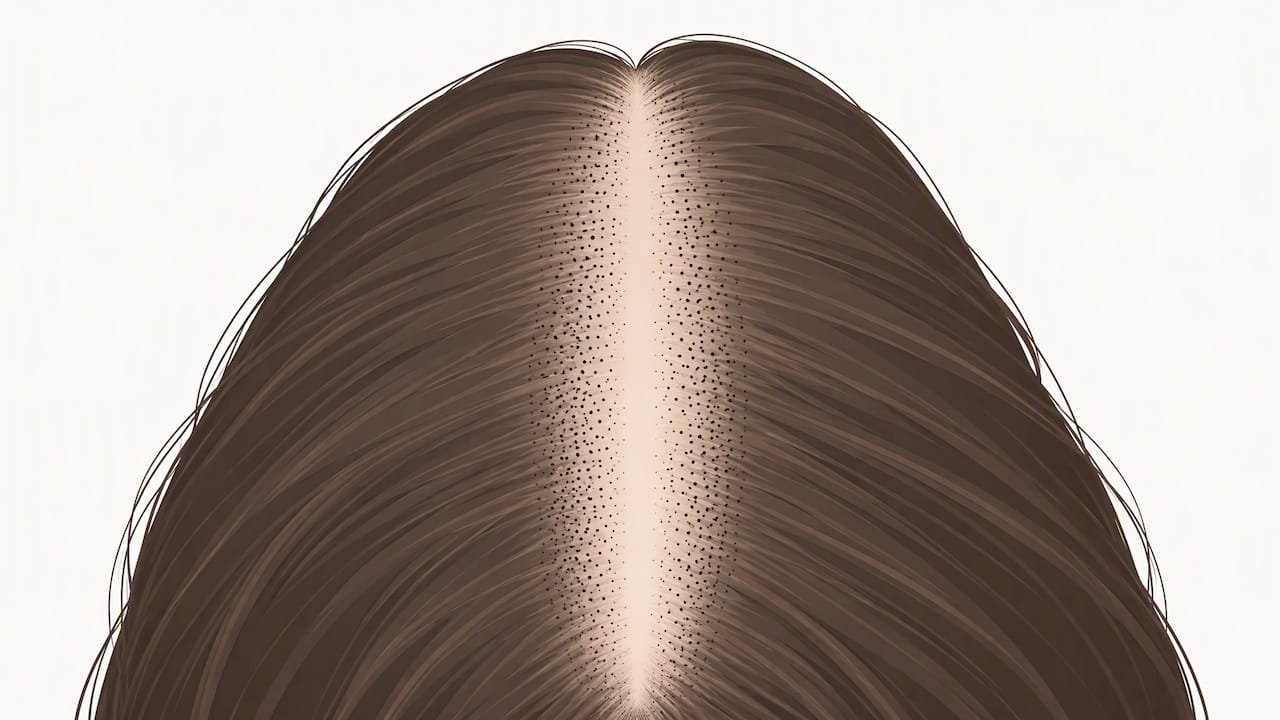
We treat a widening part as a density problem first, before anything else gets decided. We assess how much natural hair density is present along and around the part, then choose a pigment shade and dot density that matches what the hair is already doing.
Our approach leans conservative.
- We would rather add a second light layer later than start too heavy.
- We document healed results instead of only showing day-of photos.
- We recommend a test spot before committing to a full session to see how pigment behaves under your own part.
If you are evaluating any clinic for this work, ask for healed close-ups taken behind the part line and a test spot option before you book a full session.
Should you try SMP for a wide part?
A widening part is one of the more solvable cosmetic concerns in hair loss, but only when the fundamentals line up: decent existing density, no stark bald patches next to long hair, and a practitioner willing to start light. If your density is already low across a wider area, a treatment built around scalp coverage rather than part camouflage, or a combination approach, may serve you better than pushing one technique to do too much.
The checklist is simple: get a density check, ask for a test spot, and request healed photos from clients with hair like yours. Skip any studio that cannot show you healed work months after treatment.
— James Christopher
How Enhanced Scalp approaches SMP for a wide part
We built our approach to Female Scalp Micropigmentation around exactly this kind of case: longer hair, a widening part, and a need for density that stays invisible under natural movement. We start with an assessment of your density and offer a test spot so you can see the pigment behave on your own scalp before committing to a full plan.
| What you get | Why it matters |
|---|---|
| Density assessment and test spot | Confirms realistic results before a full session |
| Conservative pigment matching | Avoids a heavy or artificial look under longer hair |
| Healed photo documentation | Shows how results actually hold up over time |
If you want to see how this looks on someone with hair like yours, view our SMP treatment overview or book a consultation to get a personalized quote.
FAQ
Does SMP make hair look thicker?
SMP does not make individual hairs thicker. It adds a layer of pigment that reduces scalp visibility between existing strands, which creates the appearance of fuller density when viewed under normal lighting.
Is SMP haram in Islam?
This is a religious question that depends on personal interpretation and guidance from a qualified religious scholar, since views on cosmetic tattooing vary across different schools of thought. We recommend consulting your own imam or trusted religious authority before deciding.
Can a widening part be fixed?
A widening part can often be made far less visible with SMP when hair density along the part is reasonably strong and there are no stark bald patches nearby. Results depend on your specific density and contrast, which is why a candidacy check and test spot come before any treatment plan.
What happens to SMP after 5 years?
Pigment gradually softens over time, with most people needing a touch-up somewhere between 3 and 5 years after the original treatment to maintain the look. Sun exposure and oily skin tend to speed up fading, which is why aftercare habits matter for longevity.
How do I know if I have enough hair for SMP to work?
Practitioners typically compare your hair density against thresholds identified in clinical research, where SMP was favored at densities of 104.6 hairs per square centimeter or higher. Below that range, a hair transplant may be the more effective option, so a professional density check is worth doing first.
Sources
- Scalp micropigmentation (SMP): Semantics, terminology, and standards – ISHRS
- Hair transplantation versus scalp micropigmentation: A retrospective study of treatment selection in female pattern hair loss – PubMed
- Scalp micropigmentation procedure: A useful procedure for hair restoration – PubMed

