 Skip to content


Most clients begin planning a maintenance touch-up within four to six years after their initial scalp micropigmentation treatment, though a first minor refresh can happen sooner. Exact timing depends on skin type, sun exposure, and aftercare habits. A qualified technician should assess healed pigment in person before recommending any session count, since session-count guidance typically runs one to three sessions for an edit and two to four for a full clinician-led refresh.
TL;DR:
- Take scalp photos under consistent natural light every six to twelve months, and book a consult when thinning or color shifts appear.
- Oilier skin and unprotected sun can speed fading, so use scalp sunscreen after healing and avoid direct sun, saunas, and heavy sweating during recovery.
- A technician should compare healed results before adding pigment; conservative staged edits reduce the risk of oversaturation, which is difficult to reverse.
- Scar tissue may hold pigment unpredictably, so technicians may test a small area first; after a transplant, wait until healing stabilizes before nearby touch ups.
Table of Contents
- What an SMP touch-up is and how it differs from your initial sessions
- Typical timing: first touch-up and ongoing maintenance cadence
- Factors that speed up fading or help pigment last longer
- Signs you should book a touch-up now
- How to extend SMP life: aftercare and long-term maintenance
- What happens during a touch-up appointment
- Practical scheduling tips: what to bring to a consult and when to book
- Recommended frequency and scheduling strategies for optimal SMP maintenance
- Differences in touch-up needs based on SMP style or coverage area
- How SMP touch-ups interact with other scalp or hair treatments
- First-person clinic perspective on evaluating maintenance needs
- Enhanced Scalp maintenance services and how to book a touch-up
- FAQ
- Sources
What an SMP touch-up is and how it differs from your initial sessions
An SMP touch-up is maintenance work on pigment that has already healed, not a continuation of your original build-out. Your initial treatment layers pigment across several sessions to create density and a natural hairline. A touch-up, by contrast, addresses what time and sun exposure have changed.
A technician evaluating your scalp for a touch-up is generally looking to:
- Restore density where dots have faded or thinned unevenly.
- Correct tone shifts, since pigment can soften or take on a different cast as it ages.
- Refine hairline edges that have softened or blurred since the original design.
Before adding any pigment, an experienced artist evaluates healed work closely. Oversaturation is easy to cause and hard to reverse, so the assessment step matters as much as the session itself.
Typical timing: first touch-up and ongoing maintenance cadence
Timing ranges rather than fixed dates are the honest way to think about SMP maintenance, because skin type, pigment, and sun exposure all shift the math differently for each client.
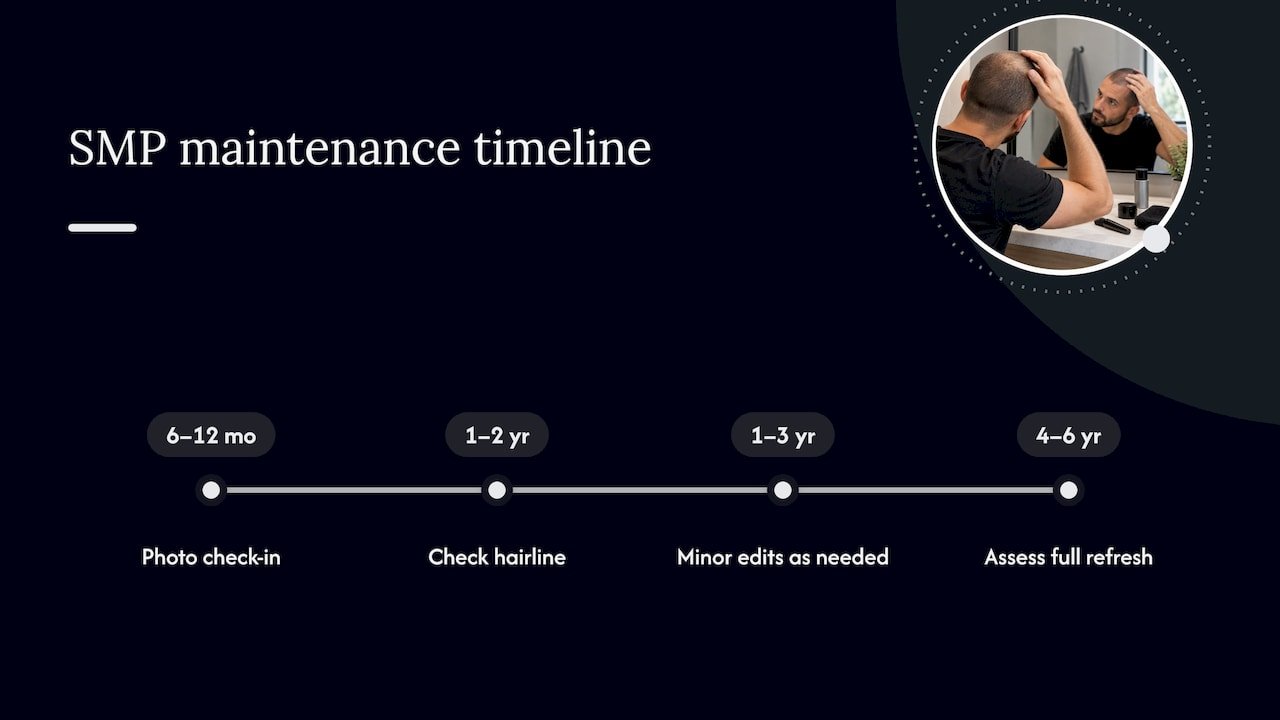
- First touch-up window: many clients find a minor refresh useful somewhere between one and three years after treatment, often to sharpen a hairline or address a small area that faded faster than the rest.
- Primary maintenance touch-up: a more complete refresh tends to land around four to six years post-treatment for most healed results, per clinic timeline guidance.
- Subsequent touch-ups: after the first major refresh, many clients settle into a similar four to six-year rhythm, though oilier skin or heavy sun exposure can shorten that window.
Scalp micropigmentation explainers note that pigment particles sit in the upper dermis and can soften gradually through natural skin turnover and environmental exposure, which is the basic reason any SMP eventually needs attention. If your treatment date was in early 2022, for example, a sensible first check-in point would fall sometime in 2026.
Factors that speed up fading or help pigment last longer
Several variables influence how long your SMP stays sharp, and most are within your control.
- Skin type and oiliness: oilier scalps tend to break down pigment faster than dry or normal skin.
- UV and sun exposure: unprotected sun is one of the fastest ways to lighten or shift pigment tone.
- Washing habits and topical products: harsh shampoos, exfoliants, and certain acne or anti-aging products can accelerate fading.
- Medical factors and medications: some skin conditions and medications affect how pigment settles and holds over time.
- Pigment quality and technician technique: deeper, well-placed dots from a skilled technician generally hold longer than shallow or inconsistent work.
A client who spends summers outdoors without protection will likely notice fading years before someone who wears a hat and applies sunscreen consistently.
Pro Tip: Apply a broad-spectrum sunscreen to your scalp daily, even under a hat, since UV exposure is one of the biggest levers you control over how long your SMP stays crisp.
Signs you should book a touch-up now
Watching for a few visual cues makes scheduling straightforward instead of guesswork.
- Loss of dot density: if your scalp starts showing through where it didn’t before, especially at the crown or hairline, that’s a clear signal.
- Color shift: pigment that reads reddish, gray, or patchy compared to when it healed has likely begun to break down unevenly.
- Uneven fading across the treated area: some zones fading faster than others, often from sun exposure patterns or pressure points, is worth a professional look.
When you notice any of these, bring clear, well-lit photos to a consult. A technician can compare them against your original healed results and tell you honestly whether you need a quick edit or a fuller session.
How to extend SMP life: aftercare and long-term maintenance
The habits you build in the weeks after treatment and in the years after matter just as much as the procedure itself. Aftercare best practices for semi-permanent pigmentation emphasize keeping the treated area clean during initial healing and steering clear of harsh chemicals that can accelerate fading later.
- Avoid direct sun, saunas, and heavy sweating during the first ten to fourteen days of healing.
- Use gentle, fragrance-free cleansers rather than exfoliating scrubs or harsh shampoos long-term.
- Skip bleaching, strong hair dyes, or chemical treatments directly on treated skin where possible.
- Apply sunscreen regularly once healed, especially if you spend time outdoors.
Pro Tip: Take a well-lit photo of your scalp under natural light every six months. Comparing these over time makes it much easier to spot gradual fading before it becomes obvious to others.
Periodic check-ins, even informal ones with your own camera, give you and your technician a reliable baseline for judging how much has actually changed.
What happens during a touch-up appointment
A touch-up starts with an assessment, not a needle. Your technician examines healed pigment and skin tone under good lighting to decide what actually needs attention.
- Assessment first: tone, saturation, and density are checked against your original healed photos when available.
- Session length: a focused edit often takes two to four hours, while a fuller refresh may run longer or split across multiple shorter sessions.
- Healing timeline: expect a similar short healing window to your original treatment, generally one to two weeks before pigment settles fully.
Technicians often prefer conservative, staged edits over heavy immediate repigmentation, since it’s far easier to add a little more pigment at a follow-up than to lighten an area that’s been overworked.
Practical scheduling tips: what to bring to a consult and when to book
A few simple steps make booking a touch-up far less stressful.
- Bring healed photos from your original treatment along with any notes from your first technician.
- Ask the clinic for examples of their own healed portfolios so you know what realistic results look like over time.
- Avoid scheduling a touch-up right before a major event, since you’ll want healing time before anyone sees the final result.
- Ask direct questions in your consult: how many sessions they expect, whether they can show healed examples of similar work, and how they select pigment for your skin tone.
Recommended frequency and scheduling strategies for optimal SMP maintenance
A practical scheduling strategy treats SMP maintenance less like a fixed appointment and more like a periodic check-in tied to what you actually see in the mirror. Rather than counting down to a specific date, pair a calendar reminder with a visual check: every six to twelve months, take a photo under consistent lighting and compare it to your healed results.
For most clients, that approach lands on a touch-up somewhere in the four to six-year range after the original treatment, consistent with general SMP fading timelines. But the smarter strategy is flexible rather than calendar-locked: if your photos show noticeable thinning or tone shift at year three, book a consult then rather than waiting out an arbitrary schedule.
A staged approach also tends to work better than waiting for dramatic fading. Smaller, earlier edits are generally easier to blend than a large repigmentation job on heavily faded skin. If you’re someone with high sun exposure, oilier skin, or a physically demanding outdoor job, it makes sense to check in earlier than someone with lower-risk factors.
Practically, this means setting two reminders: one around the one to two-year mark to check your hairline and any high-friction areas, and a second around year four to assess whether a fuller refresh makes sense. Treating these as flexible check-in points rather than hard deadlines keeps you ahead of fading instead of reacting to it after it’s already visible.
Differences in touch-up needs based on SMP style or coverage area
Not every SMP treatment ages the same way, and the style you chose at the start affects how soon you’ll notice fading.
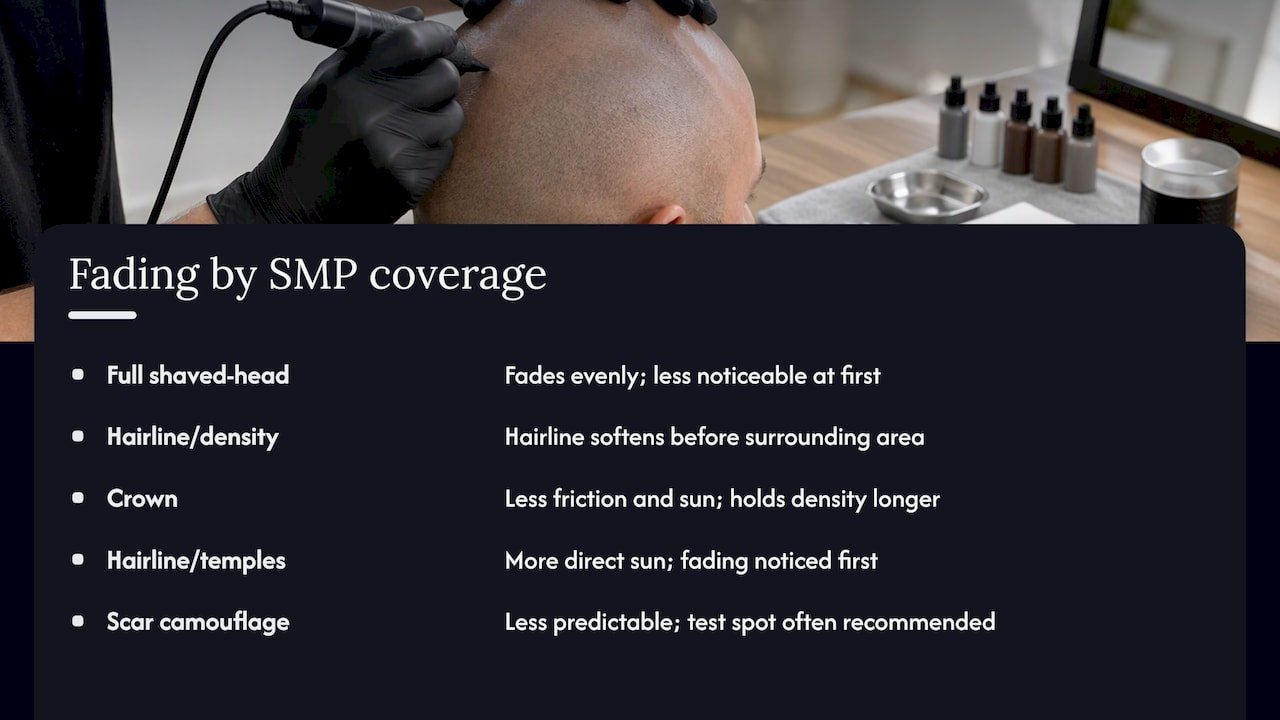
A full shaved-head look, where pigment covers the entire scalp in a uniform pattern, tends to show fading evenly across the whole area, which can make it less noticeable at first since there’s no sharp contrast line to give it away. A hairline-only or density-boost treatment, layered among existing hair, often shows wear differently: the hairline itself, being the focal point, tends to soften or blur before the rest of the treated area does.
Coverage area matters too. Crown work, which sits under less friction and sun exposure than a frontal hairline, often holds its density longer. The hairline and temple regions, which get more direct sun and more visual scrutiny, are usually the first places a client notices fading and the first area a technician will want to assess at a touch-up.
Scar camouflage work, used to blend hair transplant scarring or other scalp scars, can behave differently still. Scar tissue sometimes holds pigment less predictably than healthy skin, which is one reason technicians often recommend a test spot before committing to a full camouflage session, and why these areas may need more frequent evaluation than standard SMP.
How SMP touch-ups interact with other scalp or hair treatments
If you’ve had a hair transplant alongside SMP, whether to add density, camouflage a donor scar, or blend a transplant with a shaved-head look, your touch-up planning should account for both treatments together rather than separately.
Transplant scars can fade or shift in appearance differently than the surrounding SMP work, since scarred skin doesn’t always hold pigment the same way healthy skin does. A test spot before a full camouflage session helps predict how that particular scar will respond, and it’s worth repeating that kind of check at touch-up time if the scar tissue has changed in appearance.
If you’re considering a transplant after already having SMP, timing matters in the other direction too. Healing from a transplant can temporarily affect the look of surrounding pigment, and in some cases contributes to temporary shock loss in the transplant area. It’s generally worth waiting until that healing has stabilized before scheduling an SMP touch-up nearby, so your technician is working from an accurate picture of both treatments rather than a scalp that’s still mid-recovery.
For clients combining SMP with ongoing hair-restoration treatments outside the clinic, including topical or peptide-based regrowth approaches like those covered in guides on hair restoration peptides, it’s worth mentioning any active treatments at your consult. Changes in surrounding hair density can affect how a touch-up should be planned around it.
First-person clinic perspective on evaluating maintenance needs
We approach every touch-up assessment the same way: look at the healed result honestly before deciding anything. Clinic experience consistently points toward staged edits, usually one to three sessions, as the safer path compared to heavy repigmentation in a single sitting. If it’s been a few years since your treatment, the right first step is simply booking an evaluation rather than guessing at what you need.
— James Christopher
Enhanced Scalp maintenance services and how to book a touch-up
Our maintenance process focuses on conservative, realistic results that hold up over time. Our scalp micropigmentation service covers touch-ups and maintenance assessments for clients who were treated with us or elsewhere, and we document healed outcomes so you can see realistic examples before committing to anything.
Our approach emphasizes attention to details that affect how a touch-up ages: conservative hairline design, pigment matched carefully to your skin tone, and a focus on how the work looks years down the line, not just immediately after healing. We also offer scar camouflage treatment for clients whose maintenance needs involve transplant or injury scarring.
If you’re noticing fading, unevenness, or just want an honest read on where your SMP stands, bring your healed photos and book a consult. We’ll give you a straightforward session-count estimate based on what we actually see, not a generic timeline.
FAQ
How much does a scalp micropigmentation touch-up cost?
Touch-up pricing varies by clinic and by how much work is needed, so it’s best confirmed during a consult once a technician has assessed your healed pigment. Our full scalp micropigmentation treatment is priced at 3000-4000 CAD as a one-off, and a touch-up consult will clarify whether your case needs a smaller, less involved session.
How many days after SMP can I wash my head?
Most aftercare guidance for semi-permanent scalp pigmentation recommends avoiding washing for the first several days to let the pigment settle properly. Your technician will give you a specific window based on your treatment, since healing time can vary slightly from person to person.
Can I sweat 5 days after SMP?
Heavy sweating is generally discouraged during the first one to two weeks of healing, since it can irritate the treated skin and affect how pigment settles. Light activity is usually fine, but it’s worth checking with your technician before resuming workouts or saunas that day five.
How long does it take to heal after SMP?
Initial surface healing typically takes about ten to fourteen days, though the final settled look can take a bit longer to fully emerge. Scalp micropigmentation explainers note that pigment continues to stabilize in the skin for a few weeks after the visible surface heals.

