 Skip to content


Active breakouts or open lesions mean waiting, but acne itself does not disqualify you from scalp micropigmentation. Once a dermatologist confirms your skin is stable and a clinic test patch heals cleanly, treatment can proceed safely. This sequence is recommended for clients with acne-prone or previously inflamed skin, as it protects both the healing process and the final result.
TL;DR:
- A dermatologist should distinguish active acne, folliculitis, or acne keloidalis nuchae from flat healed scars, because inflamed or infected areas need treatment before needling.
- Acne treatment may need six to eight weeks; practitioners may then request four to six weeks without flares and a test patch before full treatment.
- Clinics should use sterile single use needles and explain infection controls; fever, pus, severe pain, swelling, or severe redness after treatment warrant prompt medical care.
- SMP can soften scar color contrast but cannot flatten pitted skin, and uneven pigment uptake may mean an additional session.
Table of Contents
- Who Is a Good Candidate for SMP With Acne-Prone Skin
- How Active Inflammation Raises Infection and Pigment Risks
- Getting Cleared: Diagnosis, Treatment Timing, and Test Patches
- What Treatment and Healing Look Like on Acne-Affected Skin
- What SMP Can and Cannot Do for Acne Scars
- Our Approach to Clients With Acne-Related Scalp Conditions
- Preparing for a Consultation When You Have Acne
- Ready to Discuss SMP for Acne-Prone or Scarred Skin
- FAQ
- Sources
Who Is a Good Candidate for SMP With Acne-Prone Skin
Not every scalp condition carries the same weight when it comes to SMP candidacy. Active acne with open pustules behaves differently than healed scarring, and the distinction matters because needling into live inflammation carries real risk while needling into settled, flat scar tissue generally does not.
Acne keloidalis nuchae, a condition that produces firm, raised bumps along the nape and can scar as it progresses, needs its own diagnosis and treatment plan before anyone considers cosmetic pigmentation. The American Academy of Dermatology notes that AKN and folliculitis both raise infection and scarring risks that directly affect whether a procedure should move forward.
A few categories to sort through with a dermatologist first:
- Active acne with pustules or open lesions: postpone treatment until the skin clears.
- Acne keloidalis nuchae: requires diagnosis and often prescription treatment before any pigment work.
- Folliculitis: a bacterial condition that needs to resolve, not camouflage.
- Keloid-prone history: flag this early, since it changes how a practitioner approaches technique.
- Healed acne scarring with no active lesions: typically the most straightforward candidacy profile.
When in doubt, a dermatologist assessment before booking costs far less than correcting a complication afterward.
How Active Inflammation Raises Infection and Pigment Risks
Needling into inflamed or infected skin does two things at once: it gives bacteria already present a more direct path deeper into the tissue, and it compromises how evenly pigment settles. The Cleveland Clinic describes SMP as generally safe but notes it carries the same risks as any skin-penetrating service, including allergic reactions to pigment and infection from improperly sterilized equipment.
Allergic reactions are uncommon but possible, which is why a patch test before full treatment is standard practice rather than an optional extra.
One figure worth remembering: according to the Cleveland Clinic, infection warning signs after a skin-penetrating cosmetic procedure include fever, pus or drainage, severe pain, swelling, and severe redness. Knowing these signs matters more when your baseline skin has a history of inflammation.
A clinic that takes this seriously should be able to show you:
- Sterile, single-use needles opened in front of you.
- Documented hand hygiene and surface cleaning between clients.
- A written risk assessment process for clients with existing skin conditions.
In Canada, personal service settings that penetrate skin fall under public health infection-prevention guidance, and pigments used in permanent makeup are regulated as cosmetics. That framework exists precisely because needling and infection control go hand in hand.
Getting Cleared: Diagnosis, Treatment Timing, and Test Patches
Preparing for SMP when you have a history of acne or a related scalp condition follows a predictable sequence, and skipping steps is where most avoidable complications start.
- Get a proper diagnosis. A dermatologist distinguishes acne from folliculitis or AKN, since each responds to different treatment and carries different scarring risk.
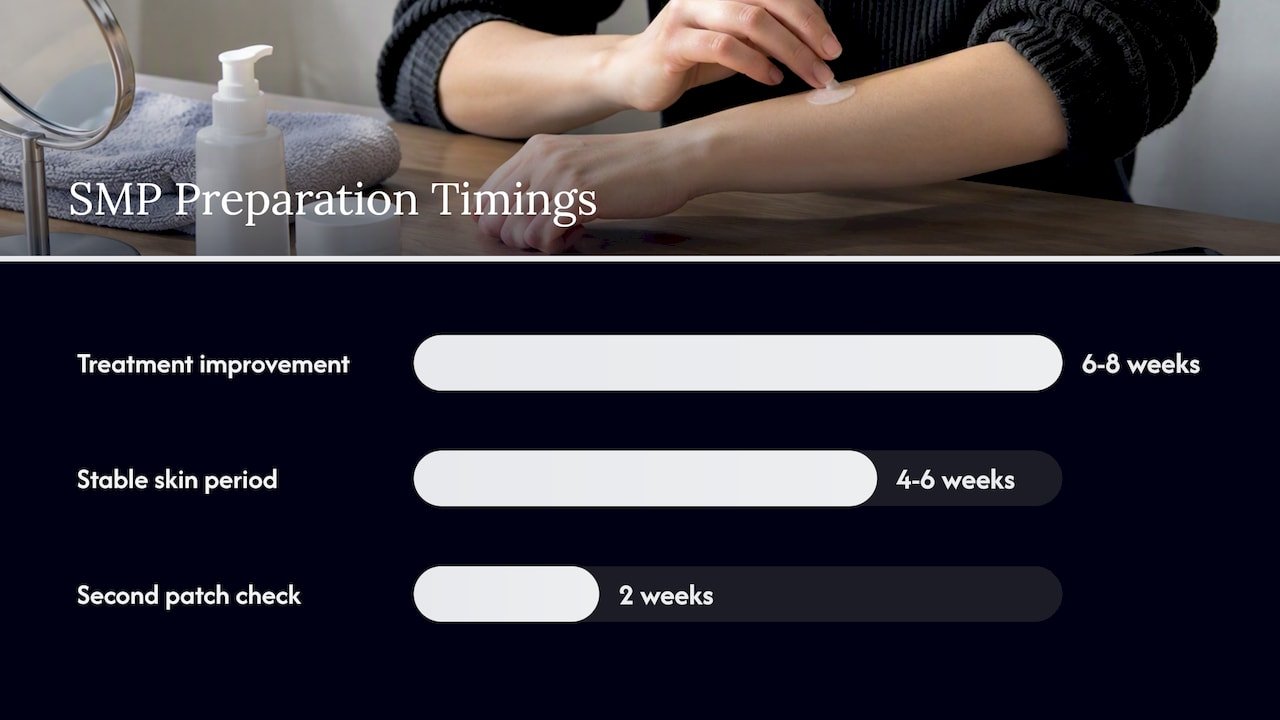
- Follow the prescribed treatment plan. The American Academy of Dermatology notes that acne treatments commonly take 6 to 8 weeks to show meaningful improvement, so build that window into your planning rather than booking around it.
- Wait for a documented stable period. Many practitioners look for roughly 4 to 6 weeks of calm, flare-free skin after a cleared episode before scheduling, though the exact window depends on the condition and your dermatologist’s guidance.
- Complete a test patch. A small area is pigmented and observed through healing, typically checked at 48 to 72 hours and again at two weeks, before any larger session is booked.
Pro Tip: Photograph your scalp weekly during the waiting period. It gives you and your practitioner an objective record of whether the skin is actually stable, not just a general impression.
A successful test patch heals with normal color retention, no excessive redness, and no new breakouts in the treated area.
What Treatment and Healing Look Like on Acne-Affected Skin
Topical numbing is standard for SMP, but previously inflamed or scarred skin can respond less predictably to both the numbing agent and the needle itself, sometimes requiring a practitioner to adjust pressure or pacing in real time.
Pigment uptake on scarred or formerly inflamed tissue is often less uniform than on smooth, unaffected skin. That is one reason clients with acne scarring frequently need an additional touch-up session to even out density, something worth discussing at the consultation stage rather than after the first appointment.
Aftercare follows a fairly strict short-term routine:
- Avoid washing the scalp for the first several days, per your practitioner’s specific instructions.
- Keep the area out of direct sun while it heals.
- Use only the gentle, fragrance-free or antimicrobial cleansers your practitioner recommends once washing resumes.
- Watch for fever, pus, severe pain, swelling, or severe redness, which the Cleveland Clinic lists as signs that need prompt medical attention rather than a wait-and-see approach.
Our own guide to SMP side effects walks through what counts as normal healing versus what warrants a call to your provider.
What SMP Can and Cannot Do for Acne Scars
SMP is a camouflage technique, not a resurfacing treatment. It works by matching pigment to your skin tone and placing it to mimic the look of density or shadow, which is highly effective at softening color contrast between scarred and unscarred skin. The Cleveland Clinic is direct about the limit: micropigmentation can camouflage color disparities and scarring, but it does not correct the underlying texture.
Deep, pitted acne scars will still show their contour under certain lighting, especially close up or under harsh overhead light, because pigment sits on the surface rather than filling the depression. This is exactly why conservative, well-placed dots often outperform heavier saturation on textured skin: they read as natural from normal viewing distance without drawing extra attention up close.
- Pigment can soften color contrast and visual density.
- Pigment cannot fill or flatten a deep pitted scar.
- Combining dermatology treatments with SMP can improve overall outcomes for clients with significant pitting.
Our Approach to Clients With Acne-Related Scalp Conditions
A conservative hairline design and pigment selection based on specific skin tone and texture are important, rather than using a one-size-fits-all template. For clients with acne, AKN, or folliculitis history, coordination with dermatologist clearance and performing a test patch before any full session is advised.
At a consultation, it is reasonable to ask for documented test spot results, healed photos from similar skin conditions, and written aftercare instructions. Such questions can be part of planning safe, realistic treatment.
— James Christopher
Preparing for a Consultation When You Have Acne
Walk into your consultation with a short paper trail: recent dermatology notes, photos of both active and healed areas, a list of current medications, and a rough timeline of flare-ups. Ask for a test patch, proof of sterile single-use needle practices, and healed-case photos from clients with similar skin history. Book only once a dermatologist has confirmed any active inflammation is under control.
Ready to Discuss SMP for Acne-Prone or Scarred Skin
We offer scalp micropigmentation built around your skin’s actual healing history, along with a dedicated scar camouflage treatment for clients whose acne has left visible marks. A test patch comes before any full session, so you see how your skin responds before committing further.
If you have a history of acne, AKN, or folliculitis, bring your dermatology notes to a consultation and we will map out a realistic timeline from there.
This article is general information, not a substitute for advice from a qualified doctor. Consult a qualified healthcare professional about your own circumstances before acting on anything here.
FAQ
Do you need to shave your head for SMP?
Most SMP candidates keep hair very short or fully shaved so the practitioner can see scalp tone and plan pigment placement accurately. Some density-focused treatments for thinning hair can work with slightly longer hair, which your practitioner will discuss at consultation.
What happens to SMP after 5 years?
Pigment fades gradually over time due to sun exposure, skin turnover, and individual metabolism, and most clients schedule a touch-up session to refresh density and color. Clients with a history of acne scarring sometimes need touch-ups slightly sooner if initial uptake was uneven.
When can I wash my hair after SMP?
Practitioners generally ask clients to avoid washing for the first several days after each session to protect the healing pigment. Our guide to SMP side effects covers the specific washing and aftercare timeline step by step.
Does SMP look better than bald?
SMP is designed to replicate the look of a closely shaved head with added density and defined shape, which many clients prefer over a bare scalp, but it comes down to personal preference. For acne-prone skin, SMP also softens color contrast from scarring that a bald scalp alone would still show.
Sources
- Scalp micropigmentation: Before & After, Benefits, Side Effects
- Acne keloidalis nuchae: Diagnosis and treatment
- Infection prevention in personal services settings (Public Health Agency of Canada)

