 Skip to content

Scalp micropigmentation (SMP) is the most direct non-surgical answer for hair loss camouflage in Canada. It deposits tiny pigment dots into the upper scalp to replicate the look of hair follicles, creating either a shaved-head illusion or the appearance of denser hair. No scalpel, no recovery ward, no transplanted grafts. The International Society of Hair Restoration Surgery (ISHRS) describes SMP as a nuanced, scalp-specific cosmetic procedure that aims to create a natural, three-dimensional illusion rather than simply painting the scalp. A peer-reviewed PMC paper confirms it as a cosmetic concealer with high patient satisfaction. If you want a professional assessment, booking a consultation with a trained Canadian SMP provider like Enhanced Scalp is the logical first step.
Key Takeaways
Scalp micropigmentation is the most practical non-surgical hair loss camouflage available in Canada, delivering a shaved-head or density illusion through pigment dots placed in the upper dermis across 2–4 sessions.
| Point | Details |
|---|---|
| What SMP does | Deposits pigment dots to mimic follicles; creates a shaved-head or density illusion, not hair regrowth. |
| Who it suits | Men and women with pattern loss, alopecia, transplant scarring, or diffuse thinning who want cosmetic camouflage. |
| How long it lasts | Typically 3–5 years before a touch-up; daily SPF use is the most effective way to slow fading. |
| Canadian cost range | Full-scalp SMP runs roughly $2,000–$5,000 CAD; small scar work starts around $500. |
| Enhanced Scalp | A Vaughan, Ontario clinic specializing in natural results, corrective SMP, and healed portfolio documentation. |
Table of Contents
- What is scalp micropigmentation and how does it work?
- Who is a good candidate for SMP, and who should wait?
- What does the SMP process look like from start to finish?
- Why do people choose SMP over surgery or doing nothing?
- What are the real risks of SMP and how do you reduce them?
- How long does SMP last, and when will you need a touch-up?
- What does SMP cost in Canada, and what affects the price?
- How do you pick a safe SMP provider in Canada?
- What should you do before and after each SMP session?
- What most SMP advice gets wrong
- Enhanced Scalp: a trusted Canadian SMP provider
- Sources
- FAQ
What is scalp micropigmentation and how does it work?
SMP is a specialized cosmetic tattooing technique, but calling it a regular tattoo undersells the precision involved. A practitioner uses ultra-fine micro-needles to deposit pigment at roughly 0.5 mm into the upper dermis, according to clinical protocol guidance. That shallow depth keeps each dot crisp and prevents the pigment from migrating in the scalp’s oil-rich environment.
Two distinct visual outcomes are possible:
- Shaved-head illusion: Dots are placed across the entire scalp to mimic a closely cropped buzz cut. This suits men with significant hair loss or complete baldness.
- Density fill: Pigment is added between existing hairs to reduce the contrast of a thinning area or widening part line. This is common for women and men with diffuse thinning.
SMP differs from body tattooing in three key ways: shallower needle depth, pigment chemistry formulated specifically for scalps, and a stippling motion rather than continuous lines. Cleveland Clinic confirms that SMP does not grow hair. It is a visual camouflage, full stop.
Pro Tip: Ask any provider what pigment chemistry they use. Carbon-based pigments tend to fade to lighter grays predictably, while some metallic-oxide formulas can shift to blue or green tones over time.
Who is a good candidate for SMP, and who should wait?
SMP suits a wide range of people. The most common candidates include:
- Men at various Norwood stages who prefer a shaved aesthetic over surgical options
- Women with widening part lines or diffuse thinning seeking density without surgery
- Anyone with transplant scarring or injury scars that they want to camouflage
- Alopecia areata or alopecia totalis patients seeking cosmetic coverage
- People with prior hair transplants who want to blend the donor strip scar
Some people should delay or avoid SMP entirely. Active scalp inflammation, psoriasis flares, or open folliculitis need to resolve before any pigment work. A history of keloid scarring is a significant contraindication because the needling process can trigger raised scar tissue. Anyone with rapidly progressing loss who has no stabilization plan may find that new bald patches emerge around treated areas, creating a patchy result over time.
Stable hair loss is not a luxury requirement — it is a clinical prerequisite. Practitioners conducting thorough consultations will ask how long your loss has been stable and whether you are managing progression. Rushing SMP during active, aggressive loss is one of the most common reasons for disappointing long-term outcomes.
What does the SMP process look like from start to finish?
The process follows a structured, multi-session protocol. Here is the typical sequence:
- Consultation and scalp assessment: The practitioner reviews your loss pattern, scalp health, skin tone, and goals. A written treatment plan and hairline design are agreed upon before any needles touch your scalp.
- Color matching: Pigment shades are selected to match your existing hair color and skin undertone, accounting for how the pigment will look once healed.
- Topical numbing: A topical anesthetic is applied before each session to manage discomfort.
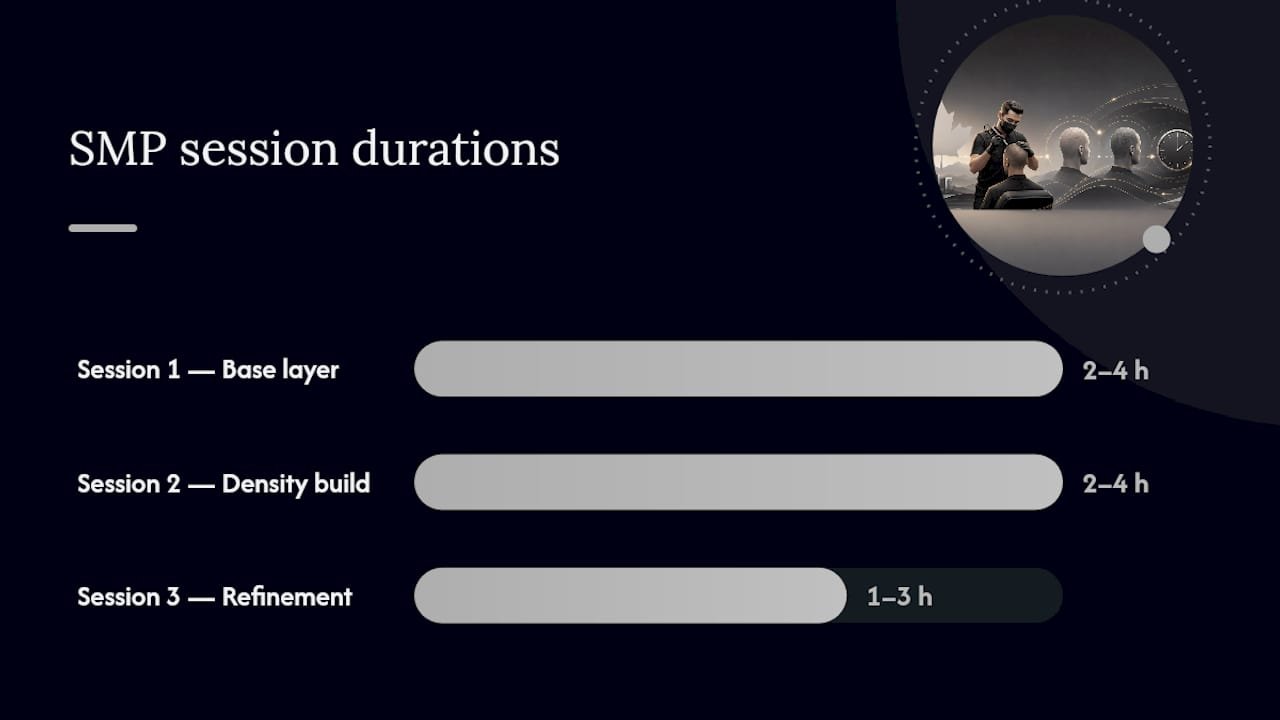
- Session 1 (base layer): A sparse foundational layer of dots is placed across the treatment area. This session establishes the framework without over-saturating the skin.
- Session 2 (density build): More dots are added to increase depth and density. The practitioner assesses how the skin retained pigment from session 1 before proceeding.
- Session 3 (refinement and finishing): Tonal adjustments, edge softening, and any areas needing extra density are addressed. This session locks in the final result.
Sessions are spaced roughly 7–14 days apart to allow healing and pigment settling. Immediately after each session, the scalp looks darker and more defined than the healed result. Over the following 7–14 days, the pigment softens and lightens slightly as the skin heals.
| Session | Purpose | Typical Duration |
|---|---|---|
| Session 1 | Base layer, hairline design | 2–4 hours |
| Session 2 | Density build, retention check | 2–4 hours |
| Session 3 | Refinement, tonal finishing | 1–3 hours |
Pro Tip: When reviewing a provider’s portfolio, request photos taken 6–12 months after the final session. Immediate post-procedure photos look sharp on everyone. Healed photos reveal the practitioner’s actual skill.
Why do people choose SMP over surgery or doing nothing?
The appeal of SMP as a non-surgical hair restoration option comes down to a few concrete advantages. There is no surgical recovery, no donor site wound, and no general anesthesia. You walk in and walk out the same day with a visible change. For people who have already had a transplant and are left with a visible strip scar, SMP offers scar camouflage that surgery cannot easily address.
Compared with wearing a hair system, SMP requires no daily adhesives, no removal routine, and no risk of the piece shifting. The debate around hair transplant vs. hair system vs. SMP often comes down to lifestyle fit. SMP is permanent cosmetic work that you maintain with occasional touch-ups, not a removable appliance. For those exploring non-SMP cosmetic options, hair toppers and extensions offer a removable alternative worth considering alongside SMP.
SMP is not a medical treatment. It does not stimulate follicles, slow loss, or alter hair biology in any way.
What are the real risks of SMP and how do you reduce them?
No cosmetic procedure is without risk. For SMP, the main ones are:
- Infection: Redness, swelling, or discharge beyond the first 48 hours warrants a call to your provider. Single-use sterile cartridges and proper clinic hygiene are non-negotiable.
- Pigment migration or color shift: Pigment placed too deep or with the wrong chemistry can blur or shift hue over time. This is a practitioner skill and pigment-selection issue.
- Allergic reaction: A patch test before your first session identifies sensitivities to pigment ingredients.
- Keloid formation: Anyone with a personal or family history of keloids should discuss this explicitly before proceeding.
- Poor aesthetic outcome: Unnatural hairlines, dots that are too large, or overly dark pigment are almost always the result of undertrained practitioners rather than the technique itself.
Safety checklist for your consultation: Confirm single-use cartridges, ask for the pigment brand and ingredient list, request a patch test, verify the clinic’s sterilization protocol, and ask to see healed photos at 6–12 months.
Medical News Today notes that a small 2021 study of 22 participants showed minimal fading over a 7–32 month follow-up, though small-sample findings require cautious interpretation.
How long does SMP last, and when will you need a touch-up?
Cleveland Clinic reports that SMP results commonly last about four years or longer, depending on pigment and skin factors. Independent practitioner overviews suggest a typical range of 3–5 years before a touch-up is commonly recommended.
Fading is driven by UV exposure, skin oiliness, pigment chemistry, and natural skin cell turnover. People with oilier scalps tend to see faster fading. Sun exposure without protection accelerates pigment breakdown noticeably. Wearing SPF 30 or higher on the scalp daily is the single most effective maintenance habit. Touch-ups are shorter and less expensive than the original treatment because they address fading rather than rebuilding from scratch.
What does SMP cost in Canada, and what affects the price?
Practitioner overviews report typical full-scalp SMP costs in the $2,000–$5,000 CAD range, with smaller scar work costing less and corrective or extensive coverage costing more.
Factors that push a quote higher include practitioner experience, clinic location, the complexity of corrective work over previous poor SMP, and the total area being treated. A transparent quote should specify the number of sessions included, the expected touch-up timeline, and written aftercare instructions.
- Ask whether the quoted price covers all sessions or is per-session
- Confirm what happens if additional sessions are needed for retention issues
- Get the treatment plan in writing before paying a deposit
How do you pick a safe SMP provider in Canada?
Canada does not have a single national licensing body for SMP practitioners, so provincial cosmetic tattoo regulations apply. In Ontario, for example, SMP falls under the Health Protection and Promotion Act’s personal services settings regulations, which govern sterilization and infection control. Ask your provider which provincial regulation they operate under and request documentation.
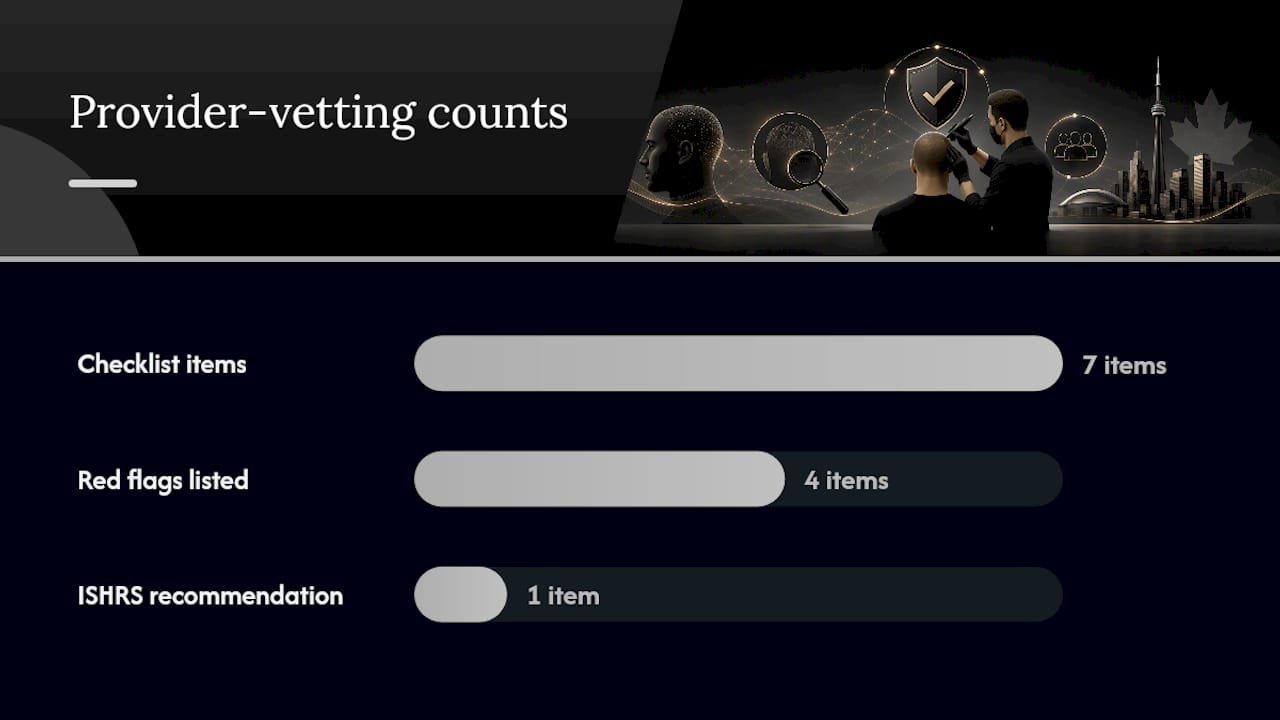
Beyond regulatory compliance, use this checklist:
- Healed before-and-after photos at 6–12 months (not just fresh post-procedure shots)
- Documented SMP-specific training or certification, not general tattoo training
- Written treatment plan and consent form before any session begins
- Single-use sterile cartridges confirmed in writing
- Pigment brand and ingredient list available on request
- Patch test offered before the first session
- Clear cancellation and refund policy
Pro Tip: Search the provider’s name alongside “healed results” on social media. Practitioners confident in their long-term work post healed photos regularly. Those who only post day-of results are telling you something.
Red flags to walk away from: A provider who shows only immediate post-procedure photos, refuses to disclose pigment chemistry, pressures you to compress sessions into a shorter timeline than recommended, or cannot explain their sterilization protocol is not a provider worth trusting with your scalp.
The ISHRS recommends seeking practitioners with scalp-specific training because the scalp’s oil glands and skin structure demand different technique than body tattooing. Enhanced Scalp’s practitioners have SMP-specific training; their training program reflects the same standards they apply to client work.
For women considering SMP for diffuse thinning, Enhanced Scalp’s female SMP service page covers density-fill outcomes specific to that presentation.
What should you do before and after each SMP session?
Before your appointment:
- Arrive with a clean, product-free scalp
- Avoid blood-thinning medications or supplements (aspirin, fish oil, vitamin E) for at least 48 hours before, unless medically contraindicated — confirm with your doctor first
- Avoid significant sun exposure or sunburn on the scalp for at least one week prior
- Skip chemical scalp services (dyes, relaxers) for two weeks before
Immediately after each session:
- Expect redness and slight swelling for 24–48 hours
- Avoid washing the scalp for 4 days after each session
- No heavy sweating, saunas, or swimming for at least 5 days
- Do not pick or scratch any flaking skin
First two weeks:
- Gentle cleansing with lukewarm water and a mild, fragrance-free cleanser from day 5 onward
- Resume regular exercise after day 5, avoiding anything that causes heavy scalp sweating sooner
- Apply SPF 30 or higher to the scalp whenever you are outdoors, starting after the skin has healed
Contact your provider immediately if you notice increasing redness, warmth, discharge, or unusual pigment color changes beyond the first 48 hours.
What most SMP advice gets wrong
The standard advice you find online treats SMP as a commodity. Pick a clinic, check the reviews, book a session. That framing misses the most important variable: healed results over time.
Fresh SMP looks sharp on almost everyone. The real test is what the work looks like 12 months later, when the scalp has cycled through seasons, sun exposure, and normal skin turnover. A practitioner who places pigment too deep to look impressive immediately is setting you up for blurred, faded dots within two years. One who uses the wrong pigment chemistry may leave you with a blue-gray tint that reads as artificial under certain lighting.
The other thing most guides skip: corrective SMP is harder and more expensive than getting it right the first time. Laser removal of scalp pigment is slow, costly, and not always complete. Choosing a provider based on price alone, or on a single impressive before-and-after photo, is how people end up needing corrective work.
The evidence-based standard, per ISHRS guidance and peer-reviewed research, is clear: SMP requires scalp-specific training, proper pigment chemistry, and a multi-session protocol. Providers who cut corners on any of those three points produce results that look fine in week one and problematic in year two.
Enhanced Scalp: a trusted Canadian SMP provider
If you have read this far and want a Canadian clinic that meets the standards described above, Enhanced Scalp is worth a direct look. Based in Vaughan, Ontario and serving Toronto, the GTA, and clients across Canada and select U.S. markets, Enhanced Scalp specializes in natural shaved-head results, density work for women, and corrective SMP for people dealing with prior poor work or transplant scarring.
The clinic documents healed results, not just fresh post-procedure photos, and provides written treatment plans before any session begins. Pigment selection and conservative hairline design are central to their approach, which means results that hold up over years rather than just weeks. For anyone dealing with alopecia or extensions as an alternative, Enhanced Scalp’s consultation process helps clarify whether SMP or another approach fits your situation better.
Book a consultation or view the healed portfolio at Enhanced Scalp’s SMP service page.
Sources
- Micropigmentation of the scalp | ISHRS
- Scalp micropigmentation: a cosmetic tattoo technique for hair loss | PMC
- Scalp Micropigmentation: What to Know Before You Book | Cleveland Clinic
- Scalp Micropigmentation What Is It Explained: The Complete Patient Guide for 2026 – Dr. Glenn M. Charles, Charles Medical Group
- Balding
- Scalp micropigmentation (SMP): Benefits, costs, results | Medical News Today
Ask any provider you consult to share the specific studies or clinical guidelines they follow. A practitioner who can point to peer-reviewed evidence and ISHRS guidance is one who takes the craft seriously.
This article is general information, not a substitute for advice from a qualified doctor. Consult a qualified healthcare professional about your own circumstances before acting on anything here.
FAQ
What exactly is non-surgical hair loss treatment?
In the context of cosmetic camouflage, non-surgical hair loss treatment refers to scalp micropigmentation (SMP), a pigment-based technique that replicates the appearance of hair follicles without surgery, grafts, or medical intervention.
How many SMP sessions does a full treatment take?
Most full-scalp treatments require 2–4 sessions, commonly three, spaced roughly 7–14 days apart to allow healing and assess pigment retention between appointments.
Is SMP permanent, and will it need touch-ups?
SMP is long-lasting but not permanent. Results typically last 3–5 years before fading requires a touch-up session; UV exposure and skin oiliness are the primary factors that accelerate fading.
How do I know if a Canadian SMP provider is qualified?
Request healed before-and-after photos at 6–12 months, ask for documented SMP-specific training, confirm single-use sterile cartridges, and verify the clinic operates under your province’s personal services or cosmetic tattoo regulations.
Can Enhanced Scalp help with corrective SMP after a bad result?
Yes. Enhanced Scalp specializes in corrective SMP for clients with prior poor work, failed hair transplants, and challenging scalp conditions, serving clients from Ontario and across Canada.

