 Skip to content

Yes, scalp micropigmentation can create a natural-looking low hairline, but only when the artist balances your request against your Norwood stage and age. The biggest mistake isn’t the technique itself. It’s placing a young man’s hairline too low, too straight, and too soon, which creates an “island” look once natural recession catches up years later. Done conservatively, with a soft, irregular edge, SMP holds up for years between touch-ups.
TL;DR:
- A natural low hairline with SMP depends on irregular edge detailing, age-appropriate placement, and matching facial geometry to avoid an artificial look over time.
- Men in Norwood stages II to III are ideal candidates for a conservative, blended low hairline, while those in stages IV to V may need hybrid approaches or higher placement to prevent disconnection with remaining hair.
- SMP results fade gradually over three to five years, with sun exposure, skin type, and pigment application depth significantly affecting longevity and appearance.
- The most common mistakes include overly low placement for young men, flat density, hard straight edges, and mismatched pigment colors that turn unnatural as they age.
- Choosing an experienced artist who shows healed, varied, and face-specific results, and who conducts thorough consultations, minimizes the risk of unnatural or poorly integrated hairlines.
Table of Contents
- What Makes A Low Hairline SMP Look Natural
- Are You A Good Candidate For A Low Hairline?
- Density-Fill Vs. Full-Scalp: How Technique Shapes The Line
- How Long Does It Last, And What Goes Wrong
- Choosing An Artist Who Won’t Botch Your Hairline
- Why Enhanced Scalp Approaches Hairlines Conservatively
- Managing Pain And Aftercare Around The Hairline
- What Real Results Actually Look Like
- Getting Your Head Around The Decision
- Practical Trade-Offs In Hairline Design
- Ready To Design A Hairline That Ages Well?
- Sources
- FAQ
What Makes A Low Hairline SMP Look Natural
A natural hairline isn’t a straight line drawn an inch above your eyebrows. It’s an irregular border that mimics how hair actually grows, with density that fades gradually rather than stopping like a paint edge.
Age-appropriate positioning matters more than any other single design decision. A hairline that sits slightly higher and softly recessed almost always reads as more believable over time than one placed aggressively low. Men in their twenties who push for a juvenile, dead-straight hairline often regret it a decade later, when the surrounding hair has receded further and the SMP line looks pasted on rather than grown.
Edge style is the second lever. A hard, defined line can work for men who keep their hair buzzed extremely short and want a crisp, barbershop-fresh look. But for most low hairline requests, a broken or faded edge, built from tiny irregular dots rather than a solid boundary, sells the illusion far better. Real hairlines are never uniform. They have single-follicle outliers, slight asymmetry, and a gradual thinning zone rather than a wall of density.
Facial geometry also drives the design. The classic M-shape, with temple points that recede slightly more than the center, tends to look more proportional than a flat, box-like frontal line, especially on men with narrower faces or a longer forehead. An experienced artist adjusts the temple points based on your bone structure, not a template.
When you’re reviewing a practitioner’s portfolio, look specifically for:
- Healed photos taken at least four to six weeks post-treatment, not fresh ink that will lighten and settle
- Visible irregularity at the hairline border rather than a hard, ruler-straight edge
- Temple points that vary from client to client instead of a repeated cookie-cutter shape
- Consistent quality across different skin tones and hair colors, not just one flattering case
Pro Tip: Ask to see a healed hairline photo taken from a low angle, at eye level with the client’s face, not a top-down shot. That angle is the hardest to fake and shows you exactly how the edge will look when someone talks to you face-to-face.
Are You A Good Candidate For A Low Hairline?
Your current Norwood stage determines how far you can safely push a hairline down, and it’s the first thing a competent practitioner should assess before touching a needle to your scalp.
- Norwood II to III. This is the sweet spot for hairline-focused SMP. Recession is mild, the surrounding hair is stable, and a practitioner can define or gently lower the line with density-fill work between existing follicles.
- Norwood IV to V. The hairline has usually receded enough that a purely cosmetic low line risks looking disconnected from thinning mid-scalp hair. These cases typically call for a hybrid plan, blending SMP with a hair transplant or transitioning toward a fuller-density, shaved-head strategy rather than an isolated low front.
- Norwood VI to VII. Full-scalp SMP recreating a shaved-head look is usually more sustainable than chasing a low hairline in isolation, since there’s little native hair left to blend with.
The island effect is what happens when a low, dense hairline is tattooed onto a scalp that keeps receding around it. Years later, the SMP line sits isolated, surrounded by thinner natural hair, looking exactly like what it is: a static line on a scalp that kept changing. It’s the single most common regret among men who got aggressive, low hairlines in their early twenties.
If your hair loss is still active or you have an undiagnosed scalp condition, a physician consultation before SMP is the safer route. A male pattern baldness assessment can clarify whether you’re still progressing or have reached a stable plateau, which changes how conservative your design should be.
Density-Fill Vs. Full-Scalp: How Technique Shapes The Line
Not all SMP is the same procedure with different amounts of ink. Density-fill and full-scalp SMP use different needle configurations, pigment densities, and session goals, and that difference shows up directly in how soft or artificial your hairline looks.
Density-fill SMP uses finer needles and works between your existing follicles, adding pigment dots that mimic hair shafts without replacing your natural strands. It’s the technique of choice when you still have hair to keep and simply want the hairline redefined, thickened, or brought forward a modest amount. Because it works with existing hair length and texture, it tends to produce the most convincing low hairline results for men in earlier Norwood stages.
Full-scalp SMP, by contrast, uses higher pigment density across the whole scalp to recreate the look of a close buzz cut. It’s built for men who are shaving their heads or have advanced hair loss, and the hairline here is designed from scratch rather than blended with surviving hair.
A few technical notes worth understanding before your consultation:
- Practitioners typically sequence treatment across a staged incremental session protocol commonly involving multiple sessions, adding density incrementally rather than in one heavy pass, which helps avoid oversaturation and lets the artist correct the hairline shape as it develops.
- Needle depth and dot spacing at the hairline itself are usually finer than the density used further back on the scalp, which is what creates that gradual, faded transition instead of a hard stop.
- Because SMP is pigment placed in the skin, not a hair-growth treatment, it changes only appearance. Expecting the line to move or grow the way real hair does is a common misunderstanding worth clearing up before treatment starts.
For men specifically dealing with recession rather than full baldness, a receding hairline SMP approach usually leans more on density-fill work than the full-scalp method.
How Long Does It Last, And What Goes Wrong
SMP is genuinely long-lasting but not permanent. Pigment particles sit in the upper dermis and gradually fade with sun exposure, skin turnover, and time, which means most clients need touch-ups. According to the International Society of Hair Restoration Surgery, touch-up sessions are commonly recommended every three to five years to maintain color and edge definition.
Several factors accelerate fading faster than average: unprotected sun exposure on the scalp, oilier skin types, and pigment applied too deep or too shallow. Clinical literature on tattoo and micropigmentation retention shows that skin type and application depth directly affect how long color holds and how the pigment ages, which is part of why practitioner skill matters more than the pigment brand itself.
The most common cosmetic problems with low hairline SMP aren’t really about longevity. They’re design mistakes made on day one:
- A line placed too low relative to the client’s age and Norwood trajectory
- Oversaturated density that looks flat and dark rather than layered like real hair
- A hard, straight edge with no irregularity or temple taper
- A pigment color that reads blue, green, or gray as it fades, rather than aging toward a natural gray-brown
Most of these are fixable. Softening a hard edge, correcting oversaturated zones, or adjusting a hairline that was placed too aggressively usually falls under corrective SMP work, and in select cases involving heavy pigment blowout, laser treatment is used to lighten the area before a redesign.
Choosing An Artist Who Won’t Botch Your Hairline
Your outcome depends more on the practitioner’s judgment than on any specific machine or pigment brand. A rushed consultation is the biggest red flag you’ll encounter.
Start with the portfolio. Ask specifically for healed results, not just fresh work, since fresh SMP always looks darker and crisper than it will settle. Look for consistency across different skin tones and multiple Norwood stages, not one polished case repeated in every ad.
In the consultation itself, ask these questions directly:
- How many sessions do you typically recommend for a low hairline, and why that number for my case?
- What’s your protocol if I want the line adjusted after the first session?
- Do you screen for scalp conditions or medical contraindications before treating?
- What’s your touch-up policy, and roughly how often do your clients return?
- Can I see healed photos from clients with a similar hair color and skin tone to mine?
Red flags worth walking away from include an artist who only shows fresh, unhealed photos, who pushes the same aggressively low hairline shape on every client regardless of face shape, or who pressures you to book same-day without a real design discussion. The FDA’s guidance on tattoo and pigment safety also stresses sterile technique and informed consent as baseline expectations, not extras, so a provider who skips a patch test, written consent, or clear pricing upfront is cutting corners somewhere else too.
Pro Tip: Bring a printed photo of a hairline shape you like, and ask the artist to explain why it would or wouldn’t suit your face and Norwood stage. Their willingness to push back on your reference photo tells you more about their judgment than anything in their portfolio.
Why Enhanced Scalp Approaches Hairlines Conservatively
Enhanced Scalp builds every hairline around one rule: it has to look right healed, not just fresh off the table. That means favoring realistic density and age-appropriate placement over the darkest, lowest line a client requests on day one, with the core SMP process built around follicle replication rather than flat shading.
A meaningful share of the clinic’s work involves fixing what other providers got wrong, including hairlines placed too low, transplant scars that never blended, and pigment that’s shifted color with age. Corrective cases require a different skill set than a first-time treatment, since the artist is working around existing ink rather than a blank scalp. Enhanced Scalp documents healed results in its treatment gallery, which is worth reviewing before any consultation so you know what a properly aged hairline actually looks like. The clinic is based in Vaughan, Ontario, and serves clients across Toronto, the GTA, and beyond.
Managing Pain And Aftercare Around The Hairline
The hairline area is more sensitive than the crown or mid-scalp, since the skin here is thinner and closer to the frontal bone. Most clients describe it as a dull vibration or scratching sensation rather than sharp pain, and topical numbing cream is standard practice before and during the session.
Aftercare in the first four to five days matters more at the hairline than anywhere else on the scalp, because it’s the area most exposed to friction from hats, sunglasses being pushed up, and touching. Avoid sweating heavily, swimming, or direct sun exposure during initial healing, since UV exposure is one of the fastest ways to fade fresh pigment unevenly. Most clinics recommend keeping the area dry for the first several days, then transitioning to a fragrance-free moisturizer once the initial scabbing resolves.
Long-term, sunscreen on the hairline isn’t optional if you want the color to age evenly. Unprotected sun exposure breaks down pigment faster at the front of the scalp than further back, since it gets more direct exposure during the day. A wide-brim hat or SPF specifically formulated for scalp use protects the investment far more cheaply than an early touch-up.
What Real Results Actually Look Like
Realistic low hairline results share a few visual traits worth knowing before you look at any gallery. The density should look layered rather than flat, with the front few millimeters noticeably sparser than the area just behind it. That gradient is what separates a hairline that reads as grown-in from one that reads as drawn-on.
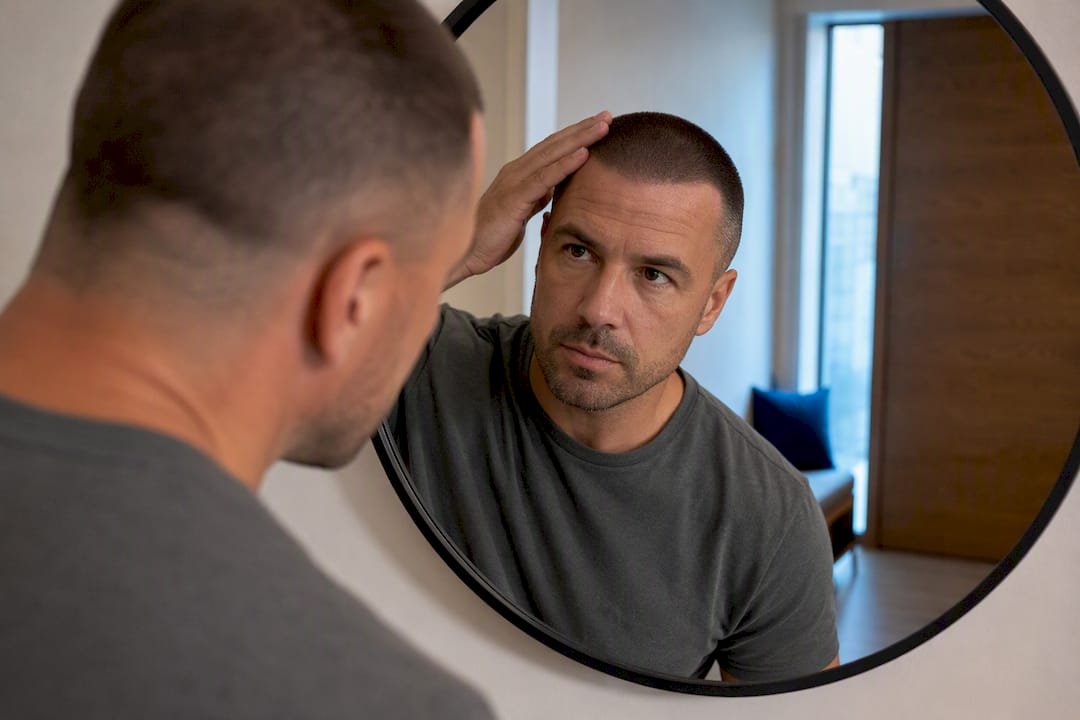
Healed photos, taken under normal indoor lighting rather than a studio spotlight, are the honest test. Fresh SMP photos almost always look better than they will in six weeks, once the pigment settles and lightens slightly. A practitioner confident in their work will show you both stages side by side.
Good results also vary person to person in a way that a template never could. Two clients with the same Norwood stage might end up with noticeably different hairline shapes, because their face shape, hair color, and personal preference all factored into the design. If every result in a portfolio looks like the same hairline stamped onto different faces, that’s a sign of a rigid process rather than customized design work.
Getting Your Head Around The Decision
Wanting a lower hairline is rarely just about hair. For a lot of men, it’s tied up with how old they feel they look, how photos turn out, or a specific memory of what their hairline used to be. That’s a legitimate motivation, but it’s worth separating from the design decision itself.
The clients who end up happiest years later are usually the ones who treated the consultation as a planning conversation, not a wish list. They asked what their hairline would look like at 45, not just at 25. They accepted a slightly more conservative shape in exchange for something that would still make sense a decade on. The ones with regrets, by contrast, usually pushed for the lowest, straightest line the artist would agree to, then watched their natural hair recede around it over the following years.
A good practitioner will sometimes talk you out of exactly what you asked for, and that’s not a red flag. It’s the same instinct that keeps a hairline looking natural instead of frozen in time.
Practical Trade-Offs In Hairline Design
The pull toward an aggressively low, youthful hairline is understandable, but it’s usually the wrong bet for anyone still early in their hair loss timeline. A slightly higher, softer design costs you a little in immediate youthfulness and gains you years of not looking like you’re wearing a mismatched wig as your natural hairline continues to shift.
There are exceptions. A man in his late thirties or older with clearly stable hair loss, who plans to keep his head shaved regardless of what happens to his remaining hair, can reasonably go lower and denser without much future risk. The trade-off shrinks once your Norwood stage has stopped moving.
For everyone else, the smarter frame isn’t “get the perfect line once.” It’s building a hairline you can reassess and refine at each touch-up, adjusting slightly as your face and hair actually change.
— James Christopher
Ready To Design A Hairline That Ages Well?
A consultation at Enhanced Scalp starts with an honest look at your Norwood stage, not a sales pitch for the lowest line possible. The clinic maps your current hair pattern, mocks up a few hairline options against your actual face shape, and selects pigment tones matched to your skin and hair color before a single needle touches your scalp.
Treatment typically unfolds over a few sessions rather than one long appointment, which gives the artist room to build density gradually and adjust the shape as it develops, backed by clear aftercare guidance for the healing weeks that follow. Enhanced Scalp is the option worth choosing over a rushed, one-session studio: the staged approach to hairline design means your line gets refined across the process instead of locked in before the artist even sees how your skin holds pigment.
Before booking, browse the healed results gallery to see what a properly aged hairline actually looks like months later, not just fresh off the table. If you’re dealing specifically with a receding hairline rather than full baldness, the male pattern baldness treatment page walks through what a consultation covers for your specific stage. When you’re ready, reach out to schedule a consultation and get a design plan built around your face, not a template.
Sources
- Scalp Micropigmentation (SMP): All You Need to Know – ISHRS
- Think you ink? Tattoo safety – FDA
- PubMed clinical literature on tattoo/micropigmentation retention and complications
- Scalp Micropigmentation for Hairline: Physician Guide – Shapiro Medical
FAQ
How long does SMP hairline pigment last?
SMP typically holds its color and definition for several years, but most clients need a touch-up every three to five years as pigment gradually fades from sun exposure and normal skin turnover.
Can SMP fix a receding hairline?
Yes, SMP can define, thicken, or lower a receding hairline through density-fill work, though the amount of change possible depends on your Norwood stage and how much native hair remains around the temples.
What are the disadvantages of SMP for a hairline?
The main downsides are that results fade gradually and require touch-ups, an inexperienced artist can create an unnaturally low or hard-edged line, and correcting a botched hairline takes more skill than a first-time treatment.
How much does hairline SMP typically cost?
Cost varies by clinic, session count, and the scope of the work, since a small hairline touch-up costs less than a full hairline redesign or corrective treatment; a consultation is the only reliable way to get an accurate quote for your specific case.
Does SMP work for very low or aggressive hairlines?
It can, but practitioners generally recommend caution for younger clients or those still in earlier Norwood stages, since an aggressively low line placed too early risks the “island effect” as natural hair continues to recede around it.

