 Skip to content

Most people need several sessions of scalp micropigmentation, with a standard protocol of three sessions for the majority of cases. Small areas or minor recession can wrap up in two visits, while advanced hair loss, heavy scarring, or corrective work often push the total to four. Sessions are typically spaced 7 to 14 days apart to let pigment settle before the next layer goes in.
TL;DR:
- Most people require three sessions for standard scalp micropigmentation, with additional sessions needed for advanced hair loss, scars, or previous treatments.
- A typical treatment involves three spaced sessions over 7 to 14 days, allowing pigment to settle and enabling careful layering for natural results.
- Factors like Norwood stage, scarring, skin type, and prior procedures influence how many sessions are necessary, often requiring more for complex cases.
- Proper healing time and aftercare are essential, with most healing and pigment settlement completing within 10 days, reducing the risk of patchy retention.
- SMP durability ranges from three to ten years, depending on sun exposure and pigment placement, with full removal usually requiring complete laser treatment of the area.
Table of Contents
- What Do Different SMP Session Counts Actually Mean?
- What Determines Your Personal SMP Session Requirements?
- What Happens During Each SMP Appointment?
- How Should You Handle Healing Between Sessions?
- How Do You Know You’re at Your Final Session?
- How Long Does SMP Last Before You Need a Touch-Up?
- Can SMP Be Removed or Corrected If You’re Unhappy?
- How Enhanced Scalp Plans Your Session Count
- A Note on Patience and Realistic Expectations
- Ready to Find Out How Many Sessions You’ll Need?
- Sources
- FAQ
What Do Different SMP Session Counts Actually Mean?
The number on your treatment plan tells you more than a price. It reflects how much surface area needs coverage, how dark the final result should look and how much room there is for error.
Two sessions usually cover smaller, more contained work: a receding hairline that hasn’t progressed far, a thin scar needing camouflage, or a diffuse-thinning case where the goal is a density blend rather than a full shaved look. Practitioners can lay down foundation dots in session one and refine tone and edges in session two without overworking the skin.
Three sessions are the industry standard for most patients, and for good reason. This spacing lets a practitioner build density in layers instead of guessing at final saturation on day one:
- Session 1 lays the foundation, establishing an initial dot density
- Session 2 builds density further
- Session 3 refines tone and increases coverage to achieve a natural shaved-head look
A fourth session may be needed in cases of advanced hair loss, corrective SMP over previous work, or clients seeking maximum density with no patchiness. More sessions mean more total chair time, and pricing structures usually reflect that. A two-session plan costs less than a four-session corrective case, simply because the labor and pigment volume scale with complexity.
What Determines Your Personal SMP Session Requirements?
No two scalps take the same path through treatment. Several variables decide whether you land at two sessions or need the full four, and understanding them helps you evaluate a quote instead of just trusting a number.
- Hair loss stage (Norwood scale): A Norwood 3 with a receding hairline typically needs fewer passes than a Norwood 6 or 7 covering the crown and full scalp. Advanced stages require additional dot density and more careful layering to avoid an artificial, overly dark result, which is why a fourth session often gets added for evenness.
- Scarring and alopecia: Scar tissue absorbs pigment differently than healthy skin, and areas affected by alopecia areata can retain unevenly. Both usually call for an extra session to correct blotchy retention.
- Skin type and oiliness: Oily skin tends to hold pigment less predictably during early sessions, sometimes requiring a touch-up pass that a drier scalp wouldn’t need.
- Aesthetic goals and history: A full shaved-head look needs different density targets than a density-blend for someone keeping existing hair. Prior hair transplants or old SMP work almost always add a session for blending scars or correcting old pigment.
These factors interact rather than stack cleanly. A Norwood 5 with transplant scarring and oily skin isn’t automatically a four-session case, but each added variable increases the odds.
Pro Tip: Ask your practitioner to walk you through which specific factor (not just “your hair loss”) is driving their session estimate. A vague answer usually means the plan wasn’t built around your scalp.
What Happens During Each SMP Appointment?
Staged sessions exist because a single long pass invites uneven saturation and pigment migration. Splitting the work lets a practitioner check how your skin actually holds pigment before committing to more.
- Session 1 (2 to 4 hours): This is the mapping and hairline design session. It sets the foundational dot pattern and defines the front edge. The result looks darker than the final outcome right after treatment, and it fades noticeably over the following week.
- Session 2 (1.5 to 3 hours), 7 to 14 days later: Density gets built on top of the healed foundation. This is where the treated area starts looking convincingly like natural follicles rather than a pattern.
- Session 3, 7 to 14 days after session 2: A shorter appointment focused on refining tone, correcting any uneven spots, and dialing in the final shade so it doesn’t skew too cool or too warm.
- Session 4 (when needed): Reserved for large treatment areas, advanced Norwood stages, or corrective layering over old pigment. Usually the shortest visit, targeting specific patches rather than the whole scalp.
Most SMP procedures follow this 7 to 14 day spacing, with session length shrinking as work progresses. Practitioners layer instead of front-loading everything into one visit because it’s the only way to evaluate true retention before adding more ink.
How Should You Handle Healing Between Sessions?
The gap between appointments isn’t dead time. Your scalp is doing real work, and rushing it is one of the more common reasons people end up needing an unplanned extra session.
Most clinics recommend roughly 10 days between appointments, which lines up with how long it takes skin to regenerate and pigment to fully settle. During days 1 through 7, expect mild redness and some surface flaking, and don’t panic if the color looks like it’s fading. That fade is normal and it’s actually the point: it lets your practitioner see your true retention before layering more density on top.
A few restrictions matter more than people expect:
- Avoid heavy sweating or intense workouts for several days
- Refrain from swimming or prolonged water exposure until the scalp fully heals
- Avoid direct sun exposure without protection, since UV can cause premature fading
- Do not shave over fresh pigment until scabbing and flaking have resolved
Skip these and you risk pushing pigment out before it sets, which sometimes means an extra session just to fix patchiness that proper aftercare would have prevented.
How Do You Know You’re at Your Final Session?
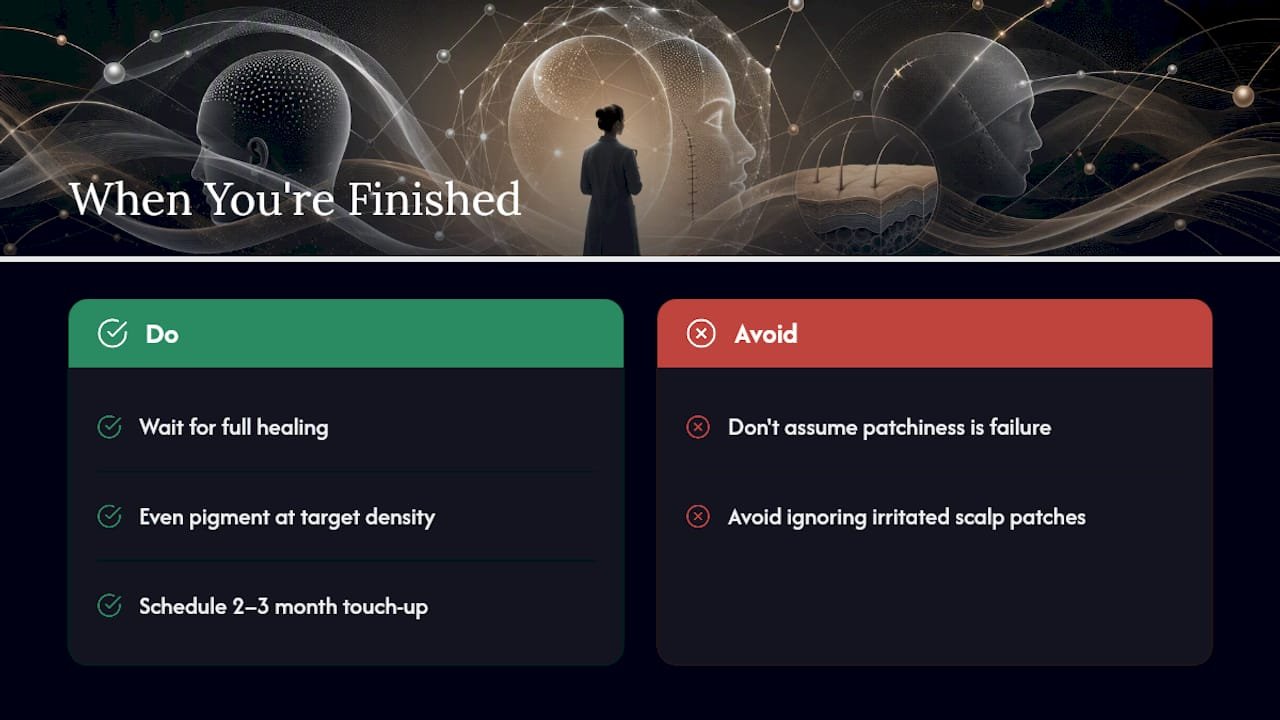
Settled pigment should look even across the treated area, with density matching your goal and no faded gaps once full healing kicks in. If you’re still seeing patchy retention or irritated patches from an underlying scalp condition, that’s a sign more work is needed, not that something went wrong.
There’s a real difference between finishing your staged treatment and getting a touch-up. A touch-up 2 to 3 months out addresses minor unevenness missed in the original plan. A touch-up years later is simple maintenance, not a correction.
How Long Does SMP Last Before You Need a Touch-Up?
Well-placed SMP commonly lasts 3 to 10 years depending on pigment depth, placement, and sun exposure. That’s a wide range, and where you land on it depends on habits more than luck.
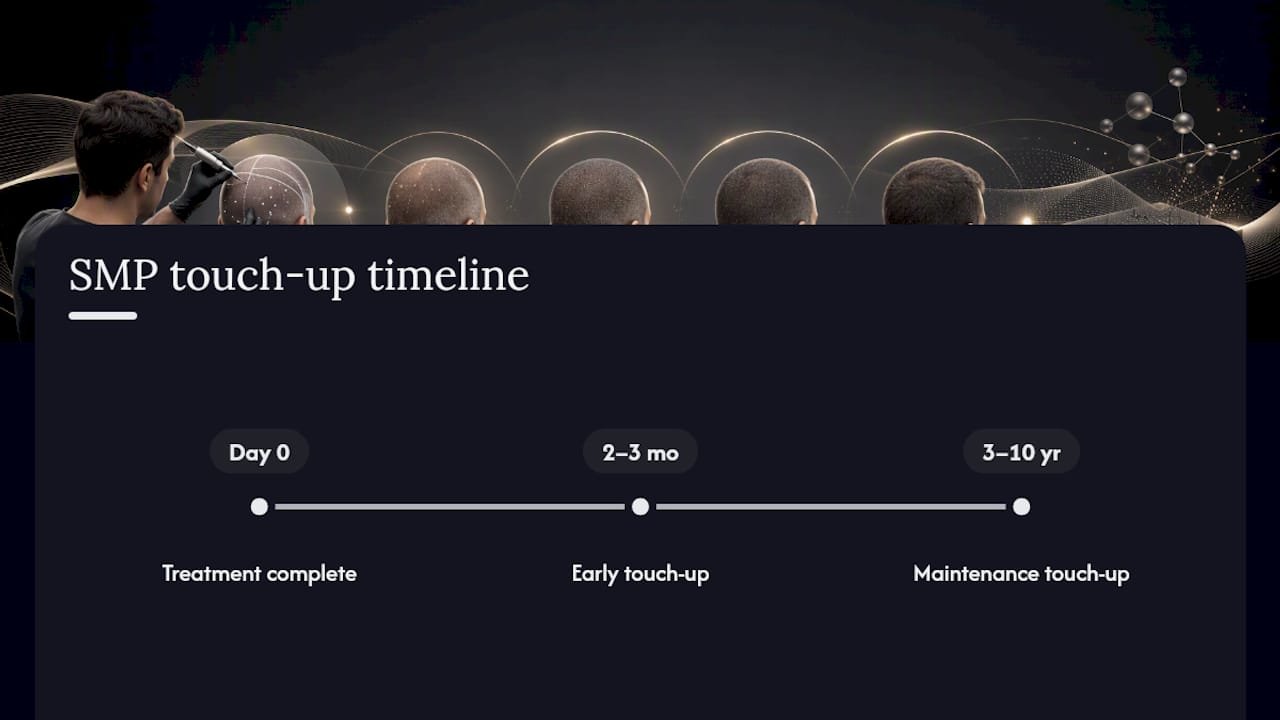
Unprotected sun exposure breaks down pigment faster than almost anything else, which is why practitioners consistently push SPF on the scalp. Shallow pigment placement fades quicker too, though it’s also easier to adjust later. A touch-up itself is usually a single, shorter session that refreshes tone and fills in any spots that faded unevenly rather than a full redo.
Can SMP Be Removed or Corrected If You’re Unhappy?
Laser removal is the standard method for clearing SMP pigment, but it comes with a real catch.
Selective removal of just one patch is generally discouraged. New SMP looks noticeably crisper and darker than aged pigment, so treating only part of a scalp usually leaves an obvious mismatch between the untouched area and the freshly cleared one.
That’s why ISHRS guidance points toward clearing the entire treated zone before reapplying pigment, rather than spot-fixing. In many cases, corrective SMP applied by a practitioner experienced in fixing prior work is the better route entirely. It can blend old pigment, adjust tone, and rebuild a natural hairline without the multiple laser sessions and downtime full removal requires.
How Enhanced Scalp Plans Your Session Count
Treatment plans are built around Norwood stage, skin type, scarring, and any prior transplant or SMP history before ever committing to a session number. That assessment happens at consultation, not mid-treatment. Ask to see healed-result photos, not just fresh work, since healed pigment is the only honest preview of your outcome.
A Note on Patience and Realistic Expectations
Staged sessions feel slow when you want results now, but rushing density in one sitting is how migration and gray undertones happen. Corrective cases especially reward patience: a properly sequenced plan, even one that takes an extra session, produces a result that actually holds up years later.
— James Christopher
Ready to Find Out How Many Sessions You’ll Need?
A consultation is the only way to get a real number instead of a guess pulled from an average. At your consultation, ask three things: what session count they estimate for your specific Norwood stage and goals, whether they can show healed (not fresh) photo documentation of similar cases, and what corrective experience they have if you’ve had prior transplants or SMP elsewhere. Practitioners should answer all three directly, building each plan around conservative hairline design and realistic density rather than a one-size-fits-all package.
If you’re ready to see where your scalp falls on the two-to-four session range, book a consultation through Enhanced Scalp’s treatment page and get a personalized plan instead of a rough estimate.
Sources
- Scalp Micropigmentation (SMP) — ISHRS
- Scalp Micropigmentation Sessions: How Many Do You Need? — Hair Doctor NYC
- Scalp micropigmentation — Healthline
FAQ
How Many SMP Sessions Do You Need?
Most people need 2 to 4 sessions, with three being the clinical standard. Larger areas, heavy scarring, or corrective work over prior SMP can push that total to four.
Can I Sweat Five Days After SMP?
Heavy sweating and intense workouts are generally restricted for several days after each session, since sweat can push pigment out before it fully settles.
Can SMP Be Removed If You Don’t Like It?
Laser removal can clear SMP pigment, but it’s typically done across the whole treated area rather than in small patches, since partial removal creates a visible mismatch between new and old skin tone.
What Are the Disadvantages of SMP?
The main drawbacks are the multi-session timeline, temporary redness and flaking after each visit, and the fact that full correction of unwanted results usually requires clearing the entire area rather than a quick spot fix.
How Often Do You Need SMP Touch-Ups?
Well-placed SMP typically lasts 3 to 10 years before a touch-up is needed, depending on pigment depth, sun exposure, and skin type.

