 Skip to content

Scalp micropigmentation is semi-permanent by design, and it does fade. Most clients plan their first meaningful refresh somewhere around year four to six, though consistent sunscreen use and gentle aftercare can push that window later. Pigment never vanishes entirely either. Even a decade out, most people retain a faint but visible base tone underneath.
TL;DR:
- SMP fading is influenced by individual biology and environmental factors like UV exposure, chlorine, and friction, which can accelerate pigment breakdown.
- The initial healing phase lasts four to six weeks, during which healing artifacts can mimic fading but do not indicate permanent pigment loss.
- Regular use of SPF 30 or higher and gentle scalp care can significantly slow long-term fading, especially beyond the first few years.
- Most clients notice significant softening or patchiness around the three- to four-year mark, with a common refresh window between five and six years.
- Long-term residual pigment usually remains after ten years, requiring light maintenance rather than full removal or total re-tattooing.
Table of Contents
- What Is the SMP Fading Timeline From Week One to Year Ten?
- Why Does SMP Fade Faster for Some People Than Others?
- How Do You Slow Down SMP Fading With Daily Aftercare?
- When Do You Actually Need an SMP Touch-Up?
- What Happens During an SMP Touch-Up Appointment?
- How Enhanced Scalp Plans for SMP Longevity From Day One
- Stop Treating Fading Like a Problem
- Ready to Plan Your SMP With Longevity in Mind?
- Where This Information Comes From
- Sources
- FAQ
What Is the SMP Fading Timeline From Week One to Year Ten?
SMP fading doesn’t move in a straight line. It happens in distinct phases, and knowing which phase you’re in prevents a lot of unnecessary panic.
Weeks 1 to 4 bring the most confusing part of the whole process: the phantom fade. Around days five to fourteen, the scalp is still healing, and pigment sits deeper in a way that makes it look lighter than it will end up. This is a healing artifact, not real pigment loss, and it’s a well-documented stage in the recovery process. Final color typically settles by week four to six, which is also when clinics schedule a perfecting touch-up to fill in anything that healed unevenly.
Months 3 through 12, and generally into year two, results stay stable. If aftercare has been reasonable, you shouldn’t notice much change at all during this stretch.
Years 3 to 4 is when most people start to see real softening, usually starting at the crown or hairline edges where sun exposure is heaviest. This is the point to start monitoring rather than reacting.
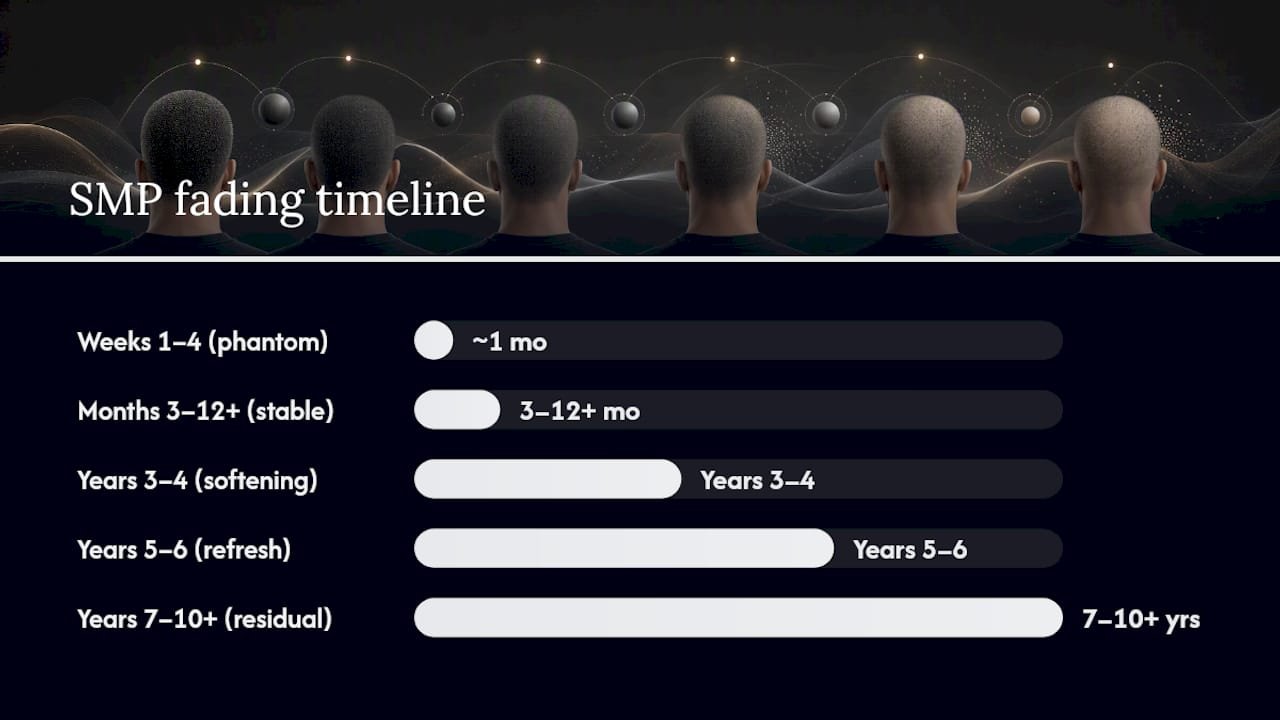
Years 5 to 6 is the consensus refresh window cited across most clinical summaries. Some clients need only a targeted touch-up on a few soft patches; others opt for a fuller refresh.
Years 7 to 10 and beyond, expect residual pigment rather than a full disappearance. A staged timeline framework commonly used by clinics puts long-term residual color at the ten-to-fifteen-year mark for many clients, with periodic maintenance extending it further.
- Weeks 1 to 4: phantom fade, then settling into true color
- Months 3 to 12+: stable plateau, minimal visible change
- Years 3 to 4: gradual softening begins
- Years 5 to 6: typical refresh or touch-up window
- Years 7 to 10+: residual pigment, ongoing light maintenance
Why Does SMP Fade Faster for Some People Than Others?
Two people can get identical treatments and end up on completely different timelines. The reason comes down to biology as much as behavior.
Pigment particles sit in the upper dermis, and the body treats them the way it treats any foreign material: slowly and steadily. Immune cells called macrophages gradually engulf pigment particles over years in a process called phagocytosis, while normal skin cell turnover in the epidermis nudges tiny amounts of pigment toward the surface and away over time. Neither process moves fast, but they never fully stop either.
Environment speeds things up considerably. UV exposure breaks down pigment molecules through photodegradation, and it’s often the single biggest accelerant. Chlorine, frequent sauna use, harsh exfoliation, and friction from tight hats all add wear. Scar tissue fades notably faster than healthy scalp skin because fibrotic tissue holds pigment less consistently, which is why clinics often plan denser initial work or extra sessions over scarred areas.
Statistic Callout: Clinical observations and small cohort data point to measurable, if modest, density drops within just months of treatment, which is exactly why early aftercare habits matter so much.
Skin type plays a role too. Oilier skin and certain scalp conditions can change how pigment settles and how it ages. Technique matters just as much as biology. The dilution ratio, needle depth, and pigment brand a technician uses all affect how gracefully results age.
- Biological turnover: macrophage activity and epidermal cell cycling
- Environmental wear: UV, chlorine, sauna heat, friction
- Individual factors: skin type, oiliness, scar tissue
- Technical factors: pigment quality, dilution, depth of implantation
How Do You Slow Down SMP Fading With Daily Aftercare?
The first six weeks matter more for long-term results than almost anything you do afterward, but daily habits for years after are what actually stretch your timeline.
- Avoid swimming, saunas, and heavy sweating for the first four to six weeks while the scalp fully heals.
- Skip harsh topicals, including strong retinoids and anything abrasive, until your technician clears you.
- Once healed, apply SPF 30 or higher to the treated scalp daily, reapplying every couple of hours during extended sun exposure. Practitioner guidance consistently points to daily sunscreen as the single biggest lever for slowing UV-related fading.
- Keep scalp cleansing gentle. Skip abrasive scrubs and anything marketed as a deep exfoliant.
- Talk to your original clinic before any laser procedure near treated skin, even for unrelated reasons.
Pro Tip: Keep a cheap wide-brim hat by your door for errands. It’s a small habit, but shielding treated skin from midday sun consistently is one of the cheapest ways to add real years to your results.
When Do You Actually Need an SMP Touch-Up?
Not every bit of fading needs a full session. Look for these signs before booking anything:
- Dots that once looked crisp and defined now read as soft or blurry up close
- Patchiness, where some zones look noticeably lighter than others
- Reduced contrast between the pigmented area and your natural skin tone, especially in bright light
Early on, a small targeted touch-up on just the fading spots usually solves the problem. A full refresh tends to make more sense once softening is widespread, which typically lines up with that four-to-six-year window. On cost, touch-ups generally run 25 to 40 percent of the original treatment price and take a fraction of the time.
What Happens During an SMP Touch-Up Appointment?
A touch-up is a much shorter appointment than your original treatment, often wrapped up in one session instead of the two or three the initial work required.
- Sessions typically run shorter because the technician is refreshing existing work, not building density from scratch
- Sensation is usually milder, and aftercare afterward is lighter than the original round
- Technicians adjust tone and density specifically where fading shows, rather than reworking the whole treated area
- Expect a short healing window afterward, with your next refresh timeline reset from that appointment
How Enhanced Scalp Plans for SMP Longevity From Day One
Longevity starts with decisions made before the needle ever touches skin. Conservative hairline design and careful pigment selection matter enormously here, because an aggressively dark or overly sharp initial result looks far worse ten years in than a naturally styled one that fades gracefully. Density is built gradually across sessions, the phantom fade is anticipated so clients aren’t alarmed by early healing color, and a perfecting touch-up is scheduled around the four-to-six-week mark as standard protocol.
Clients also get direct guidance on SPF habits, product avoidance, and a realistic maintenance calendar, which reflects an approach shaped by male pattern baldness cases and corrective work on prior poor SMP alike.
Fading isn’t a flaw in scalp micropigmentation. It’s the expected behavior of a treatment designed to age naturally rather than sit frozen and artificial for decades.
Stop Treating Fading Like a Problem
Fading isn’t failure. It’s maintenance, the same as recoloring your hair or resealing a driveway. Budget for a touch-up every few years instead of being surprised by one, and before assuming you need corrective work, get an actual consultation. Guesswork here rarely ends well.
— James Christopher
Ready to Plan Your SMP With Longevity in Mind?
Most clinics treat the initial appointment as the whole job. Enhanced Scalp treats it as the first stage of a multi-year plan, which is the real difference between SMP that looks good for six months and SMP that still looks natural at year six.
Conservative hairline design, careful pigment selection, and experience with corrective cases (failed transplants, prior poor SMP, laser removal) all feed into how well your results hold up years down the road. That planning starts with a real conversation about your scalp, your skin, and your goals, not a generic package. If you’re ready to build a personalized scalp micropigmentation plan that accounts for fading before it happens, book a consultation and walk through your options, including density work, hairline design, and touch-up scheduling, with someone who treats longevity as part of the job, not an afterthought.
Where This Information Comes From

This guide draws on clinical summaries from Shapiro Medical, HairDoctorNYC, and a Healthline overview.
Sources
- Scalp micropigmentation results: how long do they last? — Shapiro Medical
- Scalp micropigmentation: cost, fading, and the safety gap nobody discloses — AestheticMedGuide
- Scalp micropigmentation — Healthline
FAQ
How do I keep SMP from fading too fast?
Daily SPF 30 or higher on the treated scalp is the biggest lever, alongside avoiding harsh scrubs, strong retinoids, and excessive chlorine or sauna exposure.
Can I sweat five days after SMP?
Heavy sweating is discouraged for the first four to six weeks after treatment, since moisture and friction during early healing can affect how pigment settles.
How does SMP look after ten years?
Most clients retain residual pigment at the ten-year mark rather than a full disappearance, though color is typically softer and may need a light refresh depending on maintenance habits.
What happens to SMP after five years?
Five years often falls right in the common refresh window, where many clients notice enough softening to schedule either a targeted touch-up or a fuller session.
Is a full SMP refresh always necessary at the five-year mark?
Not always. Many clients only need a targeted touch-up on specific soft spots rather than reworking the entire treated area, and a clinic can assess which approach fits your actual fading pattern.

