 Skip to content

Yes, SMP can look natural on red and ginger hair when the practitioner replicates follicle shadow instead of matching hair shaft color. The controls that matter most are neutral, desaturated pigment selection, staged density built across two to four sessions, and a soft, irregular hairline. Expect a healing curve, some fading over time, and touch-ups every few years to keep the result looking sharp.
TL;DR:
- Using neutral, desaturated pigment tones and staged density builds across multiple sessions ensures a natural appearance on red and ginger hair.
- Applying a test spot before full coverage is essential to predict how pigment heals on each individual skin tone, especially for fair and pink-toned skin.
- Most clients require three to four sessions with irregular, broken hairline design to avoid a fake or solid appearance and create a realistic, feathered hairline.
- SMP results on redheads tend to fade gradually over several years, with sun exposure and improper pigment depth accelerating the fading process.
- Avoid rushing treatments or selecting warm, orange-leaning pigments to prevent unnatural results, and prioritize staged planning and healed result review.
Table of Contents
- SMP for Red Hair: Matching Follicle Shadow, Not Shaft Color
- Choosing and Mixing SMP Pigment for Redheads
- How SMP Sessions and Hairline Design Work for Red-Haired Clients
- What to Expect During Healing and How Long SMP Lasts
- Avoiding SMP Mistakes: What to Ask Before You Book
- Enhanced Scalp’s Approach to Red and Ginger Hair
- Why Redheads Need to Watch for Scalp Sensitivity
- Preparing Your Hair and Scalp Before SMP
- Does Red Hair Affect How Long SMP Results Last?
- Why Conservative Pigment Choices Beat Perfect Color Matching
- Booking a Consultation for SMP Suited to Red or Ginger Hair
- Sources
- FAQ
SMP for Red Hair: Matching Follicle Shadow, Not Shaft Color
Scalp micropigmentation never tries to recreate the color of a full head of red or auburn hair. It replicates the tiny shadow a shaved follicle casts on the scalp, which is a much darker, cooler visual than any strand of ginger or copper hair. That distinction drives almost every decision a skilled artist makes on a red-haired client.
Skin undertone plays a bigger role than most clients expect. Fair, pink-toned skin common among redheads reflects light differently than olive or deeper skin tones, which changes how a pigment reads once it heals. A tone that looks perfectly matched wet and fresh can shift warmer or cooler over the following weeks as the skin settles.
That’s why practitioners who specialize in scalp micropigmentation for red hair generally steer away from orange or copper-leaning pigments entirely. Warm tones tend to heal with a cast that reads as artificial rather than as a shadow of stubble.
A few practical patterns show up again and again in consultations:
- Strawberry blond clients usually need the lightest, most diluted neutral tones, since their natural coloring already reads soft.
- Auburn and deep copper clients can handle slightly more depth of pigment, but never a shift toward orange.
- Clients with freckled, pink-toned skin often need extra dilution testing before the artist commits to a base tone.
Muted grey-brown neutrals are the closest visual match to an actual follicle shadow on almost any skin tone, red hair included.
Choosing and Mixing SMP Pigment for Redheads
Pigment selection for red or ginger hair comes down to one working rule: desaturate first, then adjust. Practitioners lean on muted brown-gray families and actively avoid anything with a red, orange, or copper base, since those tones amplify rather than disguise the client’s natural warmth. Background practitioner guidance on this point is consistent across the industry: chasing the actual hair color almost always backfires, and the safer path is a neutral tone that mimics shadow instead.
Dilution is where the real skill shows up. A conservative artist starts lighter than they think they need to, documents the exact ratio used, and builds density gradually across sessions rather than trying to nail the final shade on day one. This matters more for red-haired clients than almost any other group, because warm undertones in the skin can pull a pigment’s appearance in unpredictable directions as it heals.
Before committing to full coverage, a test spot is non-negotiable. A small patch placed and healed over several weeks tells the artist and the client exactly how that specific pigment batch will behave on that specific skin tone, well before it’s applied across the whole scalp.
Needle depth interacts with tone too. Deposits placed too deep tend to spread and look grayer over time, while ideal placement in the papillary dermis, as outlined in standardized SMP protocol research, keeps pigment crisp and predictable.
- Select a muted brown-gray pigment family and rule out anything warm.
- Dilute more than feels necessary for the first pass.
- Apply a test spot and wait for it to fully heal.
- Evaluate the healed result in natural light before adding density.
- Document the exact dilution ratio for consistency across future sessions.
Pro Tip: Ask your artist to show you their diluted pigment on a test strip of paper before they touch your scalp. If it looks anything but a neutral gray-brown, that’s your cue to pause and ask questions.
How SMP Sessions and Hairline Design Work for Red-Haired Clients
Most clients need three to four sessions spaced a few weeks apart, giving the scalp time to heal between visits, according to Cleveland Clinic’s overview of the procedure. Each session typically runs two to four hours depending on how much coverage is planned. That staging isn’t just about comfort. It lets the artist see how pigment actually settles on that individual’s skin before adding more.
A typical protocol breaks down into three phases:
- Foundation session: light, conservative dots establish the base tone and overall pattern across the treatment area.
- Build session: density increases based on how the foundation healed, filling gaps and deepening the shadow effect where needed.
- Refinement session: final adjustments correct any unevenness and fine-tune the hairline.
Density decisions depend heavily on the goal. Clients thinning but not shaving keep density lower to blend with existing hair, while a full buzz-cut look calls for more uniform coverage. An experienced artist will often recommend a shorter, buzzed style for redheads specifically, since it reduces the contrast between remaining hair and the pigmented scalp.
Hairline design deserves special attention on fair or red-toned skin. A single solid band of pigment reads as fake almost immediately, so standardized SMP technique guidance recommends single-prong needle work with irregular spacing and small micro-breaks along the edge. That soft, broken line is what makes a hairline look like it grew that way rather than got drawn on.
What to Expect During Healing and How Long SMP Lasts
The first week after a session looks rougher than the final result. Expect light crusting and redness for a few days, with most clinics recommending you avoid washing the scalp for at least four days to let pigment settle. The scalp typically needs four to eight weeks before the color fully reveals itself, since initial inflammation and surface healing mask the true tone underneath.
SMP is semi-permanent, not permanent. Pigment particles sit in the upper dermis and gradually fade as skin cells turn over, with sun exposure and depth of application both accelerating the process, per Cleveland Clinic’s guidance on SMP outcomes. Clinical case series tracking staged three-session protocols found strong overall satisfaction, though scarred tissue tends to fade faster and less predictably than healthy scalp, based on technical analysis published in a recent case series.
Most clients get several years of solid color before a touch-up becomes necessary. A few habits stretch that timeline:
- Apply sunscreen or wear a hat during extended sun exposure, since UV light breaks down pigment faster than almost anything else.
- Skip harsh exfoliating scrubs directly on treated areas.
- Watch for uneven patches or a shift toward a warmer tone, both signs it’s time to book a follow-up.
Clinics that publish fading timeline guidance tend to set touch-up expectations honestly rather than promising results that never fade.
Avoiding SMP Mistakes: What to Ask Before You Book
Most bad SMP outcomes trace back to the same handful of technical errors. Incorrect needle depth causes blurring as pigment migrates into deeper skin layers. The wrong pigment family produces a reddish or orange cast that never looks like natural shadow. Rushing density in a single session, before checking how earlier work healed, leads to patchy, uneven coverage that’s hard to correct later.
Certain scalp conditions raise the stakes further. Clients with a history of keloid scarring, significant scar tissue from a prior transplant, or generally reactive, easily irritated skin should get a medical opinion before booking, since these factors affect how pigment settles and heals.
A consultation should raise red flags fast if something feels off. Watch for:
- No healed photo gallery, only fresh, unhealed work.
- No staged, multi-session plan, just a promise to “finish it all in one visit.”
- No mention of a test spot before full treatment begins.
- Pressure to book immediately without time to review healed results.
- Vague or nonexistent answers about touch-up policy and pricing.
A qualified practitioner will happily walk through healed photos, explain their staged-session approach, and describe exactly how they handle test spots for warm or fair skin tones.
Enhanced Scalp’s Approach to Red and Ginger Hair
Enhanced Scalp builds every treatment plan around conservative hairline design, realistic follicle replication, and pigment selection customized to the individual, an approach that lines up directly with what redheads need most. The clinic also handles corrective work, including cases where a prior SMP session left a warm or orange cast, failed hair transplants, and difficult scarred scalp tissue.
Test spots and staged sessions aren’t an afterthought here. They’re built into how the clinic approaches red and fair-toned clients from the first consultation, which typically covers a scalp assessment, a discussion of pigment options, and a realistic session timeline. Enhanced Scalp also documents healed results rather than showing only fresh work, which matters enormously when you’re trying to judge how a pigment will actually look on your skin months down the line.
If you’re evaluating any clinic for red or ginger hair, ask to see their healed results gallery before committing to anything.
Why Redheads Need to Watch for Scalp Sensitivity
Fair, red-toned skin tends to run more reactive than average, and that shows up during SMP in a few predictable ways. Redness that lingers a little longer after each session is common, partly because fair skin shows inflammation more visibly than darker skin tones, even when the underlying healing process is completely normal.
Sensitivity to the needle itself can also run higher. Some clients with red hair report a slightly stronger sensation during treatment, which is one more reason a staged, multi-session approach beats trying to cram everything into a single long sitting. Spreading the work out gives the scalp recovery time between passes and lets a practitioner watch for any unusual reaction before going further.
Redness that persists well past the normal healing window, spreads beyond the treated area, or comes with swelling deserves a call to the clinic rather than a wait-and-see approach. Most post-procedure redness settles within days, and anything that doesn’t follow that pattern is worth flagging early rather than assuming it will resolve on its own.
Clients with a documented history of eczema, psoriasis, or other reactive skin conditions should mention that upfront during consultation. It doesn’t rule out SMP, but it does shape how conservatively the practitioner should approach pigment testing and session pacing.
Preparing Your Hair and Scalp Before SMP
A little preparation in the weeks before your first session makes the entire process smoother. Keep the scalp free of harsh chemical treatments, including hair dye, bleach, or strong exfoliating treatments, for at least two weeks before your appointment. Freshly irritated or chemically treated skin doesn’t take pigment as predictably, which matters even more for clients whose skin already runs sensitive.
Sun exposure deserves attention too. A sunburned or heavily tanned scalp changes how pigment appears once healed, so protecting the area in the days leading up to treatment helps the artist choose an accurate tone. This is especially relevant for fair-skinned redheads, whose skin tone can shift more dramatically with sun exposure than average.
Avoid blood thinners, excessive alcohol, and caffeine in the 24 to 48 hours before your session, since all three can increase bleeding and bruising during the procedure. If you’re on prescription blood thinners, talk to your doctor before adjusting anything.
Come to your appointment with clean, product-free hair. Styling products, dry shampoo residue, or oils on the scalp can interfere with how the artist sees your natural skin tone, which is the single most important reference point for choosing the right pigment.
Does Red Hair Affect How Long SMP Results Last?
Red and ginger hair itself doesn’t shorten SMP’s lifespan, but the fair skin that often comes with it can influence how fading shows up. Lighter, more UV-sensitive skin tends to show pigment breakdown a bit more visibly than deeper skin tones, simply because there’s less natural pigment competing for attention.
The bigger factor is always technique, not hair color. Pigment deposited at the correct depth in the papillary dermis holds its tone far more reliably than pigment placed too deep, regardless of whether the client is a redhead, brunette, or completely gray. Research on SMP standardization backs this up: depth and technique drive retention outcomes more than any single client characteristic.
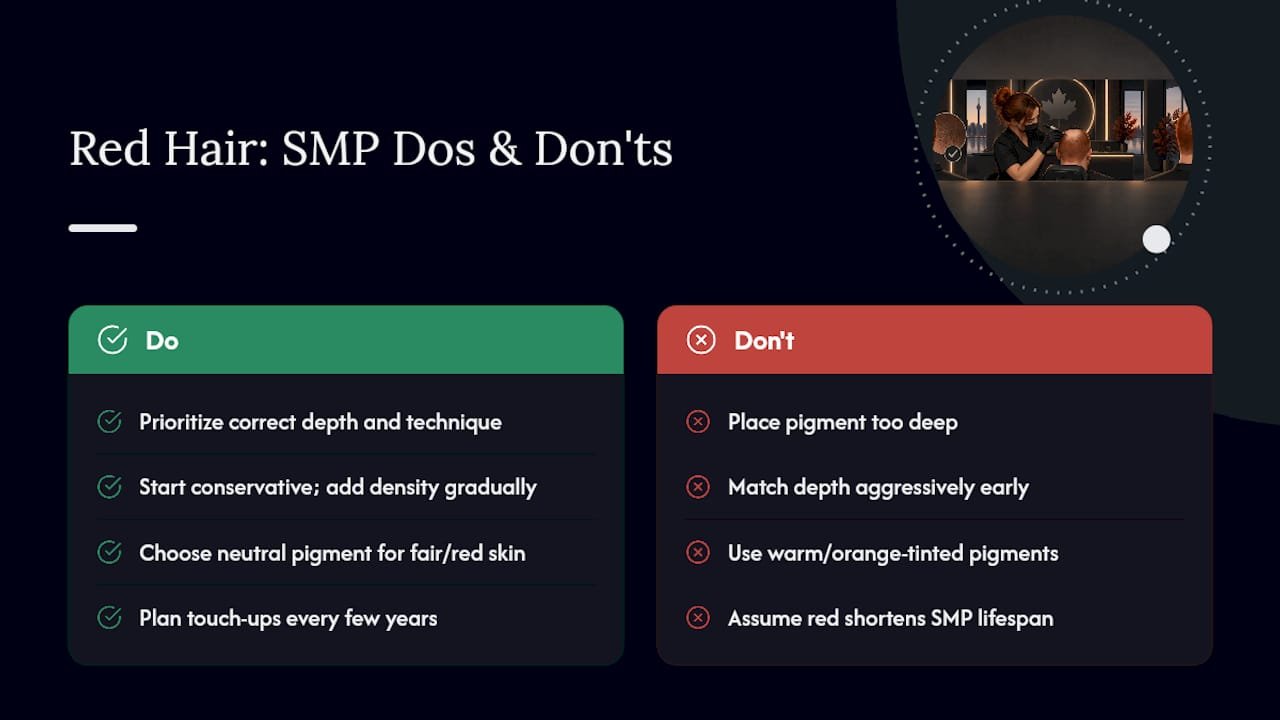
Where red hair does matter is in how mistakes become visible. A warm or orange-tinted pigment mistake fades unevenly and often gets more noticeable, not less, as it ages, since the surrounding skin’s fair undertone makes any warm cast stand out. That’s a strong argument for starting conservative and adding density gradually rather than trying to match depth aggressively in early sessions.
Most clients, regardless of hair color, land in the same general maintenance window: solid results for a few years before a touch-up session becomes worthwhile. What changes for redheads is less about timing and more about precision. Getting the initial pigment choice right the first time avoids a fading pattern that draws attention instead of blending in.
Why Conservative Pigment Choices Beat Perfect Color Matching
The biggest misconception about SMP for red hair is that success means finding a pigment that matches the hair color. It doesn’t. The clients who end up happiest are the ones whose artist deliberately ignored their actual hair shade and focused entirely on replicating shadow. Conventional thinking pushes toward “matching,” when the smarter goal is always “blending.”
Where most consultations fall short is skipping the test spot stage or treating it as optional paperwork rather than a real diagnostic step. Fair, red-toned skin behaves unpredictably enough that skipping this step is genuinely risky, not just cautious overkill. Any practitioner who wants to move straight to full coverage without a healed test spot is optimizing for their schedule, not your results.
If you take one thing from this article, prioritize staging over speed. Ask hard questions about dilution ratios, request to see healed galleries specific to red or fair-skinned clients, and resist any pressure to finish everything in one sitting. The clients who get burned are almost always the ones who let urgency override caution.
— James Christopher
Booking a Consultation for SMP Suited to Red or Ginger Hair
Enhanced Scalp is the option for readers who want a clinic that treats red and ginger hair as its own category, not an afterthought to standard pigment charts. A consultation covers a full scalp assessment, a conversation about pigment strategy suited to your skin tone, a test spot when appropriate, and a realistic staged session plan.
Before booking anywhere, ask to see healed photos specific to fair or red-haired clients, not just fresh work, and get a clear answer on touch-up policy before you commit to a plan. Enhanced Scalp’s full Scalp Micropigmentation service starts at $3,000 to $4,000 CAD for a complete treatment, and the team walks new clients through pigment testing and staged planning from the very first visit. If you’re ready to see what a conservative, follicle-shadow approach looks like on your own scalp, book a consultation and bring your questions about dilution, depth, and healed results.
Sources
- Scalp micropigmentation: Before & after, benefits, side effects | Cleveland Clinic
- Standardization of SMP procedure and its impact on outcome | PMC
FAQ
Does SMP Make Hair Look Thicker?
Yes, SMP creates the visual density of a closely buzzed scalp by replicating thousands of tiny follicle shadows across thinning or bald areas. It’s especially effective at blending with existing hair rather than adding actual hair volume.
How Much Does SMP Cost for Red or Ginger Hair?
Pricing depends on the clinic and treatment scope rather than hair color specifically. Enhanced Scalp’s full Scalp Micropigmentation treatment runs $3,000 to $4,000 CAD, covering the full staged session plan.
Does SMP Eventually Fade Away?
Yes, SMP is semi-permanent and fades gradually as skin cells turn over and pigment breaks down from UV exposure, according to Cleveland Clinic. Most clients need a touch-up every few years to maintain the original depth of tone.
How Does SMP Look After 10 Years?
Results after a decade typically show softer, lighter pigment than the original session, with the exact rate of fading depending on skin type, sun exposure, and how deep the pigment was originally placed. Clients who get periodic touch-ups every few years maintain a consistent look far longer than those who never revisit the clinic.
Can You Dye SMP Red to Match Your Hair Color?
No, pigment used in SMP is designed to replicate follicle shadow, not blend with dyed or natural hair color, and it can’t be “re-dyed” the way hair can. Reputable practitioners intentionally avoid warm or red-toned pigments because they heal unnaturally rather than matching real hair shade.

