 Skip to content

Scalp micropigmentation can create a natural-looking afro hairline for most candidates, but only when the technician adjusts needle choice, dot pattern, and pigment for textured hair and darker skin. It is a cosmetic tattoo effect, not a treatment that regrows hair, and it fades over time. Anyone considering it should book a consultation that includes a test spot, especially if scarring or traction alopecia is involved.
TL;DR:
- Proper needle selection, dot pattern, and pigment blending are essential to create a natural afro hairline and avoid an artificial appearance.
- Candidates with stable traction alopecia or scars that have healed are better suited, while active inflammation or keloid tendency warrant delays or avoidance.
- Test spots on scar tissue and healed photos are crucial for assessing pigment uptake and final results on textured scalps.
- Results typically last three to five years, with fading more noticeable on scarred or fibrotic skin, requiring scheduled touch-ups.
- Safety precautions include avoiding sun exposure, monitoring for signs of infection, and following personalized aftercare instructions from experienced practitioners.
Table of Contents
- Who is a good candidate for afro hairline SMP
- How SMP technique changes for afro-textured hairlines
- What the procedure and healing timeline actually look like
- How long results last and when touch-ups make sense
- Safety, side effects, and aftercare for textured scalps
- Choosing a practitioner who understands afro hairlines
- What practitioners wish clients understood about afro SMP
- How Enhanced Scalp approaches afro hairline SMP
- Sources
- FAQ
Who is a good candidate for afro hairline SMP
SMP tends to work best for people with stable hair loss patterns rather than hair loss that is still actively progressing. Traction alopecia, common along afro-textured hairlines from tight styling, is a frequent reason people seek SMP once the underlying inflammation has settled. Transplant scars and patchy density along the hairline are also common reasons clients pursue it, since pigment can camouflage the scar tissue and blend it into the surrounding scalp.
Certain conditions call for caution or a delayed start. Active scalp inflammation, uncontrolled dermatologic disease, a strong keloid history, pregnancy, and immunocompromised states are all reasons a responsible technician will pause or decline treatment.
- Traction alopecia that has stopped progressing is often a strong candidate profile.
- Transplant scarring or thinning along the hairline can usually be camouflaged once healed.
- Active inflammation, keloid tendency, or uncontrolled skin conditions are reasons to wait or avoid treatment.
Afro-textured scalps sometimes need a closer look before treatment begins. Skin tone, scar behavior, and how the scalp responds to needle penetration all affect pigment uptake, which is why a proper assessment (and a test spot on scarred areas) matters more here than it does for a straightforward, unscarred scalp.
How SMP technique changes for afro-textured hairlines
The core adjustment for afro hair is needle choice and placement. A single-prong needle is generally preferred for the hairline itself, since it lays down finer dots that mimic individual follicles more convincingly than a multi-prong tool, which is better suited to filling density behind the hairline. According to a procedural standardization review, randomized dot placement produces a far more natural look than any grid or line pattern, which the eye reads as artificial almost instantly.
- Dots are placed at varying sizes and irregular spacing to replicate how real follicular openings appear.
- Pigment is custom-blended to match melanin levels rather than applied as a flat black, since black-only ink can shift color over months.
- Needle depth and rotor speed are adjusted for tissue resistance, since scarred or fibrotic skin behaves differently than healthy scalp.
The same review notes that ideal pigment deposition sits in the papillary dermis: too shallow and it washes out within weeks, too deep and it blurs or spreads over time.
Pro Tip: Ask your technician whether they adjust needle depth for scar tissue versus healthy scalp; a flat answer of “no difference” is a warning sign.
What the procedure and healing timeline actually look like
Most reputable practitioners start with a consultation and, when scarring or fibrotic tissue is present, a small test spot to check how the skin takes pigment before committing to a full session. This step matters more for afro hairlines with prior scarring than for a clean, unscarred scalp.
- Session one typically focuses on outlining the hairline and establishing a light base layer of pigment.
- Later sessions build density and correct any unevenness the first layer revealed once it settled.
- Most plans involve multiple sessions spaced weeks apart, since pigment always looks darker immediately after application than it will once healed.
- The first 48 to 72 hours often bring light crusting, redness, and superficial pigment loss as the skin sheds; this is a normal part of healing.
Healed results are best judged around four weeks after the final session, once any temporary redness or unevenness has resolved. Touch-ups, when needed, are usually scheduled after that healed check, not immediately following a session. Readers curious about the session-by-session breakdown can review a fuller walkthrough of the SMP process from start to finish.
How long results last and when touch-ups make sense
SMP is a cosmetic procedure that simulates the appearance of hair follicles. It does not stimulate biological regrowth, according to the Cleveland Clinic, a distinction worth repeating since marketing images sometimes blur it.
Pigment retention is not uniform across skin types. A prospective study on SMP for scarring alopecia found favorable outcomes in about half of cases overall, with traction alopecia and frontal fibrosing alopecia responding better than densely fibrotic conditions like morphea, which showed poorer retention and more fading.
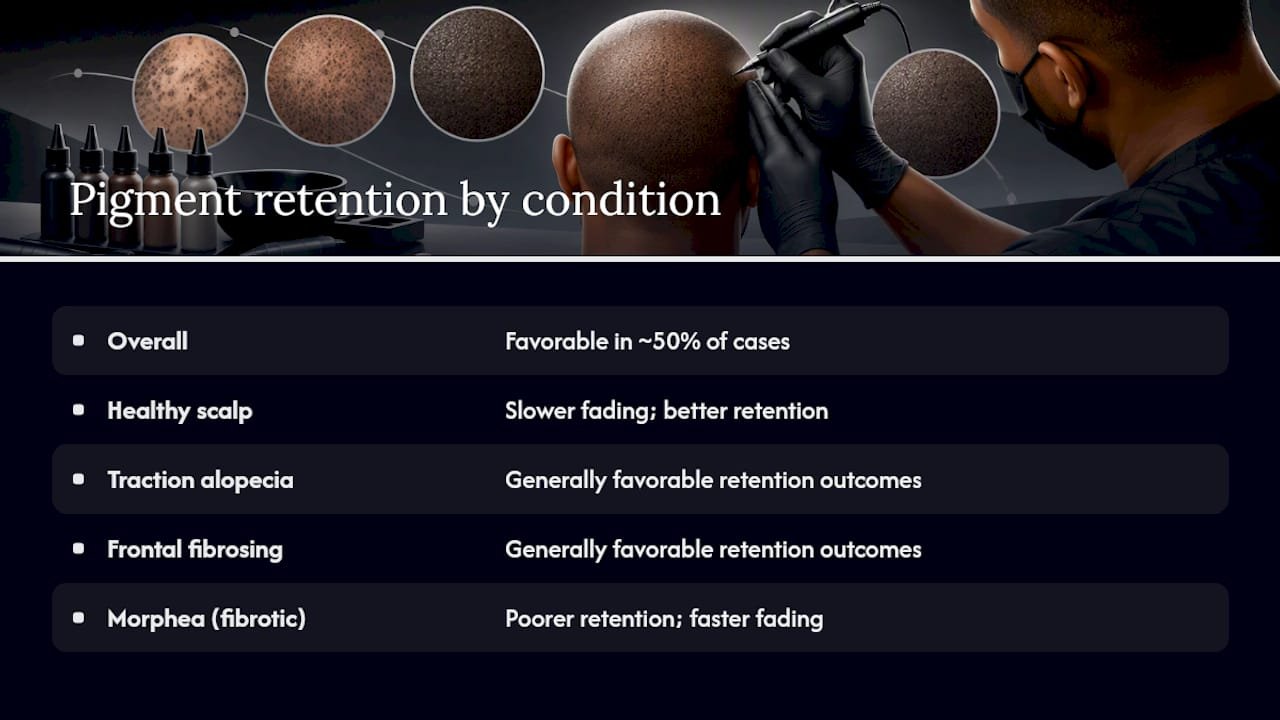
Fading shows up first as softened edges or lighter density rather than an abrupt change, and it tends to happen faster on scarred or heavily fibrotic patches than on healthy scalp. Some hairline styles are designed with a longer touch-up cycle in mind; one clinic example is a low hairline approach built for a three to five year touch-up cadence. Practitioners who tailor pigment blends rather than relying on pure black also tend to see less unwanted color shift as the tattoo ages.
Safety, side effects, and aftercare for textured scalps
Short-term side effects after SMP are common and usually temporary. Expect some crusting, mild bruising, and swelling in the days after a session, along with light pigment loss as the outer skin layer sheds.
- Avoid vigorous washing, sweating, or direct sun exposure on the treated area for the first week or two.
- Watch for early signs of infection, such as spreading redness, warmth, or discharge, and act quickly if they appear.
- Scarred or fibrotic skin can resist pigment differently than healthy scalp, which is one reason test patches are recommended before full sessions on those areas.
- Follow the aftercare schedule your technician gives you rather than a generic tattoo aftercare routine, since scalp skin heals differently than body skin.
Pro Tip: Keep the treated area away from direct sun for several weeks; UV exposure is one of the fastest ways to accelerate fading. Persistent redness beyond the normal healing window, pus, unexpected pigment color changes, or any sign of keloid formation are reasons to consult a medical professional rather than wait it out. General aftercare and pigment retention principles from the tattoo world, outlined by resources like Soul Kraft Ink, overlap with much of what SMP aftercare recommends.
Choosing a practitioner who understands afro hairlines
The single best filter is healed photography. Anyone can show a flattering in-session photo taken minutes after the needle stops; healed photos, taken weeks later once swelling and dark pigment settle, tell you what the result actually looks like on skin like yours.
- Ask to see healed, high-resolution photos of afro-textured clients, not just close-cropped or filtered images.
- Ask whether they do test spots on scar tissue and what needle types and pigment brands they use.
- Ask about their touch-up policy and how they price follow-up sessions.
- Look for documented corrective work, since a technician who can fix a bad hairline usually understands how to avoid creating one.
Red flags include straight or grid-like dot placement, a reluctance to show healed results, no offer of a test patch on scarred areas, and pricing that is not disclosed until after you have committed to a deposit. A technician who documents both successes and corrective cases is generally more trustworthy than one who shows only best-case galleries.
What practitioners wish clients understood about afro SMP
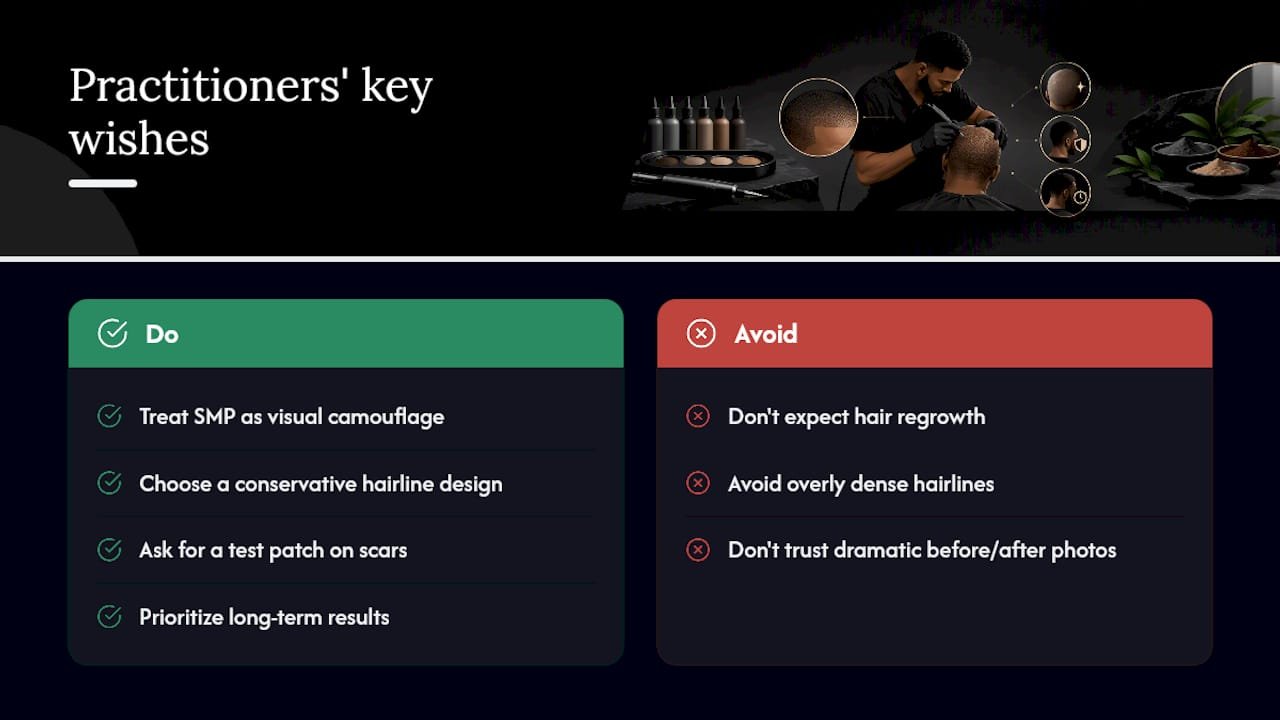
SMP is camouflage, not regeneration. Treat it the way you would a hairstyle or a haircut choice, something that changes how your scalp reads visually, not a medical fix for the biology of hair loss.
The most trustworthy signal in this field is restraint. Conservative hairline design and a willingness to run a test patch on a scar before committing to full treatment usually indicate a technician who cares more about your long-term result than a dramatic before-and-after photo. An overly dense, sharply defined hairline promise is often the first sign of an unrealistic outcome, not a skilled one.
— James Christopher
How Enhanced Scalp approaches afro hairline SMP
Enhanced Scalp builds its hairline work around conservative design and honest documentation rather than promising a dramatically lowered or overly dense line. The clinic’s focus on corrective SMP, fixing failed transplants and prior poor SMP work, means the technicians spend a lot of time studying what goes wrong on textured and scarred scalps, which shapes how they approach a fresh afro hairline case.
- Consultations include a review of your hairline history, scarring, and hair pattern before any pigment touches skin.
- A test spot is used on scarred or fibrotic areas to judge pigment uptake before a full session.
- Healed results are documented and shared, not just in-session photos.
If you are weighing your options, the scalp micropigmentation treatment page outlines the process and pricing details for the standard hairline treatment. Clients dealing specifically with transplant or injury scarring can also look at the scar camouflage treatment page for a more targeted starting point.
Sources
- Standardization of SMP procedure and its impact on outcome – PMC
- Efficacy, safety, and patient-reported outcomes of scalp micropigmentation in scarring alopecia – JCAS
FAQ
How long does a SMP hairline last?
Most SMP hairlines stay visually strong for a few years before touch-ups are needed, though timing varies by skin type and scar tissue. Some hairline designs are built with a three to five year touch-up cycle in mind, while heavily scarred or fibrotic areas tend to fade faster, according to research on scarring alopecia.
How much does a hairline SMP cost?
Pricing depends on the clinic and the scope of work involved. At Enhanced Scalp, the standard scalp micropigmentation treatment is priced at 3000-4000 CAD as a one-off cost, with scar-specific work quoted separately after a consultation.
Does SMP make hair look thicker?
Yes, SMP can make a shaved or thinning scalp look denser by adding the illusion of thousands of tiny follicles between existing hairs. It works by shading the scalp rather than adding real hair, so the density effect is entirely visual.
Does SMP promote hair growth?
No. SMP is a cosmetic procedure that simulates the look of hair follicles and does not stimulate biological regrowth, according to the Cleveland Clinic. Any perceived thickening comes from the pigment pattern, not new hair.

