 Skip to content

Most FUT strip scars can be substantially improved. The right approach depends on your scar subtype and scalp laxity: scalp micropigmentation (SMP) works across nearly all scar types, FUE grafting into the scar restores actual hair coverage, trichophytic re-excision physically narrows the scar line, and the punch-out technique offers a faster surgical option for widened scars. Adjuncts like fractional CO₂ laser, corticosteroid injections, and silicone sheeting handle hypertrophic or raised scars before any grafting or excision attempt.
Before booking anything, take these steps:
- Wait if your scar is under 12 months old. Most scars are not stable enough for revision before that point.
- Photograph the scar now. Use consistent lighting, multiple angles, and a hair length that exposes the scar clearly. These photos are your baseline and your most useful consultation tool.
- Book a specialist consult, not a general dermatologist visit. You want a hair restoration surgeon or a credentialed SMP practitioner who has treated FUT scars specifically.
- Bring your surgical records. The number of prior strip procedures, closure technique, and any complications all affect what revision is safe.
- Avoid aggressive self-treatment. Silicone gels are fine. Dermabrasion kits, at-home microneedling, and tanning the scar area are not.
Key Takeaways
Most FUT donor scars respond well to a matched repair plan: the scar subtype, scalp laxity, and hair length preference together determine whether SMP, FUE grafting, surgical excision, or a combination produces the best outcome.
| Point | Details |
|---|---|
| Wait for scar maturity | Most revision procedures require a stable, 12-month-old scar before grafting or excision is appropriate. |
| Match treatment to scar type | Hypertrophic scars need conservative flattening first; widened scars may suit excision or grafting; all types respond to SMP. |
| Precondition before grafting | Fractional CO₂ laser or PRP spaced 4–6 weeks apart improves vascularity and graft survival in scar tissue. |
| Consult checklist matters | Confirm scalp laxity assessment, donor reserve, staged plan, and healed before-and-after photos before committing to any procedure. |
| Enhancedscalp for SMP camouflage | Enhancedscalp offers corrective SMP for FUT scars with conservative pigment selection and transparent documentation of healed results. |
Table of Contents
- What does an FUT donor scar look like, and how does it heal?
- Who is a good candidate for repair, and when should you wait?
- Surgical revision and FUE grafting: how they work and what to expect
- What can minimally invasive options do for your scar?
- How does SMP work for FUT scar camouflage?
- How do you choose the right repair path?
- What does recovery actually look like after each treatment?
- Enhancedscalp’s SMP approach to FUT scar camouflage
- Sources
What does an FUT donor scar look like, and how does it heal?
The strip excision in FUT leaves a horizontal linear scar across the back of the scalp, typically running from ear to ear or across a portion of that span. What that scar looks like at 18 months depends on closure technique, scalp tension, genetics, and post-op care. Four subtypes show up consistently in clinical practice.
Fine-line scars heal narrow, flat, and close to skin tone. With enough surrounding hair density, they are nearly invisible at most hair lengths. Widened or stretched scars are the most common complaint. The strip closes under tension, and if scalp laxity is limited or the patient returns to strenuous activity too soon, the scar spreads. These can reach several millimeters wide and become visible at shorter hair lengths. Atrophic or depressed scars sit below the surrounding scalp surface, creating a groove that catches light differently. Hypertrophic scars are raised, firm, and sometimes itchy. They are less common in the scalp than on the trunk but do occur, particularly in patients with a personal or family history of aggressive scarring. A true keloid on the scalp is rare but requires a different management path entirely.
The healing timeline, stage by stage
Weeks 0–6: The scar is red, slightly raised, and actively healing. Sutures come out around 10–14 days. The scar may feel tight or itchy. Width and color at this stage tell you almost nothing about the final result.
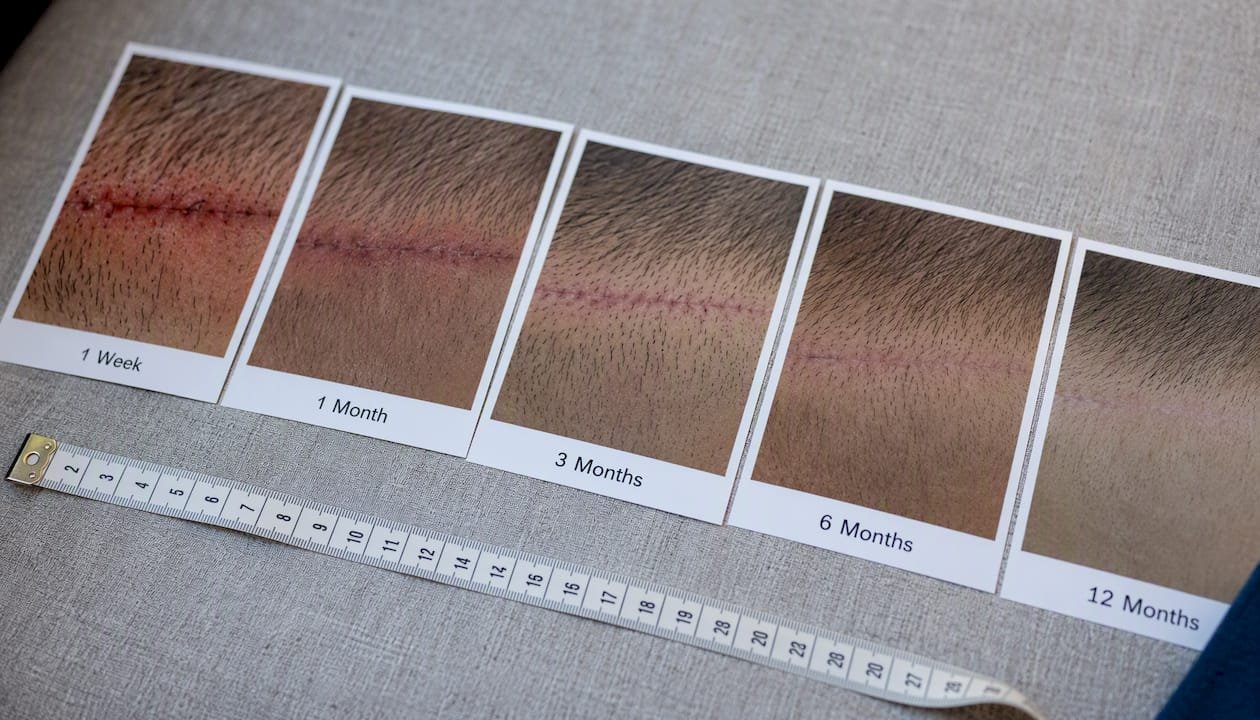
Months 3–6: Collagen remodeling begins. The scar typically softens, flattens, and starts to fade from red or pink toward a lighter tone. This is when widening, if it is going to happen, usually becomes apparent.
Months 12–18: The scar is considered mature. Color has stabilized, firmness has resolved in most cases, and width is unlikely to change further. This is the window when most revision procedures are appropriate.
A scar that is still pink, itchy, or changing width at 9 months is still maturing. A scar that has been stable in color and texture for at least 3 consecutive months is likely ready for assessment. The 4-subtype framework from clinical practice recommends the 12-month maturation rule before most grafting or excision, and that guideline holds across scar types.
Pro Tip: Photograph your scar every 4–6 weeks from the same angle, with the same hair length, and in natural daylight. A side-by-side series of 6 photos tells a specialist far more than a single image taken the day of the consult.
Who is a good candidate for repair, and when should you wait?
Candidacy for FUT scar repair is not a yes-or-no question. It is a combination of scar characteristics, timing, and what you are trying to achieve.
Factors that determine candidacy:
- Scar width: Scars under 2 mm wide are often better addressed with SMP alone. Wider scars may benefit from excision or grafting, but only if laxity permits.
- Scalp laxity: The single most important factor for surgical revision. Without adequate laxity, re-excision produces a scar that stretches wider than the original.
- Skin type and keloid tendency: Patients with a history of hypertrophic or keloid scarring elsewhere on the body need conservative management first. Intralesional corticosteroid injections are typically the starting point.
- Hair density around the scar: Thin surrounding density limits how well grafts can blend. It also affects how much donor supply remains for grafting into the scar.
- Hair texture: Tightly coiled hair can obscure a scar more effectively at shorter lengths. Straight, fine hair offers less natural coverage, making SMP or grafting more impactful.
Who should wait, who can consider early steps, and who needs specialist co-management
- Wait (scar under 12 months, still changing): No grafting, no excision, no laser. Silicone gel or sheeting is appropriate during this window for hypertrophic scars.
- Early conservative intervention (3–6 months, hypertrophic or raised): Intralesional corticosteroid injections can begin before the 12-month mark to flatten a raised scar and reduce the risk of permanent thickening.
- Ready for assessment (12+ months, stable color and texture): Full candidacy evaluation including scalp laxity testing, scar width measurement, and donor reserve assessment.
- Specialist co-management required: Ongoing pain, rapid scar widening after the 6-month mark, signs of infection (warmth, discharge, crusting), or confirmed keloid formation. These require a dermatologist or plastic surgeon alongside any hair restoration specialist.
Surgical revision and FUE grafting: how they work and what to expect
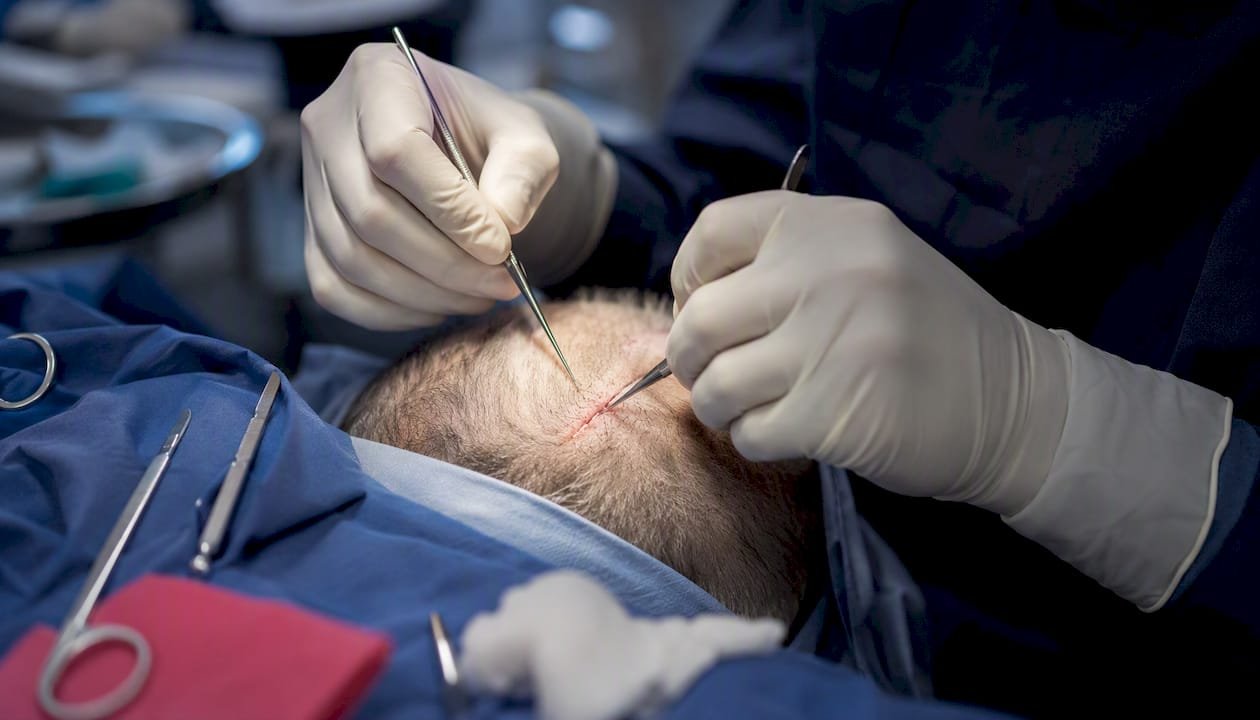
Surgical approaches to FUT scar repair fall into three categories: trichophytic re-excision, the punch-out technique, and FUE grafting directly into the scar. Each targets a different problem.
Trichophytic re-excision
The surgeon removes the existing scar and closes the wound using a trichophytic technique, beveling one wound edge so hair follicles grow through the scar line rather than stopping at it. Done well, this makes the scar line nearly invisible because hair physically emerges from within it. The catch: it requires meaningful scalp laxity. Attempting re-excision without adequate laxity produces a scar that stretches wider than the one you started with. Patients who have already had one or two strip procedures often have limited remaining laxity, which disqualifies them from this approach.
The punch-out technique
This method uses alternating 0.8–1.0 mm serrated punches along the scar width, then closes the resulting wounds with a continuous suture to mechanically reduce scar width. A case series of 58 patients reported improved scar appearance with short operative time and low postoperative discomfort. Average surgical time for the described method runs approximately 15 minutes, and the technique does not consume additional follicular units from the donor area, making it a practical option for widened scars where donor supply is already limited.
Pros and cons of surgical revision:
- Trichophytic re-excision offers the most dramatic width reduction but requires laxity and carries re-widening risk.
- The punch-out technique is faster, lower-risk, and preserves donor supply, but improvement is more modest.
- Both require suture removal at 10–14 days and a recovery period of 2–4 weeks before returning to normal activity.
- Final cosmetic results from excision take 12–18 months to fully stabilize.
FUE grafting into the scar
Placing individual follicular units directly into scar tissue adds real hair growth to the scar line. Graft survival in scar tissue is lower than in normal scalp because scar tissue has reduced vascularity. Staged sessions at lower density than a standard transplant are the standard approach, with most specialists recommending 2–3 sessions spaced at least 12 months apart. The ISHRS HTForum clinical guidance on widened FUT scars notes that lower density placement and staged grafting are typical recommendations given the survival differential in scar tissue versus normal scalp.
Preconditioning the scar before grafting changes that equation. Fractional CO₂ laser or PRP treatments spaced 4–6 weeks apart, completed 2–3 months before planned grafting, improve scar vascularity and graft take. A randomized trial cited in NCBI clinical resources showed higher graft survival in laser-pretreated scars compared to untreated controls. If you are planning FUE into a scar, preconditioning is worth the extra months.
What can minimally invasive options do for your scar?
Non-surgical treatments do not remove or replace the scar. They modify its height, color, or texture, and in some cases prepare it for a better surgical outcome.
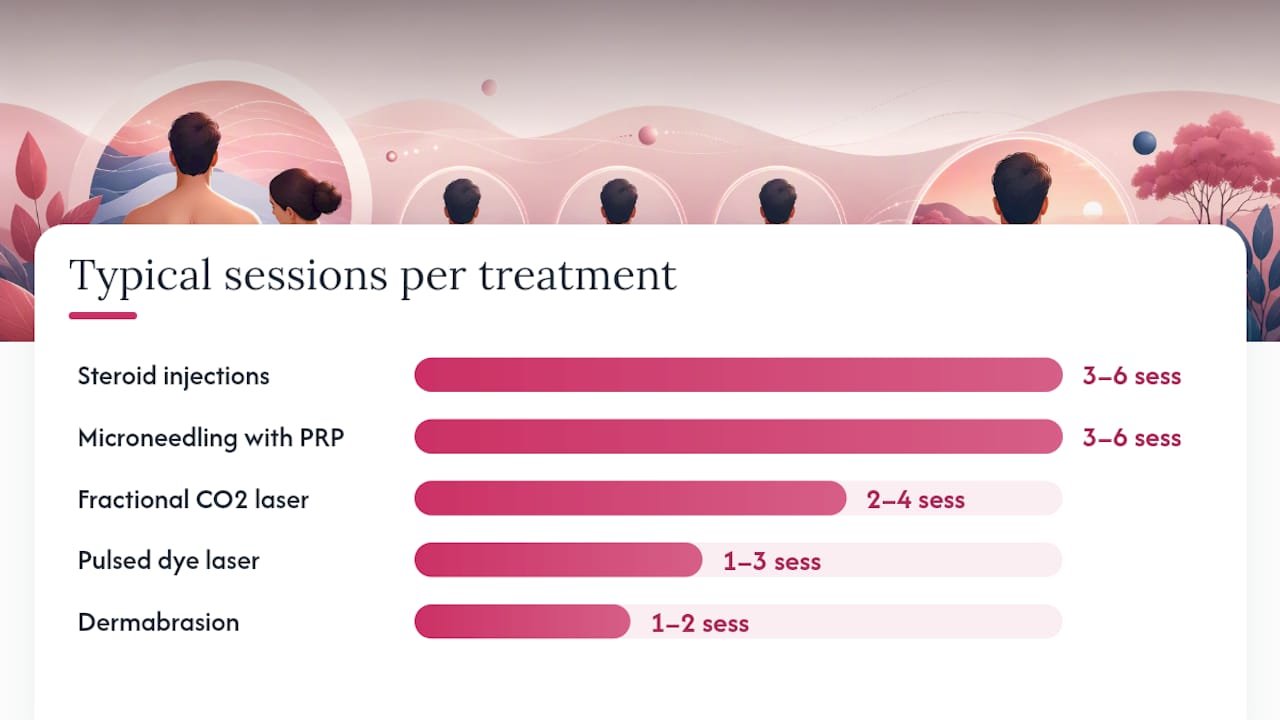
Intralesional corticosteroid injections are the first-line treatment for hypertrophic scars. Injected directly into the raised tissue, they reduce collagen overproduction, flatten the scar, and relieve itching. Multiple sessions spaced 4–6 weeks apart are typical. Clinical evidence supports corticosteroids alongside silicone therapy as effective conservative measures before any surgical intervention.
Fractional CO₂ laser targets scar texture and surface irregularity. It resurfaces the upper layers of the scar, stimulates collagen remodeling, and improves vascularity ahead of grafting. Downtime is 5–7 days of redness and peeling per session. Most protocols run 2–4 sessions.
Pulsed dye laser (PDL) addresses redness and hyperpigmentation in pink or red scars. It does not change scar width or height but can significantly reduce color contrast. One to three sessions typically suffice.
Microneedling with PRP is a lower-intensity preconditioning option. It stimulates collagen and improves blood supply to the scar. Downtime is minimal (24–48 hours of redness). It is often used as a preconditioning step when fractional laser is not available or the patient prefers a gentler approach.
Dermabrasion mechanically removes the top layer of scar tissue to improve surface texture. It is less precise than fractional laser and carries a higher risk of hypopigmentation in darker skin tones.
Silicone sheeting and topical silicone gels are the safest and most accessible options. They hydrate the scar, reduce collagen overproduction, and flatten mild hypertrophic scars over 3–6 months of consistent use. They work best when started early (within the first few months of healing) and are appropriate for any scar type as a conservative first step.
| Treatment | Best for | Sessions | Downtime | Benefit level |
|---|---|---|---|---|
| Intralesional corticosteroids | Raised, hypertrophic scars | 3–6 (every 4–6 weeks) | Minimal | High for height reduction |
| Fractional CO₂ laser | Texture, vascularity, preconditioning | 2–4 | 5–7 days per session | High for texture and graft prep |
| Pulsed dye laser | Redness, hyperpigmentation | 1–3 | 1–2 days | Moderate for color |
| Microneedling with PRP | Preconditioning, mild texture | 3–6 | 24–48 hours | Moderate |
| Dermabrasion | Surface texture | 1–2 | 7–14 days | Moderate |
| Silicone sheeting/gel | Mild hypertrophic, early intervention | Ongoing (3–6 months) | None | Moderate for height |
How does SMP work for FUT scar camouflage?
Scalp micropigmentation deposits pigment into the upper dermis of the scar using a fine needle, replicating the appearance of hair stubble at the follicle level. In a linear FUT scar, the goal is to reduce the color contrast between the pale scar tissue and the surrounding pigmented scalp skin. At a shaved or very short hair length, a well-executed SMP treatment makes the scar line blend into the surrounding stubble pattern rather than standing out as a pale stripe.
SMP does not create real hair. What it creates is the visual impression of hair at the skin level, which is exactly what a linear scar needs. For clients who wear their hair at a grade 1–3 length, SMP is often the single most effective and immediate improvement available, with no surgery, no recovery, and no impact on remaining donor supply.
Pros of SMP for scar camouflage:
- No surgery, no sutures, no downtime beyond 3–5 days of mild redness.
- Works on all scar subtypes including widened, hypopigmented, and atrophic scars.
- Results are visible immediately after the healing period (approximately 10–14 days for the initial session).
- Can be combined with prior FUE grafting or surgical excision for a more complete result.
- Longevity typically runs several years, with periodic touch-ups to maintain pigment saturation.
Cons and limitations:
- SMP does not change scar width, height, or texture. A raised hypertrophic scar should be flattened first.
- Results depend heavily on practitioner skill and pigment selection. Poor SMP on a scar can look worse than the scar itself.
- Clients who wear longer hair styles may not see the same benefit as those with shorter cuts.
- Periodic touch-ups are part of the long-term commitment.
What to look for at an SMP consultation
A credentialed SMP practitioner should assess your scar in person, not from a photo alone. Ask to see a healed gallery specifically of scar work, not just alopecia or hairline cases. The color-matching process for scar tissue is different from standard SMP because the target area has no melanin. A practitioner who does not discuss pigment selection for pale scar tissue specifically is not experienced with this application.
A patch test on a small section of the scar before committing to a full treatment is reasonable to request, particularly if your skin tone is darker or your scar has significant texture variation.
Pro Tip: Ask the practitioner to show you healed results at 12+ months, not just freshly completed work. Pigment fades and shifts as it heals, and the 2-week-post-session photo is not what you will live with long-term.
Enhancedscalp’s scar camouflage service is built specifically for cases like this, with a focus on natural healed results and transparent documentation of how work looks after full healing.
How do you choose the right repair path?
The right repair path is not the most aggressive one. It is the one matched to your scar subtype, your scalp laxity, your hair length preferences, and your tolerance for downtime and risk. Here is a practical framework for evaluating your options at consultation.
- Confirm your scar subtype first. Ask the clinician to classify your scar (fine-line, widened, hypertrophic, or keloid-tendency) and explain which treatments are appropriate for that subtype. A clinician who recommends the same approach for every scar type is not doing a thorough assessment.
- Ask about scalp laxity. If excision is on the table, the clinician should physically assess laxity by pinching and moving the scalp. If they skip this step, re-excision risk is not being properly evaluated.
- Ask about donor reserve. FUE grafting into the scar uses follicular units. If your donor supply is already limited from prior procedures, this affects how many grafts are available and whether a staged plan is realistic.
- Request a staged plan. A single session rarely produces a final result for surgical or grafting approaches. Ask what the full sequence looks like: preconditioning, primary procedure, secondary sessions, and SMP finish if needed.
- Ask to see healed before-and-after photos of scar cases specifically. Not renderings, not freshly completed work, not alopecia cases. Healed scar results from the same practitioner.
Ballpark cost ranges
- SMP for scar camouflage: Typically $1,500–$3,500 for a full treatment course, depending on scar length, number of sessions, and clinic location. Major metro areas run higher.
- FUE grafting into scar: $3,000–$8,000+ per session depending on graft count and clinic. Multiple sessions multiply that figure.
- Trichophytic re-excision: $2,500–$6,000 depending on scar length and surgeon experience.
- Punch-out technique: Generally lower than full excision given shorter operative time; pricing varies widely by clinic.
- Laser or steroid adjuncts: $300–$800 per session, typically 2–6 sessions depending on the treatment.
Red flags at consultation: Any promise of complete scar removal, pressure to book the same day, no healed gallery for scar cases, or a plan that skips preconditioning for a scar that clearly needs it. Walk away from any clinician who cannot explain why they are recommending a specific approach for your specific scar subtype.
What does recovery actually look like after each treatment?
| Approach | Downtime | Visible improvement begins | Final result timeline |
|---|---|---|---|
| SMP (scar camouflage) | 3–5 days redness | After first session heals (10–14 days) | After 2–3 sessions (3–6 months total) |
| FUE grafting into scar | 7–10 days | Hair growth at 4–6 months | Full result at 12+ months per session |
| Trichophytic re-excision | 2–4 weeks | Scar line visible improvement at 3–6 months | Final result at 12–18 months |
| Punch-out technique | 1–2 weeks | Immediate width reduction; final at 6–12 months | 6–12 months |
| Fractional CO₂ laser | 5–7 days per session | After 2nd or 3rd session | 3–6 months after final session |
| Intralesional corticosteroids | Minimal | 4–8 weeks per injection | After 3–6 sessions |
Signs of complications to watch for after any procedure:
- Increasing redness, warmth, or swelling beyond the first 48–72 hours (possible infection).
- Discharge or crusting that does not resolve within 2 weeks.
- Graft areas that show no growth at 6 months (poor graft take, may need re-evaluation).
- Scar that widens noticeably in the weeks after excision (re-widening from inadequate laxity).
- Pigment that turns blue-gray or greenish after SMP (pigment migration, requires correction by an experienced practitioner).
After SMP, avoid direct sun exposure on the treated area for at least 4 weeks and use SPF 50+ consistently thereafter. Sun exposure is the primary driver of pigment fade. After FUE grafting, treat the scar area as you would any fresh graft site: no scratching, no pressure, no swimming for 2 weeks.
A practitioner perspective on FUT scar repair priorities
The most common mistake patients make is choosing the most aggressive option first. A widened scar that looks significant at 8 months may look dramatically different at 18 months, and a re-excision attempted too early, or without adequate laxity, produces a worse outcome than waiting. The ISHRS 2025 practice census confirms that FUT donor scar revision remains one of the most common requests hair restoration specialists receive, which means there is a well-developed body of clinical experience to draw from.
The sequencing that produces the most reliable outcomes follows a clear logic: stabilize hypertrophic or raised scars first with conservative measures, precondition the scar tissue if grafting is planned, proceed with the primary structural intervention (excision or grafting), then use SMP to refine residual contrast. Skipping preconditioning to save time often means lower graft survival and a second round of sessions that could have been avoided.
The trade-off between real hair and cosmetic illusion is worth naming plainly. FUE grafting gives you actual hair growth in the scar, which looks natural at any hair length. SMP gives you the appearance of hair at short lengths, with no surgery and no recovery. For many patients, SMP alone is sufficient. For others, a combination of grafting and SMP produces the most complete result. Neither approach is universally superior. The right answer depends on your hair length preference, your tolerance for downtime, and how much donor supply you have left to work with.
Enhancedscalp’s SMP approach to FUT scar camouflage
SMP for FUT scar camouflage is one of the most technically demanding applications in the field. The scar tissue has no melanin, the surface texture may be uneven, and the pigment needs to match surrounding stubble across a range of lighting conditions. Enhancedscalp specializes in exactly this kind of corrective work, including clients with widened, hypopigmented, and previously treated scars.
At a consultation, you can expect a detailed scar assessment, a review of healed gallery results from comparable cases, and an honest conversation about whether SMP alone is appropriate or whether a combination approach would serve you better. Enhancedscalp’s process prioritizes conservative pigment selection and realistic healed outcomes over results that look sharp in a freshly completed photo but fade or shift within a year.
Clients across the United States can access Enhancedscalp’s services, including those in New York through the New York service location. To see healed scar camouflage results before committing, the results gallery documents real outcomes at full healing. When you are ready to discuss your specific scar, book a consultation through the scalp micropigmentation service page to get a candidacy assessment and a clear picture of what SMP can realistically achieve for your scar type.
Sources
- The “Punching‑Out” Technique to Reduce the FUT Scar
- Hair Transplant Strip Scar Management Options: The 4‑Subtype Framework That Matches Your FUT Scar to the Right Treatment Pathway
- Scar management and wound healing (NCBI Bookshelf resource)
- PubMed entry related to scar treatment (article details on intralesional corticosteroids and scar management)
- 2025 ISHRS practice census (PDF)
This article is general information, not a substitute for advice from a qualified doctor. Consult a qualified healthcare professional about your own circumstances before acting on anything here.

