 Skip to content

Scalp micropigmentation works well for diffuse thinning when scalp visibility is the main complaint, not total hair loss. A 2024 retrospective study found SMP is recommended once hair density sits at or above 104.6 hairs per square centimeter, while a hair transplant is the stronger option at or below 96.17 hairs/cm². SMP is cosmetic, meaning it does not regrow hair, so a consultation to measure your actual density is the real first step.
TL;DR:
- SMP is suitable only when hair density is at or above 104.6 hairs per square centimeter, with transplant options preferable below 96.17 hairs/cm².
- Diffuse thinning responds best to pigment dots placed just beneath existing hair, matching finer hair caliber, and layered gradually over multiple sessions.
- Clients with active shedding or unrealistic expectations should stabilize scalp health first and understand SMP does not promote hair growth.
- Results typically last 2 to 5 years before requiring touch-ups, with sun exposure and skin type influencing fading speed and pigment longevity.
- Proper consultation should verify technician experience with thinning patterns, pigment quality, layering plans, and clear policies on results and costs.
Table of Contents
- How Density SMP Creates the Illusion of Fuller Hair
- Who Is a Good Candidate for SMP on Thinning Hair?
- What Actually Happens During a Density SMP Session
- How Long Density SMP Results Actually Last
- SMP vs. Hair Transplant and Medical Therapies
- What to Ask Before Booking a Density SMP Appointment
- Practitioner Perspective: Why Restraint Beats a Fast Finish
- Enhanced Scalp: Density SMP Built for Natural, Healed Results
- Primary Sources and Further Reading
- Sources
- FAQ
How Density SMP Creates the Illusion of Fuller Hair
Diffuse thinning is a contrast problem before it’s a hair-count problem. When scalp skin shows through evenly across the crown or part line, your brain reads that lighter background as “thin.” Density SMP works by depositing thousands of tiny pigment dots that mimic follicle shadows at skin level, closing the gap between skin tone and hair color so the scalp reads darker and less visible beneath the existing strands, a technique the Cleveland Clinic describes as core to how SMP is applied.
For diffuse cases, technicians typically adjust a few things you would not need for a fully shaved head:
- Dot depth and angle shift to sit just beneath the hair canopy rather than directly on bare scalp.
- Dot size scales down to match finer, thinning hair caliber so the pigment stays invisible up close.
- Pigment tone is layered gradually, building shadow across two or more visits rather than going dark in one pass.
Diffuse thinning responds especially well to this approach because there is still hair present to blend the pigment into, unlike advanced baldness where SMP has to recreate an entire hairline pattern from scratch.
Who Is a Good Candidate for SMP on Thinning Hair?
Hair density is the number that actually decides this, not how thin your hair “looks” in a mirror. The retrospective study on treatment selection found a clear split.
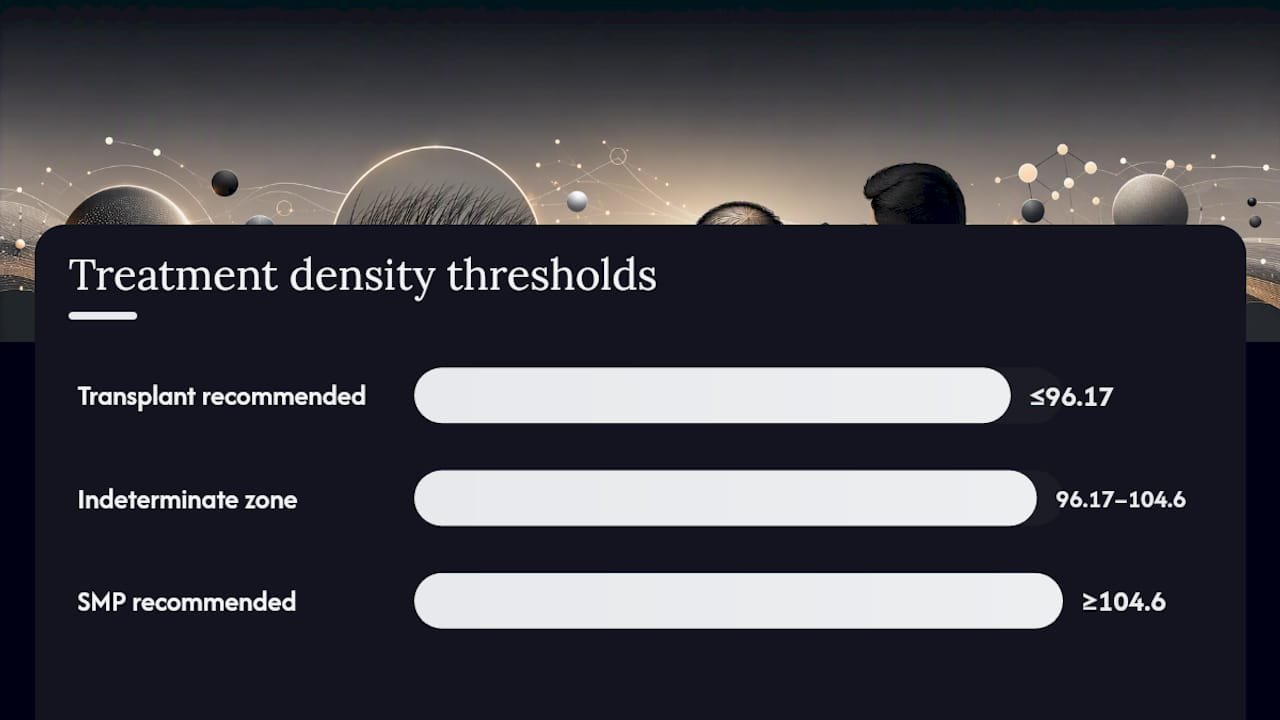
Hair density threshold: SMP is recommended at ≥104.6 hairs/cm². Hair transplant surgery is strongly recommended at ≤96.17 hairs/cm². Between those two figures, the decision usually comes down to individual factors like caliber and pattern.
Beyond the raw number, a few clinical factors matter:
- Fine, low-caliber hair thins the visual coverage faster, so it often needs SMP even at moderate density scores.
- A widening part line responds better to SMP than patchy, irregular loss, which can look uneven once pigmented.
- Active shedding or an unstable scalp condition should be stabilized medically before any pigment is placed.
- Unrealistic expectations, particularly hoping SMP will restore actual hair growth, is a candidacy red flag on its own.
What Actually Happens During a Density SMP Session
Density work on thinning hair takes longer than a shaved-head SMP because the artist is working around, not just onto, existing strands. Sessions commonly run 1 to 4 hours each, and most clients need two to three sessions to reach a finished result, according to Medical News Today’s overview of standard SMP protocols.
- First session: establishes the base layer of pigment dots at conservative density, deliberately understated.
- Second session: builds on the first, deepening shadow where scalp show-through is still visible and refining dot placement.
- Optional third session: fine-tunes color match and closes any remaining gaps, especially around the part line or crown.
Working under unshaved hair means the artist has to part sections repeatedly and place pigment at multiple angles so it reads naturally from every direction, not just straight down. Pain is typically mild since practitioners use topical anesthetic, and there is no real downtime.
Pro Tip: Avoid heavy sweating, direct sun, and swimming pools for the first week after each session. Pigment is still settling into the skin, and early sun exposure or sweat is one of the most common causes of patchy, uneven healed results.
Mild redness or tightness for a day or two is normal and resolves on its own.
How Long Density SMP Results Actually Last
Your first session will look subtler than you expect, and that’s intentional. Practitioners under-pigment early sessions on purpose, since healed color always settles darker than it appears the day of treatment. The full effect only shows up after the final layered session, once shadow depth and color match are dialed in.
Longevity range: most clients see solid results for 2 to 5 years before a touch-up is needed, though this varies by skin type, sun exposure, and pigment formula used.
A few things influence how fast pigment fades:
- Consistent sun exposure without SPF accelerates fading noticeably.
- Oilier skin types can break down pigment faster than dry skin.
- Higher-quality, scalp-specific pigments hold their tone longer than repurposed tattoo ink.
Over a 5 to 10 year span, expect one or two touch-ups rather than a full redo, and any color drift is usually correctable in a single refresh session.
SMP vs. Hair Transplant and Medical Therapies
SMP earns its place in the thinning-hair conversation because of what it does immediately, not because it competes head-to-head with a transplant. The advantages are real: visible improvement the same day, essentially zero downtime, and a lower upfront cost than surgical restoration.
The limitations are just as real. SMP is strictly cosmetic, so it does nothing to slow progression or restore follicles, a point WebMD is direct about when describing what the treatment can and cannot do.
- Choose SMP when density sits at or above roughly 104.6 hairs/cm² and the goal is closing visible gaps.
- Choose transplant when density has dropped to around 96.17 hairs/cm² or below, since SMP alone won’t rebuild enough coverage.
- Combine both when a transplant restores some density but SMP is needed to camouflage residual thinning between grafts.
- Pair SMP with medical therapy like minoxidil if you also want to attempt regrowth, understanding that minoxidil can take 6 to 12 months to show any effect and works for only some users.
What to Ask Before Booking a Density SMP Appointment
A good consultation should feel more like a technical interview than a sales pitch. Bring these questions with you.
- Can you see healed photos, taken months after treatment, of cases with a similar thinning pattern to mine?
- How many diffuse-thinning or female-density cases has this technician specifically handled?
- What pigment brand is used, and how does it hold up against color shift over time?
- What’s the layering plan, and how many sessions is it built around?
- What is the touch-up policy, and is there any guarantee on healed results?
Walk away from anyone who only shows fresh, unhealed post-treatment photos, promises a finished look in a single session, or whose portfolio images all look uniformly dark. Confirm total cost, session spacing, and refund terms in writing before you commit.
Practitioner Perspective: Why Restraint Beats a Fast Finish
Practitioners who specialize in density SMP will tell you the biggest mistake is going too dark, too fast. Conservative pigment placement in the first session protects against an artificial look years down the road, since color only gets darker as skin ages and pigment settles. Female density work is harder than it looks. Blending pigment under longer hair, at multiple angles, without disturbing the strands takes real technical control. Enhanced Scalp builds every diffuse-thinning treatment around that same layered, understated approach, prioritizing a natural healed result over a dramatic same-day change.
— James Christopher
Enhanced Scalp: Density SMP Built for Natural, Healed Results
Enhanced Scalp treats diffuse thinning as a density problem, not a baldness problem, which is why sessions are planned around conservative pigment layering instead of a rushed, one-visit fix. Services relevant to thinning hair include density SMP for both men and women, along with corrective work for anyone unhappy with prior SMP or transplant scarring.
Every treatment plan starts with an honest look at your density and hair pattern, followed by realistic, documented healed photos rather than same-day glamour shots. If you want to know whether your scalp qualifies for density SMP or would respond better to a combination approach, book a consultation to get a plan built around your actual hair, not a generic template.
Primary Sources and Further Reading
The PubMed retrospective study supplies the hair-density cutoffs used throughout this guide to compare SMP and transplant candidacy. Medical News Today and WebMD cover session structure, cost ranges, and realistic expectations. The Cleveland Clinic explains the pigmentation technique itself in plain clinical terms.
Sources
- Hair transplantation versus scalp micropigmentation: A retrospective study of treatment selection in persons with female pattern hair loss
- Scalp micropigmentation (SMP): Benefits, costs, results
- Scalp Micropigmentation: What Is It?
- Scalp micropigmentation (SMP): What to know
FAQ
What is the best treatment for diffuse hair thinning?
It depends on hair density: SMP is generally recommended at ≥104.6 hairs/cm², while a hair transplant is stronger below 96.17 hairs/cm². Many people also pair SMP with medical therapy for a combined cosmetic and regrowth strategy.
How much does SMP usually cost?
Pricing varies by clinic, session count, and area treated, and typically requires 2 to 3 sessions of 1 to 4 hours each. Ask any provider for a full quote based on your specific density and coverage needs.
What are the disadvantages of SMP hair treatment?
SMP is purely cosmetic. It does not regrow hair or stop hair loss progression, and it requires periodic touch-ups as pigment fades over time.
How does SMP look after 10 years?
With quality pigment and proper sun care, most people need only one or two touch-ups over a decade rather than a full redo. Fading speed depends on skin type, sun exposure, and the pigment formula the technician used.

