 Skip to content


If you have SMP and an oily or shiny scalp, cleanse gently and often, skip greasy or occlusive products, and use a medicated dandruff shampoo if flakes persist. Book a follow-up or test spot with us at Enhanced Scalp. For lasting flakes or irritation, the Canadian Dermatology Association advises seeing a dermatologist.
TL;DR:
- After your clinic confirms healing, wash an oily scalp gently, often daily, and use fingertips rather than nails; avoid heavy oils, waxes, and occlusive balms.
- For persistent dandruff, ketoconazole 2% shampoo is typically used twice weekly for two to four weeks, left on for three to five minutes.
- Oil can blur pigment when deposits sit too deep, while surface shine can make intact dots look faded by reducing contrast.
- Because oily skin holds pigment less predictably, ask about a test spot, conservative staged density, and a review before committing to full coverage.
- Seek medical advice for symptoms lasting more than four weeks, severe itching, redness, swelling, yellow crusting, or flakes that worsen or spread elsewhere.
Table of Contents
- Why does your scalp get oily, and how does dandruff show up?
- How do oil and shine affect SMP pigment and perceived definition?
- What does a clinic-safe aftercare routine look like for an oily scalp?
- Which medicated shampoos help, and how do you use them with SMP?
- How do practitioners adjust technique for oily scalps?
- What should realistic maintenance look like?
- When should you see a dermatologist or come back to your clinic?
- How we evaluate oily scalps and run test spots
- Book an assessment or test spot with us
- FAQ
- Sources
Why does your scalp get oily, and how does dandruff show up?
Your scalp carries a dense population of oil glands, and the sebum they release is what makes skin look shiny. That oil also feeds Malassezia, a yeast that lives on most scalps. According to the Canadian Dermatology Association, seborrheic dermatitis is an oily-scalp condition where excess oil and this yeast lead to clumping and flaking.
The two kinds of flakes look different:
- Dry dandruff: small, white, powdery flakes that fall onto your shoulders, usually with a tight or dry-feeling scalp.
- Oily seborrheic dermatitis: larger, yellowish or greasy flakes that cling to the scalp, often with redness around the hairline, behind the ears or in the brows.
- Shine without flakes: simple oiliness. It is common, and it still matters for SMP, as the next section explains.
Start with home measures. The Mayo Clinic notes that mild dandruff can usually be treated at home by washing more often with a gentle shampoo. Since your scalp holds pigment, we want you to be gentle: no scratching, no hot-water blasting, no scrubbing with fingernails.
Know the red flags too. The NHS advises seeing a GP if symptoms persist after four weeks, if the scalp is very itchy, red or swollen, or if flaky areas appear elsewhere on the body. We apply the same thresholds to our clients.
How do oil and shine affect SMP pigment and perceived definition?
Oil changes two things: how pigment behaves in the skin and how the finished result looks to the eye.
Pigment behavior. The ISHRS explains that oily scalps can cause pigment to spread if it is deposited too deeply, which is why practitioners keep deposits in the topmost layers of the epidermis. Placement that is too deep in oil-rich skin is where blurred, softened dots come from. Shallow, consistent depth is what keeps each dot crisp.
Visual definition. Shine acts like a mirror. A glossy scalp reflects light and flattens contrast, so healed dots can look less sharp even when the pigment is fully intact. Clients sometimes read this as fading when the real issue is surface oil. A freshly cleansed scalp often looks noticeably more defined than the same scalp at the end of an oily day.
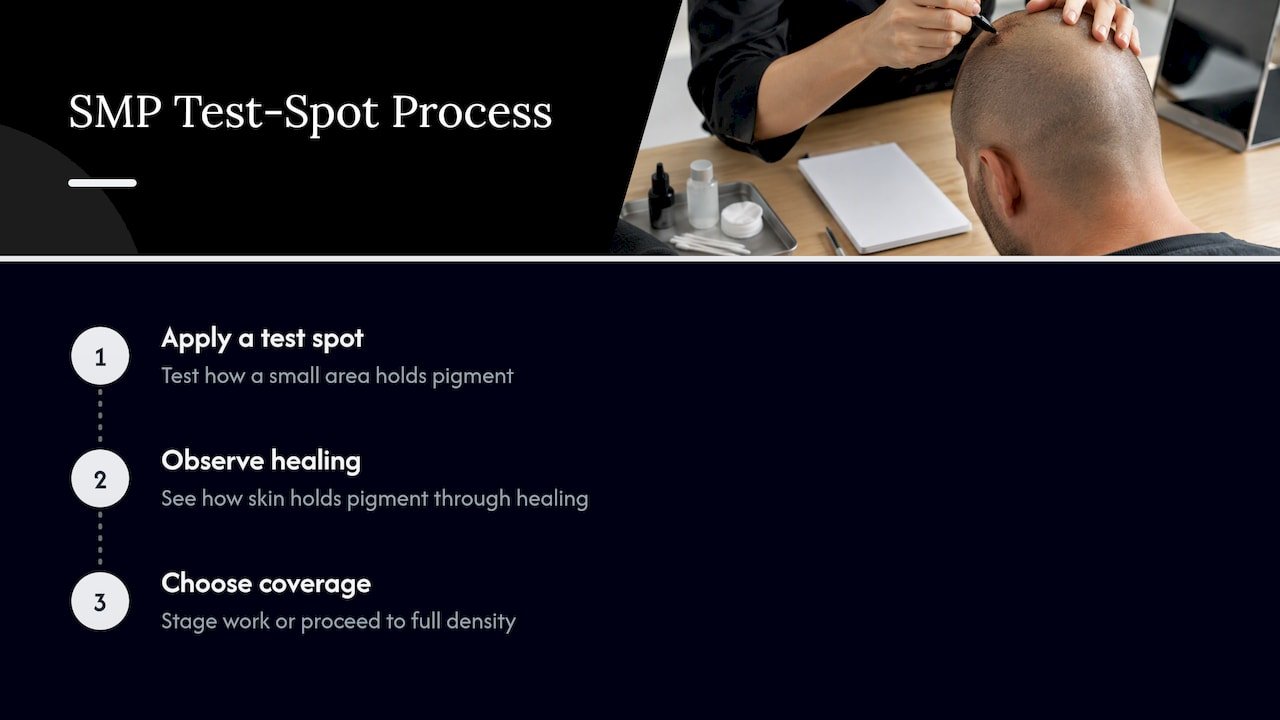
Predictability. Very oily scalps are less predictable than dry or balanced ones. Because of that, we may stage the work or run a test spot before committing to full density. A small test area shows how your skin holds pigment through healing, and it costs you nothing in terms of your overall design.
For more on managing glare, see our clinic article on reducing scalp shine.
What does a clinic-safe aftercare routine look like for an oily scalp?
Healing comes first, oil control second. Follow your own artist’s instructions where they differ from this general outline, and use this routine as a framework for the conversation.
- Early healing: keep the scalp dry and untouched unless your clinic tells you otherwise. Do not scratch, pick or rub at any scabbing or flaking.
- First gentle rinse: when your clinic clears you, rinse with lukewarm water and a mild, fragrance-free cleanser. Use fingertips with light pressure, never nails.
- Rinse thoroughly: leftover lather is a common source of buildup and itch on oily scalps.
- Pat dry: use a clean towel and press, never rub. Abrasion is how pigment gets disturbed.
- Weeks 2 to 4: as healing progresses, cleanse regularly, often daily on an oily scalp, once your clinic confirms the skin is ready.
- Reintroduce shampoo gradually: your clinic will tell you when regular shampooing is safe, and when medicated products can join the routine.
What to avoid: occlusive balms, heavy oils and waxy pomades. They sit on the surface, trap sweat and sebum, and make shine and buildup worse. A light, non-occlusive moisturizer is acceptable only if we advise it for your case.
Sweat and exercise. Pat sweat away with a clean towel rather than wiping. Plan hard workouts away from the early healing window, and rinse gently afterward. Shaving during early healing also matters, so read our guide to shaving with SMP.
Touch-up planning. On a scalp that runs oily, plan for a possible earlier touch-up. We review healed results and decide together, rather than guessing.
Which medicated shampoos help, and how do you use them with SMP?
Several active ingredients are used in dandruff care. Ketoconazole acts against Malassezia, as the Nizoral product information notes. The Nizoral summary of product characteristics notes that ketoconazole acts against Malassezia and has anti-inflammatory action.
Typical patterns:
- Ketoconazole 2% shampoo: per its product characteristics, the shampoo is indicated for prevention and treatment of dandruff and seborrheic dermatitis. Treatment is usually twice weekly for 2 to 4 weeks, with maintenance once every 1 to 2 weeks.
- Leave-on time: lather, then leave it for 3 to 5 minutes before rinsing.
- Rotation: rotating up to three shampoos with different active ingredients can help maintain control, per the Mayo Clinic.
Mayo Clinic: medicated dandruff shampoos can be used 2 to 3 times weekly, with rotation among different active ingredients for long-term control.
Using them with SMP. Wait until your clinic confirms the skin is healed enough. Then build a lather in your hands first, apply with flat fingertips, massage lightly, and rinse with lukewarm water. Skip scrubbing: the active ingredient does the work during the leave-on time, not friction.
Know when to stop. If you notice stinging, new redness, or any change in how your pigment looks, stop and contact us or a dermatologist. Healed pigment should look the same before and after a wash, and a change is worth a professional look.
How do practitioners adjust technique for oily scalps?
Much of the outcome is decided before you ever wash a hair, during planning and in the artist’s hand.
Pigment base. Pigments come in gel and alcohol bases. A published review of micropigmentation notes that in patients with oily scalps a gel-based dye can be used to minimize diffusion, and that good-quality dyes are superior because they cause less diffusion after deposition. The ISHRS likewise describes practitioners using gel-based pigments for oily skin.
Depth control. Meticulous, shallow placement keeps pigment where it should stay. Oily skin punishes inconsistency, so steady technique is the priority over speed.
Conservative density. We would rather build gradually than overshoot. Staged sessions and a test spot confirm retention before we commit to full coverage.
What to ask your practitioner:
- Do you offer a test spot, and how long do you wait before judging it?
- Which pigment base do you use, and why for my scalp?
- What is the planned touch-up schedule for an oily scalp?
- How do you handle seborrheic or flaky scalps, and do you coordinate with dermatologists?
Our scalp micropigmentation overview explains how we approach pigment placement in more detail.
What should realistic maintenance look like?
Expect a healing period, followed by a review and touch-up if needed. After that, many clients maintain results over the long term with occasional refreshes. On an oily scalp, we may recommend an earlier or more frequent touch-up, and we decide that from your healed results.
Keep this routine:
- Cleanse gently and regularly. Daily washing is reasonable for oily skin once healed, using a mild shampoo.
- Avoid buildup. Rinse fully, and switch to light, non-greasy styling products.
- Protect from the sun. Sun exposure is one of the biggest accelerators of fading, so use a hat or a scalp-safe sunscreen outdoors.
- Skip aggressive scrubbing. Exfoliating brushes and harsh scrubs wear pigment faster.
- Review at the right time. Come back for assessment when definition drops, rather than waiting for a dramatic change.
When should you see a dermatologist or come back to your clinic?
Get assessed if you notice:
- Itching that does not settle
- Redness or swelling
- Yellow crusting
- Flakes that worsen after medicated shampoo
- Flaky patches elsewhere on the body
The NHS and the Canadian Dermatology Association both advise professional review when symptoms persist.
What to bring: photos of your scalp over time, the dates of your SMP sessions, and a list of every product you use. This lets a dermatologist and our team coordinate quickly.
Test spot or touch-up? If irritation is active, we generally prefer to let the skin settle under medical guidance before retesting or touching up. Our article on SMP with seborrheic dermatitis explains how dermatologist clearance and test patches fit together.
How we evaluate oily scalps and run test spots
When an oily scalp comes through our door, we slow down. We examine the skin, ask about flaking and any history of seborrheic dermatitis, and propose a test spot before committing to full density. We favor conservative density and careful pigment choice, and we involve a dermatologist when the skin calls for it.
We also set clear expectations: when you should return for review, when a touch-up makes sense, and what to do between visits. Oily scalps vary a lot from person to person, so a tailored plan beats a generic one. If you are unsure where your scalp falls, reach out and we will talk it through.
— James Christopher
Book an assessment or test spot with us
If you would rather have your oily scalp evaluated than guess, we offer an assessment and test spot. At the appointment, we cover:
- A scalp exam and a discussion of your oily-scalp and dandruff history
- Suggested aftercare and coordination around medicated shampoo
- A test spot plan to confirm how your skin holds pigment
- A touch-up timeline matched to your scalp
We work conservatively and aim for natural, realistic results, with follow-up after your session. Our Scalp Micropigmentation treatment page lists our pricing at 3000-4000 CAD, one-off. Book your assessment and test spot there today.
This article is general information, not a substitute for advice from a qualified doctor. Consult a qualified healthcare professional about your own circumstances before acting on anything here.
FAQ
Can an oily scalp make SMP fade faster?
It can affect how SMP looks and holds. Oil can encourage pigment to spread if it is placed too deeply, per the ISHRS. Shallow placement, gel-based pigment and good aftercare help keep results crisp.
Is it safe to use dandruff shampoo after SMP?
Usually yes, once your clinic confirms the scalp has healed enough. Apply it gently with fingertips and rinse well. Stop and get advice if you notice irritation or any change in your pigment.
How often should you wash an oily scalp after SMP?
Once healed, regular gentle washing is typically fine for oily scalps, and your clinic will tell you when to start. Early on, follow your artist’s instructions exactly. Avoid rubbing, and pat dry.
Why does my SMP look faded when my scalp is shiny?
Shine reflects light and reduces contrast, so dots can look softer even when the pigment is intact. Cleanse gently, let the scalp dry, and look again. If definition stays low, ask us for a review.
Sources
- Scalp Micropigmentation (SMP): All You Need to Know – ISHRS
- Dandruff – Canadian Dermatology Association
- Dandruff – Diagnosis and treatment – Mayo Clinic
- Nizoral Antidandruff Shampoo – Summary of Product Characteristics (SmPC) – (emc) | 6456

