 Skip to content


Fresh scalp micropigmentation always looks darker and more sharply defined than the final healed result, and most of that softening happens in the first 4 to 12 weeks. The dots lighten, edges blur slightly, and the overall tone settles into something far more natural than what you see walking out of your first session. Pigment selection, correct implantation depth, and disciplined aftercare are what keep that settling predictable instead of patchy.
TL;DR:
- Expect a density dip around days 6 to 10; wait until weeks 6 to 12, when pigment settles, to assess color and plan needed corrections.
- Keep the scalp dry for 72 hours, avoid swimming, saunas, and intense workouts for 7 to 14 days, and delay shaving until flaking stops.
- Scar tissue can retain pigment unpredictably; request a test spot before full treatment, especially after a transplant or earlier scalp micropigmentation.
- Plan maintenance every 2 to 5 years, depending on skin type, sun exposure, and pigment placement; corrective treatment addresses diffusion or poor prior work.
Table of Contents
- The SMP healing timeline from day one to month twelve
- Why pigment shade and dot definition shift between fresh and healed
- What makes healed SMP lighter, blurrier, or more stable
- When results are final and how often touch-ups happen
- Aftercare rules that protect your healed result
- What documented healed cases reveal about fresh-to-healed change
- Why we design for the healed look, not the fresh one
- How we help you get a healed result that holds up
- FAQ
- Sources
The SMP healing timeline from day one to month twelve
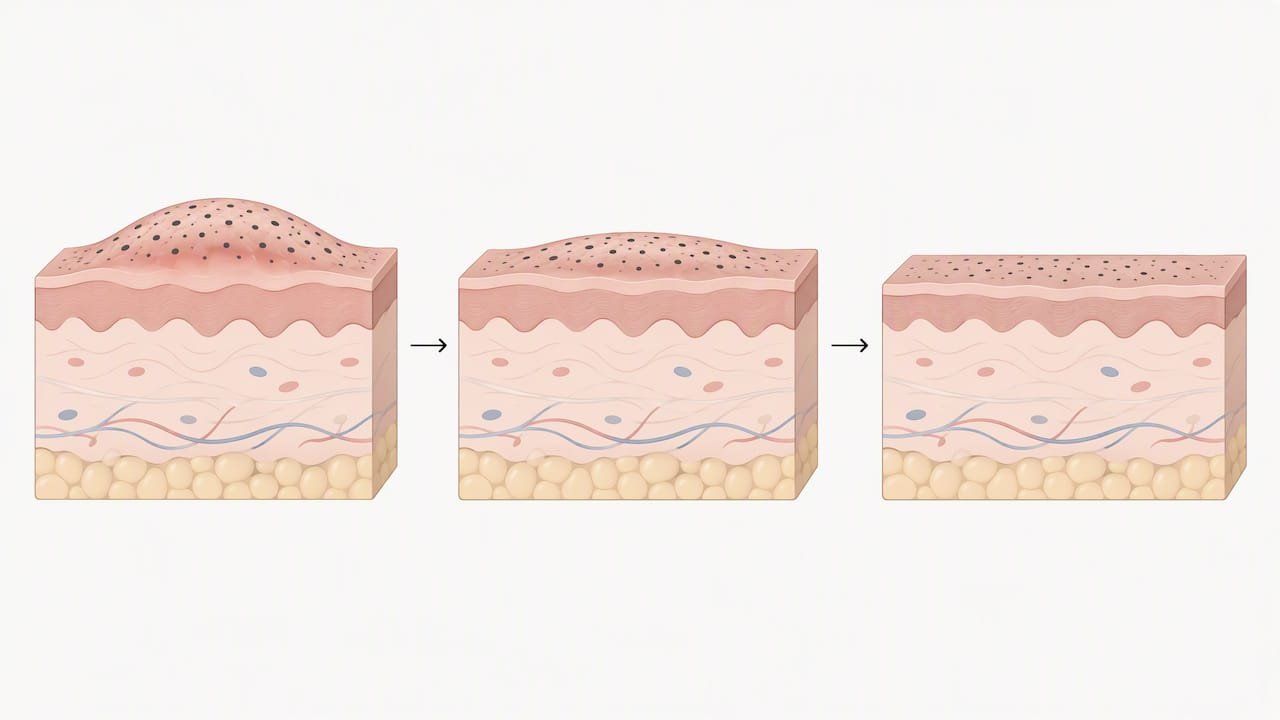
Scalp micropigmentation does not look “finished” the day you leave the clinic. What you see immediately is the most intense version of the work, and it changes in fairly predictable stages.
- Day of treatment: The scalp is red and the dots look unusually dark and crisp. This is the best time to take a baseline photo, but not a reliable preview of the healed look.
- Days 3 to 7: Light scabbing and flaking begin. As the surface crust lifts, the pigment underneath can look patchy or lighter in places, which worries a lot of first-timers unnecessarily.
- Weeks 2 to 6: Pigment reappears as the skin finishes shedding, and the overall tone starts to soften. This is when the scalp begins to look like it belongs to the final result rather than the fresh one.
- Weeks 6 to 12: Most clinics schedule the first touch-up in this window because the pigment has settled enough to judge density, color accuracy, and symmetry accurately.
- Months 3 to 12: Slower, smaller shifts continue as the skin fully matures around the pigment. By the end of this period, the result is generally considered stable.
Clinic healing-timeline guides consistently describe this same arc: dark and sharp immediately, a dip in visible density around days 6 to 10 as scabs shed, then a steady reappearance and softening through weeks 2 to 6, with touch-ups typically planned after the 6 to 12 week mark once the skin has settled. That staged approach exists because judging final color or density too early leads to corrections that aren’t actually necessary. If you want a closer look at the session-by-session mechanics behind this schedule, our SMP process guide walks through what happens at each visit.
Why pigment shade and dot definition shift between fresh and healed
The visual gap between fresh and healed SMP comes down to where the pigment sits in the skin and how the body reacts to it afterward.
- Implantation depth determines how sharp the dots look once healing finishes. Pigment placed at the right depth, near the epithelial-dermal junction rather than sitting shallow in the epidermis, holds its shape and resists spreading.
- Scab and crust dynamics temporarily mask the true color. The scalp looks lighter under a scab, then darker again as it’s revealed, before finally softening to its real healed tone.
- Diffusion is the pigment spreading slightly under the skin, which blurs dot edges. Fading is the pigment losing density or intensity over time. They produce different visual effects and have different causes.
- Pigment oxidation can shift color tone over months, which is why formulation choice matters as much as placement.
Experimental work on microneedle-based pigment implantation found that deeper placement reduced diffusion rings and improved localization over a 28-day observation window in ex vivo testing, reinforcing that depth is one of the strongest technical levers on how crisp healed dots stay. A controlled implantation depth is one of the most reliable ways to protect dot definition through healing, based on that same diffusion data.
What makes healed SMP lighter, blurrier, or more stable
Not every scalp heals the same way, and a few factors predict whether your healed result stays crisp or softens more than expected.
- Oily skin accelerates blurring. Higher sebum production tends to push pigment particles outward faster, softening dot edges sooner than on drier skin.
- Scarring or fibrotic tissue reduces retention. A study on scarring alopecia found pigment fading occurred early and universally, pigment diffusion affected over half the patients by six months, and visible color changes were reported in most cases by six months, with touch-ups needed in all instances. Outcomes also varied by diagnosis: milder conditions like frontal fibrosing alopecia and traction alopecia retained pigment and satisfaction better than denser fibrotic conditions like morphea and lichen planopilaris.
- Technician depth control matters. Pigment placed too shallow tends to fade early; pigment placed too deep increases diffusion risk.
- Sun exposure, chlorine, and heavy sweating during healing can accelerate both fading and uneven color retention.
- Some medications and systemic conditions slow healing or affect how the skin holds pigment, which is why a thorough consultation matters before treatment begins.
Pro Tip: If you have scarring from a previous transplant or SMP attempt, ask for a test spot before committing to full treatment, since retention on scar tissue is far less predictable than on healthy skin.
When results are final and how often touch-ups happen
Healed SMP is rarely a one-and-done outcome. It’s closer to a maintained cosmetic result with a defined schedule.
- The first touch-up usually lands at 6 to 12 weeks after the last session, once scabbing has fully resolved and the true healed density is visible.
- Minor touch-ups add density or correct small areas of unevenness; corrective work is a different scope entirely, usually reserved for diffusion, poor previous work, or scarring complications.
- Ongoing maintenance typically falls every 2 to 5 years, depending on skin type, sun exposure, and how the original pigment was placed.
- A touch-up session generally involves deepening color in faded areas, adding density where hair loss has progressed, or tightening dot definition where diffusion has softened edges.
Aftercare rules that protect your healed result
What you do in the days and weeks after treatment has more influence on your final result than almost anything else.
- Avoid soaking, heavy sweating, or direct water contact on the scalp for the first 72 hours, since the skin is still sealing and pigment can be disturbed before it sets.
- Hold off on swimming, saunas, and intense workouts for roughly 7 to 14 days, giving the scabbing and shedding process time to finish without disruption.
- Wait before resuming shaving until flaking has fully stopped, usually after the first week or so; our guide to shaving in the first 72 hours covers the exact sequence.
- Skip sunscreen, retinoids, or other active topicals directly on the treated area until healing is complete, and protect the scalp from direct sun exposure afterward to slow fading.
- Contact your clinic promptly if you notice signs of infection, unusual pain, or pigment loss that looks abnormal rather than the expected scab-related lightening.
Pro Tip: Keep a lightweight, fragrance-free moisturizer on hand for the days after scabbing resolves. Hydrated skin tends to show pigment more evenly than dry, flaking skin.
For a deeper look at how recovery windows compare across cosmetic procedures, a day-by-day recovery timeline for lip filler shows a similar pattern of swelling, settling, and gradual stabilization common to percutaneous treatments.
What documented healed cases reveal about fresh-to-healed change
Healed portfolios are some of the most useful evidence for setting realistic expectations, since they show what actually remains after the drama of the fresh session fades.
- Fresh sessions often look darker and heavier than intended, precisely because that density softens predictably over the following weeks.
- Conservative pigment choices and proper session spacing tend to guide the healed shade toward something that reads as natural hair rather than a flat, drawn-on pattern, a point we cover in more detail in does SMP look real.
- When comparing healed photos, check for consistent dot size, soft edges rather than hard outlines, and a shade that matches the surrounding hair rather than sitting noticeably darker.
Why we design for the healed look, not the fresh one
Most people judge their first session by how it looks the day they leave, which is the least useful moment to judge it. We design hairlines and density conservatively because the healed result, not the fresh one, is what you’ll actually live with for years.
A pigment choice that looks perfect on day one but oxidizes into a blue or gray cast by month six isn’t a good outcome, no matter how sharp it looked at first. The consultation should be built around where the result lands at month three, not what shows up in the mirror that afternoon.
— James Christopher
How we help you get a healed result that holds up
We prioritize natural hairline design, appropriate pigment selection, and clear documentation of healed results rather than focusing on a dramatic initial appearance that may fade unevenly.
- Review our healed portfolio work to see how sessions settle over time.
- Book a consultation to discuss hairline design, pigment matching, and a realistic touch-up schedule.
- Ask about our approach to corrective SMP if you’re dealing with prior poor work or transplant scarring.
Ready to see what a healed result could look like on your scalp? Book your scalp micropigmentation session and we’ll walk you through pigment options, timeline, and aftercare before you commit.
FAQ
How long should I wait to shave after SMP?
Most clinics recommend waiting until flaking and scabbing have fully resolved, typically around the first week, before shaving again. Shaving too early can disturb pigment that hasn’t fully settled, so check with your clinic based on how your scalp is healing.
What does SMP look like right after treatment versus healed?
Fresh SMP looks darker, sharper, and more uniform than the healed result, which softens and lightens over several weeks as scabbing resolves and pigment settles. The healed version typically shows softer dot edges and a more natural-looking density.
Does SMP stimulate hair growth?
Scalp micropigmentation is a cosmetic tattooing technique designed to replicate the look of hair follicles, not to regrow hair. Some experimental microneedle-based platforms have suggested micro-wounding might influence pathways linked to hair regrowth, but that evidence remains preliminary and doesn’t apply to standard SMP treatment.
Is it safe to sweat five days after SMP?
Light activity is usually fine by day five, but heavy sweating is typically discouraged until closer to the one to two week mark, since moisture can disrupt pigment that’s still settling. Follow your clinic’s specific aftercare schedule rather than a fixed universal rule.
Sources
- Efficacy, safety, and patient-reported outcomes of scalp micropigmentation in scarring alopecia – JCAS
- Scalp Micro-Pigmentation via Transcutaneous Implantation of Flexible Tissue Interlocking Biodegradable Microneedles – MDPI

